Massachusetts: Sharing the road — Part 3 Practice Test
Vulnerable road users and the four-foot passing rule, bicycles and bicycle lanes, motorcycles, mopeds, scooters, trucks and buses, school buses, farm vehicles, animals and funeral processions. — Part 3
Independent educational site · not affiliated with any government agency or DMV
Ready? Test yourself
- Instant feedback with an explanation
- Every answer cites its source in the manual
- Your best score is saved on this device
Questions are original and based on the official manual "Massachusetts Driver's Manual" (Revised April 2026), Massachusetts Registry of Motor Vehicles.
All 35 questions in this practice test
Take the test above first, then use this list to study. Tap “Show answer” to see the correct answer and explanation.
Show the questions and answersHide the questions
-
You find yourself in another driver's blind spot. What should you do?
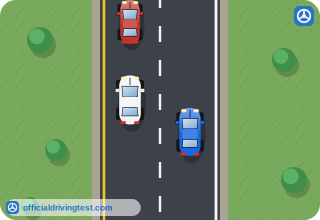
- Stay beside the other vehicle for a while so it can see you
- Slow down and stay in the blind spot until the driver sees you
- Sound your horn and stay in the same lane next to it
- Safely drive through the blind spot as quickly as you can
Show answer
Correct answer: Safely drive through the blind spot as quickly as you can
If you are in another driver's blind spot, safely drive through it as quickly as you can.
Source: Massachusetts Driver's Manual (Revised April 2026), page 95 · Open this page in the manual (Manual page 95)
-
How should you drive around a truck or bus on the highway?
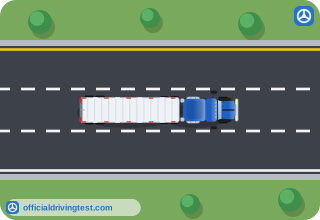
- Do not follow closely behind it or drive into the space around it
- Follow closely behind it so that you can save fuel
- Stay alongside it for a long stretch of road
- Stay directly in front of it so that the driver sees you
Show answer
Correct answer: Do not follow closely behind it or drive into the space around it
It is easy for a car or motorcycle to be hidden in a large vehicle's blind spots, so do not follow closely behind a truck or bus.
Source: Massachusetts Driver's Manual (Revised April 2026), page 95 · Open this page in the manual (Manual page 95)
-
You are turning at an intersection and a bicyclist is going straight through. What must you do?
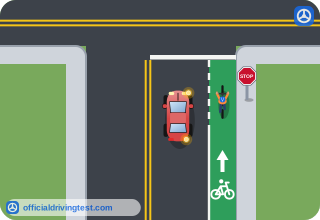
- Yield to the bicyclist going straight
- Turn ahead of the bicyclist
- Honk and turn when the bicyclist slows
- Move into the bicycle lane and turn
Show answer
Correct answer: Yield to the bicyclist going straight
If you are turning, you must yield to bicyclists going straight through an intersection, and you must never cut in front of a bicyclist.
Source: Massachusetts Driver's Manual (Revised April 2026), page 96 · Open this page in the manual (Manual page 96)
-
Where are the blind spots of a large vehicle that you should be aware of when driving near it?
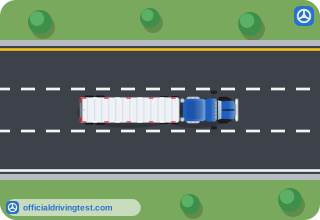
- On the right and left sides only
- Right, left, front, and behind
- In front and behind only
- Directly behind the vehicle only
Show answer
Correct answer: Right, left, front, and behind
The manual says to be aware of the large vehicle driver's blind spots on the right, left, front, and behind.
Source: Massachusetts Driver's Manual (Revised April 2026), page 102 · Open this page in the manual (Manual page 102)
-
If you are operating a motorcycle, how may you pass?
- Two abreast, if the road is wide
- Alongside the vehicle you are passing
- Only single file
- Between two lanes of traffic
Show answer
Correct answer: Only single file
The manual states that a motorcycle operator may only pass single file.
Source: Massachusetts Driver's Manual (Revised April 2026), page 103 · Open this page in the manual (Manual page 103)
-
According to the manual, roadways are intended for whom?
- Motor vehicles and bicycles only
- Drivers and pedestrians only
- Bicyclists and pedestrians only
- Drivers, bicyclists, and pedestrians
Show answer
Correct answer: Drivers, bicyclists, and pedestrians
The manual says roadways are intended for drivers, bicyclists, and pedestrians.
Source: Massachusetts Driver's Manual (Revised April 2026), page 104 · Open this page in the manual (Manual page 104)
-
Why does the manual say motorists must be especially careful on the road?
- More vulnerable users can be seriously injured or killed
- Bicyclists are required to ride in the center of the lane
- Most crashes involve bicyclists and pedestrians
- Pedestrians always have the right-of-way over motorists
Show answer
Correct answer: More vulnerable users can be seriously injured or killed
The manual says motorists must be especially careful because more vulnerable users can be seriously injured or killed.
Source: Massachusetts Driver's Manual (Revised April 2026), page 104 · Open this page in the manual (Manual page 104)
-
Which of these is something aggressive drivers often do, according to the manual?
- Let other vehicles merge ahead of them
- Drive well below the speed limit
- Prevent other motorists from passing them
- Stop for every yellow light
Show answer
Correct answer: Prevent other motorists from passing them
The manual lists preventing other motorists from passing them among the things aggressive drivers often do.
Source: Massachusetts Driver's Manual (Revised April 2026), page 104 · Open this page in the manual (Manual page 104)
-
Which of these behaviors does the manual list for aggressive drivers?
- Give way to emergency vehicles
- Run red lights
- Signal before every lane change
- Keep a long following distance
Show answer
Correct answer: Run red lights
The manual lists running red lights among the things aggressive drivers often do.
Source: Massachusetts Driver's Manual (Revised April 2026), page 104 · Open this page in the manual (Manual page 104)
-
What does the manual advise when you are confronted by an aggressive driver?
- Challenge the driver by matching speed
- Make eye contact to show you are not afraid
- Respond to rude gestures in kind
- Attempt to get out of the driver's way
Show answer
Correct answer: Attempt to get out of the driver's way
The manual advises you to attempt to get out of an aggressive driver's way, not to challenge the person, to avoid eye contact and to ignore rude gestures.
Source: Massachusetts Driver's Manual (Revised April 2026), page 104 · Open this page in the manual (Manual page 104)
-
When confronted by an aggressive driver, why does the manual tell you to wear your safety belt?
- It will keep you in control of your vehicle and protect you in a crash
- It shows the other driver that you are obeying traffic laws
- It lets you drive away from the other driver at a higher speed
- It prevents the other driver from approaching or touching your car
Show answer
Correct answer: It will keep you in control of your vehicle and protect you in a crash
The manual says your safety belt will keep you in control of your vehicle and protect you in a crash.
Source: Massachusetts Driver's Manual (Revised April 2026), page 104 · Open this page in the manual (Manual page 104)
-
If you have a cell phone and need to report an emergency situation involving an aggressive driver, whom does the manual say to call?
- The RMV
- The local fire department
- The State Police
- The nearest highway department
Show answer
Correct answer: The State Police
The manual says to call the State Police to report an emergency situation.
Source: Massachusetts Driver's Manual (Revised April 2026), page 105 · Open this page in the manual (Manual page 105)
-
How do State Police patrol highways to look for aggressive drivers?
- Only in marked cruisers
- In unmarked vehicles
- Only by aircraft
- Only at night
Show answer
Correct answer: In unmarked vehicles
The manual says State Police patrol highways in unmarked vehicles and look for aggressive drivers who put everyone in danger.
Source: Massachusetts Driver's Manual (Revised April 2026), page 105 · Open this page in the manual (Manual page 105)
-
If you are arrested for aggressive driving and are a threat to public safety, what can the RMV do before your court date?
- Revoke your insurance coverage
- Cancel your court date
- Issue a new license with restrictions
- Suspend your license and registration
Show answer
Correct answer: Suspend your license and registration
The manual says the RMV can suspend your license and registration before a court date if you are a threat to public safety.
Source: Massachusetts Driver's Manual (Revised April 2026), page 105 · Open this page in the manual (Manual page 105)
-
What do yellow school buses have for warning other drivers?
- Flashing red lights and stop signs that fold out from the driver's side
- Flashing yellow lights and a flag that folds out from the right side
- Flashing amber lights and a lighted arrow on the rear
- Flashing white lights and a warning sign on the roof
Show answer
Correct answer: Flashing red lights and stop signs that fold out from the driver's side
The manual says yellow school buses have flashing red lights and stop signs that fold out from the driver's side.
Source: Massachusetts Driver's Manual (Revised April 2026), page 105 · Open this page in the manual (Manual page 105)
-
How can you recognize a school pupil transport vehicle, such as a van, station wagon or family sedan?
- Flashing yellow lights and a SCHOOL sign on the door
- Flashing amber lights and a stop sign on the rear
- Flashing red lights and a SCHOOL BUS sign on top
- A flashing green light and a yellow flag
Show answer
Correct answer: Flashing red lights and a SCHOOL BUS sign on top
The manual says school pupil transport vehicles have flashing red lights and SCHOOL BUS signs on top.
Source: Massachusetts Driver's Manual (Revised April 2026), page 105 · Open this page in the manual (Manual page 105)
-
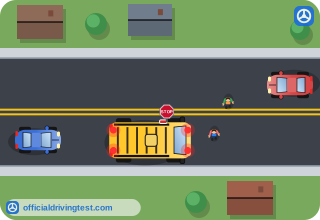
When must you stop for a school bus that has its lights flashing and a stop sign extended?
- Only when you are behind the bus
- No matter which side of the road you are on
- Only when you see children on the road
- Only when the bus is on your side of the road
Show answer
Correct answer: No matter which side of the road you are on
The manual says you must stop, and that it does not matter which side of the road you are traveling on.
Source: Massachusetts Driver's Manual (Revised April 2026), page 105 · Open this page in the manual (Manual page 105)
-
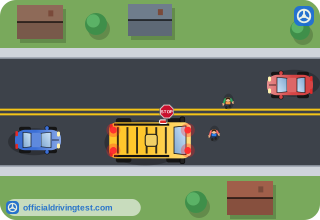
Once you have stopped for a school bus with flashing lights and a stop sign extended, how long must you remain stopped?
- Until the bus driver waves you through with a hand signal
- Until the last child has crossed in front of your vehicle
- Until the bus has moved at least 100 feet from your vehicle
- Until the lights stop flashing or the stop sign folds back
Show answer
Correct answer: Until the lights stop flashing or the stop sign folds back
The manual says to remain stopped until the lights stop flashing or the stop sign folds back.
Source: Massachusetts Driver's Manual (Revised April 2026), page 105 · Open this page in the manual (Manual page 105)
-
What can a first violation of the law requiring you to stop for a school bus cause?
- A license suspension and a $250 fine
- A warning and no fine
- A $50 fine with no suspension
- A $100 fine and points on your record
Show answer
Correct answer: A license suspension and a $250 fine
The manual says a first violation of this law can cause a license suspension and a $250 fine.
Source: Massachusetts Driver's Manual (Revised April 2026), page 105 · Open this page in the manual (Manual page 105)
-
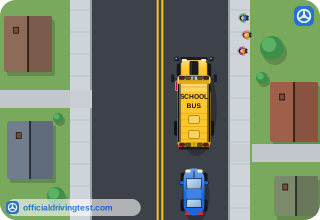
After the warning signals of a school bus have stopped, what should you do?
- Resume your normal speed as soon as the road is clear
- Sound your horn to warn any children who are near the bus
- Proceed slowly and continue to look for children
- Wait for a hand signal from the bus driver before moving
Show answer
Correct answer: Proceed slowly and continue to look for children
The manual says that even after the warning signals have stopped you should proceed slowly and continue to look for children.
Source: Massachusetts Driver's Manual (Revised April 2026), page 105 · Open this page in the manual (Manual page 105)
-
When do you not have to stop for a school bus with its lights flashing?
- When the road you are traveling on has three or more lanes
- When it has stopped on the other side of a divided highway with a barrier
- When the bus is stopped on the opposite side of any two-way road
- When you are already past the bus as its lights start flashing
Show answer
Correct answer: When it has stopped on the other side of a divided highway with a barrier
The manual says the only exception is a school bus stopped on the other side of a divided highway with a barrier between travel directions.
Source: Massachusetts Driver's Manual (Revised April 2026), page 105 · Open this page in the manual (Manual page 105)
-
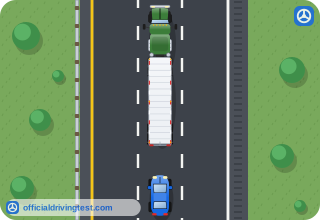
If you cannot see a truck's rearview mirrors, what are you doing?
- Passing safely
- Leaving a safe cushion
- Driving in the truck's lane correctly
- Tailgating
Show answer
Correct answer: Tailgating
The manual says that if you cannot see a truck's rearview mirrors, you are tailgating.
Source: Massachusetts Driver's Manual (Revised April 2026), page 106 · Open this page in the manual (Manual page 106)
-
Compared with an automobile or a motorcycle, how much distance may a large truck need to stop, especially when roads are wet or icy?
- Twice as much
- Half as much
- The same
- Three times as much
Show answer
Correct answer: Twice as much
The manual says a large truck may need twice as much distance to stop as an automobile or a motorcycle, especially when roads are wet or icy.
Source: Massachusetts Driver's Manual (Revised April 2026), page 106 · Open this page in the manual (Manual page 106)
-
What may a truck driver risk by trying to stop suddenly at highway speeds?
- Rolling backward
- Losing a wheel
- Jackknifing
- Stalling the engine
Show answer
Correct answer: Jackknifing
The manual says the driver may risk jackknifing by trying to stop suddenly at highway speeds.
Source: Massachusetts Driver's Manual (Revised April 2026), page 106 · Open this page in the manual (Manual page 106)
-
On a multiple-lane highway, in which lanes can trucks and buses only drive?
- The two left-hand lanes
- The two right-hand lanes
- Only the far right lane
- Any lane except the far left
Show answer
Correct answer: The two right-hand lanes
The manual says that on a multiple-lane highway, trucks and buses can only drive in the two right-hand lanes.
Source: Massachusetts Driver's Manual (Revised April 2026), page 106 · Open this page in the manual (Manual page 106)
-
If you travel in the second lane of a multiple-lane highway, what should you do?
- Drive slower than traffic to keep a safety cushion
- Stay in the lane even when a truck wants to pass
- Speed up to keep trucks from passing
- Stay with the flow of traffic
Show answer
Correct answer: Stay with the flow of traffic
The manual says that if you travel in the second lane you should stay with the flow of traffic and not drive below the minimum speed limit.
Source: Massachusetts Driver's Manual (Revised April 2026), page 106 · Open this page in the manual (Manual page 106)
-
If the driver of a truck or bus wants to pass you, what should you do?
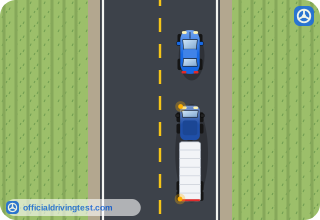
- Move over when it is safe to do so and let it pass
- Speed up to stay ahead of it until the next exit
- Stay in your lane and hold your speed steady
- Brake hard to signal it to stay behind you
Show answer
Correct answer: Move over when it is safe to do so and let it pass
The manual says to move over when it is safe to do so and let the vehicle pass.
Source: Massachusetts Driver's Manual (Revised April 2026), page 106 · Open this page in the manual (Manual page 106)
-
How does passing a tractor-trailer or a bus compare with passing another car or a motorcycle?
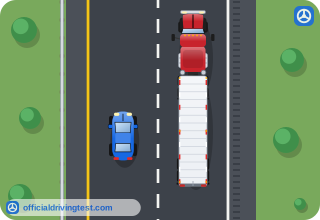
- It takes less time
- It takes about the same time
- It takes longer
- It takes longer only on a downhill grade
Show answer
Correct answer: It takes longer
The manual says it takes longer to pass a tractor-trailer or a bus than another car or a motorcycle.
Source: Massachusetts Driver's Manual (Revised April 2026), page 106 · Open this page in the manual (Manual page 106)
-
How do large vehicles travel on hills?
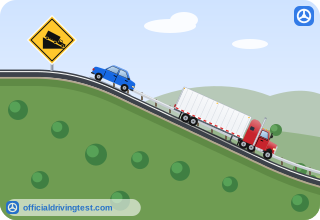
- Faster uphill and slower downhill
- Slower uphill and faster downhill
- At the same speed uphill and downhill
- Faster both uphill and downhill
Show answer
Correct answer: Slower uphill and faster downhill
The manual says large vehicles travel slower uphill and faster downhill.
Source: Massachusetts Driver's Manual (Revised April 2026), page 106 · Open this page in the manual (Manual page 106)
-
Before making a wide right turn, what may a large vehicle sometimes have to do?
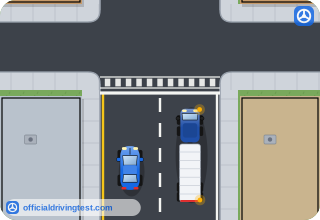
- Move to the right shoulder
- Stop in the intersection
- Back up
- Move to the left
Show answer
Correct answer: Move to the left
The manual says large vehicles make wide turns, and sometimes they must move to the left before making a wide turn to the right.
Source: Massachusetts Driver's Manual (Revised April 2026), page 106 · Open this page in the manual (Manual page 106)
-
If you are thinking about passing a tractor, what should you remember?
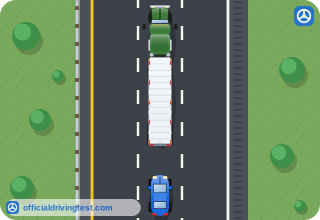
- It may be pulling more than one trailer
- It may be carrying a wide load
- It may have a second engine
- It may be unable to stop for a school bus
Show answer
Correct answer: It may be pulling more than one trailer
The manual says to remember that a tractor may be pulling more than one trailer.
Source: Massachusetts Driver's Manual (Revised April 2026), page 106 · Open this page in the manual (Manual page 106)
-
If you are next to a truck or bus, where are you probably?
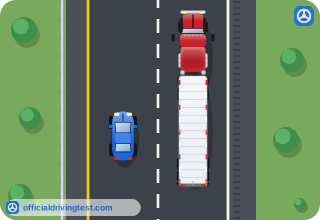
- In the safest position
- In the driver's clear view
- In a blind spot
- In the passing lane
Show answer
Correct answer: In a blind spot
The manual says that if you are next to a truck or bus, you are probably in a blind spot.
Source: Massachusetts Driver's Manual (Revised April 2026), page 107 · Open this page in the manual (Manual page 107)
-
A large vehicle is coming toward you on an undivided road. What should you do?
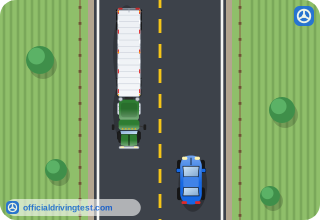
- Move toward the center line
- Stay to the right
- Pull onto the shoulder and stop
- Flash your headlights and slow down
Show answer
Correct answer: Stay to the right
The manual says to stay to the right, which avoids being sideswiped or shaken by air turbulence.
Source: Massachusetts Driver's Manual (Revised April 2026), page 107 · Open this page in the manual (Manual page 107)
-
At intersections, what should you take extra care in judging when a large vehicle is oncoming?
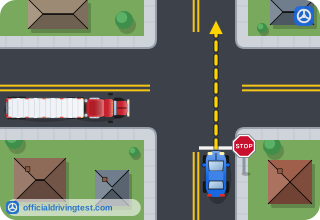
- The width of the cross street
- The number of axles on the vehicle
- The distance to the next intersection
- The speed of the oncoming vehicle
Show answer
Correct answer: The speed of the oncoming vehicle
The manual says to take extra care in judging the speed of the oncoming vehicle, since trucks and buses cannot slow down easily if you cut in front of them to turn.
Source: Massachusetts Driver's Manual (Revised April 2026), page 107 · Open this page in the manual (Manual page 107)
-
What should you do when a public transport bus signals to pull away from a bus stop?
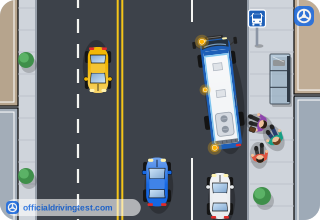
- Allow it to pull away
- Pass it before it moves
- Stay close behind it
- Honk your horn
Show answer
Correct answer: Allow it to pull away
The manual says to be courteous and allow signaling buses to pull away from bus stops.
Source: Massachusetts Driver's Manual (Revised April 2026), page 107 · Open this page in the manual (Manual page 107)