Massachusetts: Sharing the road — Part 1 Practice Test
Vulnerable road users and the four-foot passing rule, bicycles and bicycle lanes, motorcycles, mopeds, scooters, trucks and buses, school buses, farm vehicles, animals and funeral processions. — Part 1
Independent educational site · not affiliated with any government agency or DMV
Ready? Test yourself
- Instant feedback with an explanation
- Every answer cites its source in the manual
- Your best score is saved on this device
Questions are original and based on the official manual "Massachusetts Driver's Manual" (Revised April 2026), Massachusetts Registry of Motor Vehicles.
All 35 questions in this practice test
Take the test above first, then use this list to study. Tap “Show answer” to see the correct answer and explanation.
Show the questions and answersHide the questions
-
What does the manual say to do about snow plows?
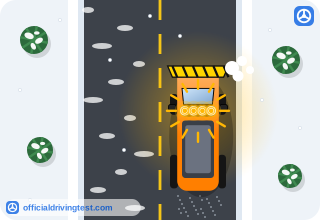
- Pass them as soon as possible
- Follow them closely for better traction
- Honk to tell them to move over
- Yield to plows and do not crowd them
Show answer
Correct answer: Yield to plows and do not crowd them
In winter, be alert for emergency vehicles, yield to plows, and do not crowd plows.
Source: Massachusetts Driver's Manual (Revised April 2026), page 48 · Open this page in the manual (Manual page 48)
-
Which of these does Massachusetts law define as a vulnerable road user?
- Taxi drivers
- School bus drivers
- Roadside workers
- Delivery truck drivers
Show answer
Correct answer: Roadside workers
The law lists pedestrians, roadside workers, bicyclists, people riding horses or horse drawn carriages, and people using wheelchairs, personal mobility devices, motorized bicycles, scooters, skateboards, or roller skates.
Source: Massachusetts Driver's Manual (Revised April 2026), page 49 · Open this page in the manual (Manual page 49)
-
When you pass a vulnerable road user, what is the smallest passing distance you must leave?
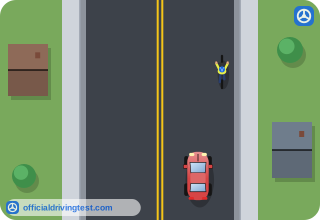
- Four feet
- Two feet
- Three feet
- Six feet
Show answer
Correct answer: Four feet
You must leave a safe passing distance of at least four feet between your vehicle and a vulnerable road user.
Source: Massachusetts Driver's Manual (Revised April 2026), page 49 · Open this page in the manual (Manual page 49)
-
When passing a vulnerable road user, what may you do if it is safe?
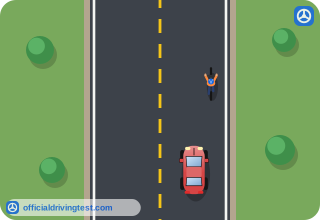
- Pass only on the shoulder, never crossing any line
- Use all or part of the next lane and cross the center line if necessary
- Exceed the speed limit briefly if no other traffic is nearby on the road
- Honk until the user moves aside
Show answer
Correct answer: Use all or part of the next lane and cross the center line if necessary
If it is safe, you may use all or part of the lane next to you and cross the center line if necessary.
Source: Massachusetts Driver's Manual (Revised April 2026), page 49 · Open this page in the manual (Manual page 49)
-
What speed rule applies while you are passing a vulnerable road user?
- You may exceed the limit to pass quickly
- You must drive 10 mph below the limit
- The speed limit is suspended
- You must obey the speed limit
Show answer
Correct answer: You must obey the speed limit
You must obey the speed limit while passing a vulnerable road user.
Source: Massachusetts Driver's Manual (Revised April 2026), page 49 · Open this page in the manual (Manual page 49)
-
A rectangular sign reading "MOTORISTS GIVE 4 FT TO PASS" with a bicycle symbol is posted on which roads?
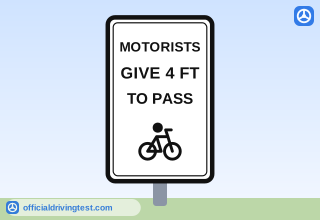
- Roads that do not have designated bike lanes or separated paths
- Roads with a posted speed limit above 45 mph and no sidewalks or shoulders
- Roads that already have bike lanes on both sides
- Limited-access highways
Show answer
Correct answer: Roads that do not have designated bike lanes or separated paths
The sign giving motorists 4 feet to pass is posted on roads that do not have designated bike lanes or separated paths.
Source: Massachusetts Driver's Manual (Revised April 2026), page 49 · Open this page in the manual (Manual page 49)
-
Which roads may bicyclists and moped riders be barred from by posted signs?
- Limited-access or express state highways
- Any road with a posted speed limit of 30 mph or higher
- Any road that has a center line and two travel lanes
- Any road without a sidewalk or a paved shoulder
Show answer
Correct answer: Limited-access or express state highways
Bicyclists and moped riders may use public roadways except limited-access or express state highways with posted signs saying they are not allowed.
Source: Massachusetts Driver's Manual (Revised April 2026), page 50 · Open this page in the manual (Manual page 50)
-
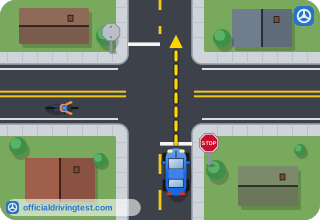
Which traffic laws must bicyclists and moped riders obey?
- Only the speed limit and pedestrian crossing laws on public roads
- No traffic control laws on low-speed local roads
- The same traffic control and right-of-way laws as drivers
- Only the laws that apply to pedestrians on roadways
Show answer
Correct answer: The same traffic control and right-of-way laws as drivers
Bicyclists and moped riders must obey the same traffic control and right-of-way laws as other drivers.
Source: Massachusetts Driver's Manual (Revised April 2026), page 50 · Open this page in the manual (Manual page 50)
-
Which driver action can seriously injure or kill a bicyclist or moped rider?
- Using your turn signal
- Dimming your headlights
- Opening a door without looking
- Waiting for oncoming traffic to pass
Show answer
Correct answer: Opening a door without looking
Drivers can seriously injure or kill bicyclists and moped riders by being distracted, drifting out of their lane, or opening a door without looking.
Source: Massachusetts Driver's Manual (Revised April 2026), page 50 · Open this page in the manual (Manual page 50)
-
When passing a bicycle or moped, why should you lower your speed?
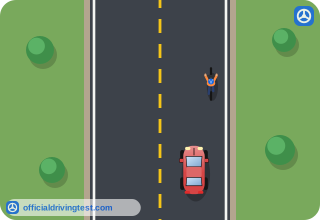
- The wind caused by your vehicle can throw a rider off balance
- Bicycles cannot be passed at all above 25 mph under Massachusetts law
- Slower passing lets you honk longer
- Moped riders cannot hear fast vehicles
Show answer
Correct answer: The wind caused by your vehicle can throw a rider off balance
The wind caused by your vehicle can throw a rider off balance, so lower your speed when passing.
Source: Massachusetts Driver's Manual (Revised April 2026), page 50 · Open this page in the manual (Manual page 50)
-
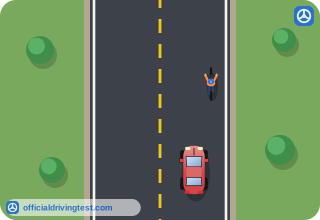
What should you do if you do not have enough room to pass a bicycle or moped safely?
- Pass anyway and move over slowly as you go by the rider on your right
- Honk to make the rider move right
- Speed up to pass quickly
- Wait for oncoming traffic to pass or for the lane to get wider
Show answer
Correct answer: Wait for oncoming traffic to pass or for the lane to get wider
If you do not have enough room to pass safely, wait for oncoming traffic to pass or for the lane to get wider.
Source: Massachusetts Driver's Manual (Revised April 2026), page 51 · Open this page in the manual (Manual page 51)
-
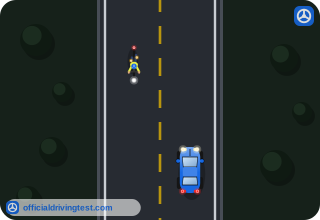
What should you do with your headlights at night if a bicyclist is coming toward you?
- Turn on your high beams
- Dim them
- Flash them repeatedly
- Turn them off
Show answer
Correct answer: Dim them
Dim your headlights at night if a bicyclist is coming toward you.
Source: Massachusetts Driver's Manual (Revised April 2026), page 51 · Open this page in the manual (Manual page 51)
-
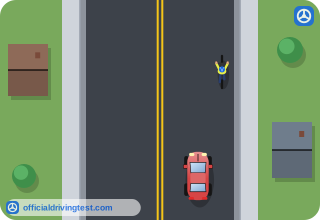
What should you be aware of regarding a bicyclist or moped rider?
- They might need to swerve suddenly, just like any other driver
- They never swerve because they are lighter than other vehicles on the road
- They always ride in a straight line near the curb
- They must stop at every intersection
Show answer
Correct answer: They might need to swerve suddenly, just like any other driver
A bicyclist or moped rider might need to swerve suddenly, just like any other driver.
Source: Massachusetts Driver's Manual (Revised April 2026), page 51 · Open this page in the manual (Manual page 51)
-
When parked on the side of a road, what should you always do before opening your vehicle door?
- Sound your horn
- Turn on your emergency lights
- Check carefully for bicycles or mopeds
- Open the door slowly without looking behind you
Show answer
Correct answer: Check carefully for bicycles or mopeds
When parked on the side of a road, always check carefully for bicycles or mopeds before opening your vehicle door.
Source: Massachusetts Driver's Manual (Revised April 2026), page 51 · Open this page in the manual (Manual page 51)
-
When does the motorcycle riding season usually go in Massachusetts?
- From May through August
- From March through October
- From April through September
- From June through November
Show answer
Correct answer: From March through October
The riding season usually goes from March through October, but some motorcyclists ride all year.
Source: Massachusetts Driver's Manual (Revised April 2026), page 51 · Open this page in the manual (Manual page 51)
-
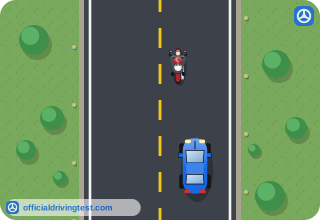
What do studies show drivers often do about motorcycles?
- Notice them sooner than they notice larger vehicles
- Judge their speed correctly
- Leave extra space for them
- Overlook them and focus on larger vehicles
Show answer
Correct answer: Overlook them and focus on larger vehicles
Studies have shown that drivers often overlook motorcycles and focus on larger vehicles.
Source: Massachusetts Driver's Manual (Revised April 2026), page 51 · Open this page in the manual (Manual page 51)
-
When should drivers be especially alert for oncoming motorcycles?
- Only when driving through a large parking lot or a driveway
- Only when traveling in a straight line
- Only on roads with no center line
- When entering traffic or turning left across traffic
Show answer
Correct answer: When entering traffic or turning left across traffic
Drivers should be especially alert for oncoming motorcycles when entering traffic or turning left across traffic, not just at intersections.
Source: Massachusetts Driver's Manual (Revised April 2026), page 51 · Open this page in the manual (Manual page 51)
-
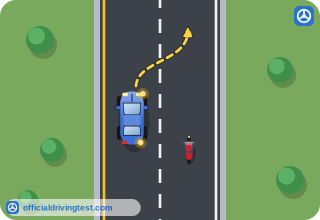
Why should you check your mirrors and blind spots for motorcycles when changing lanes or merging?
- Motorcycles always travel much faster than other traffic on the road
- Motorcycles can be hidden in blind spots because of their size
- Motorcycles may not use headlights
- Motorcycles always ride in the left lane
Show answer
Correct answer: Motorcycles can be hidden in blind spots because of their size
Motorcycles can be hidden in blind spots because of their size.
Source: Massachusetts Driver's Manual (Revised April 2026), page 51 · Open this page in the manual (Manual page 51)
-
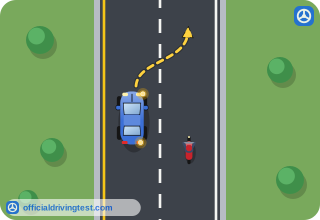
Before changing lanes, what does the manual say about checking for motorcycles?
- Check once, and accelerate
- Signal at the last moment
- Signal early, and check twice
- Do not check if the road is clear
Show answer
Correct answer: Signal early, and check twice
The manual says to signal early and check twice before changing lanes.
Source: Massachusetts Driver's Manual (Revised April 2026), page 51 · Open this page in the manual (Manual page 51)
-
What following distance should you use behind a motorcycle?
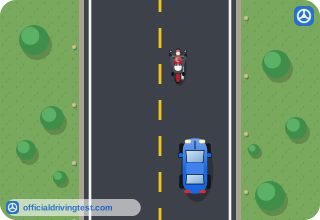
- A four-second following distance
- A two-second following distance
- A three-second following distance
- A one-second following distance
Show answer
Correct answer: A four-second following distance
Use a four-second following distance behind a motorcycle, compared with three seconds for other motor vehicles.
Source: Massachusetts Driver's Manual (Revised April 2026), page 51 · Open this page in the manual (Manual page 51)
-
Do motorcycles have the same right to use the full width of a lane as other vehicles?
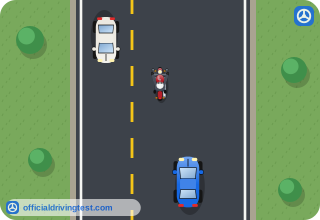
- No, they must stay on the right half
- Yes, and you must never share a lane with a motorcycle
- Yes, but you may share the lane with it when the lane is wide
- No, they must use the shoulder
Show answer
Correct answer: Yes, and you must never share a lane with a motorcycle
Motorcycles have the same right to use the full width of a lane, and you must never share a lane with one.
Source: Massachusetts Driver's Manual (Revised April 2026), page 51 · Open this page in the manual (Manual page 51)
-
Is it all right to move into the same lane space as a motorcycle if the lane is wide and the motorcyclist is riding to one side?
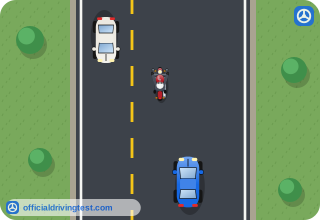
- Yes, if you stay well to the other side of the lane from the rider
- Yes, if you are passing quickly
- Yes, if the motorcyclist signals you
- No, never move into the same lane space as a motorcycle
Show answer
Correct answer: No, never move into the same lane space as a motorcycle
Never move into the same lane space as a motorcycle, even if the lane is wide and the motorcyclist is riding to one side.
Source: Massachusetts Driver's Manual (Revised April 2026), page 51 · Open this page in the manual (Manual page 51)
-
What does the manual say about crowding into a lane with a motorcycle?
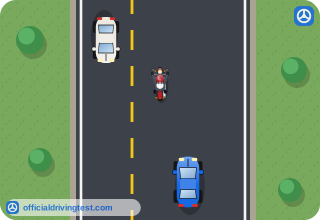
- It is illegal and very dangerous
- It is allowed if the lane is wide
- It is allowed during heavy traffic
- It is legal but discouraged
Show answer
Correct answer: It is illegal and very dangerous
Crowding into a lane with a motorcycle is illegal and very dangerous.
Source: Massachusetts Driver's Manual (Revised April 2026), page 52 · Open this page in the manual (Manual page 52)
-
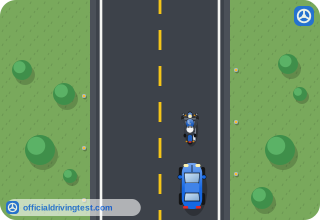
Why do motorcyclists need to move within a lane?
- Because they must stay exactly in the center of every lane they travel in
- Because they must pass other motorcycles in the same lane
- For traffic maneuvers and to avoid road debris, potholes, or surface oil
- Because lane markings do not apply to them
Show answer
Correct answer: For traffic maneuvers and to avoid road debris, potholes, or surface oil
Motorcyclists need to move within a lane for traffic maneuvers and to avoid road debris, potholes, or surface oil.
Source: Massachusetts Driver's Manual (Revised April 2026), page 51 · Open this page in the manual (Manual page 51)
-
Why can gravel, potholes, and slippery surfaces be big hazards for motorcycles?
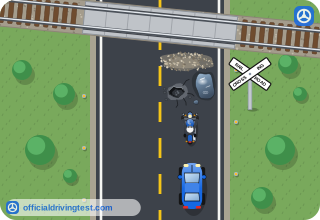
- They can make a motorcyclist change speed and direction suddenly
- They can make a motorcyclist unable to see the lane lines
- They force every motorcyclist to ride on the shoulder instead of the lane
- They only affect motorcycles that carry a passenger
Show answer
Correct answer: They can make a motorcyclist change speed and direction suddenly
Gravel, potholes, and slippery surfaces can cause a motorcyclist to change speed and direction suddenly.
Source: Massachusetts Driver's Manual (Revised April 2026), page 52 · Open this page in the manual (Manual page 52)
-
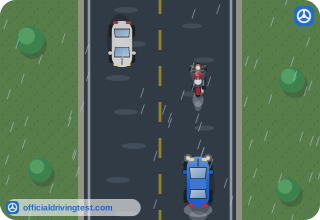
In bad weather, what should you give a motorcycle?
- Less space so the rider can see you in the mirrors
- A shorter following distance than for cars
- The right of way at every turn
- Extra space in case it needs to stop suddenly
Show answer
Correct answer: Extra space in case it needs to stop suddenly
Motorcycles need more distance to stop in bad weather, so always give one extra space in case it needs to stop suddenly.
Source: Massachusetts Driver's Manual (Revised April 2026), page 52 · Open this page in the manual (Manual page 52)
-
What is a moped (also known as a motorized bicycle)?
- A pedal bicycle with a helper motor, or a non-pedal bicycle with a motor
- A three-wheeled vehicle with a 500 cc engine
- A two-wheeled vehicle with a manual transmission
- A four-wheeled vehicle with a gross weight rating under 3,000 lbs and a roof
Show answer
Correct answer: A pedal bicycle with a helper motor, or a non-pedal bicycle with a motor
A moped is a pedal bicycle with a helper motor, or a non-pedal bicycle with a motor.
Source: Massachusetts Driver's Manual (Revised April 2026), page 52 · Open this page in the manual (Manual page 52)
-
What is the maximum cylinder capacity of a moped?
- Thirty (30) cubic centimeters
- One hundred (100) cubic centimeters
- Fifty (50) cubic centimeters
- Two hundred fifty (250) cubic centimeters
Show answer
Correct answer: Fifty (50) cubic centimeters
A moped’s cylinder capacity must be fifty (50) cubic centimeters or lower.
Source: Massachusetts Driver's Manual (Revised April 2026), page 52 · Open this page in the manual (Manual page 52)
-
What type of transmission must a moped have?
- Manual
- Automatic
- Four-speed
- Dual-clutch
Show answer
Correct answer: Automatic
A moped must have an automatic transmission.
Source: Massachusetts Driver's Manual (Revised April 2026), page 52 · Open this page in the manual (Manual page 52)
-
When driving a moped, what is the fastest you may drive?
- 15 mph
- 35 mph
- 40 mph
- 25 mph
Show answer
Correct answer: 25 mph
Moped rules say do not drive faster than 25 mph.
Source: Massachusetts Driver's Manual (Revised April 2026), page 52 · Open this page in the manual (Manual page 52)
-
Where may a moped not be ridden?
- Bicycle lanes along roads
- Off-street recreational paths
- Roads with a posted speed limit under 25 mph
- Residential side streets
Show answer
Correct answer: Off-street recreational paths
Moped riders may not ride on off-street recreational paths, but they can use bicycle lanes along roads.
Source: Massachusetts Driver's Manual (Revised April 2026), page 52 · Open this page in the manual (Manual page 52)
-
Who must wear a helmet that meets or exceeds the US DOT standard on a moped?
- Drivers only
- Passengers only
- Drivers and passengers
- Only drivers and passengers under 18
Show answer
Correct answer: Drivers and passengers
Moped drivers and passengers must wear helmets that meet or exceed the US DOT standard.
Source: Massachusetts Driver's Manual (Revised April 2026), page 52 · Open this page in the manual (Manual page 52)
-
What must a moped rider do before stopping or turning?
- Use the correct electronic and hand signals
- Sound the horn twice and then turn
- Flash the headlight and brake light together
- Slow to a walking pace
Show answer
Correct answer: Use the correct electronic and hand signals
Moped riders must use the correct electronic and hand signals before stopping or turning.
Source: Massachusetts Driver's Manual (Revised April 2026), page 52 · Open this page in the manual (Manual page 52)
-
When operating a moped with a learner’s permit, whom may you carry?
- One adult passenger
- No passengers
- One passenger with a helmet
- One licensed driver
Show answer
Correct answer: No passengers
When operating a moped with a learner’s permit, do not carry any passengers.
Source: Massachusetts Driver's Manual (Revised April 2026), page 53 · Open this page in the manual (Manual page 53)
-
What is the most you can be fined for a violation of the moped rules?
- Up to $25
- Up to $500
- Up to $1,000
- Up to $100
Show answer
Correct answer: Up to $100
You can be fined up to $100 for a violation of any of the moped rules.
Source: Massachusetts Driver's Manual (Revised April 2026), page 53 · Open this page in the manual (Manual page 53)