Massachusetts: Parking rules — Part 1 Practice Test
Questions in this part include: “When you stop or park, how wide a clear roadway must you always leave for traffic to pass?” · “What does state law require when you leave your vehicle by itself?”
Independent educational site · not affiliated with any government agency or DMV
Ready? Test yourself
- Instant feedback with an explanation
- Every answer cites its source in the manual
- Your best score is saved on this device
Questions are original and based on the official manual "Massachusetts Driver's Manual" (Revised April 2026), Massachusetts Registry of Motor Vehicles.
All 16 questions in this practice test
Take the test above first, then use this list to study. Tap “Show answer” to see the correct answer and explanation.
Show the questions and answersHide the questions
-
When you stop or park, how wide a clear roadway must you always leave for traffic to pass?
- At least 8 feet
- At least 10 feet
- At least 12 feet
- At least 15 feet
Show answer
Correct answer: At least 12 feet
The manual says you must always leave at least a 12-foot wide, clear roadway for traffic to pass.
Source: Massachusetts Driver's Manual (Revised April 2026), page 109 · Open this page in the manual (Manual page 109)
-
What does state law require when you leave your vehicle by itself?
- Stop the motor, set the parking brake, lock the ignition, remove the key, and lock the door
- Stop the motor, set the parking brake, leave the key in the ignition, and lock the door
- Stop the motor, put the shifter in neutral, turn on the hazard lights, and leave the door unlocked
- Set the parking brake, leave the motor idling, and lock only the driver's door
Show answer
Correct answer: Stop the motor, set the parking brake, lock the ignition, remove the key, and lock the door
State law requires you to stop the motor, set the parking brake, make sure the ignition is locked, remove your key, and lock the door.
Source: Massachusetts Driver's Manual (Revised April 2026), page 109 · Open this page in the manual (Manual page 109)
-
What must you do when you pull away from the curb?
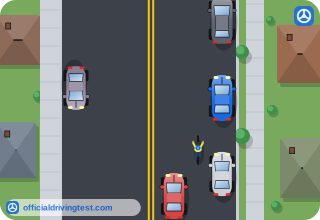
- Signal and ease out so that passing vehicles slow down to let you in
- Wait for passing vehicles in the lane, then signal and move out slowly
- Honk your horn to warn traffic and then pull out into the lane at once
- Turn on your hazard lights and move into the travel lane right away
Show answer
Correct answer: Wait for passing vehicles in the lane, then signal and move out slowly
The manual says you must wait for vehicles in the travel lane to pass, then signal that you are pulling out and move slowly into traffic.
Source: Massachusetts Driver's Manual (Revised April 2026), page 109 · Open this page in the manual (Manual page 109)
-
If you park in a business or residential district, your vehicle must be no more than how far from the curb?
- 6 inches
- 18 inches
- 24 inches
- 12 inches
Show answer
Correct answer: 12 inches
The manual says that in a business or residential district your vehicle must be no more than 12 inches from the curb.
Source: Massachusetts Driver's Manual (Revised April 2026), page 109 · Open this page in the manual (Manual page 109)
-
What is the only exception to the rule that you must park no more than 12 inches from the curb in a business or residential district?
- Where angled parking is allowed
- Where a parking meter is present
- Where the street has no sidewalk
- Where a loading zone is posted
Show answer
Correct answer: Where angled parking is allowed
The manual says the only exception to the 12-inch curb rule is if angled parking is allowed.
Source: Massachusetts Driver's Manual (Revised April 2026), page 109 · Open this page in the manual (Manual page 109)
-
When you pull up alongside the vehicle in front of the space for parallel parking, how much room should you leave between your vehicle and the parked one?
- About six inches
- About five or six feet
- About two or three feet
- About one foot
Show answer
Correct answer: About two or three feet
The manual says to leave about two or three feet between your vehicle and the parked one.
Source: Massachusetts Driver's Manual (Revised April 2026), page 109 · Open this page in the manual (Manual page 109)
-
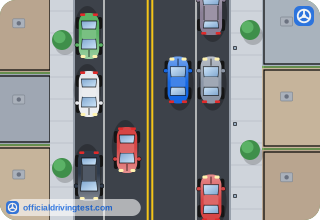
Before you back into a parallel parking space, what should you check?
- Look only to your left, since traffic comes from there
- Look in your mirrors only, without turning your head
- Look behind you both ways for pedestrians and other traffic
- Look only at the curb ahead of you to judge the gap
Show answer
Correct answer: Look behind you both ways for pedestrians and other traffic
The manual says to look behind you both ways to check for pedestrians and other traffic.
Source: Massachusetts Driver's Manual (Revised April 2026), page 109 · Open this page in the manual (Manual page 109)
-
Which way do you turn the steering wheel when you slowly begin backing into a parallel parking space?
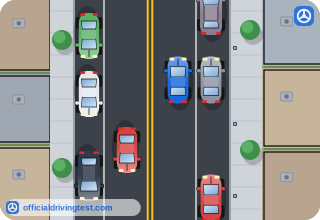
- All the way toward the curb
- All the way away from the curb
- Halfway toward the curb
- Straight, until your rear wheels touch the curb
Show answer
Correct answer: All the way toward the curb
The manual says to slowly back up and turn the steering wheel all the way toward the curb.
Source: Massachusetts Driver's Manual (Revised April 2026), page 109 · Open this page in the manual (Manual page 109)
-
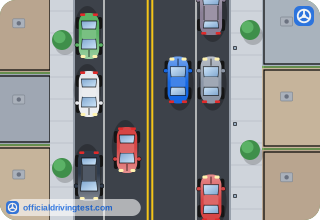
While you back into a parallel parking space, what should you look through?
- Your rear-view mirror, with a quick glance over your shoulder
- Your side mirror on the curb side, turning your head only when needed
- Both side mirrors and the rear-view mirror at the same time
- Directly out your rear window, without using your mirrors
Show answer
Correct answer: Directly out your rear window, without using your mirrors
The manual says to look directly out your rear window and not to use your mirrors.
Source: Massachusetts Driver's Manual (Revised April 2026), page 110 · Open this page in the manual (Manual page 110)
-
When your front passes the rear bumper of the parked vehicle while you back into a parallel parking space, what do you do with the steering wheel?
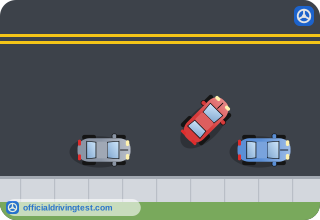
- Straighten it and stop backing up
- Turn it the opposite way and keep backing up
- Keep it turned toward the curb until you stop
- Turn it further toward the curb and pull forward
Show answer
Correct answer: Turn it the opposite way and keep backing up
The manual says that when your front passes the parked vehicle's rear bumper, you turn the steering wheel the opposite way and continue backing up.
Source: Massachusetts Driver's Manual (Revised April 2026), page 110 · Open this page in the manual (Manual page 110)
-
When you finish backing into a parallel parking space, what should you leave in front of and behind your vehicle?
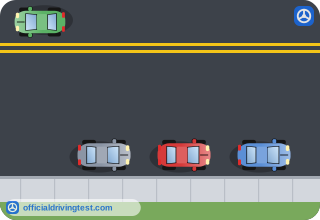
- Enough space so that other vehicles can get out
- Only a few inches so more cars can fit on the block
- About two or three feet, the same as when you pulled up
- Enough room for a bicycle to pass between
Show answer
Correct answer: Enough space so that other vehicles can get out
The manual says to keep enough space in front of and behind you so that other vehicles can get out.
Source: Massachusetts Driver's Manual (Revised April 2026), page 110 · Open this page in the manual (Manual page 110)
-
You are parking on a hill and your vehicle has a manual transmission. Besides setting the parking brake, what should you do?
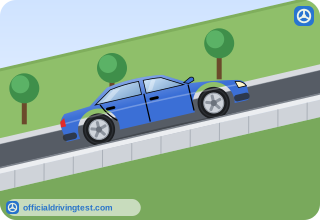
- Shift into neutral
- Shift into park
- Leave the vehicle in gear
- Keep the clutch pedal pressed down
Show answer
Correct answer: Leave the vehicle in gear
The manual says to set the parking brake and leave a manual-transmission vehicle in gear when parking on a hill.
Source: Massachusetts Driver's Manual (Revised April 2026), page 110 · Open this page in the manual (Manual page 110)
-
You are parking on a hill and your vehicle has an automatic transmission. What should you do?
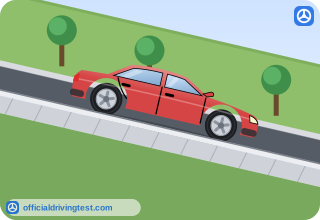
- Leave it in drive with your foot on the brake
- Set the parking brake and shift into park
- Shift into neutral and set the parking brake
- Shift into park and leave the parking brake off
Show answer
Correct answer: Set the parking brake and shift into park
With an automatic transmission, the manual says to set your parking brake and shift into park.
Source: Massachusetts Driver's Manual (Revised April 2026), page 110 · Open this page in the manual (Manual page 110)
-
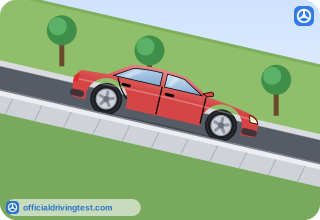
Why must you turn your front wheels in the proper direction when you park on a hill?
- To make it easier to pull out of the space later on
- To keep the tires from wearing unevenly on the slope
- To keep the steering wheel from locking while parked
- To stop the vehicle from rolling downhill if the brake fails
Show answer
Correct answer: To stop the vehicle from rolling downhill if the brake fails
The manual says you must turn your front wheels in the proper direction to stop the vehicle from rolling downhill if the brake fails.
Source: Massachusetts Driver's Manual (Revised April 2026), page 110 · Open this page in the manual (Manual page 110)
-
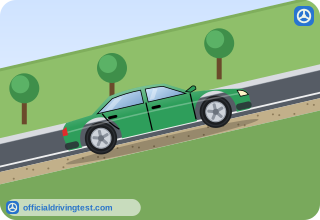
You park on a hill where there is no curb. Which way should you turn your wheels?
- Toward the travel lane
- Straight ahead
- Toward the center of the road
- Toward the edge of the road
Show answer
Correct answer: Toward the edge of the road
With no curb, the manual says to turn your wheels inward, toward the edge of the road.
Source: Massachusetts Driver's Manual (Revised April 2026), page 110 · Open this page in the manual (Manual page 110)
-
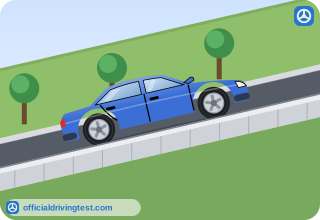
You park uphill against a curb. Which way should you turn your wheels?
- Toward the curb
- Away from the curb, toward the travel lane
- Straight ahead
- Parallel to the road, with the wheels centered
Show answer
Correct answer: Away from the curb, toward the travel lane
Parking uphill against a curb, the manual says to turn your wheels outward, toward the travel lane.
Source: Massachusetts Driver's Manual (Revised April 2026), page 110 · Open this page in the manual (Manual page 110)