Massachusetts: Highway driving Practice Test
Entering and leaving a highway, acceleration and deceleration lanes, choosing a lane, signaling an exit and stopping in the breakdown lane.
Independent educational site · not affiliated with any government agency or DMV
Ready? Test yourself
- Instant feedback with an explanation
- Every answer cites its source in the manual
- Your best score is saved on this device
Questions are original and based on the official manual "Massachusetts Driver's Manual" (Revised April 2026), Massachusetts Registry of Motor Vehicles.
All 21 questions in this practice test
Take the test above first, then use this list to study. Tap “Show answer” to see the correct answer and explanation.
Show the questions and answersHide the questions
-
Where are breakdown lanes found?
- In the middle of two-way roads and city streets
- On the right-hand shoulder of highways and expressways
- On the left side of divided highways next to the median
- Between a bicycle lane and the sidewalk on a street
Show answer
Correct answer: On the right-hand shoulder of highways and expressways
The manual lists breakdown lanes on the right-hand shoulder of highways and expressways as a kind of lane.
Source: Massachusetts Driver's Manual (Revised April 2026), page 93 · Open this page in the manual (Manual page 93)
-
As a general rule, what should you not use a highway breakdown lane for?
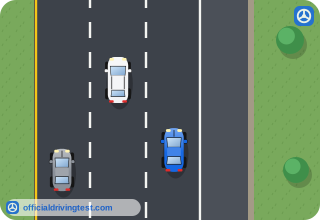
- Stopping in an emergency
- Pulling over when a vehicle breaks down
- Travel or passing
- Waiting for a tow truck
Show answer
Correct answer: Travel or passing
As a general rule, do not use a highway breakdown lane for travel or passing.
Source: Massachusetts Driver's Manual (Revised April 2026), page 94 · Open this page in the manual (Manual page 94)
-
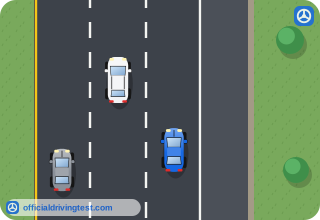
On some highways, when may you use the breakdown lane for travel?
- Whenever traffic in the other lanes is moving slowly
- During specific times that are posted clearly
- Whenever you are passing a stopped vehicle
- Whenever you are about to exit the highway
Show answer
Correct answer: During specific times that are posted clearly
On some highways you may use the breakdown lane for travel during specific times, and the hours of use are posted clearly.
Source: Massachusetts Driver's Manual (Revised April 2026), page 94 · Open this page in the manual (Manual page 94)
-
What is a divided highway?
- A highway with separate roadways for traffic in opposite directions
- A highway with a center lane used for left turns by both directions
- A highway with lanes reserved for buses and carpools
- A highway with a bicycle lane on each side of the road
Show answer
Correct answer: A highway with separate roadways for traffic in opposite directions
A divided highway has separate roadways for traffic in opposite directions.
Source: Massachusetts Driver's Manual (Revised April 2026), page 94 · Open this page in the manual (Manual page 94)
-
What does it mean when a highway is "controlled access"?
- It has a toll booth at each entrance
- It has a posted minimum speed
- It has no signals or intersections
- It has traffic signals at each ramp
Show answer
Correct answer: It has no signals or intersections
Controlled access highways have no signals or intersections, and you enter and exit them using ramps.
Source: Massachusetts Driver's Manual (Revised April 2026), page 94 · Open this page in the manual (Manual page 94)
-
Where do you enter or exit an expressway or freeway?
- At rotaries, using breakdown lanes
- At interchanges, using ramps
- At traffic signals, using turn lanes
- At crosswalks, using bicycle lanes
Show answer
Correct answer: At interchanges, using ramps
You enter and exit expressways and freeways using ramps, at interchanges.
Source: Massachusetts Driver's Manual (Revised April 2026), page 94 · Open this page in the manual (Manual page 94)
-
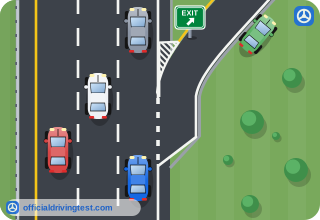
When entering or exiting a highway, how early should you be in the proper lane?
- Only once you are on the ramp
- At the last moment, to avoid blocking traffic
- Only after you have slowed to the ramp speed limit
- Well in advance, so you can enter or exit safely
Show answer
Correct answer: Well in advance, so you can enter or exit safely
Make sure you are in the proper lane well in advance so you can safely enter or exit the highway.
Source: Massachusetts Driver's Manual (Revised April 2026), page 94 · Open this page in the manual (Manual page 94)
-
When entering a highway, whom must you yield the right-of-way to?
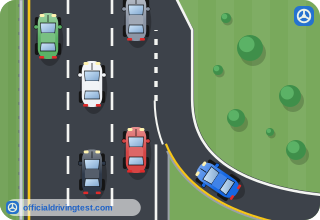
- Drivers already on the highway
- Drivers who are about to exit
- Vehicles entering from the ramp behind you
- Only vehicles in the right lane
Show answer
Correct answer: Drivers already on the highway
The manual says to yield the right-of-way to drivers already on the highway.
Source: Massachusetts Driver's Manual (Revised April 2026), page 95 · Open this page in the manual (Manual page 95)
-
When you enter a highway, how should you adjust your speed?
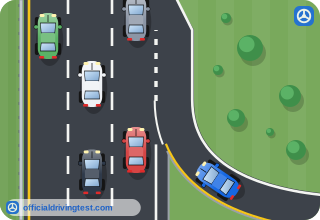
- Keep your speed low until you reach the middle lane
- Stay at the ramp speed until traffic opens up
- Increase your speed to match vehicles already on the road
- Stop at the end of the ramp and wait for a gap
Show answer
Correct answer: Increase your speed to match vehicles already on the road
When you enter a highway, you should increase your speed to match vehicles already on the road.
Source: Massachusetts Driver's Manual (Revised April 2026), page 95 · Open this page in the manual (Manual page 95)
-
You miss your exit on a highway. What should you do?
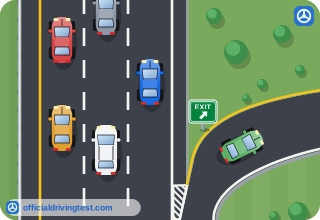
- Stop on the shoulder and back up carefully to the exit you missed
- Do not stop; get off at the next exit and follow signs to rejoin the other way
- Back up carefully along the breakdown lane to the exit
- Make a U-turn at the next opening in the median strip
Show answer
Correct answer: Do not stop; get off at the next exit and follow signs to rejoin the other way
If you miss your exit, do not stop and never back up; get off at the next exit and look for signs showing how to rejoin the road in the other direction.
Source: Massachusetts Driver's Manual (Revised April 2026), page 95 · Open this page in the manual (Manual page 95)
-
How far before the exit ramp should you signal your exit from a highway?
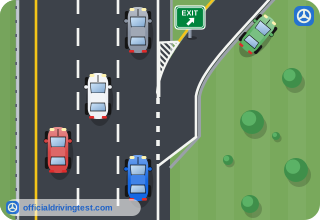
- At least 100 feet
- At least 50 feet
- At least 1,000 feet
- At least 500 feet
Show answer
Correct answer: At least 500 feet
Be sure to signal your exit at least 500 feet before you reach the exit ramp.
Source: Massachusetts Driver's Manual (Revised April 2026), page 95 · Open this page in the manual (Manual page 95)
-
As you drive along an exit ramp after leaving the highway, what should you do?
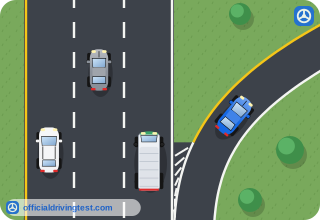
- Slow to the posted exit ramp speed limit
- Keep the highway speed until the end of the ramp
- Stop at the top of the ramp
- Use the left lane to go around slower vehicles
Show answer
Correct answer: Slow to the posted exit ramp speed limit
As you leave the highway and drive along the exit ramp, slow to the posted exit ramp speed limit.
Source: Massachusetts Driver's Manual (Revised April 2026), page 95 · Open this page in the manual (Manual page 95)
-
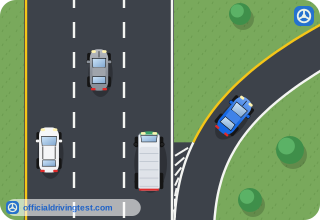
At busy times, what can happen on exit ramps?
- They are closed so traffic must use the next exit instead
- They become one-way in the opposite direction
- They can get backed up, so be alert for slowing or stopped traffic
- They allow vehicles to pass slow traffic on the right
Show answer
Correct answer: They can get backed up, so be alert for slowing or stopped traffic
At busy times exit ramps can get backed up, so be especially alert for slowing or stopped traffic around ramps.
Source: Massachusetts Driver's Manual (Revised April 2026), page 95 · Open this page in the manual (Manual page 95)
-
On an expressway with three or more lanes in your direction, which lane should you use for slower driving?
- The middle lane
- The far left lane
- The breakdown lane
- The far right lane
Show answer
Correct answer: The far right lane
On an expressway with three or more lanes in your direction, use the far right lane for slower driving.
Source: Massachusetts Driver's Manual (Revised April 2026), page 95 · Open this page in the manual (Manual page 95)
-
Where in your lane should you drive on a highway?
- Close to the line on your left side
- Close to the line on your right side
- In the middle of your lane, between the lines
- Over the line for a better view of the road
Show answer
Correct answer: In the middle of your lane, between the lines
The manual says to drive in the middle of your lane, staying between the lines.
Source: Massachusetts Driver's Manual (Revised April 2026), page 95 · Open this page in the manual (Manual page 95)
-
What three steps should you remember when changing lanes?
- Slow, signal, stop
- Look, signal, move
- Signal, honk, move
- Brake, look, signal
Show answer
Correct answer: Look, signal, move
The three steps to remember when changing lanes are (1) look, (2) signal, (3) move.
Source: Massachusetts Driver's Manual (Revised April 2026), page 95 · Open this page in the manual (Manual page 95)
-
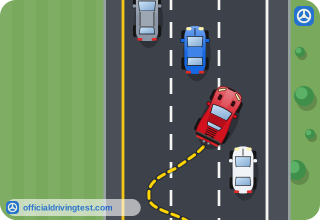
What does the manual say about weaving in and out of traffic on a highway?
- Weave only when traffic is slow
- Weave to find the fastest lane
- Do not weave in and out of traffic
- Weave only when you have signaled
Show answer
Correct answer: Do not weave in and out of traffic
The manual tells you not to weave in and out of traffic.
Source: Massachusetts Driver's Manual (Revised April 2026), page 95 · Open this page in the manual (Manual page 95)
-
On a highway, what should you look out for in addition to vehicles entering the highway?
- Vehicles stopped in the far left lane
- Vehicles or pedestrians in the breakdown lane
- Pedestrians walking in the middle lane
- Bicyclists riding in the passing lane
Show answer
Correct answer: Vehicles or pedestrians in the breakdown lane
Look out for vehicles entering the highway and any vehicles or pedestrians in the breakdown lane.
Source: Massachusetts Driver's Manual (Revised April 2026), page 95 · Open this page in the manual (Manual page 95)
-
What should you do if you have driven for a long time and feel tired on the highway?
- Open the window and keep driving to the next town
- Move to the breakdown lane and take a short nap
- Speed up so that the drive is over sooner than planned
- Get off the highway at the next exit, rest stop, or service area
Show answer
Correct answer: Get off the highway at the next exit, rest stop, or service area
To avoid highway hypnosis when tired from a long drive, you should get off the highway at the next exit, rest stop, or service area.
Source: Massachusetts Driver's Manual (Revised April 2026), page 95 · Open this page in the manual (Manual page 95)
-
What should you do before exiting a highway that uses breakdown lanes as travel lanes?
- Look to your right and check your right-hand blind spot
- Look to your left and check your left-hand blind spot
- Slow to a stop in the breakdown lane
- Move to the far left lane to wait for traffic
Show answer
Correct answer: Look to your right and check your right-hand blind spot
Take extra care when exiting a highway that uses breakdown lanes as travel lanes: look to your right and check your right-hand blind spot.
Source: Massachusetts Driver's Manual (Revised April 2026), page 96 · Open this page in the manual (Manual page 96)
-
If you plan to drive far, how often does the manual say to stop and stretch?
- Every 30 minutes or every 25 miles
- Every four hours or every 250 miles
- Every two hours or every 100 miles
- Every hour or every 50 miles
Show answer
Correct answer: Every two hours or every 100 miles
If you plan to drive far, stop and stretch every two hours or every 100 miles.
Source: Massachusetts Driver's Manual (Revised April 2026), page 96 · Open this page in the manual (Manual page 96)