Massachusetts: Emergencies and crashes — Part 4 Practice Test
Questions in this part include: “Which center monitors most major tunnels within Massachusetts?” · “You damage a parked vehicle or other property in a crash. What must you try to do?”
Independent educational site · not affiliated with any government agency or DMV
Ready? Test yourself
- Instant feedback with an explanation
- Every answer cites its source in the manual
- Your best score is saved on this device
Questions are original and based on the official manual "Massachusetts Driver's Manual" (Revised April 2026), Massachusetts Registry of Motor Vehicles.
All 18 questions in this practice test
Take the test above first, then use this list to study. Tap “Show answer” to see the correct answer and explanation.
Show the questions and answersHide the questions
-
Which center monitors most major tunnels within Massachusetts?
- The Highway Operations Center
- The Registry Operations Center
- The State Tunnel Authority
- The Crash Records Center
Show answer
Correct answer: The Highway Operations Center
The manual says most major tunnels within Massachusetts are monitored by the Highway Operations Center.
Source: Massachusetts Driver's Manual (Revised April 2026), page 127 · Open this page in the manual (Manual page 127)
-
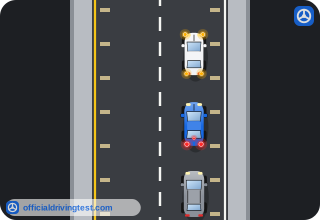
If you are in a crash or have a disabled vehicle in a tunnel, what does the manual say to do if it is safe?
- Walk to the nearest exit
- Stand beside the vehicle
- Stay in your vehicle
- Push the vehicle out of the tunnel
Show answer
Correct answer: Stay in your vehicle
The manual says to stay in your vehicle if it is safe to do so and wait for emergency personnel.
Source: Massachusetts Driver's Manual (Revised April 2026), page 128 · Open this page in the manual (Manual page 128)
-
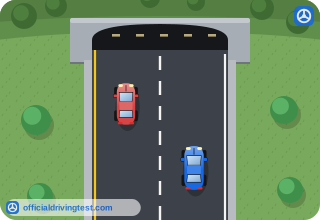
When entering a tunnel, what should you turn on?
- Your high beams
- Your headlights
- Your parking lights only
- Your fog lights only
Show answer
Correct answer: Your headlights
The manual says to turn on your headlights when entering a tunnel.
Source: Massachusetts Driver's Manual (Revised April 2026), page 128 · Open this page in the manual (Manual page 128)
-
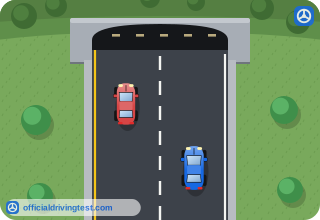
When should you not enter a tunnel?
- When the tunnel has more than one lane in each direction
- When traffic ahead of you is moving slowly in the tunnel
- When a message sign is displayed above the entrance
- When you notice smoke near the entrance or your car is smoking
Show answer
Correct answer: When you notice smoke near the entrance or your car is smoking
The manual says not to enter if you notice smoke near the entrance or if your car is smoking or burning.
Source: Massachusetts Driver's Manual (Revised April 2026), page 128 · Open this page in the manual (Manual page 128)
-
Which of these is prohibited in Massachusetts tunnels?
- Hazardous materials, including propane
- Motorcycles
- Passenger vans
- Vehicles carrying bicycles on roof racks
Show answer
Correct answer: Hazardous materials, including propane
The manual says hazardous materials are prohibited in tunnels, including propane.
Source: Massachusetts Driver's Manual (Revised April 2026), page 128 · Open this page in the manual (Manual page 128)
-
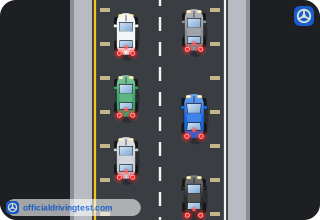
In heavy traffic in a tunnel, what distance should you keep from other vehicles?
- A close distance, when traffic is moving slowly
- No set distance, when traffic is stopped
- A safe distance, even if traffic is moving slowly
- A safe distance, only when traffic is moving fast
Show answer
Correct answer: A safe distance, even if traffic is moving slowly
The manual says to keep a safe distance from other vehicles, even if traffic is moving slowly.
Source: Massachusetts Driver's Manual (Revised April 2026), page 128 · Open this page in the manual (Manual page 128)
-
In heavy traffic in a tunnel, what should you note?
- The location of the next toll booth
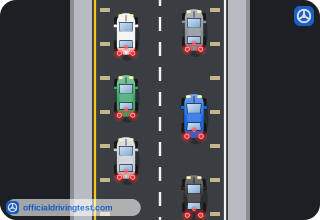
- The location of emergency exits
- The speed of the vehicle ahead
- The brand of the nearest tow truck
Show answer
Correct answer: The location of emergency exits
The manual says to note the location of emergency exits when in heavy traffic in a tunnel.
Source: Massachusetts Driver's Manual (Revised April 2026), page 128 · Open this page in the manual (Manual page 128)
-
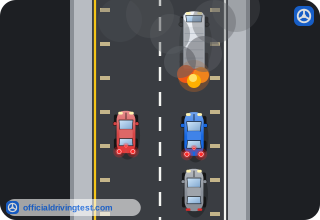
If there is a fire in a tunnel, what should you do with your keys?
- Take them with you when you exit the vehicle at once
- Give them to a passing driver who stops to help you
- Lock the vehicle and keep the keys in your pocket
- Leave them in the vehicle to help emergency personnel
Show answer
Correct answer: Leave them in the vehicle to help emergency personnel
The manual says to leave your keys in the vehicle to help emergency personnel.
Source: Massachusetts Driver's Manual (Revised April 2026), page 128 · Open this page in the manual (Manual page 128)
-
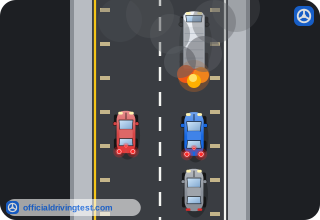
If there is a fire in a tunnel, what should you do with your belongings?
- Leave them in the vehicle
- Take them with you
- Place them in the trunk
- Hand them to emergency personnel
Show answer
Correct answer: Leave them in the vehicle
The manual says to leave your things in the vehicle for your safety, because fire and smoke can kill.
Source: Massachusetts Driver's Manual (Revised April 2026), page 128 · Open this page in the manual (Manual page 128)
-
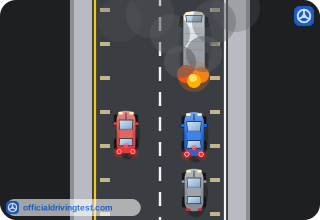
If there is a fire in a tunnel, where should you exit unless directed otherwise?
- At the farthest tunnel exit
- Through the roof ventilation
- At the nearest tunnel entrance
- Through the nearest vehicle door of another car
Show answer
Correct answer: At the nearest tunnel entrance
The manual says to exit at the nearest tunnel entrance, unless directed otherwise.
Source: Massachusetts Driver's Manual (Revised April 2026), page 128 · Open this page in the manual (Manual page 128)
-
You are involved in a small crash. What must you do?
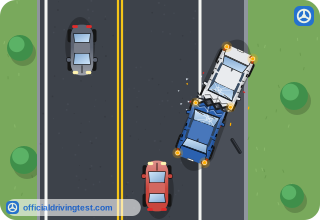
- Leave the scene if no one is injured in the crash
- Stop your vehicle; never leave the scene of a crash
- Leave the scene if the damage is under $1,000
- Leave the scene if the other driver has already left
Show answer
Correct answer: Stop your vehicle; never leave the scene of a crash
Even in a small crash you must stop your vehicle, and leaving the scene is against the law and could be charged as a hit and run.
Source: Massachusetts Driver's Manual (Revised April 2026), page 129 · Open this page in the manual (Manual page 129)
-
After a crash with no injuries, what does the Driver Removal Law require?
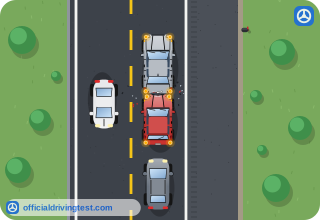
- That vehicles stay where they stopped until police arrive
- That only damaged vehicles be moved
- That drivers wait 30 minutes before moving
- That vehicles be moved out of travel lanes to a safe location
Show answer
Correct answer: That vehicles be moved out of travel lanes to a safe location
If there are no injuries, the Driver Removal Law requires that vehicles be moved out of travel lanes to a safe location.
Source: Massachusetts Driver's Manual (Revised April 2026), page 129 · Open this page in the manual (Manual page 129)
-
After a crash, which information must you exchange with the other drivers or property owners involved?
- Name, address, license number, registration, and insurance details
- Name, address, Social Security number, and date of birth
- Name, employer, phone number, and home insurance policy
- Name, address, license plate number, and bank account
Show answer
Correct answer: Name, address, license number, registration, and insurance details
The manual lists name, address, driver's license number, vehicle registration, and insurance information to be exchanged.
Source: Massachusetts Driver's Manual (Revised April 2026), page 129 · Open this page in the manual (Manual page 129)
-
You damage a parked vehicle or other property in a crash. What must you try to do?
- Leave a note with your phone number and then drive away
- Locate the owner to report the crash, or notify the local police
- Wait for the owner for at least one hour
- Report it only to your insurance company later that day
Show answer
Correct answer: Locate the owner to report the crash, or notify the local police
The manual says you must try to locate the owner to report the crash or notify the local police.
Source: Massachusetts Driver's Manual (Revised April 2026), page 129 · Open this page in the manual (Manual page 129)
-
Within how many days of a crash must you file a crash report with both the RMV and the local police department?
- Two days
- Ten days
- Thirty days
- Five days
Show answer
Correct answer: Five days
The manual says that within five days of the crash you must file a crash report with both the RMV and the local police department.
Source: Massachusetts Driver's Manual (Revised April 2026), page 129 · Open this page in the manual (Manual page 129)
-
How much property damage in a crash requires you to report it?
- $1,000 or more
- $100 or more
- $500 or more
- $5,000 or more
Show answer
Correct answer: $1,000 or more
The manual says you must report any crash with $1,000 or more of property damage.
Source: Massachusetts Driver's Manual (Revised April 2026), page 129 · Open this page in the manual (Manual page 129)
-
You have injured a cat, dog, or any other animal with your vehicle. What should you do?
- Move the animal off the road and then drive on home
- Notify only the RMV and nobody else
- Notify the local police and, if possible, the animal's owner
- Notify only your insurance company
Show answer
Correct answer: Notify the local police and, if possible, the animal's owner
The manual says to notify the local police and, if possible, the animal's owner.
Source: Massachusetts Driver's Manual (Revised April 2026), page 129 · Open this page in the manual (Manual page 129)
-
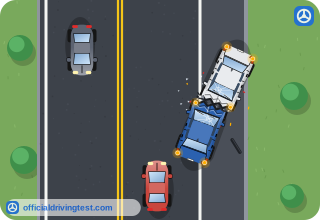
What is the first step in a crash involving injuries?
- Exchange insurance information
- Check to see if anyone is injured
- Notify your insurance company
- Move your vehicle off the road
Show answer
Correct answer: Check to see if anyone is injured
The manual lists checking to see if anyone is injured as the first step in a crash involving injuries.
Source: Massachusetts Driver's Manual (Revised April 2026), page 129 · Open this page in the manual (Manual page 129)