Massachusetts: Emergencies and crashes — Part 3 Practice Test
Questions in this part include: “After your headlights fail, what should you do with your emergency flashers once you have pulled off the road?” · “When should you put on your safety vest after a breakdown?”
Independent educational site · not affiliated with any government agency or DMV
Ready? Test yourself
- Instant feedback with an explanation
- Every answer cites its source in the manual
- Your best score is saved on this device
Questions are original and based on the official manual "Massachusetts Driver's Manual" (Revised April 2026), Massachusetts Registry of Motor Vehicles.
All 18 questions in this practice test
Take the test above first, then use this list to study. Tap “Show answer” to see the correct answer and explanation.
Show the questions and answersHide the questions
-
After your headlights fail, what should you do with your emergency flashers once you have pulled off the road?
- Turn them off to save the battery
- Turn them off and use the high beams
- Leave them on
- Turn them off and use the turn signal
Show answer
Correct answer: Leave them on
The manual says to pull off the road as quickly as possible and leave your emergency flashers on.
Source: Massachusetts Driver's Manual (Revised April 2026), page 125 · Open this page in the manual (Manual page 125)
-
When your vehicle breaks down, where should you not park it?
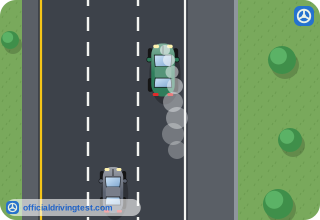
- On a straight, flat stretch of the road ahead
- Next to the right edge of the road surface
- On a hill or a curve where others cannot see you
- Off the pavement on firm ground
Show answer
Correct answer: On a hill or a curve where others cannot see you
The manual says never to park on a hill or a curve where others cannot see you.
Source: Massachusetts Driver's Manual (Revised April 2026), page 125 · Open this page in the manual (Manual page 125)
-
Your vehicle breaks down and you cannot get it off the pavement. What should you do?
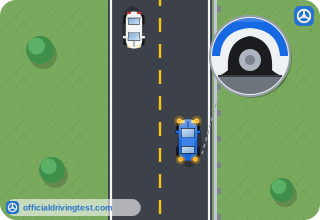
- Have the passengers push the vehicle toward the shoulder
- Get all passengers out of the vehicle and off the road
- Have everyone stand beside the vehicle
- Leave the passengers inside and walk for help alone
Show answer
Correct answer: Get all passengers out of the vehicle and off the road
The manual says that if you cannot get your vehicle off the pavement, you get all passengers out of the vehicle and off the road.
Source: Massachusetts Driver's Manual (Revised April 2026), page 125 · Open this page in the manual (Manual page 125)
-
On a highway with a breakdown lane or shoulder, where should you move a broken-down vehicle?
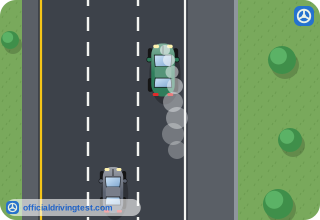
- Just inside the breakdown lane, next to the travel lane
- Onto the median strip
- Into the slowest travel lane
- As far from the travel lane as you can
Show answer
Correct answer: As far from the travel lane as you can
The manual says to move your vehicle as far from the travel lane as you can.
Source: Massachusetts Driver's Manual (Revised April 2026), page 125 · Open this page in the manual (Manual page 125)
-
After a breakdown, once your vehicle is parked and you are still inside it, which lights should you turn on?
- Your emergency warning (hazard) lights
- Your high beams and interior lights
- Your front and rear fog lights only
- Your backup (reverse) lights
Show answer
Correct answer: Your emergency warning (hazard) lights
The manual says to turn on your emergency warning (hazard) lights, and at night also your vehicle's interior lights.
Source: Massachusetts Driver's Manual (Revised April 2026), page 126 · Open this page in the manual (Manual page 126)
-
After a breakdown at night, what else should you turn on inside your parked vehicle besides the hazard lights?
- The high beams as well
- The windshield wipers too
- The vehicle's interior lights
- The radio and heater fan
Show answer
Correct answer: The vehicle's interior lights
The manual says that at night you also turn on your vehicle's interior lights.
Source: Massachusetts Driver's Manual (Revised April 2026), page 126 · Open this page in the manual (Manual page 126)
-
When should you put on your safety vest after a breakdown?
- After you place the warning triangles
- While you are still inside the vehicle
- After you raise the hood
- Only if it is dark outside
Show answer
Correct answer: While you are still inside the vehicle
The manual says to put your safety vest on while still inside the vehicle.
Source: Massachusetts Driver's Manual (Revised April 2026), page 126 · Open this page in the manual (Manual page 126)
-
Where does the manual say to tie a cloth to signal for help from a broken-down vehicle?
- To your antenna or door handle
- To your side mirror or bumper
- To your license plate
- To the steering wheel
Show answer
Correct answer: To your antenna or door handle
The manual says to tie a white cloth to your antenna or door handle.
Source: Massachusetts Driver's Manual (Revised April 2026), page 126 · Open this page in the manual (Manual page 126)
-
What color cloth should you tie to your antenna or door handle when it is snowing?
- White
- Yellow
- Red
- Blue
Show answer
Correct answer: Red
The manual says to use a red cloth when it is snowing.
Source: Massachusetts Driver's Manual (Revised April 2026), page 126 · Open this page in the manual (Manual page 126)
-
What does the manual say to do with your vehicle's hood when you are broken down and setting up safety equipment?
- Keep it closed and locked
- Raise it
- Remove it
- Cover it with a blanket
Show answer
Correct answer: Raise it
The manual lists raising your vehicle's hood as part of setting up safety equipment.
Source: Massachusetts Driver's Manual (Revised April 2026), page 126 · Open this page in the manual (Manual page 126)
-
If you stop on a divided highway, where should you place your warning triangles or LED flares?
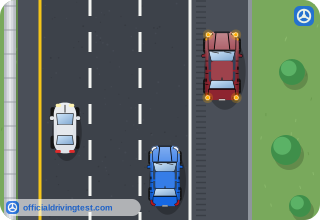
- 100 feet behind and 100 feet in front of your vehicle
- 10 feet in front and 100 feet behind your vehicle
- 200 feet behind your vehicle only
- 10 feet and 100 feet behind your vehicle
Show answer
Correct answer: 10 feet and 100 feet behind your vehicle
On a divided highway the manual places the triangles or flares 10 feet and 100 feet behind your vehicle.
Source: Massachusetts Driver's Manual (Revised April 2026), page 126 · Open this page in the manual (Manual page 126)
-
If you stop on a two-lane road with traffic in both directions, where should you place your warning triangles or LED flares?
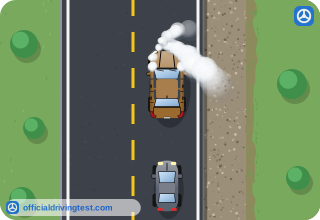
- 10 and 100 feet behind, and 100 feet in front of your vehicle
- 10 feet behind and 100 feet behind your vehicle only
- 50 feet behind and 150 feet in front of your vehicle
- 50 feet behind and 50 feet in front of your vehicle
Show answer
Correct answer: 10 and 100 feet behind, and 100 feet in front of your vehicle
On a two-lane road or an undivided highway the manual places them 10 feet and 100 feet behind and 100 feet in front of your vehicle.
Source: Massachusetts Driver's Manual (Revised April 2026), page 126 · Open this page in the manual (Manual page 126)
-
You see smoke coming from under your vehicle's hood. What should you do?
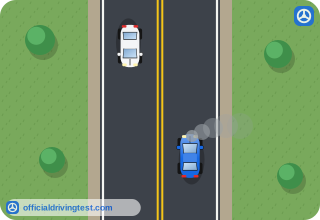
- Open the hood at once to check the engine and find the fire
- Pull off the road, turn off the ignition, and move away
- Keep driving to the nearest repair shop as fast as you can
- Stay inside and wait for the smoke to clear on its own
Show answer
Correct answer: Pull off the road, turn off the ignition, and move away
The manual says to pull off the road, turn off the ignition, and move away from the vehicle, then call the fire department or emergency services.
Source: Massachusetts Driver's Manual (Revised April 2026), page 127 · Open this page in the manual (Manual page 127)
-
When should you try to fight a car fire yourself?
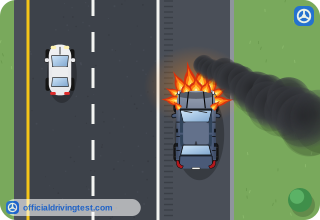
- Whenever the fire is small
- Whenever the fire is under the hood
- Whenever you cannot reach emergency services
- Only if you have an extinguisher
Show answer
Correct answer: Only if you have an extinguisher
The manual says not to try to fight the fire unless you have an extinguisher.
Source: Massachusetts Driver's Manual (Revised April 2026), page 127 · Open this page in the manual (Manual page 127)
-
If your car drives into water, how should you escape?
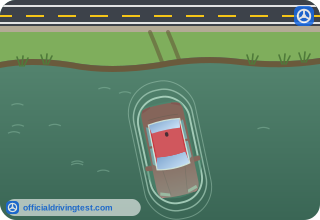
- Unfasten your safety belt and escape through a window
- Open a door and swim out as the water rises around you
- Stay inside and wait for the car to sink to the bottom
- Keep your safety belt on and wait for help
Show answer
Correct answer: Unfasten your safety belt and escape through a window
The manual says to unfasten your safety belt and escape through a window.
Source: Massachusetts Driver's Manual (Revised April 2026), page 127 · Open this page in the manual (Manual page 127)
-
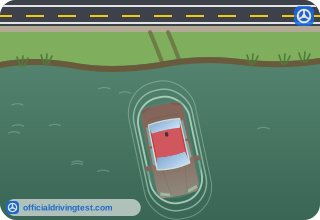
Why should you not open a door if your car drives into water?
- The door would be damaged and the engine would stall
- The doors would lock automatically from the water
- Water would rush in and the vehicle could flip over
- Water pressure would break the windows
Show answer
Correct answer: Water would rush in and the vehicle could flip over
The manual says that opening a door would cause water to rush in and your vehicle could flip over.
Source: Massachusetts Driver's Manual (Revised April 2026), page 127 · Open this page in the manual (Manual page 127)
-
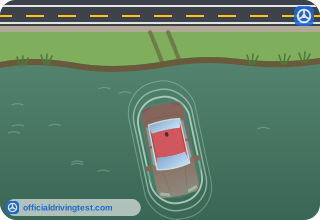
If your car drives into water and you have power windows, what should you do?
- Keep them closed to keep the water out of the car
- Open them quickly before water stops them working
- Open only the windows on the driver’s side
- Open only the rear windows
Show answer
Correct answer: Open them quickly before water stops them working
The manual says to open power windows quickly before the water causes them to stop working.
Source: Massachusetts Driver's Manual (Revised April 2026), page 127 · Open this page in the manual (Manual page 127)
-
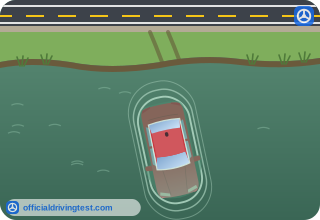
If your vehicle sinks before you can get out, where may an air pocket form?
- Under the dashboard
- In the trunk
- In the front seat
- In the rear seat
Show answer
Correct answer: In the rear seat
The manual says to climb into the rear seat, where an air pocket may form.
Source: Massachusetts Driver's Manual (Revised April 2026), page 127 · Open this page in the manual (Manual page 127)