Massachusetts: Emergencies and crashes — Part 2 Practice Test
Questions in this part include: “When the brakes fail, how should you use the parking brake?” · “How can you find out what type of brakes your vehicle has?”
Independent educational site · not affiliated with any government agency or DMV
Ready? Test yourself
- Instant feedback with an explanation
- Every answer cites its source in the manual
- Your best score is saved on this device
Questions are original and based on the official manual "Massachusetts Driver's Manual" (Revised April 2026), Massachusetts Registry of Motor Vehicles.
All 18 questions in this practice test
Take the test above first, then use this list to study. Tap “Show answer” to see the correct answer and explanation.
Show the questions and answersHide the questions
-
What is the first thing to do with your foot when your vehicle starts to skid?
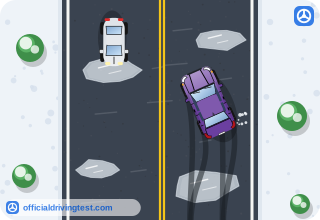
- Press the gas pedal down harder
- Press the brake pedal firmly
- Place it on the parking brake
- Slowly remove it from the gas pedal
Show answer
Correct answer: Slowly remove it from the gas pedal
The manual says to slowly remove your foot from the gas pedal and shift into neutral.
Source: Massachusetts Driver's Manual (Revised April 2026), page 123 · Open this page in the manual (Manual page 123)
-
How should you handle a skid in a front-wheel drive vehicle compared with a rear-wheel drive vehicle?
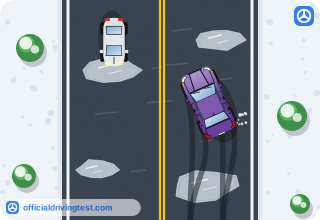
- The same way for both
- Steer against the skid in front-wheel drive
- Brake hard in front-wheel drive only
- Accelerate in rear-wheel drive only
Show answer
Correct answer: The same way for both
The manual says you should handle a skid the same for front and rear-wheel drive vehicles.
Source: Massachusetts Driver's Manual (Revised April 2026), page 123 · Open this page in the manual (Manual page 123)
-
What may you need to do while recovering from a skid?
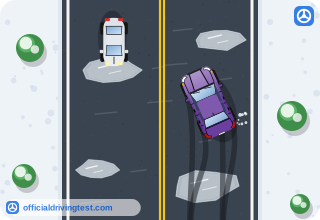
- Hold the wheel perfectly still until the car stops
- Pump the brake pedal until the car stops
- Steer left and right a few times to regain control
- Shift into reverse to slow down
Show answer
Correct answer: Steer left and right a few times to regain control
The manual says you may need to steer left and right a few times until you get your car completely under control.
Source: Massachusetts Driver's Manual (Revised April 2026), page 124 · Open this page in the manual (Manual page 124)
-
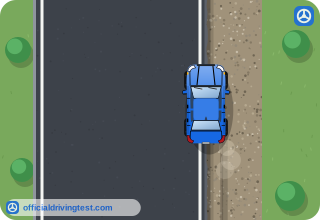
If you drive off the pavement onto the shoulder, what should you do first?
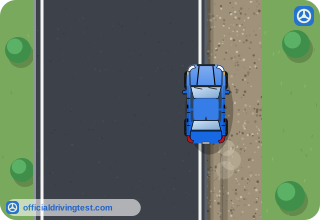
- Turn the steering wheel sharply back onto the road right away
- Hold the wheel tightly and slowly remove your foot from the gas pedal
- Brake as hard as you can to stop the vehicle at once
- Press the gas pedal firmly to regain your speed quickly
Show answer
Correct answer: Hold the wheel tightly and slowly remove your foot from the gas pedal
The manual says to hold the steering wheel tightly and slowly remove your foot from the gas pedal.
Source: Massachusetts Driver's Manual (Revised April 2026), page 124 · Open this page in the manual (Manual page 124)
-
After running off the pavement and slowing down, what should you do before steering back onto the road?
- Turn on your high beams
- Speed up to match traffic
- Sound your horn twice
- Check for traffic behind you
Show answer
Correct answer: Check for traffic behind you
The manual says to check for traffic behind you, then steer gently back onto the road.
Source: Massachusetts Driver's Manual (Revised April 2026), page 124 · Open this page in the manual (Manual page 124)
-
If you get a flat tire, a blowout, or lose a wheel, what should you do with the gas pedal?
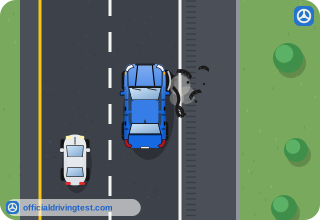
- Slowly remove your foot from it
- Press it harder to keep speed
- Pump it several times
- Hold it steady while you steer
Show answer
Correct answer: Slowly remove your foot from it
The manual says to grip the steering wheel tightly and slowly remove your foot from the gas pedal.
Source: Massachusetts Driver's Manual (Revised April 2026), page 124 · Open this page in the manual (Manual page 124)
-
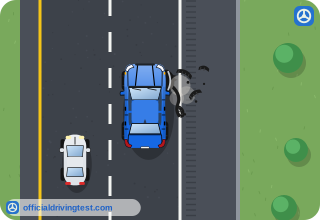
After a flat tire or blowout, when should you pull your car off the road?
- Only after the car has stopped by itself
- Only after the tire has been changed
- As soon as it is safe
- Before you slow down
Show answer
Correct answer: As soon as it is safe
The manual says to pull your car off the road as soon as it is safe.
Source: Massachusetts Driver's Manual (Revised April 2026), page 124 · Open this page in the manual (Manual page 124)
-
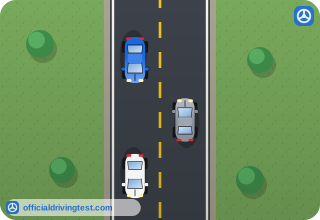
Your vehicle has antilock brakes and the brakes do not respond when you fully press the pedal. What should you do first?
- Pump the brake pedal several times rapidly to build pressure
- Downshift to a lower gear, working down to the lowest if necessary
- Shift into reverse to bring the vehicle to a stop quickly
- Turn off the engine and coast to a stop on the shoulder
Show answer
Correct answer: Downshift to a lower gear, working down to the lowest if necessary
The manual says to downshift to a lower gear and work down to the lowest gear if necessary.
Source: Massachusetts Driver's Manual (Revised April 2026), page 124 · Open this page in the manual (Manual page 124)
-
When the brakes fail, how should you use the parking brake?
- Pull it fully up and leave it there until you stop
- Apply it with one quick, hard pull on the lever
- Use it only after the vehicle has come to a stop
- Apply it gently and hold the release in case of a skid
Show answer
Correct answer: Apply it gently and hold the release in case of a skid
The manual says to apply the parking brake gently and hold the brake release in case your vehicle starts to skid.
Source: Massachusetts Driver's Manual (Revised April 2026), page 124 · Open this page in the manual (Manual page 124)
-
If you cannot slow your vehicle after the brakes fail, what should you do?
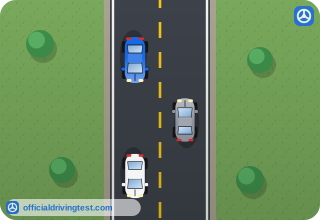
- Sound your horn and flash your lights to warn others
- Turn off the ignition and let the vehicle coast down
- Steer into the oncoming lane to get past slow traffic
- Shift into park to stop the wheels from turning
Show answer
Correct answer: Sound your horn and flash your lights to warn others
The manual says to sound your horn and flash your lights to warn drivers or pedestrians around you.
Source: Massachusetts Driver's Manual (Revised April 2026), page 124 · Open this page in the manual (Manual page 124)
-
If your vehicle does not have antilock brakes and the brakes fail, what should you do?
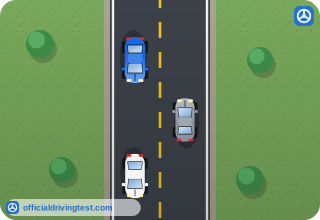
- Hold the brake pedal down steadily and wait
- Release the brake pedal completely
- Pump the brake pedal several times rapidly
- Pump the parking brake rapidly
Show answer
Correct answer: Pump the brake pedal several times rapidly
The manual says to pump the brake pedal several times rapidly to build up brake fluid pressure if the vehicle has no antilock brakes.
Source: Massachusetts Driver's Manual (Revised April 2026), page 124 · Open this page in the manual (Manual page 124)
-
How can you find out what type of brakes your vehicle has?
- By checking the sticker on the driver's door frame only
- By checking the dashboard indicator or the vehicle’s user manual
- By pressing the brake pedal while the car is parked
- By looking at the size of the tires
Show answer
Correct answer: By checking the dashboard indicator or the vehicle’s user manual
The manual says you can determine your brake type by checking the dashboard indicator or the vehicle's user manual.
Source: Massachusetts Driver's Manual (Revised April 2026), page 124 · Open this page in the manual (Manual page 124)
-
If your gas pedal sticks, what should you do first?
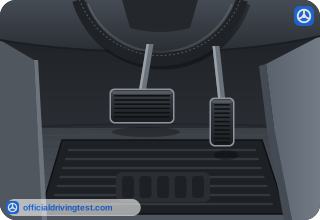
- Shift into reverse and press hard on the brake pedal to slow
- Pump the gas pedal repeatedly to try to free it up
- Steer to the shoulder without braking
- Put the car in neutral and press the brake pedal to slow down
Show answer
Correct answer: Put the car in neutral and press the brake pedal to slow down
The manual says to put your car in neutral and press the brake pedal to slow down.
Source: Massachusetts Driver's Manual (Revised April 2026), page 124 · Open this page in the manual (Manual page 124)
-
If a stuck gas pedal does not release when you try to free it with your foot, what should you do?
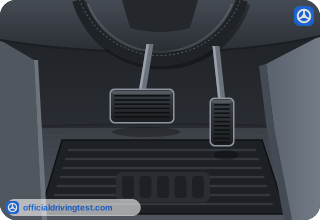
- Reapply the brakes
- Press the gas pedal harder
- Shift into park
- Turn the wheel sharply to the right
Show answer
Correct answer: Reapply the brakes
The manual says that if the gas pedal doesn't release, you reapply the brakes.
Source: Massachusetts Driver's Manual (Revised April 2026), page 124 · Open this page in the manual (Manual page 124)
-
A vehicle is driving toward you head on in your lane. Which way should you go?
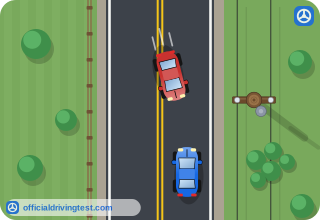
- Speed up and pull to the left
- Brake hard and stay in your lane
- Slow down and pull to the right
- Slow down and pull to the left
Show answer
Correct answer: Slow down and pull to the right
The manual says to slow down and pull to the right.
Source: Massachusetts Driver's Manual (Revised April 2026), page 125 · Open this page in the manual (Manual page 125)
-
A vehicle is driving toward you head on in your lane. What should you do to alert the other driver?
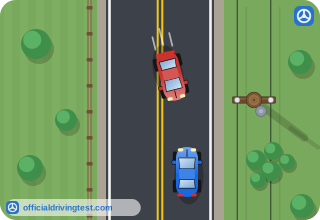
- Turn off your headlights
- Sound your horn
- Flash your hazard lights only
- Wave out the window
Show answer
Correct answer: Sound your horn
The manual says to sound your horn to alert the other driver.
Source: Massachusetts Driver's Manual (Revised April 2026), page 125 · Open this page in the manual (Manual page 125)
-
Your headlights suddenly go out. Which of these should you turn on?
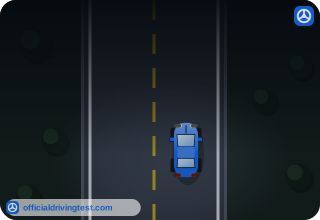
- Only your high beams, and keep driving as usual
- Your windshield wipers and the defroster fan
- Only your interior lights, and keep driving
- Parking lights, emergency flashers, or turn signal
Show answer
Correct answer: Parking lights, emergency flashers, or turn signal
The manual says to turn on your parking lights, emergency flashers, or turn signal.
Source: Massachusetts Driver's Manual (Revised April 2026), page 125 · Open this page in the manual (Manual page 125)
-
Your headlights suddenly go out. What should you try with the headlight switch?
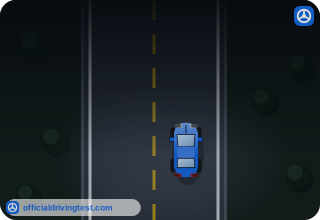
- Try it a few times
- Hold it down for a full minute
- Leave it alone and keep driving
- Switch it off and wait for ten minutes
Show answer
Correct answer: Try it a few times
The manual says to try the headlight switch a few times.
Source: Massachusetts Driver's Manual (Revised April 2026), page 125 · Open this page in the manual (Manual page 125)