Massachusetts: Emergencies and crashes — Part 1 Practice Test
Questions in this part include: “Where does the manual say to store your car safety kit?” · “What is hydroplaning?”
Independent educational site · not affiliated with any government agency or DMV
Ready? Test yourself
- Instant feedback with an explanation
- Every answer cites its source in the manual
- Your best score is saved on this device
Questions are original and based on the official manual "Massachusetts Driver's Manual" (Revised April 2026), Massachusetts Registry of Motor Vehicles.
All 18 questions in this practice test
Take the test above first, then use this list to study. Tap “Show answer” to see the correct answer and explanation.
Show the questions and answersHide the questions
-
What does the manual recommend tying to your vehicle during a breakdown?
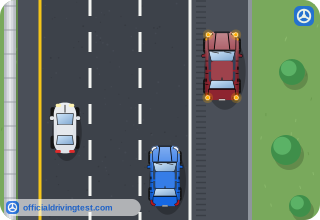
- Yellow and orange flags
- Blue and green ribbons
- White and red cloths
- Black and white banners
Show answer
Correct answer: White and red cloths
The manual recommends carrying white and red cloths to tie to your vehicle during a breakdown.
Source: Massachusetts Driver's Manual (Revised April 2026), page 35 · Open this page in the manual (Manual page 35)
-
Where does the manual say to store your car safety kit?
- In the trunk, beneath the spare tire and out of the way
- In a locked box in the garage at home
- Under the hood, next to the battery
- Within reach, such as in the glove compartment
Show answer
Correct answer: Within reach, such as in the glove compartment
The safety kit should be stored within reach of the driver or passengers, such as in the glove compartment.
Source: Massachusetts Driver's Manual (Revised April 2026), page 35 · Open this page in the manual (Manual page 35)
-
What does the Highway Assistance Patrol (HAP) provide?
- Free safety and emissions inspections
- Help to stranded drivers
- Driver license renewals along highways
- Installation of child safety seats
Show answer
Correct answer: Help to stranded drivers
The manual says the Highway Assistance Patrol provides help to stranded drivers.
Source: Massachusetts Driver's Manual (Revised April 2026), page 34 · Open this page in the manual (Manual page 34)
-
What should you do with your vehicle when it breaks down?
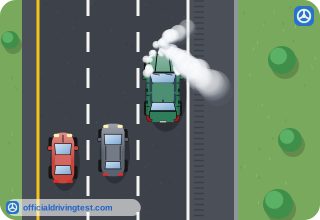
- Stay in the lane with your lights off and change the flat tire as quickly as you can
- Turn off all your lights so you do not distract other drivers
- Stand in the road behind your vehicle to flag down other drivers
- Use emergency lights and move as far to the side of the road as you can
Show answer
Correct answer: Use emergency lights and move as far to the side of the road as you can
Use emergency lights when your vehicle breaks down, move as far to the side as you can, and never change a flat tire in a traffic lane.
Source: Massachusetts Driver's Manual (Revised April 2026), page 45 · Open this page in the manual (Manual page 45)
-
Where should you never change a flat tire?
- On the side of the road
- In a traffic lane
- At the side of a parking area
- Beside a guardrail
Show answer
Correct answer: In a traffic lane
The manual says never to change a flat tire in a traffic lane; wait for help to arrive.
Source: Massachusetts Driver's Manual (Revised April 2026), page 45 · Open this page in the manual (Manual page 45)
-
Besides a breakdown, what else can you use your emergency lights for?
- To tell drivers behind you to pass
- To claim the right of way at an intersection ahead of you
- To warn drivers behind you about a crash or hazard
- To show you are parking briefly in a lane
Show answer
Correct answer: To warn drivers behind you about a crash or hazard
You can use emergency lights to warn drivers behind you about a traffic crash or hazard, giving them as much warning as possible.
Source: Massachusetts Driver's Manual (Revised April 2026), page 45 · Open this page in the manual (Manual page 45)
-
What is hydroplaning?
- Your tires locking up and sliding on dry pavement during a hard stop
- Your wheels spinning on loose gravel
- Your tires riding on water with no contact with the road
- Your brakes overheating on a long hill
Show answer
Correct answer: Your tires riding on water with no contact with the road
Hydroplaning happens when your tires are riding on water and have no contact with the road.
Source: Massachusetts Driver's Manual (Revised April 2026), page 47 · Open this page in the manual (Manual page 47)
-
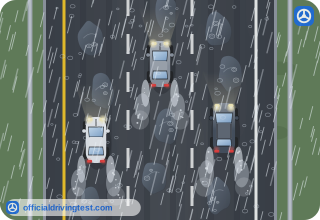
Hydroplaning is caused by which combination?
- Tire color, water, road width, and wind
- Road conditions, water, and speed
- Brake fluid, air, and wind
- Light, rain, and engine noise
Show answer
Correct answer: Road conditions, water, and speed
The manual says hydroplaning is caused by road conditions, water, and speed.
Source: Massachusetts Driver's Manual (Revised April 2026), page 47 · Open this page in the manual (Manual page 47)
-
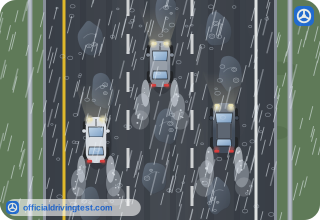
Your vehicle starts to hydroplane. What should you do?
- Hit the brakes hard
- Turn the wheel suddenly
- Press the gas pedal harder to speed through
- Slowly step off the gas pedal
Show answer
Correct answer: Slowly step off the gas pedal
If your vehicle starts to hydroplane, you are driving too fast; slowly step off the gas pedal and never hit the brakes or turn suddenly.
Source: Massachusetts Driver's Manual (Revised April 2026), page 47 · Open this page in the manual (Manual page 47)
-
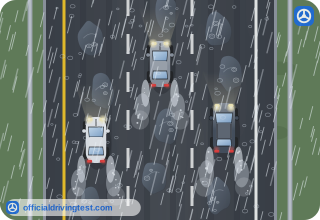
If your vehicle starts to hydroplane, what does the manual say it means?
- Your tires are too new for wet roads
- Your road is too dry
- Your engine is too cold
- You are driving too fast
Show answer
Correct answer: You are driving too fast
The manual says that if your vehicle starts to hydroplane, you are driving too fast.
Source: Massachusetts Driver's Manual (Revised April 2026), page 47 · Open this page in the manual (Manual page 47)
-
If you skid on ice or snow, which direction should you turn?
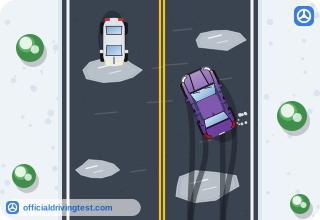
- Into the direction of the skid
- Away from the direction of the skid
- Back toward the center line
- Straight ahead with the wheel locked
Show answer
Correct answer: Into the direction of the skid
The manual says to turn into the direction of the skid.
Source: Massachusetts Driver's Manual (Revised April 2026), page 48 · Open this page in the manual (Manual page 48)
-
Before driving in winter, how much ice and snow must you remove from your vehicle?
- Only the ice and snow that is on the windshield and wipers
- Only the ice on the side and rear windows
- All of it, including from the roof, hood, and trunk
- Only what you can reach without a ladder
Show answer
Correct answer: All of it, including from the roof, hood, and trunk
The manual says to remove all ice and snow, and to clear the roof, hood, and trunk so it does not blow into vehicles behind you.
Source: Massachusetts Driver's Manual (Revised April 2026), page 48 · Open this page in the manual (Manual page 48)
-
For what can you be charged if you do not clear ice and snow from your vehicle before driving?
- Reckless endangerment
- Negligent operation
- Failure to yield
- Operating without insurance
Show answer
Correct answer: Negligent operation
If you do not clear the ice and snow from your vehicle, you can be charged with negligent operation.
Source: Massachusetts Driver's Manual (Revised April 2026), page 48 · Open this page in the manual (Manual page 48)
-
In winter, how full should you keep your gas tank to prevent the gas line from freezing?
- At least one-quarter full
- Completely empty
- Exactly three-quarters full
- At least half full
Show answer
Correct answer: At least half full
Keep your gas tank at least half full to prevent the gas line from freezing.
Source: Massachusetts Driver's Manual (Revised April 2026), page 48 · Open this page in the manual (Manual page 48)
-
Which items does the manual say to keep in your trunk in winter?
- A tow rope, jumper cables, and a spare fuse
- A map and a spare key
- A hammer and a bucket of water
- A blanket, flashlight, and small shovel
Show answer
Correct answer: A blanket, flashlight, and small shovel
In winter, keep a blanket, flashlight, and small shovel in your trunk.
Source: Massachusetts Driver's Manual (Revised April 2026), page 49 · Open this page in the manual (Manual page 49)
-
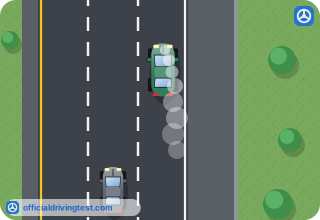
Your vehicle breaks down on a highway. Where should you move it?
- To the left lane, as close to the median as you can get
- To the breakdown lane or shoulder, away from the travel lane
- To the middle of the road, so that other drivers can see it
- To the right travel lane, with your hazard lights turned on
Show answer
Correct answer: To the breakdown lane or shoulder, away from the travel lane
If your vehicle breaks down, move it to the breakdown lane or shoulder and as far from the travel lane as you can.
Source: Massachusetts Driver's Manual (Revised April 2026), page 96 · Open this page in the manual (Manual page 96)
-
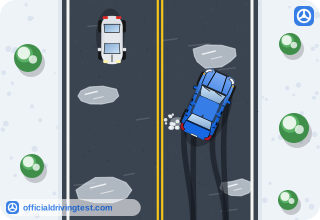
Your rear tires are skidding to the left. Which way should you turn the steering wheel?
- To the right
- Straight ahead
- To the left
- Back and forth quickly
Show answer
Correct answer: To the left
The manual says to turn the steering wheel in the direction of the skid: if the rear tires skid left, steer left.
Source: Massachusetts Driver's Manual (Revised April 2026), page 123 · Open this page in the manual (Manual page 123)
-
Why should you not hit the brakes when your vehicle skids?
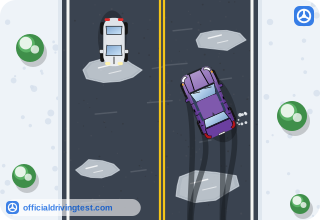
- You will lose power steering
- You will make the skid worse
- You will damage the tires
- You will stall the engine
Show answer
Correct answer: You will make the skid worse
The manual says not to hit the brakes in a skid because you will make the skid worse.
Source: Massachusetts Driver's Manual (Revised April 2026), page 123 · Open this page in the manual (Manual page 123)