Maryland: Speed and following distance Practice Test
Choosing a safe speed, following and stopping distances, and keeping space around your vehicle in bad weather.
Independent educational site · not affiliated with any government agency or DMV
Ready? Test yourself
- Instant feedback with an explanation
- Every answer cites its source in the manual
- Your best score is saved on this device
Questions are original and based on the official manual "Maryland Driver’s Manual" (October 2025 Edition (DL-002 10-25)), Maryland Motor Vehicle Administration.
All 24 questions in this practice test
Take the test above first, then use this list to study. Tap “Show answer” to see the correct answer and explanation.
Show the questions and answersHide the questions
-
What does the posted speed limit tell you?
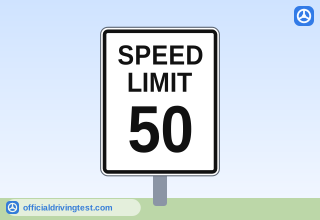
- The maximum legal speed on a road under ideal conditions
- The speed you must drive on every road at all times
- The minimum safe speed in bad weather
- The average speed of the traffic on the road
Show answer
Correct answer: The maximum legal speed on a road under ideal conditions
The posted speed limit is the maximum legal speed you can travel on a road under ideal conditions.
Source: Maryland Driver’s Manual (October 2025 Edition (DL-002 10-25)), page 14
-
What does Maryland Vehicle Law require regarding your speed?
- To drive at exactly the posted speed limit at all times
- To drive at least ten miles per hour below the limit
- To drive at a reasonable speed and be aware of hazards
- To drive at the speed of the fastest vehicle nearby
Show answer
Correct answer: To drive at a reasonable speed and be aware of hazards
Maryland Vehicle Law requires you to drive at a reasonable speed and be aware of existing and potential hazards.
Source: Maryland Driver’s Manual (October 2025 Edition (DL-002 10-25)), page 14
-
Is it legal to drive faster than the posted speed limit when road conditions are good?
- Yes, if you are keeping up with the speed of other traffic
- No, it is illegal to drive faster than the posted limit
- Yes, if the road is dry and the traffic is light
- Yes, if you stay only a few miles over the limit
Show answer
Correct answer: No, it is illegal to drive faster than the posted limit
You may drive slower than the posted limit based on road conditions, but it is illegal to drive any faster than the posted speed limit.
Source: Maryland Driver’s Manual (October 2025 Edition (DL-002 10-25)), page 14
-
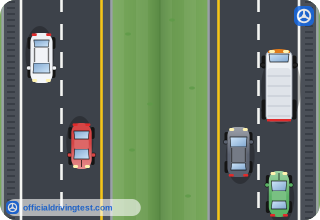
According to the manual, what is the safest speed to drive?
- Slower than the other traffic, so they can pass you
- Faster than the other traffic, so you can stay ahead
- The speed of the slowest vehicle on the road
- The same speed as most traffic, up to the maximum limit
Show answer
Correct answer: The same speed as most traffic, up to the maximum limit
It is safest to drive at the same speed that most traffic is moving, up to the maximum speed limit.
Source: Maryland Driver’s Manual (October 2025 Edition (DL-002 10-25)), page 14
-
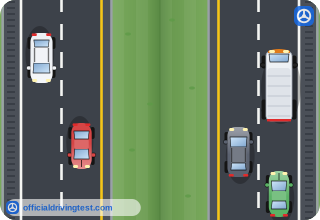
Why can driving at a speed lower than other traffic increase the chances of a crash?
- It encourages other vehicles to constantly pass you
- It makes other drivers forget to use their turn signals
- It makes your brake lights harder for others to see
- It lowers the traction of your tires on the road
Show answer
Correct answer: It encourages other vehicles to constantly pass you
Driving lower than other traffic encourages other vehicles to constantly pass you, which increases the chances of a crash.
Source: Maryland Driver’s Manual (October 2025 Edition (DL-002 10-25)), page 14
-
Which is an effect of driving over the speed limit?
- It saves a large amount of travel time
- It makes it easier to react to a hazard
- It takes longer to stop your vehicle
- It lets other drivers judge your distance more accurately
Show answer
Correct answer: It takes longer to stop your vehicle
Driving over the speed limit takes longer to stop your vehicle.
Source: Maryland Driver’s Manual (October 2025 Edition (DL-002 10-25)), page 14
-
Why is a crash at excessive speed more likely to cause serious injuries and deaths?
- The vehicle’s brakes always fail at higher speeds
- The force and impact in the crash increase
- The seat belts cannot hold at higher speeds
- The vehicle always rolls over at higher speeds
Show answer
Correct answer: The force and impact in the crash increase
Driving over the speed limit increases the force and impact in a crash, which more likely results in serious injuries and deaths.
Source: Maryland Driver’s Manual (October 2025 Edition (DL-002 10-25)), page 14
-
Why does speeding increase the risk of crashes involving other vehicles, bicyclists, and pedestrians?
- They cannot hear your horn at higher speeds
- They cannot see your headlights at higher speeds
- They are not required to yield to you
- They may not be able to judge your distance accurately
Show answer
Correct answer: They may not be able to judge your distance accurately
Speeding increases crash risk because other vehicles, bicyclists, and pedestrians may not be able to judge your distance accurately.
Source: Maryland Driver’s Manual (October 2025 Edition (DL-002 10-25)), page 14
-
At which of these places does the manual say you should reduce your speed?
- Toll plazas
- Wide, empty roads in daylight
- Straight, dry highway stretches
- Roads with no other traffic
Show answer
Correct answer: Toll plazas
The manual lists toll plazas among the places where you should reduce your speed to stay safe.
Source: Maryland Driver’s Manual (October 2025 Edition (DL-002 10-25)), page 14
-
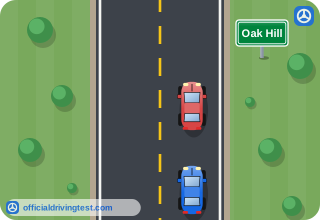
What minimum following distance does the MVA recommend under ideal driving conditions?
- 1 to 2 seconds
- 3 to 4 seconds
- 5 to 6 seconds
- 8 to 10 seconds
Show answer
Correct answer: 3 to 4 seconds
The MVA recommends a minimum following distance of 3 to 4 seconds under ideal driving conditions.
Source: Maryland Driver’s Manual (October 2025 Edition (DL-002 10-25)), page 15
-
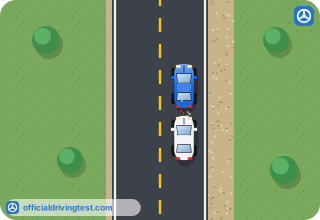
According to the manual, what causes most rear-end crashes?
- Driving too far below the speed limit
- Changing lanes without signaling
- Stopping too far behind the car ahead
- Following too closely
Show answer
Correct answer: Following too closely
The manual says most rear-end crashes are caused by following too closely.
Source: Maryland Driver’s Manual (October 2025 Edition (DL-002 10-25)), page 15
-
When you check your following distance, what is a reference point?
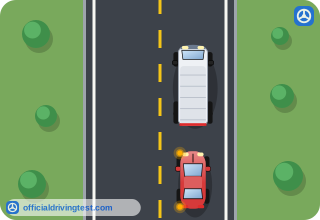
- An object ahead, like a bridge, overpass, sign, or mile marker
- A mark on your windshield that lines up with the car ahead
- The brake lights of the vehicle ahead of you at all times
- The painted lane line beside the vehicle ahead of you
Show answer
Correct answer: An object ahead, like a bridge, overpass, sign, or mile marker
A reference point is an object ahead, like a bridge, overpass, sign, or mile marker.
Source: Maryland Driver’s Manual (October 2025 Edition (DL-002 10-25)), page 15
-
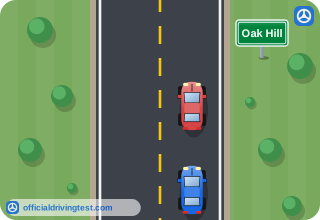
You begin counting as the car ahead passes a reference point and reach “3 one thousand” before your car reaches it. What does that mean?
- You are following too closely and should slow down
- You are less than 3 seconds behind the car ahead
- You are at least 3 seconds behind and at a safe distance
- You are too far back and should speed up
Show answer
Correct answer: You are at least 3 seconds behind and at a safe distance
If you reach 3 one thousand or more before your car reaches the object, you are at least 3 seconds behind the car in front and at a safe distance.
Source: Maryland Driver’s Manual (October 2025 Edition (DL-002 10-25)), page 15
-
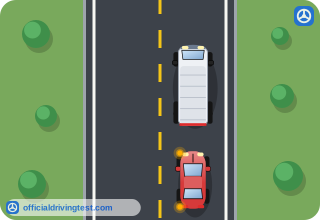
When following vehicles that stop often, such as buses and delivery vans, how many seconds should you leave?
- Two or three seconds
- Four or five seconds
- One or two seconds
- Less than one second
Show answer
Correct answer: Four or five seconds
You should increase the distance to four or five seconds, and possibly more if needed, behind vehicles that stop often.
Source: Maryland Driver’s Manual (October 2025 Edition (DL-002 10-25)), page 15
-
What does your stopping distance help you choose?
- The best lane to drive in
- The right distance for passing
- The correct time to use your signals
- A safe driving speed
Show answer
Correct answer: A safe driving speed
The distance it takes to stop your vehicle is important to help you choose a safe driving speed.
Source: Maryland Driver’s Manual (October 2025 Edition (DL-002 10-25)), page 15
-
Which of these affects how far it takes you to stop your vehicle?
- The condition of your tire treads
- The color of your vehicle
- The number of mirrors on your vehicle
- The age of your driver’s license
Show answer
Correct answer: The condition of your tire treads
Your stopping distance depends on several things, including the condition of your tire treads.
Source: Maryland Driver’s Manual (October 2025 Edition (DL-002 10-25)), page 15
-
When you drive at night, what should you do about the distance between you and the vehicle in front of you?
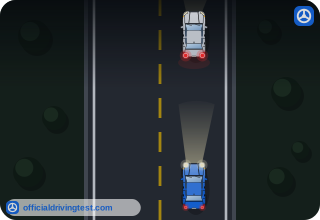
- Decrease it
- Keep it the same as in daylight
- Keep it as short as possible
- Increase it
Show answer
Correct answer: Increase it
The manual says to increase the distance to the vehicle in front of you at night, which helps prevent a crash if that vehicle needs to stop quickly.
Source: Maryland Driver’s Manual (October 2025 Edition (DL-002 10-25)), page 28
-
What should you do with your normal driving speed when you drive in fog?

- Reduce it
- Keep it the same
- Increase it to leave the fog sooner
- Match the speed of the nearest vehicle
Show answer
Correct answer: Reduce it
The manual says to reduce your normal driving speed in fog.
Source: Maryland Driver’s Manual (October 2025 Edition (DL-002 10-25)), page 28
-
In fog, you see headlights or another vehicle’s taillights ahead. What should you do?
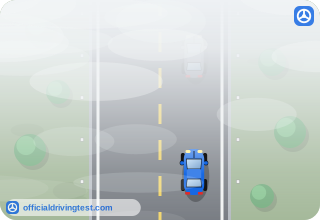
- Speed up to pass the vehicle
- Switch to high beams and keep your speed
- Reduce your speed even more and be prepared to stop quickly
- Follow closely so you can keep the vehicle in sight
Show answer
Correct answer: Reduce your speed even more and be prepared to stop quickly
The manual says that when you see headlights or taillights ahead in fog, you should reduce your speed even more and be prepared to stop quickly.
Source: Maryland Driver’s Manual (October 2025 Edition (DL-002 10-25)), page 28
-
When driving in inclement weather, how does the space you need between you and the car in front compare on wet roads and dry roads?
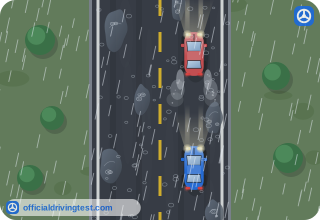
- It is much greater on wet roads than on dry roads
- It is the same on wet and dry roads
- It is slightly smaller on wet roads than on dry roads
- It is much smaller on wet roads
Show answer
Correct answer: It is much greater on wet roads than on dry roads
The manual says the space needed between you and the car in front is much greater on wet roads than on dry roads.
Source: Maryland Driver’s Manual (October 2025 Edition (DL-002 10-25)), page 28
-
In inclement weather, the space needed is much greater on wet roads than on dry roads. When is even more space needed?
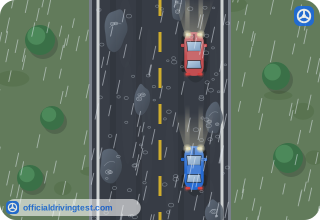
- When the road is dry and clear
- When you drive in a tunnel
- On roads covered with snow or ice
- When the speed limit is low
Show answer
Correct answer: On roads covered with snow or ice
The manual says you need even more space when the road is covered with snow or ice.
Source: Maryland Driver’s Manual (October 2025 Edition (DL-002 10-25)), page 28
-
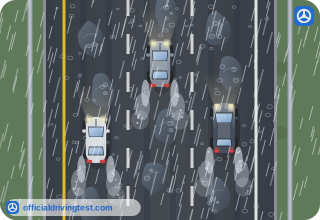
Why should you reduce your speed when you drive in inclement weather?
- So your tires wear more slowly
- So your headlights shine farther
- So you can drive without headlights
- So you have more time to react
Show answer
Correct answer: So you have more time to react
The manual says to reduce your speed so you have more time to react in inclement weather.
Source: Maryland Driver’s Manual (October 2025 Edition (DL-002 10-25)), page 28
-
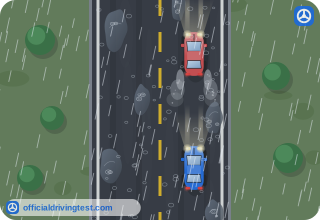
What should you do with your speed on wet roads to help prevent hydroplaning?
- Raise it to push water aside
- Keep it the same as on dry roads
- Hold it at the posted limit
- Lower it
Show answer
Correct answer: Lower it
The manual says to lower your speed on wet roads to prevent hydroplaning.
Source: Maryland Driver’s Manual (October 2025 Edition (DL-002 10-25)), page 30
-
On an interstate exit, to what speed should you continue slowing?
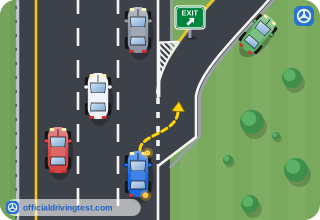
- The posted speed limit for the exit ramp
- The speed of traffic on the highway
- The minimum speed for the highway
- A full stop at the end of the ramp
Show answer
Correct answer: The posted speed limit for the exit ramp
The manual says to continue slowing to the posted speed limit for the exit ramp.
Source: Maryland Driver’s Manual (October 2025 Edition (DL-002 10-25)), page 32