Maryland: Signals and vehicle controls Practice Test
Using your headlights and high beams, anti-lock brakes, and newer vehicle technologies such as driver assistance systems.
Independent educational site · not affiliated with any government agency or DMV
Ready? Test yourself
- Instant feedback with an explanation
- Every answer cites its source in the manual
- Your best score is saved on this device
Questions are original and based on the official manual "Maryland Driver’s Manual" (October 2025 Edition (DL-002 10-25)), Maryland Motor Vehicle Administration.
All 29 questions in this practice test
Take the test above first, then use this list to study. Tap “Show answer” to see the correct answer and explanation.
Show the questions and answersHide the questions
-
Before you drive, what does the manual say you should adjust?
- Your tire pressure
- Your seat and mirrors
- Your windshield wipers
- Your headlight angle
Show answer
Correct answer: Your seat and mirrors
The manual says that before you drive you should adjust your seat and mirrors.
Source: Maryland Driver’s Manual (October 2025 Edition (DL-002 10-25)), page 13
-
What does the manual suggest you use to let other drivers know what you plan to do?

- Your horn
- Turn signals
- Your hazard lights
- Your headlights
Show answer
Correct answer: Turn signals
The risk management steps include letting other drivers know what you plan to do by using turn signals.
Source: Maryland Driver’s Manual (October 2025 Edition (DL-002 10-25)), page 13
-
When driving, you must turn on your headlights anytime there is not enough light to clearly see at least how far in front of your vehicle?
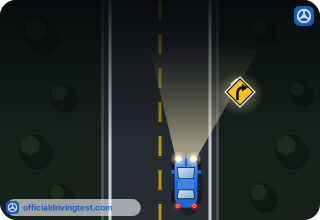
- 1,000 feet
- 500 feet
- 300 feet
- 100 feet
Show answer
Correct answer: 1,000 feet
The manual says you must turn on your headlights anytime there is not enough light to clearly see at least 1,000 feet in front of your vehicle.
Source: Maryland Driver’s Manual (October 2025 Edition (DL-002 10-25)), page 27
-
Maryland law requires you to turn on your headlights when you are:
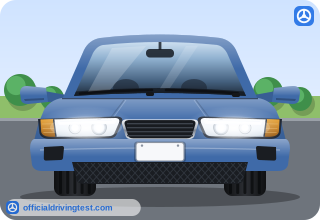
- driving on any road that has streetlights
- driving in a tunnel in clear weather
- using your windshield wipers in inclement weather
- parked at the side of a road
Show answer
Correct answer: using your windshield wipers in inclement weather
The manual says Maryland law requires headlights on when you use your windshield wipers in inclement weather.
Source: Maryland Driver’s Manual (October 2025 Edition (DL-002 10-25)), page 27
-
In the manual, what is "inclement weather"?
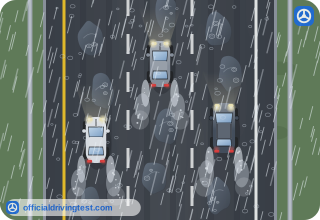
- Any weather in which the sun is not visible
- Bad weather that might cause unsafe conditions
- Weather in which only snow or ice is on the road
- Fog that lasts for more than one hour
Show answer
Correct answer: Bad weather that might cause unsafe conditions
The manual defines inclement weather as bad weather that might cause unsafe conditions.
Source: Maryland Driver’s Manual (October 2025 Edition (DL-002 10-25)), page 27
-
On which kind of road does the manual say to use high beam headlights?
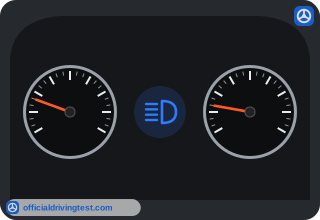
- Roads with streetlights
- Roads covered with snow
- Roads in a construction area
- Roads without streetlights
Show answer
Correct answer: Roads without streetlights
The manual says to use high beams on roads without streetlights so you can see other vehicles and people.
Source: Maryland Driver’s Manual (October 2025 Edition (DL-002 10-25)), page 27
-
When you are driving with your high beams on, at least how far before reaching vehicles coming toward you must you change to low beams?
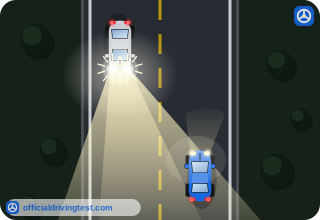
- 500 feet
- 1,000 feet
- 300 feet
- 200 feet
Show answer
Correct answer: 500 feet
The manual says you must change to low beams at least 500 feet before reaching vehicles coming toward you.
Source: Maryland Driver’s Manual (October 2025 Edition (DL-002 10-25)), page 27
-
You must change to low beams when you are following a vehicle that is:
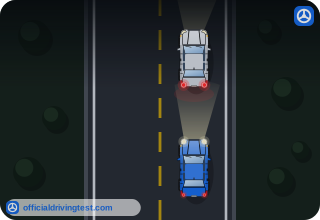
- 500 feet or less in front of you
- 1,000 feet or less in front of you
- 300 feet or less in front of you
- 100 feet or less in front of you
Show answer
Correct answer: 300 feet or less in front of you
The manual says you must change to low beams when following a vehicle that is 300 feet or less in front of you.
Source: Maryland Driver’s Manual (October 2025 Edition (DL-002 10-25)), page 27
-
Which kind of headlights does the manual say to use for driving at night on a road with streetlights?
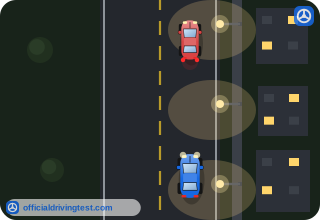
- High beams
- Low beams
- Fog lights only
- Parking lights only
Show answer
Correct answer: Low beams
The manual lists driving at night on a road with streetlights as a normal driving situation in which to use low beams.
Source: Maryland Driver’s Manual (October 2025 Edition (DL-002 10-25)), page 27
-
When you are entering a tunnel or construction area, low beam headlights are:
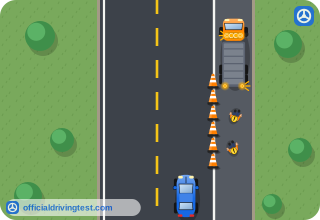
- always required by law in every tunnel and work area
- forbidden because they blind construction workers
- required by law only when it is raining
- not always required by law, but they help others see you
Show answer
Correct answer: not always required by law, but they help others see you
The manual says the law does not always require low beams there, but they make it easier for other drivers and construction workers to see you.
Source: Maryland Driver’s Manual (October 2025 Edition (DL-002 10-25)), page 27
-
What is harder to judge when you are driving at night?
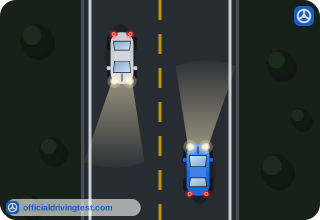
- How far away other vehicles are and how fast they are moving
- How wide your own lane is and how far away the next exit is
- How many lanes the road has and how wide each one is
- What color the traffic signs are
Show answer
Correct answer: How far away other vehicles are and how fast they are moving
The manual says that at night it is harder to judge how far away other vehicles are and how fast they are moving.
Source: Maryland Driver’s Manual (October 2025 Edition (DL-002 10-25)), page 27
-
When you drive at night, how far can you see?
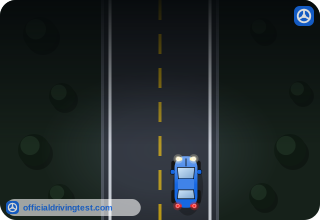
- About the same distance as in daylight
- As far as the nearest streetlight
- Only as far as your headlights allow
- Only as far as the vehicle ahead
Show answer
Correct answer: Only as far as your headlights allow
The manual says that at night you can see only as far as your headlights allow.
Source: Maryland Driver’s Manual (October 2025 Edition (DL-002 10-25)), page 27
-
At night, you should not stare into the headlights of oncoming traffic. Where should you look instead?
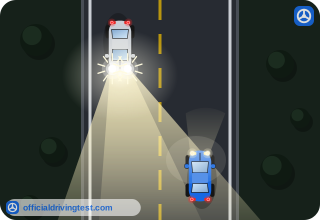
- Slightly to the left of your lane, toward the center line
- At the road ahead, or slightly to the right of your lane
- At the center of the oncoming vehicle
- At your rear-view mirror
Show answer
Correct answer: At the road ahead, or slightly to the right of your lane
The manual says to look at the road in front of you, or slightly to the right of the lane you are traveling in, such as at the right edge of your lane.
Source: Maryland Driver’s Manual (October 2025 Edition (DL-002 10-25)), page 28
-
Which headlights should you use in fog?

- High beam headlights only
- High beams, plus fog lights if you have them on the vehicle
- Parking lights only
- Low beam headlights only, plus fog lights if you have them
Show answer
Correct answer: Low beam headlights only, plus fog lights if you have them
The manual says to use low beam headlights only in fog, and also fog lights if you have them.
Source: Maryland Driver’s Manual (October 2025 Edition (DL-002 10-25)), page 28
-
What does ADAS stand for?
- Automated Driver Alert and Steering
- Advanced Driver Assistance Systems
- Active Driving Awareness System
- Assisted Driving And Safety
Show answer
Correct answer: Advanced Driver Assistance Systems
ADAS stands for Advanced Driver Assistance Systems, vehicle technologies that are features that make driving safer.
Source: Maryland Driver’s Manual (October 2025 Edition (DL-002 10-25)), page 42
-
Which of these is an example of ADAS technology named in the manual?
- Satellite Radio Tuning
- Keyless Door Entry
- Heated Seat Control
- Lane Keeping Assistance
Show answer
Correct answer: Lane Keeping Assistance
Automatic Emergency Braking, Lane Keeping Assistance and Blind Spot Warning are examples of ADAS technology.
Source: Maryland Driver’s Manual (October 2025 Edition (DL-002 10-25)), page 42
-
ADAS technology is designed to assist you with which driving task?
- Keeping a safe distance from other vehicles
- Choosing the shortest route to your destination
- Paying road tolls without stopping at booths
- Predicting weather conditions along your route
Show answer
Correct answer: Keeping a safe distance from other vehicles
ADAS technology is designed to assist with tasks such as staying in your lane, reducing blind spots, keeping a safe distance from other vehicles, avoiding crashes and parking.
Source: Maryland Driver’s Manual (October 2025 Edition (DL-002 10-25)), page 42
-
Many vehicles use what to identify possible dangers?
- Radio signals from nearby drivers
- Tire pressure gauges
- Sensors and cameras
- Horn and brake lights
Show answer
Correct answer: Sensors and cameras
Many vehicles use sensors and cameras to identify possible dangers.
Source: Maryland Driver’s Manual (October 2025 Edition (DL-002 10-25)), page 42
-
Who is responsible for the safe operation of your vehicle, even when it has ADAS?
- The vehicle manufacturer
- You are, at all times
- The ADAS software
- The car dealership
Show answer
Correct answer: You are, at all times
Drivers should not rely on ADAS to fully operate the vehicle; the driver is responsible for the safe operation of the vehicle at all times.
Source: Maryland Driver’s Manual (October 2025 Edition (DL-002 10-25)), page 42
-
How should you stay aware of everything around you while driving a vehicle with ADAS?
- By trusting the technology to monitor traffic for you
- By relying on the dashboard icons alone
- By letting the sensors watch traffic for you
- By checking traffic using your vehicle’s mirrors and cameras
Show answer
Correct answer: By checking traffic using your vehicle’s mirrors and cameras
It is your responsibility to be aware of everything around you by checking traffic using your vehicle’s mirrors and cameras.
Source: Maryland Driver’s Manual (October 2025 Edition (DL-002 10-25)), page 42
-
What limitation of ADAS technology does the manual describe?
- It may not work properly in rain, snow, fog, on hills, and around curves
- It stops working as soon as the vehicle leaves the interstate
- It switches off automatically whenever the driver brakes
- It works only when the driver keeps both hands off the wheel
Show answer
Correct answer: It may not work properly in rain, snow, fog, on hills, and around curves
The technology has limitations and may not work properly in rain, snow, fog, on hills, and around curves.
Source: Maryland Driver’s Manual (October 2025 Edition (DL-002 10-25)), page 42
-
How does ADAS technology respond from one type of vehicle to another?
- It responds identically, but the dashboard icons differ
- It responds identically and uses the same dashboard icons
- It responds differently, and even dashboard icons may differ
- It responds only in vehicles built in the same model year
Show answer
Correct answer: It responds differently, and even dashboard icons may differ
The technology responds differently from one type of vehicle to another, and even the dashboard icons may differ.
Source: Maryland Driver’s Manual (October 2025 Edition (DL-002 10-25)), page 42
-
What does the manual say about the names of ADAS technologies?
- Every manufacturer must use the same standard name for each feature
- There are many names, and they do not always describe what the technology does
- The names always describe exactly what the technology does
- Only three names are used, so they are easy to tell apart
Show answer
Correct answer: There are many names, and they do not always describe what the technology does
There are many different names for the technology, and the names do not always describe what the technology does.
Source: Maryland Driver’s Manual (October 2025 Edition (DL-002 10-25)), page 42
-
What should you always do with your vehicle sensors?
- Cover them when the vehicle is parked
- Adjust them yourself before each trip
- Turn them off in clear weather
- Keep them clean and damage free
Show answer
Correct answer: Keep them clean and damage free
You should always keep your vehicle sensors clean and damage free.
Source: Maryland Driver’s Manual (October 2025 Edition (DL-002 10-25)), page 42
-
What should you always do with the software technology in your vehicle?
- Keep it up-to-date and follow the manufacturer’s recommendations
- Update it only when the vehicle is more than one year old
- Leave it unchanged for as long as you own the vehicle
- Update it only after the warranty period ends
Show answer
Correct answer: Keep it up-to-date and follow the manufacturer’s recommendations
You should always keep the software technology up-to-date and follow the manufacturer’s recommendations.
Source: Maryland Driver’s Manual (October 2025 Edition (DL-002 10-25)), page 42
-
How can you learn about the technologies on a vehicle you are about to drive?
- By calling the vehicle’s insurance company for instructions
- By asking the next driver you meet on the road
- By reviewing your vehicle manual or asking your car dealership
- By testing each feature at highway speed
Show answer
Correct answer: By reviewing your vehicle manual or asking your car dealership
Learn how to use the technologies safely and effectively by reviewing your vehicle manual or asking your car dealership.
Source: Maryland Driver’s Manual (October 2025 Edition (DL-002 10-25)), page 42
-
What do Anti-Lock Braking Systems (ABS) help prevent?
- Your engine from overheating when you brake
- Your tires from wearing out unevenly over time
- Your wheels from locking up so you can control your car
- Your car from drifting while you are accelerating
Show answer
Correct answer: Your wheels from locking up so you can control your car
ABS helps prevent your wheels from locking up so you can control your car.
Source: Maryland Driver’s Manual (October 2025 Edition (DL-002 10-25)), page 52
-
What does ABS do when your vehicle’s computer detects that one or more wheels are locking?
- It releases the brakes completely until the wheels spin
- It begins to pump the brakes much faster so they do not lock
- It turns on the hazard lights and slows the engine
- It reduces engine power until the vehicle stops
Show answer
Correct answer: It begins to pump the brakes much faster so they do not lock
When the computer detects a wheel locking, ABS begins to pump the brakes much faster so they do not lock.
Source: Maryland Driver’s Manual (October 2025 Edition (DL-002 10-25)), page 53
-
What may you notice when ABS engages?
- A loud horn sound from the dashboard speakers
- The brake pedal going soft and sinking to the floor
- The steering wheel locking in place in the straight position
- A rumble from the brakes and a vibrating brake pedal
Show answer
Correct answer: A rumble from the brakes and a vibrating brake pedal
When ABS engages, you may hear a rumble from the brakes and the brake pedal will vibrate under your foot.
Source: Maryland Driver’s Manual (October 2025 Edition (DL-002 10-25)), page 53