Maryland: Sharing the road — Part 1 Practice Test
Large trucks and their No-Zones, school buses, motorcycles, bicycles and the passing distance, mopeds, scooters and low-speed vehicles, and aggressive driving. — Part 1
Independent educational site · not affiliated with any government agency or DMV
Ready? Test yourself
- Instant feedback with an explanation
- Every answer cites its source in the manual
- Your best score is saved on this device
Questions are original and based on the official manual "Maryland Driver’s Manual" (October 2025 Edition (DL-002 10-25)), Maryland Motor Vehicle Administration.
All 34 questions in this practice test
Take the test above first, then use this list to study. Tap “Show answer” to see the correct answer and explanation.
Show the questions and answersHide the questions
-
According to the manual, what is a basic rule of driving that applies at all times?
- The driver should follow the vehicle ahead at one second
- The driver should pass any vehicle that is below the limit
- The driver should match the speed of the vehicle behind
- The driver should control the vehicle to avoid a crash
Show answer
Correct answer: The driver should control the vehicle to avoid a crash
A basic rule of driving is that the driver should control the vehicle at all times to avoid a crash.
Source: Maryland Driver’s Manual (October 2025 Edition (DL-002 10-25)), page 13
-
What is it called when you search ahead and are ready to change speed or change lanes so you have time to identify risks?
- Defensive driving
- Reactive driving
- Aggressive driving
- Right-of-way driving
Show answer
Correct answer: Defensive driving
Searching ahead and being ready to change speed or lanes to identify risks is called defensive driving.
Source: Maryland Driver’s Manual (October 2025 Edition (DL-002 10-25)), page 13
-
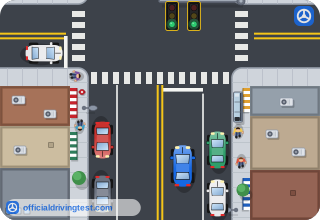
As part of visual search, what should you watch while you drive?
- Only the road directly ahead of you
- Only the vehicles in your own lane
- The front, sides, and rear of your vehicle
- Only the lines painted on the road
Show answer
Correct answer: The front, sides, and rear of your vehicle
Constantly observing your surroundings includes watching the front, sides, and rear of your vehicle.
Source: Maryland Driver’s Manual (October 2025 Edition (DL-002 10-25)), page 13
-
According to the risk management steps, what should you not assume about other drivers?
- That they will make a mistake at some point
- That they have a valid driver’s license
- That they are driving slower than you
- That they will do what they are supposed to do
Show answer
Correct answer: That they will do what they are supposed to do
The manual says not to assume that other drivers will do what they are supposed to do.
Source: Maryland Driver’s Manual (October 2025 Edition (DL-002 10-25)), page 13
-
Where should you not make lane changes?
- On a road with two or more lanes
- On a one-way road
- In an intersection
- On a road with a wide shoulder
Show answer
Correct answer: In an intersection
You should not drift across lane lines or make lane changes when in an intersection.
Source: Maryland Driver’s Manual (October 2025 Edition (DL-002 10-25)), page 15
-
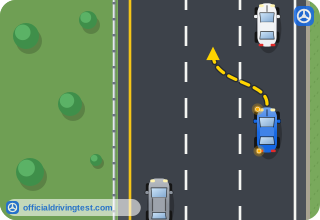
When may you switch lanes?
- As soon as you turn on your turn signal
- Only after you determine it is safe to do so
- Whenever the driver ahead is slower than you
- Whenever the lane beside you looks empty
Show answer
Correct answer: Only after you determine it is safe to do so
The manual says not to switch lanes until you determine it is safe to do so.
Source: Maryland Driver’s Manual (October 2025 Edition (DL-002 10-25)), page 15
-
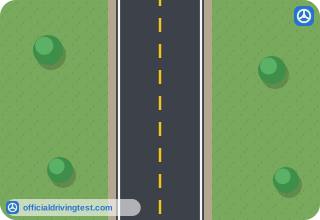
Generally, where should you keep your vehicle on the road?
- To the left of the center of the road
- Directly on the center line
- On the shoulder of the road
- To the right of the center of the road
Show answer
Correct answer: To the right of the center of the road
Generally you should keep your vehicle to the right of the center of the road.
Source: Maryland Driver’s Manual (October 2025 Edition (DL-002 10-25)), page 15
-
In which situation may you keep your vehicle left of the center of the road?
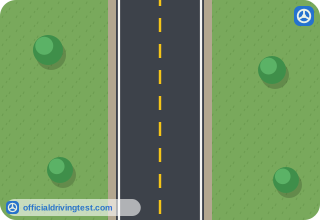
- When passing another vehicle going in the same direction
- When you are driving slower than the other traffic
- When you are about to stop at the next intersection
- When there are no other vehicles in sight ahead
Show answer
Correct answer: When passing another vehicle going in the same direction
You may keep left of the center when passing another vehicle going in the same direction, when a sign or signal says it is okay, or when something in the way makes it necessary.
Source: Maryland Driver’s Manual (October 2025 Edition (DL-002 10-25)), page 15
-
What should you do before passing, so that drivers around you know what you plan to do?
- Flash your headlights
- Use your turn signal
- Sound your horn
- Turn on your hazard lights
Show answer
Correct answer: Use your turn signal
The manual says to use your turn signal before passing so drivers around you know what you plan to do.
Source: Maryland Driver’s Manual (October 2025 Edition (DL-002 10-25)), page 16
-
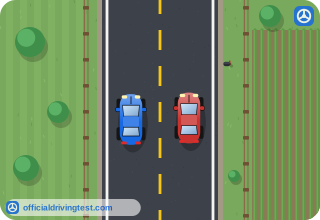
Before returning to the lane you came from after passing, what must you see in your rear-view mirror?
- The turn signal of the passed vehicle
- The license plate of the passed vehicle
- The brake lights of the passed vehicle
- Both headlights of the passed vehicle
Show answer
Correct answer: Both headlights of the passed vehicle
You must see both headlights of the passed vehicle in your rear-view mirror before returning to the lane you came from.
Source: Maryland Driver’s Manual (October 2025 Edition (DL-002 10-25)), page 16
-
Generally, on which side of another vehicle should you pass?
- On the left side of the other vehicle
- On the right side of the other vehicle
- On the shoulder of the road
- On whichever side has more room
Show answer
Correct answer: On the left side of the other vehicle
Generally you should pass on the left side of the other vehicle.
Source: Maryland Driver’s Manual (October 2025 Edition (DL-002 10-25)), page 16
-
On which of these occasions may you pass on the right, if it is safe and you stay on the road?
- The other vehicle is about to make a right turn
- The other vehicle is slowing down for a stop sign
- The other vehicle is about to make a left turn
- The other vehicle is driving below the speed limit
Show answer
Correct answer: The other vehicle is about to make a left turn
You may pass on the right if it is safe, you stay on the road, and the other vehicle is about to make a left turn.
Source: Maryland Driver’s Manual (October 2025 Edition (DL-002 10-25)), page 16
-
What does “unobstructed” mean on a road where you may pass on the right?
- There is no other traffic on the road in either direction
- There are no median strips, signs, or other things in the way
- There are no pedestrians, bicyclists, or animals near the road
- There are no curves, hills, or intersections along the road
Show answer
Correct answer: There are no median strips, signs, or other things in the way
Unobstructed means there are no median strips, signs, or other things in the way.
Source: Maryland Driver’s Manual (October 2025 Edition (DL-002 10-25)), page 16
-
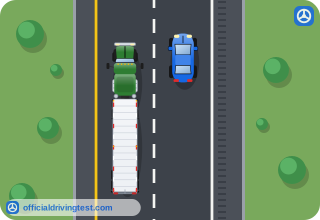
What must you do when another vehicle is passing you?
- Speed up slightly so that the other vehicle passes sooner
- Move onto the shoulder so the other vehicle can pass
- Brake hard so that the other vehicle can get by quickly
- Yield to the other vehicle and not increase your speed
Show answer
Correct answer: Yield to the other vehicle and not increase your speed
When being passed you must yield to the other vehicle and not increase your speed.
Source: Maryland Driver’s Manual (October 2025 Edition (DL-002 10-25)), page 16
-
In which situation does the manual say you may not pass?
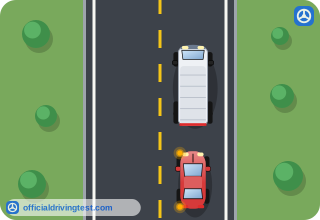
- When approaching the top of a hill and you cannot clearly see ahead
- On an unobstructed one-way road with two or more lanes
- When the other vehicle is about to make a left turn
- On an unobstructed road with two or more lanes going the same way
Show answer
Correct answer: When approaching the top of a hill and you cannot clearly see ahead
You may not pass when approaching the top of a hill or on a curve and you cannot clearly see ahead.
Source: Maryland Driver’s Manual (October 2025 Edition (DL-002 10-25)), page 16
-
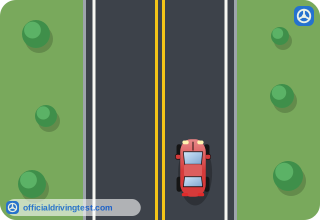
Where there are double solid yellow lines, what does the manual say about passing?
- You may pass if no vehicles are coming
- You may pass if you signal first
- You may not pass
- You may pass if the vehicle ahead is slow
Show answer
Correct answer: You may not pass
The manual lists places with double solid yellow lines as places where you may not pass.
Source: Maryland Driver’s Manual (October 2025 Edition (DL-002 10-25)), page 16
-
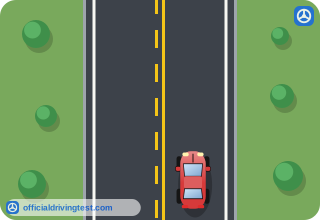
Where the solid yellow line in the middle of the road is on your side, may you pass?
- Yes, if you signal first
- No, you may not pass there
- Yes, if no vehicles are coming
- Yes, if the vehicle ahead is moving slowly
Show answer
Correct answer: No, you may not pass there
You may not pass where the solid yellow line in the middle of the road is on your side.
Source: Maryland Driver’s Manual (October 2025 Edition (DL-002 10-25)), page 16
-
Within how many feet of an intersection or railroad grade crossing may you not pass?
- 50 feet
- 200 feet
- 300 feet
- 100 feet
Show answer
Correct answer: 100 feet
You may not pass when crossing or within 100 feet of an intersection or railroad grade crossing.
Source: Maryland Driver’s Manual (October 2025 Edition (DL-002 10-25)), page 16
-
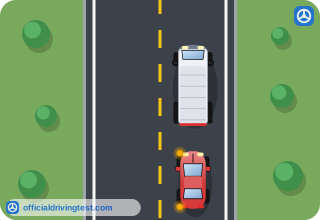
When your view is obstructed, within 100 feet of what may you not pass?
- A bridge, elevated road, or tunnel
- A school zone, playground, or residential street
- A toll plaza, parking lot, or driveway
- A bus stop, taxi stand, or loading zone
Show answer
Correct answer: A bridge, elevated road, or tunnel
You may not pass when your view is obstructed as you come within 100 feet of a bridge, elevated road, or tunnel.
Source: Maryland Driver’s Manual (October 2025 Edition (DL-002 10-25)), page 16
-
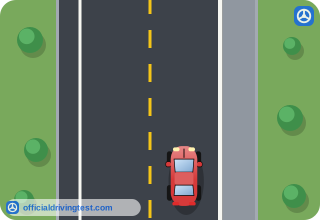
May you pass on the shoulder of the road?
- Yes, but only on the right-hand shoulder of the road
- Yes, but only on the left-hand shoulder of the road
- No, not on the shoulder to the right or to the left
- Yes, if the shoulder is wide enough for your vehicle
Show answer
Correct answer: No, not on the shoulder to the right or to the left
The manual says you may not pass on the shoulder of the road, either to the right or to the left.
Source: Maryland Driver’s Manual (October 2025 Edition (DL-002 10-25)), page 16
-
In areas where you see “stay right” signs, which lane should you use?
- The left-hand lane, unless you are turning right
- Whichever lane has the least traffic
- The right-hand lane or lanes, unless passing
- The center lane only, unless you are exiting
Show answer
Correct answer: The right-hand lane or lanes, unless passing
Where “stay right” signs are posted you should drive in the right-hand lane or lanes unless you are passing a vehicle.
Source: Maryland Driver’s Manual (October 2025 Edition (DL-002 10-25)), page 16
-
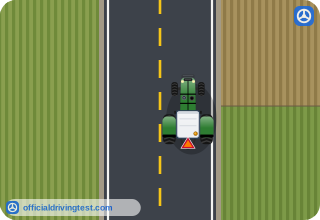
Which of these are named as slow moving vehicles you may come across on the road?
- Ambulances
- Tow trucks
- Taxis
- Horse-drawn vehicles
Show answer
Correct answer: Horse-drawn vehicles
The manual says slow moving vehicles include bicycles, horse-drawn vehicles, and farm vehicles.
Source: Maryland Driver’s Manual (October 2025 Edition (DL-002 10-25)), page 32
-
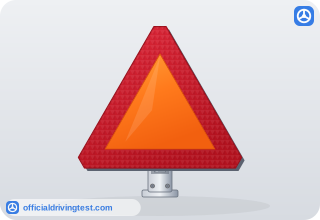
A red-bordered orange triangle on the back of a vehicle warns you that the vehicle is going how fast?
- 15 miles per hour or less
- 25 miles per hour or less
- 35 miles per hour or less
- 45 miles per hour or less
Show answer
Correct answer: 25 miles per hour or less
The slow-moving sign on the back of a vehicle warns you it is only going 25 miles per hour or less.
Source: Maryland Driver’s Manual (October 2025 Edition (DL-002 10-25)), page 32
-
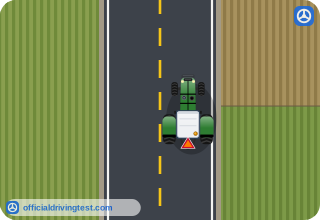
What should you be constantly aware of when driving near slow-moving vehicles?
- Only vehicles that display a slow-moving warning sign
- Only vehicles in front of you in your own lane
- Any vehicles that might be traveling at a much slower speed
- Vehicles that have stopped on the side of the road
Show answer
Correct answer: Any vehicles that might be traveling at a much slower speed
The manual says to be constantly aware of any vehicles that might be traveling at a much slower speed.
Source: Maryland Driver’s Manual (October 2025 Edition (DL-002 10-25)), page 32
-
What may you need to change when driving near slow-moving vehicles?
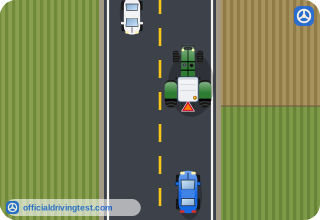
- Your vehicle’s speed and position
- Your vehicle’s turn signal
- Your vehicle’s headlight setting
- Your vehicle’s tire pressure
Show answer
Correct answer: Your vehicle’s speed and position
The manual says to change your vehicle’s speed and position if necessary near slow-moving vehicles.
Source: Maryland Driver’s Manual (October 2025 Edition (DL-002 10-25)), page 32
-
When should you pass a slow-moving vehicle?
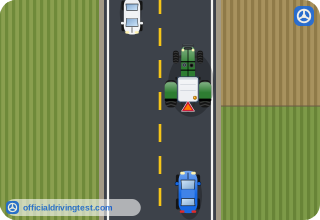
- Only when it is safe to do so
- As soon as you catch up to it
- Whenever the road ahead has a broken line
- After sounding your horn
Show answer
Correct answer: Only when it is safe to do so
The manual says to pass the slow-moving vehicle only when it is safe to do so.
Source: Maryland Driver’s Manual (October 2025 Edition (DL-002 10-25)), page 32
-
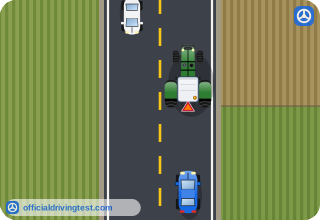
If you must follow a slower moving vehicle while waiting for a safe time to pass, what should you use to warn others coming up behind you?
- Your high beams
- Your horn
- Your emergency flashers
- Your left turn signal
Show answer
Correct answer: Your emergency flashers
The manual says to use your emergency flashers to help warn others coming up behind you.
Source: Maryland Driver’s Manual (October 2025 Edition (DL-002 10-25)), page 32
-
Which of these is an example of aggressive driving?
- Allowing extra time to travel
- Always signaling your intentions
- Tailgating
- Yielding the right-of-way
Show answer
Correct answer: Tailgating
Examples of aggressive driving include speeding, tailgating, and ignoring traffic signals and devices.
Source: Maryland Driver’s Manual (October 2025 Edition (DL-002 10-25)), page 34
-
Which of these can cause people to drive aggressively?
- Light traffic and clear roads
- Crowded roads and unexpected delays
- Driving with extra time to spare
- Being patient and courteous
Show answer
Correct answer: Crowded roads and unexpected delays
Crowded roads, unexpected delays, rushing, road construction, and stress can cause people to drive aggressively.
Source: Maryland Driver’s Manual (October 2025 Edition (DL-002 10-25)), page 34
-
How does the manual say you must treat all other people using the road?
- Compete with them to keep your place
- Yield to them only at intersections
- Ignore them unless they signal you
- Respect and cooperate with them
Show answer
Correct answer: Respect and cooperate with them
You must respect and cooperate with all other people using the road.
Source: Maryland Driver’s Manual (October 2025 Edition (DL-002 10-25)), page 34
-
Which of these is a tip the manual gives to reduce the chance of an aggressive driving incident?
- Allow extra time to travel
- Drive faster to arrive sooner
- Stay close behind slower vehicles
- Compete with other drivers for position
Show answer
Correct answer: Allow extra time to travel
Allowing extra time to travel is one tip to reduce the possibility of an aggressive driving incident.
Source: Maryland Driver’s Manual (October 2025 Edition (DL-002 10-25)), page 34
-
What do large trucks often do just before making a right turn?
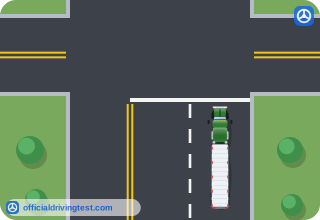
- Move onto the right shoulder
- Move left
- Speed up
- Stop at the curb
Show answer
Correct answer: Move left
When making a right turn, large trucks will often move left before making the turn, so other drivers may think they are changing lanes.
Source: Maryland Driver’s Manual (October 2025 Edition (DL-002 10-25)), page 37
-
What does the manual say about passing any truck on the right?
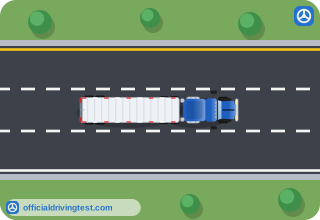
- It is the safest side to pass on
- It is allowed only on freeways
- It is allowed only after the truck signals
- It can be risky
Show answer
Correct answer: It can be risky
The manual says that passing any truck on the right can be risky.
Source: Maryland Driver’s Manual (October 2025 Edition (DL-002 10-25)), page 37
-
A large truck is stopped at or approaching an intersection and begins its turn. Why should you never try to cut in along its right side?
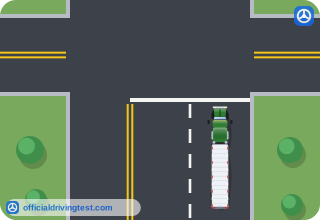
- You could be caught between the turning truck and the curb
- The truck driver may not hear your horn
- Your car may be struck by the truck's trailer door
- The truck must always finish its turn first
Show answer
Correct answer: You could be caught between the turning truck and the curb
Cutting in along the right side as the truck driver begins the turn could leave you caught between the turning truck and the curb.
Source: Maryland Driver’s Manual (October 2025 Edition (DL-002 10-25)), page 38