Maryland: Seat belts and child safety Practice Test
Maryland’s seat belt law, child safety seats and air bags.
Independent educational site · not affiliated with any government agency or DMV
Ready? Test yourself
- Instant feedback with an explanation
- Every answer cites its source in the manual
- Your best score is saved on this device
Questions are original and based on the official manual "Maryland Driver’s Manual" (October 2025 Edition (DL-002 10-25)), Maryland Motor Vehicle Administration.
All 19 questions in this practice test
Take the test above first, then use this list to study. Tap “Show answer” to see the correct answer and explanation.
Show the questions and answersHide the questions
-
Before you drive, what does the manual say you should make sure of?
- That all passengers are seated in the rear seat
- That every passenger has read the driver’s manual
- That you and all passengers are wearing a seat belt
- That the radio has been switched off
Show answer
Correct answer: That you and all passengers are wearing a seat belt
Before driving you should make sure that you and all of your passengers are wearing a seat belt.
Source: Maryland Driver’s Manual (October 2025 Edition (DL-002 10-25)), page 13
-
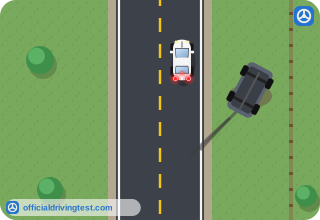
According to the manual, what is the single most effective way to prevent death and serious injury in a car crash?
- Wearing a seat belt
- Driving only in daylight
- Avoiding interstate highways
- Using a hands-free phone
Show answer
Correct answer: Wearing a seat belt
The manual states that wearing a seat belt is the single most effective way to prevent death and serious injury in a car crash.
Source: Maryland Driver’s Manual (October 2025 Edition (DL-002 10-25)), page 26
-
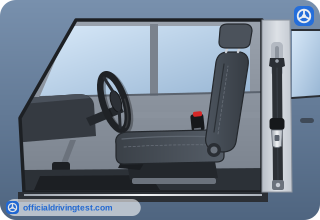
When must you use a safety belt if you have a Provisional License?
- Only on highways
- Always
- Only when you carry passengers
- Only at night
Show answer
Correct answer: Always
A Provisional License holder must always use a safety belt.
Source: Maryland Driver’s Manual (October 2025 Edition (DL-002 10-25)), page 47
-
If you have a Provisional License, who must use safety belts or child safety seats in your vehicle?
- Only passengers under age 18
- Only passengers in the front seat
- Only passengers who are not family members
- All passengers
Show answer
Correct answer: All passengers
Under the seat belt restriction, all passengers must use safety belts or child safety seats.
Source: Maryland Driver’s Manual (October 2025 Edition (DL-002 10-25)), page 47
-
Who must wear a safety belt or be buckled in a child safety seat by law?
- Only the driver of the vehicle itself
- The driver and all passengers of a motor vehicle
- Only passengers who sit in the front seat
- Only the passengers who are under age 16
Show answer
Correct answer: The driver and all passengers of a motor vehicle
By law, the driver and all passengers of a motor vehicle must wear a safety belt or be buckled in a child safety seat.
Source: Maryland Driver’s Manual (October 2025 Edition (DL-002 10-25)), page 52
-
All children under what age must ride in a child safety seat, unless the child is 4’9” or taller?
- Age 4
- Age 6
- Age 10
- Age 8
Show answer
Correct answer: Age 8
All children under age 8 must ride in a child safety seat, unless the child is 4’9” or taller.
Source: Maryland Driver’s Manual (October 2025 Edition (DL-002 10-25)), page 52
-
A child under age 8 does NOT have to ride in a child safety seat if the child is at least how tall?
- 4’9”
- 3’11”
- 4’2”
- 5’3”
Show answer
Correct answer: 4’9”
The child safety seat requirement for children under age 8 does not apply if the child is 4’9” or taller.
Source: Maryland Driver’s Manual (October 2025 Edition (DL-002 10-25)), page 52
-
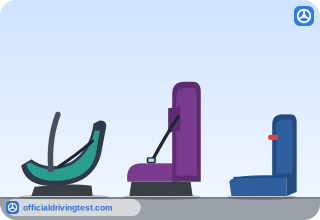
How must children younger than 2 ride?
- In a forward-facing seat in the front seat of the car
- Buckled in with only the vehicle’s lap belt in the back
- In a rear-facing child safety seat that meets federal guidelines
- On an adult’s lap while the adult is buckled in the back
Show answer
Correct answer: In a rear-facing child safety seat that meets federal guidelines
Children younger than 2 must ride in a rear-facing child safety seat that meets federal guidelines.
Source: Maryland Driver’s Manual (October 2025 Edition (DL-002 10-25)), page 52
-
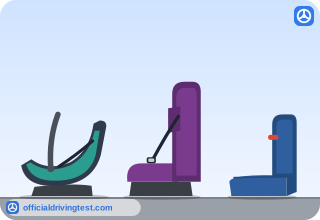
How long must children younger than 2 stay in a rear-facing child safety seat?
- Until they turn three years old and can start talking clearly
- Until they reach the height or weight specified by the manufacturer
- Until they are able to sit up in the seat without any help
- Until they have been moved into a forward-facing booster seat
Show answer
Correct answer: Until they reach the height or weight specified by the manufacturer
They must stay rear-facing until they reach the height or weight specified by the manufacturer.
Source: Maryland Driver’s Manual (October 2025 Edition (DL-002 10-25)), page 52
-
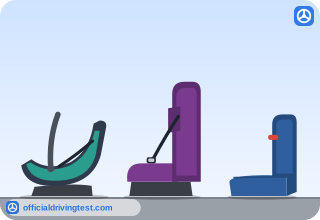
Whose instructions must you follow when using a child safety seat?
- Only the child’s doctor or the child’s pediatrician
- Only the store that originally sold you the seat
- Only the MVA and its approved seat inspectors
- The manufacturers of your child safety seat and vehicle
Show answer
Correct answer: The manufacturers of your child safety seat and vehicle
You must follow all instructions provided by the manufacturer of your child safety seat and vehicle.
Source: Maryland Driver’s Manual (October 2025 Edition (DL-002 10-25)), page 52
-
Besides car seats and booster seats, what else do child safety seats include?
- Other federally approved child safety devices
- Any cushion that raises the child up higher
- Any blanket folded and placed under the child
- Any adult-sized seat belt worn by the child
Show answer
Correct answer: Other federally approved child safety devices
Child safety seats include car seats, booster seats and other federally approved child safety devices.
Source: Maryland Driver’s Manual (October 2025 Edition (DL-002 10-25)), page 52
-
Which program can you contact if you cannot purchase or obtain a child safety seat?
- The Safe Rides Maryland program
- The Child Passenger Safety Council
- Kids In Safety Seats
- The Buckle Up Maryland campaign
Show answer
Correct answer: Kids In Safety Seats
The manual says you may contact Kids In Safety Seats (KISS) at the Maryland Department of Health if you are unable to purchase or obtain a child safety seat.
Source: Maryland Driver’s Manual (October 2025 Edition (DL-002 10-25)), page 52
-
What does Kids In Safety Seats (KISS) coordinate?
- Free driving lessons offered to new parents in every county
- Programs that rent car seats or booster seats at a low cost to families
- Inspections of used vehicles before they are sold to families
- Discounts on vehicle insurance for families with young children
Show answer
Correct answer: Programs that rent car seats or booster seats at a low cost to families
KISS coordinates programs in various areas of the State that rent car seats or booster seats at a low cost to families who cannot afford to purchase them.
Source: Maryland Driver’s Manual (October 2025 Edition (DL-002 10-25)), page 52
-
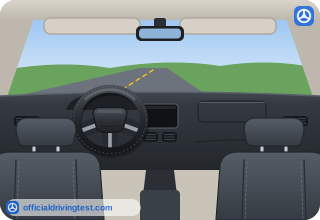
For the best air bag protection, what should you use together with the air bags?
- Only the vehicle’s lap belt alone
- A pillow placed behind your back
- The vehicle’s headrest by itself
- Your vehicle’s lap and shoulder belt
Show answer
Correct answer: Your vehicle’s lap and shoulder belt
Air bags work best when used with your vehicle’s lap and shoulder belt.
Source: Maryland Driver’s Manual (October 2025 Edition (DL-002 10-25)), page 52
-
How much space should you try to keep between the steering wheel and your chest for the best air bag protection?
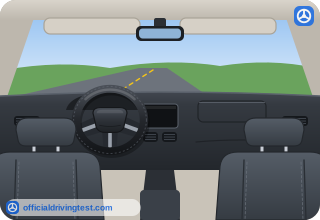
- 10-12 inches
- 2-4 inches
- 5-6 inches
- 18-24 inches
Show answer
Correct answer: 10-12 inches
The manual says to sit as far back from the steering wheel as possible and try to keep 10-12 inches between the steering wheel and your chest.
Source: Maryland Driver’s Manual (October 2025 Edition (DL-002 10-25)), page 52
-
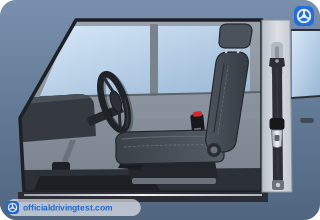
Where should a pregnant woman place the lap part of the seat belt?
- Over the rounding of the belly, just below the chest and above the hips
- Across the middle of the belly, above the hips and below the ribs
- Under the abdomen, as low as possible on the hips and across the upper thighs
- Behind her back, with the shoulder belt kept in front of her stomach
Show answer
Correct answer: Under the abdomen, as low as possible on the hips and across the upper thighs
Pregnant women should place the lap part of the seat belt under the abdomen as low as possible on the hips and across the upper thighs.
Source: Maryland Driver’s Manual (October 2025 Edition (DL-002 10-25)), page 52
-
Where should a pregnant woman place the shoulder belt?
- Under the abdomen at the hips
- Over the rounding of the belly
- Across the side of her neck
- Behind her back at the waist
Show answer
Correct answer: Over the rounding of the belly
Pregnant women should place the shoulder belt over the rounding of the belly.
Source: Maryland Driver’s Manual (October 2025 Edition (DL-002 10-25)), page 52
-
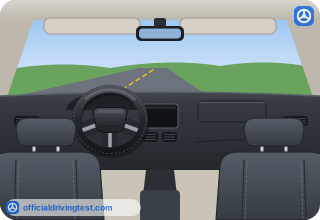
Who should never ride in the front seat of a vehicle that has a passenger air bag?
- Adult passengers over age 65 years old
- Children over age 13 who wear a seat belt
- Anyone who is wearing a seat belt
- Children in a rear-facing car seat
Show answer
Correct answer: Children in a rear-facing car seat
Children in a rear-facing car seat should never ride in the front seat of a vehicle with a passenger air bag.
Source: Maryland Driver’s Manual (October 2025 Edition (DL-002 10-25)), page 52
-
Children under what age should ride buckled up in a rear seat, in a child safety seat or with a seat belt?
- Age 13
- Age 10
- Age 11
- Age 15
Show answer
Correct answer: Age 13
Children under age 13 should ride buckled up in a rear seat in a child safety seat or with a seat belt.
Source: Maryland Driver’s Manual (October 2025 Edition (DL-002 10-25)), page 52