Maryland: Pedestrians Practice Test
Yielding to pedestrians at crosswalks and when turning, and reading pedestrian signals.
Independent educational site · not affiliated with any government agency or DMV
Ready? Test yourself
- Instant feedback with an explanation
- Every answer cites its source in the manual
- Your best score is saved on this device
Questions are original and based on the official manual "Maryland Driver’s Manual" (October 2025 Edition (DL-002 10-25)), Maryland Motor Vehicle Administration.
All 11 questions in this practice test
Take the test above first, then use this list to study. Tap “Show answer” to see the correct answer and explanation.
Show the questions and answersHide the questions
-
How do pedestrians use a crosswalk signal to stop traffic so they can cross?
- By stepping onto the crosswalk
- By pushing a button on a pole on the side of the road
- By waving a hand at approaching drivers from the curb
- By pressing a button inside each car
Show answer
Correct answer: By pushing a button on a pole on the side of the road
Pedestrians use a crosswalk signal by pushing a button on a pole on the side of the road, which tells drivers to stop and then tells pedestrians to cross.
Source: Maryland Driver’s Manual (October 2025 Edition (DL-002 10-25)), page 19
-
A pedestrian crosswalk signal shows a white walking figure. What should the pedestrian do?
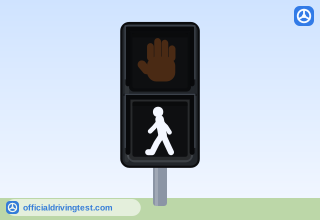
- Wait for the figure to turn into a flashing orange hand
- Cross without looking because traffic must stop
- Push the button again and keep waiting
- Look both ways and start crossing after traffic has stopped
Show answer
Correct answer: Look both ways and start crossing after traffic has stopped
When the walking figure shows, pedestrians look both ways and start crossing after traffic has stopped.
Source: Maryland Driver’s Manual (October 2025 Edition (DL-002 10-25)), page 19
-
A pedestrian crosswalk signal shows a flashing orange hand with a countdown number. What should a pedestrian who has not yet started crossing do?
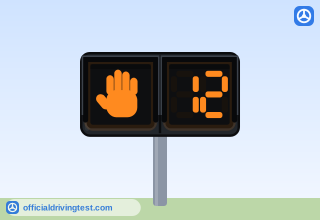
- Not start crossing
- Start crossing quickly
- Push the button and run across
- Start crossing after looking both ways
Show answer
Correct answer: Not start crossing
A flashing hand with a countdown means "Don’t start"; a pedestrian who has already started should finish crossing.
Source: Maryland Driver’s Manual (October 2025 Edition (DL-002 10-25)), page 19
-
What do pedestrian crosswalk lines look like?
- Yellow, solid lines
- White, solid lines
- Rows of small triangles
- Yellow, broken lines
Show answer
Correct answer: White, solid lines
Pedestrian crosswalk lines are white, solid lines that show where pedestrians cross.
Source: Maryland Driver’s Manual (October 2025 Edition (DL-002 10-25)), page 25
-
Besides two white, solid lines, how may crosswalks be marked?
- With rows of small triangles placed beside each line
- With a single yellow dotted line in the middle of the road
- With a double solid yellow line across the whole crosswalk
- With additional lines between the solid lines or in place of them
Show answer
Correct answer: With additional lines between the solid lines or in place of them
Crosswalks may have additional lines between the white, solid lines or in place of them.
Source: Maryland Driver’s Manual (October 2025 Edition (DL-002 10-25)), page 25
-
As you come to a traffic circle, whom should you watch for and yield to in the crosswalk?
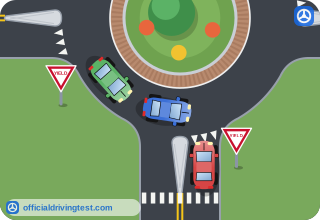
- Pedestrians
- Bicyclists only
- Drivers waiting behind you
- Traffic officers only
Show answer
Correct answer: Pedestrians
The manual says to watch for and yield to pedestrians in the crosswalk at a traffic circle.
Source: Maryland Driver’s Manual (October 2025 Edition (DL-002 10-25)), page 31
-
At a street crossing, what must pedestrians do even though they have the right-of-way?
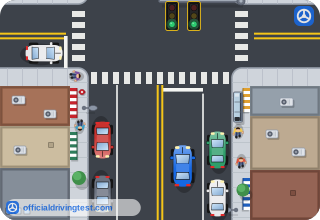
- Obey traffic control signals
- Wait for drivers to wave them across
- Cross only at marked crosswalks
- Stay on the sidewalk until the road is empty
Show answer
Correct answer: Obey traffic control signals
Pedestrians have the right-of-way at street crossings, but they must still obey traffic control signals.
Source: Maryland Driver’s Manual (October 2025 Edition (DL-002 10-25)), page 37
-
When there is no traffic signal, for pedestrians in which crosswalks must you stop?
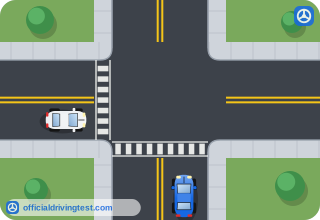
- Marked crosswalks only
- Only crosswalks next to a school
- Both marked and unmarked crosswalks
- Only crosswalks at stop signs
Show answer
Correct answer: Both marked and unmarked crosswalks
Where there is no traffic signal, drivers must stop for pedestrians in a marked or an unmarked crosswalk.
Source: Maryland Driver’s Manual (October 2025 Edition (DL-002 10-25)), page 37
-
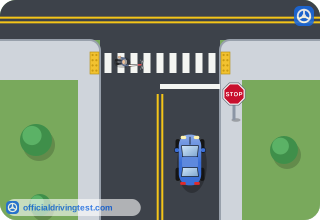
Why should drivers be especially alert for pedestrians who are deaf, blind or mobility impaired?
- They are not permitted to cross without a helper
- They may have difficulty seeing or hearing traffic
- They must cross in the middle of the block, away from corners
- They always cross before the signal changes to green
Show answer
Correct answer: They may have difficulty seeing or hearing traffic
These pedestrians may have difficulty seeing or hearing traffic and may need extra time to cross the road.
Source: Maryland Driver’s Manual (October 2025 Edition (DL-002 10-25)), page 37
-
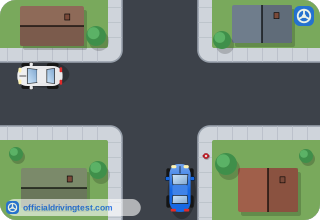
What is true of most intersections that have no painted crosswalk lines?
- They have no crosswalk, so pedestrians must wait
- They have a crosswalk only when a signal is present
- They have a crosswalk only on the side of a stop sign
- They still have a crosswalk
Show answer
Correct answer: They still have a crosswalk
The manual says most intersections have a crosswalk even if it is not marked.
Source: Maryland Driver’s Manual (October 2025 Edition (DL-002 10-25)), page 37
-
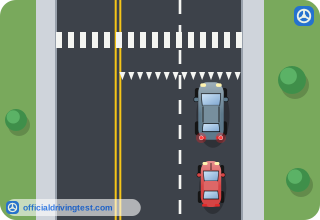
What may you NOT do when another vehicle is stopped at a crosswalk?
- Pass that vehicle
- Stop behind that vehicle
- Wait for the vehicle to move
- Look for pedestrians in the crosswalk
Show answer
Correct answer: Pass that vehicle
You may not pass any vehicle that is stopped at a crosswalk.
Source: Maryland Driver’s Manual (October 2025 Edition (DL-002 10-25)), page 37