Maryland: Pavement markings — Part 2 Practice Test
Questions in this part include: “What do single dotted yellow or white lines do?” · “What separates bike lanes from motor vehicle lanes?”
Independent educational site · not affiliated with any government agency or DMV
Ready? Test yourself
- Instant feedback with an explanation
- Every answer cites its source in the manual
- Your best score is saved on this device
Questions are original and based on the official manual "Maryland Driver’s Manual" (October 2025 Edition (DL-002 10-25)), Maryland Motor Vehicle Administration.
All 17 questions in this practice test
Take the test above first, then use this list to study. Tap “Show answer” to see the correct answer and explanation.
Show the questions and answersHide the questions
-
What do single dotted yellow or white lines do?
- Mark the right edge of the road
- Separate general lanes from HOV lanes
- Continue lane lines through intersections
- Mark the edges of reversible lanes
Show answer
Correct answer: Continue lane lines through intersections
Single dotted yellow or white lines continue lane lines through intersections.
Source: Maryland Driver’s Manual (October 2025 Edition (DL-002 10-25)), page 24
-
Where lane lines continue through an intersection, what should drivers in the intersection do?
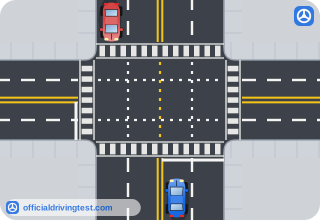
- Straddle the lane lines when turning
- Stay inside the lane markings
- Move to the center of the intersection
- Stay to the right of the lane markings
Show answer
Correct answer: Stay inside the lane markings
Drivers in intersections should stay inside the lane markings that continue the lane lines.
Source: Maryland Driver’s Manual (October 2025 Edition (DL-002 10-25)), page 24
-
Which pavement marking shows where a vehicle must stop for a STOP sign or red traffic signal?
- Rows of small triangles
- A single broken white line
- A double solid yellow line
- A white, solid line
Show answer
Correct answer: A white, solid line
A stop line is a white, solid line that shows where a vehicle must stop for a STOP sign or red traffic signal.
Source: Maryland Driver’s Manual (October 2025 Edition (DL-002 10-25)), page 25
-
Which pavement marking shows where a vehicle must yield to other vehicles or pedestrians?
- Rows of small triangles across the lane
- A white, solid line across the road
- A single broken white line across the lane
- A double solid yellow line across the road
Show answer
Correct answer: Rows of small triangles across the lane
Yield lines are rows of small triangles across the lane that show where a vehicle must yield to other vehicles or pedestrians.
Source: Maryland Driver’s Manual (October 2025 Edition (DL-002 10-25)), page 25
-
Which pavement markings tell you about lane reductions, such as a road changing from two lanes to one?
- Stop lines
- Yield lines
- Word and symbol markings
- Pedestrian crosswalk lines
Show answer
Correct answer: Word and symbol markings
Word and symbol markings tell you about lane reductions, for example when the road is changing from two lanes to just one.
Source: Maryland Driver’s Manual (October 2025 Edition (DL-002 10-25)), page 25
-
What do ‘SCHOOL’ and ‘RxR’ pavement markings warn you that you are approaching?
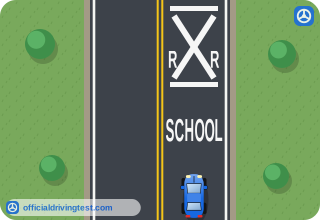
- Bicycle lanes and pedestrian crosswalks
- School areas and railroad crossings
- Work zones and school buses
- Hospital zones and rest areas
Show answer
Correct answer: School areas and railroad crossings
‘SCHOOL’ and ‘RxR’ markings warn that you are approaching school areas and railroad crossings.
Source: Maryland Driver’s Manual (October 2025 Edition (DL-002 10-25)), page 25
-
Where are shared-use lane markings for bicycles mostly found?
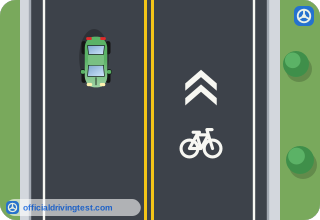
- On interstate highways
- On rural roads
- In work zones
- In cities
Show answer
Correct answer: In cities
Some roads have shared-use lane markings, and they are mostly in cities.
Source: Maryland Driver’s Manual (October 2025 Edition (DL-002 10-25)), page 25
-
Shared-use lane markings alert drivers to what?
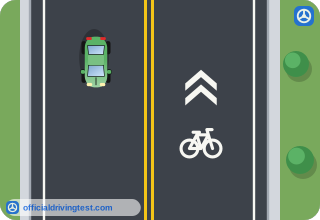
- That bicyclists may be on the road
- That pedestrians are crossing
- That bicyclists should ride against traffic here
- That the lane is for bicycles only
Show answer
Correct answer: That bicyclists may be on the road
Shared-use lane markings alert drivers that bicyclists may be on the road.
Source: Maryland Driver’s Manual (October 2025 Edition (DL-002 10-25)), page 25
-
Shared-use lane markings discourage which action by bicyclists?
- Biking at night on any road
- Biking in groups of two or more
- Biking in the wrong direction
- Biking in a bike lane
Show answer
Correct answer: Biking in the wrong direction
Shared-use lane markings discourage biking in the wrong direction.
Source: Maryland Driver’s Manual (October 2025 Edition (DL-002 10-25)), page 25
-
Shared-use lane markings tell bicyclists what?
- How fast to ride
- Where to ride
- Where to park
- When to stop
Show answer
Correct answer: Where to ride
Shared-use lane markings tell bicyclists where to ride.
Source: Maryland Driver’s Manual (October 2025 Edition (DL-002 10-25)), page 25
-
What separates bike lanes from motor vehicle lanes?
- Solid or broken yellow lines
- Rows of small triangles
- Double solid yellow lines
- Solid or broken white lines
Show answer
Correct answer: Solid or broken white lines
Solid or broken white lines separate bike lanes from motor vehicle lanes.
Source: Maryland Driver’s Manual (October 2025 Edition (DL-002 10-25)), page 25
-
How may bike lanes be marked?
- With bike lane signs or by bicycle symbols and arrows
- With rows of small triangles and RxR symbols
- Only with red paint across the whole lane
- Only with double solid yellow lines and arrows
Show answer
Correct answer: With bike lane signs or by bicycle symbols and arrows
Bike lanes may be marked with bike lane signs or by bicycle symbols and arrows.
Source: Maryland Driver’s Manual (October 2025 Edition (DL-002 10-25)), page 25
-
Where parallel parking is allowed, similar lines may separate which lanes from the parking lanes?
- Left-turn lanes
- HOV lanes
- Bicycle lanes
- Reversible lanes
Show answer
Correct answer: Bicycle lanes
Where parallel parking is allowed, similar lines may separate the bicycle lanes from the parking lanes.
Source: Maryland Driver’s Manual (October 2025 Edition (DL-002 10-25)), page 25
-
When you are driving on a road, on which side of your vehicle should yellow pavement markings always be?
- Your left side
- Your right side
- Your right side on one-way roads only
- Either side, depending on the lane
Show answer
Correct answer: Your left side
The manual says yellow pavement markings should never be on your right side; they should always be on your left side, marking the left edge of the road.
Source: Maryland Driver’s Manual (October 2025 Edition (DL-002 10-25)), page 27
-
What do yellow pavement markings divide?
- Traffic traveling in the same direction
- Parked vehicles from moving vehicles
- Traffic going in opposite directions
- Bicycle lanes from travel lanes
Show answer
Correct answer: Traffic going in opposite directions
The manual says yellow is used to divide traffic going in opposite directions.
Source: Maryland Driver’s Manual (October 2025 Edition (DL-002 10-25)), page 27
-
Which edge of the road do white pavement markings mark?
- The left edge
- The right edge
- The center
- The edge of the shoulder only
Show answer
Correct answer: The right edge
The manual says white pavement markings mark the right edge of the road.
Source: Maryland Driver’s Manual (October 2025 Edition (DL-002 10-25)), page 27
-
What else do white pavement markings do besides marking the right edge of the road?
- Divide traffic going in opposite directions
- Show where passing is never allowed
- Mark the left edge of the road
- Divide traffic traveling in the same direction
Show answer
Correct answer: Divide traffic traveling in the same direction
The manual says white markings also divide traffic traveling in the same direction.
Source: Maryland Driver’s Manual (October 2025 Edition (DL-002 10-25)), page 27