Maryland: Pavement markings — Part 1 Practice Test
Questions in this part include: “What is a stop line?” · “What is a divided highway?”
Independent educational site · not affiliated with any government agency or DMV
Ready? Test yourself
- Instant feedback with an explanation
- Every answer cites its source in the manual
- Your best score is saved on this device
Questions are original and based on the official manual "Maryland Driver’s Manual" (October 2025 Edition (DL-002 10-25)), Maryland Motor Vehicle Administration.
All 18 questions in this practice test
Take the test above first, then use this list to study. Tap “Show answer” to see the correct answer and explanation.
Show the questions and answersHide the questions
-
What is a stop line?
- A wide white line painted across the road that shows where you must stop at an intersection
- A broken white line painted along the edge of the road that shows where you may park
- A solid yellow line painted along the road that shows where passing is allowed
- A wide white sign beside the road that shows how fast you may drive
Show answer
Correct answer: A wide white line painted across the road that shows where you must stop at an intersection
A stop line is a wide white line painted across the road that shows where you must stop at an intersection.
Source: Maryland Driver’s Manual (October 2025 Edition (DL-002 10-25)), page 17
-
According to the manual, what do pavement markings give you without requiring you to look away from the road?
- Important guidance and information
- The legal speed limit for the road
- The names of nearby towns and exits
- The route number of the road ahead
Show answer
Correct answer: Important guidance and information
Pavement markings provide important guidance and information without requiring you to look away from the road.
Source: Maryland Driver’s Manual (October 2025 Edition (DL-002 10-25)), page 24
-
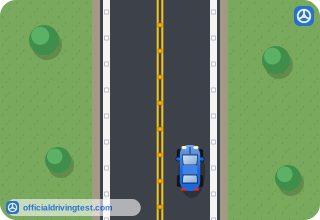
Why may lines be extra wide or have reflective markers attached in some locations?
- To show that passing is permitted
- To mark lanes reserved for emergency vehicles
- To draw your attention and help you see the lines
- To show where parking is allowed
Show answer
Correct answer: To draw your attention and help you see the lines
Lines may be extra wide or have reflective markers attached to draw your attention and help you see the lines.
Source: Maryland Driver’s Manual (October 2025 Edition (DL-002 10-25)), page 24
-
What does a single broken white line separate, and what is permitted?
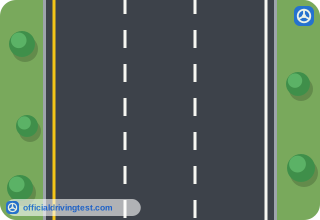
- Lanes going opposite directions; passing in either direction
- Lanes going the same direction; crossing from one lane to the other
- Lanes going the same direction; no changing lanes
- Lanes going opposite directions; no passing in either direction
Show answer
Correct answer: Lanes going the same direction; crossing from one lane to the other
A single broken white line separates lanes where all traffic goes in the same direction, and crossing from one lane to the other is permitted.
Source: Maryland Driver’s Manual (October 2025 Edition (DL-002 10-25)), page 24
-
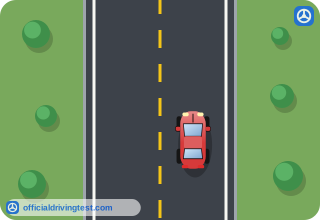
What does a single broken yellow line separate, and what is permitted?
- Lanes going the same direction; crossing from one lane to the other
- Lanes going opposite directions; no passing in either direction
- Lanes going the same direction; no changing lanes
- Lanes going opposite directions; passing with care in either direction
Show answer
Correct answer: Lanes going opposite directions; passing with care in either direction
A single broken yellow line separates lanes where vehicles travel in opposite directions, and passing with care is permitted in either direction.
Source: Maryland Driver’s Manual (October 2025 Edition (DL-002 10-25)), page 24
-
Which line marks the right edge of the road?
- Single solid white
- Single solid yellow
- Single broken white
- Double solid white
Show answer
Correct answer: Single solid white
A single solid white line marks the right edge of the road.
Source: Maryland Driver’s Manual (October 2025 Edition (DL-002 10-25)), page 24
-
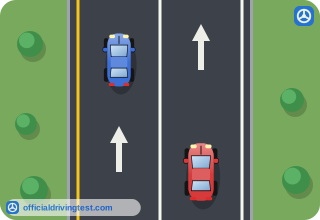
A single solid white line separates lanes where all vehicles are going in the same direction. What does it mean for changing lanes?
- Lane changing is required
- Lane changing is not allowed
- Lane changing is discouraged
- Lane changing is allowed only at night
Show answer
Correct answer: Lane changing is discouraged
A single solid white line between lanes going the same way means lane changing is discouraged.
Source: Maryland Driver’s Manual (October 2025 Edition (DL-002 10-25)), page 24
-
Which line marks left edge lines on divided highways, one-way roads, and ramps?
- Single solid white
- Single solid yellow
- Single broken yellow
- Double solid white
Show answer
Correct answer: Single solid yellow
A single solid yellow line marks left edge lines on divided highways, one-way roads, and ramps.
Source: Maryland Driver’s Manual (October 2025 Edition (DL-002 10-25)), page 24
-
What is a divided highway?
- A road with a two-way left turn lane in the middle, painted with yellow lines
- A road whose lanes change direction at different times of day, as signs show
- A road with more than one lane going in each direction, separated by paint
- A road with a guardrail, strip of land, or other barrier between traffic in each direction
Show answer
Correct answer: A road with a guardrail, strip of land, or other barrier between traffic in each direction
A divided highway has a guardrail, strip of land, or other barrier between traffic traveling in each direction.
Source: Maryland Driver’s Manual (October 2025 Edition (DL-002 10-25)), page 24
-
Which lines mark the edges of reversible lanes?
- Double broken yellow lines
- Double solid yellow lines
- Single broken white lines
- Single dotted white lines
Show answer
Correct answer: Double broken yellow lines
Double (side-by-side) broken yellow lines mark the edges of reversible lanes.
Source: Maryland Driver’s Manual (October 2025 Edition (DL-002 10-25)), page 24
-
How do you know when you may enter and exit a lane marked with double broken yellow lines?
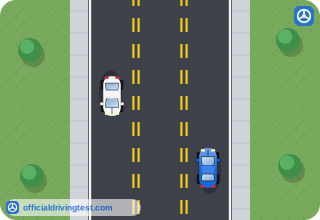
- It is allowed whenever no other vehicle is in the lane
- It is allowed only when passing a slower vehicle
- It is based on what traffic signs and signals say is permitted
- It is allowed only at intersections
Show answer
Correct answer: It is based on what traffic signs and signals say is permitted
For a reversible lane marked by double broken yellow lines, you may enter and exit based on what traffic signs and signals say is permitted.
Source: Maryland Driver’s Manual (October 2025 Edition (DL-002 10-25)), page 24
-
What does a double solid white line mean?
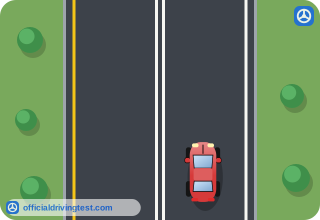
- Traffic goes the same direction and lane changing is discouraged
- Traffic goes the same direction and you are not allowed to change lanes
- Traffic goes opposite directions and passing is not allowed
- Traffic goes the same direction and crossing is permitted
Show answer
Correct answer: Traffic goes the same direction and you are not allowed to change lanes
Double solid white lines separate lanes going the same direction where you are not allowed to change lanes.
Source: Maryland Driver’s Manual (October 2025 Edition (DL-002 10-25)), page 24
-
A double solid white line may also be used to separate general lanes from which lanes?
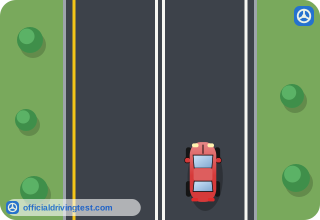
- Reversible lanes
- Two-way left turn lanes
- Exit-only lanes
- HOV lanes
Show answer
Correct answer: HOV lanes
Double solid white lines may be used to separate general lanes from HOV lanes.
Source: Maryland Driver’s Manual (October 2025 Edition (DL-002 10-25)), page 24
-
A double solid white line may be used before an obstruction. On which side may you pass the obstruction?
- Either side
- Only the left side
- Only the right side
- Neither side
Show answer
Correct answer: Either side
Double solid white lines may be used before obstructions that you may pass on either side.
Source: Maryland Driver’s Manual (October 2025 Edition (DL-002 10-25)), page 24
-
What does a double solid yellow line mean?
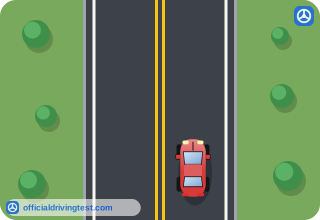
- Traffic goes opposite directions and passing with care is permitted
- Traffic goes the same direction and you may not change lanes
- Traffic goes opposite directions and passing is not allowed in either direction
- Passing is permitted only for traffic on the broken-line side
Show answer
Correct answer: Traffic goes opposite directions and passing is not allowed in either direction
Double solid yellow lines separate lanes of traffic going in opposite directions where passing is not allowed in either direction.
Source: Maryland Driver’s Manual (October 2025 Edition (DL-002 10-25)), page 24
-
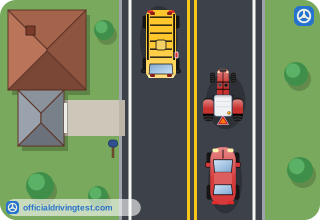
What may you do across a double solid yellow line, for example when turning into a driveway?
- Pass a slower vehicle
- Make a left turn across it
- Change lanes
- Stop to park in the lane
Show answer
Correct answer: Make a left turn across it
You may make a left turn across a double solid yellow line, for example when turning into a driveway.
Source: Maryland Driver’s Manual (October 2025 Edition (DL-002 10-25)), page 24
-
On a two-way road with a solid yellow line next to a broken yellow line, who may pass with care?
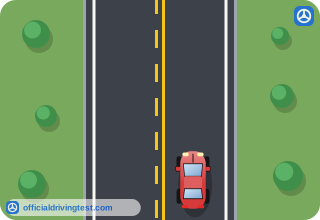
- Traffic on the side of the solid line
- Traffic going in both directions
- Traffic going in neither direction
- Traffic on the side of the broken line
Show answer
Correct answer: Traffic on the side of the broken line
With a solid plus broken yellow line, careful passing is allowed for traffic on the side of the broken line and not for traffic on the side of the solid line.
Source: Maryland Driver’s Manual (October 2025 Edition (DL-002 10-25)), page 24
-
How are the edges of two-way left turn lanes marked?
- Solid yellow lines on the outside and broken yellow lines on the inside
- Broken yellow lines on the outside and solid yellow lines on the inside
- Double solid white lines on both sides
- Double broken yellow lines on both sides
Show answer
Correct answer: Solid yellow lines on the outside and broken yellow lines on the inside
The edges of two-way left turn lanes are marked with solid lines on the outside and broken lines on the inside.
Source: Maryland Driver’s Manual (October 2025 Edition (DL-002 10-25)), page 24