Maryland: Emergencies and crashes — Part 4 Practice Test
Questions in this part include: “After a crash with no injuries, what facts about the crash itself should you write down?” · “You strike an unattended vehicle and cannot find its owner. What must you do?”
Independent educational site · not affiliated with any government agency or DMV
Ready? Test yourself
- Instant feedback with an explanation
- Every answer cites its source in the manual
- Your best score is saved on this device
Questions are original and based on the official manual "Maryland Driver’s Manual" (October 2025 Edition (DL-002 10-25)), Maryland Motor Vehicle Administration.
All 19 questions in this practice test
Take the test above first, then use this list to study. Tap “Show answer” to see the correct answer and explanation.
Show the questions and answersHide the questions
-
After a crash with no injuries, what facts about the crash itself should you write down?
- How the crash happened
- Who you think should be fined
- The other driver's past violations
- What each vehicle is worth
Show answer
Correct answer: How the crash happened
The manual tells you to write down the facts of how the crash happened.
Source: Maryland Driver’s Manual (October 2025 Edition (DL-002 10-25)), page 43
-
In which of these situations must you always call the police after a crash?
- The crash happened on a weekend afternoon in clear weather
- A driver appears to be under the influence of alcohol or drugs
- Only a bumper was scratched and nobody complained
- The other driver is a teenager
Show answer
Correct answer: A driver appears to be under the influence of alcohol or drugs
You must always call the police when a driver appears to be under the influence of alcohol or drugs.
Source: Maryland Driver’s Manual (October 2025 Edition (DL-002 10-25)), page 43
-
In which of these situations must you always call the police after a crash?
- The other driver is older than you
- The crash happened in a parking lot
- A passenger is not wearing a seat belt
- A driver does not have a license
Show answer
Correct answer: A driver does not have a license
You must always call the police when a driver does not have a license.
Source: Maryland Driver’s Manual (October 2025 Edition (DL-002 10-25)), page 44
-
In which of these situations must you always call the police after a crash?
- A driver tries to leave without giving you information
- The other driver gives you a different phone number
- The other driver wants to wait for a tow truck
- A witness refuses to give a statement
Show answer
Correct answer: A driver tries to leave without giving you information
You must always call the police when a driver tries to leave the scene without giving you insurance and other important information.
Source: Maryland Driver’s Manual (October 2025 Edition (DL-002 10-25)), page 44
-
In which of these situations must you always call the police after a crash?
- Your vehicle has a flat tire
- The other driver has no insurance card with them
- Public property has been damaged
- Traffic has slowed near the crash
Show answer
Correct answer: Public property has been damaged
You must always call the police when public property has been damaged.
Source: Maryland Driver’s Manual (October 2025 Edition (DL-002 10-25)), page 44
-
If you strike an unattended vehicle or other unattended property, what must you do first?
- Stop as close as possible to where the crash occurred
- Drive on and report it from your destination
- Move to the nearest parking lot before stopping
- Leave your vehicle and ask the police to come
Show answer
Correct answer: Stop as close as possible to where the crash occurred
You are required to stop your vehicle as close as possible to where the crash occurred, without blocking traffic more than necessary.
Source: Maryland Driver’s Manual (October 2025 Edition (DL-002 10-25)), page 44
-
After you strike an unattended vehicle, what must you try to do?
- Wait for the police to find the owner
- Ask a witness to contact the owner later
- Find the owner and tell them what happened
- Report the damage to the MVA
Show answer
Correct answer: Find the owner and tell them what happened
You are required to try to find the owner of the vehicle or property to tell them what happened and provide your information.
Source: Maryland Driver’s Manual (October 2025 Edition (DL-002 10-25)), page 44
-
You strike an unattended vehicle and cannot find its owner. What must you do?
- Leave without a note, since no one was hurt in the crash
- Leave a note with your contact information where it is easy to find
- Wait beside the vehicle for as long as it takes the owner to return
- Take pictures of the damage and then drive away
Show answer
Correct answer: Leave a note with your contact information where it is easy to find
If you cannot find the owner, you must leave a note about what happened with your contact information, where they can easily find it.
Source: Maryland Driver’s Manual (October 2025 Edition (DL-002 10-25)), page 44
-
What must you do if you hit and injure a domestic animal with your vehicle?
- Move the animal off the road and continue
- Drive on and report it later
- Take the animal to its owner's home
- Immediately call the police
Show answer
Correct answer: Immediately call the police
If you hit and injure a domestic animal with your vehicle, you must immediately call the police.
Source: Maryland Driver’s Manual (October 2025 Edition (DL-002 10-25)), page 44
-
Which of these is given as an example of a domestic animal?
- Deer
- Foxes
- Raccoons
- Horses
Show answer
Correct answer: Horses
The manual lists dogs, cats, horses, and cows as examples of domestic animals.
Source: Maryland Driver’s Manual (October 2025 Edition (DL-002 10-25)), page 44
-
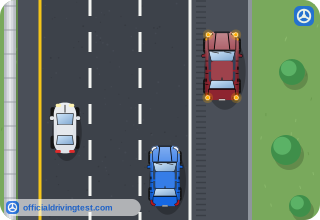
Which of these is advice for responding to a roadside emergency?
- Ignore other traffic until help arrives
- Assess the situation
- Leave your vehicle as quickly as possible
- Wait for a passing driver to take charge
Show answer
Correct answer: Assess the situation
The manual advises you to assess the situation and use good judgment in deciding how to respond.
Source: Maryland Driver’s Manual (October 2025 Edition (DL-002 10-25)), page 44
-
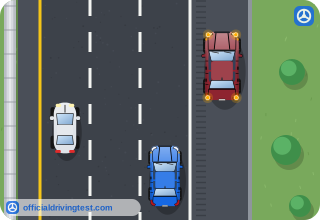
Why should you watch for other vehicles during a roadside emergency?
- Other drivers must stop and help you
- The police will ask what you saw
- Roadside emergencies can change in an instant
- Traffic always slows near a disabled vehicle
Show answer
Correct answer: Roadside emergencies can change in an instant
You should watch for other vehicles because roadside emergencies can change in an instant.
Source: Maryland Driver’s Manual (October 2025 Edition (DL-002 10-25)), page 44
-
If your vehicle becomes disabled, what should you do your best to do?
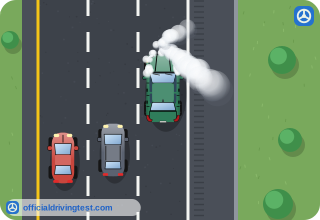
- Move it to the shoulder
- Leave it in the lane so others can see it
- Stop it beside the nearest sign
- Push it onto the grass
Show answer
Correct answer: Move it to the shoulder
If your vehicle becomes disabled, do your best to move it to the shoulder.
Source: Maryland Driver’s Manual (October 2025 Edition (DL-002 10-25)), page 44
-
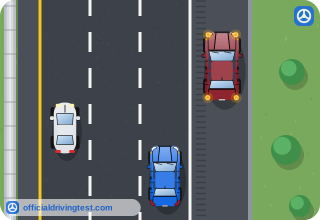
If your vehicle is disabled and you can reach an off-ramp or parking lot, what does the manual say to consider?
- Stopping in the lane to avoid damaging the vehicle
- Going there, even if you drive on a flat tire
- Waiting on the highway for a tow truck to reach you
- Backing up to the previous exit
Show answer
Correct answer: Going there, even if you drive on a flat tire
You can consider reaching an off-ramp or parking lot even if it means driving on a flat tire or damaging a rim, because the further you are from traffic, the safer you will be.
Source: Maryland Driver’s Manual (October 2025 Edition (DL-002 10-25)), page 44
-
Where must you never stop or park when your vehicle is disabled?
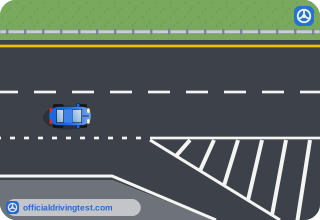
- On the shoulder of the road, away from the lanes
- In a parking lot off the road
- Behind a traffic barrier near the road
- In the triangular painted zones where ramps exit
Show answer
Correct answer: In the triangular painted zones where ramps exit
The manual says never to stop or park in the triangular shaped painted zones where a ramp exits the road.
Source: Maryland Driver’s Manual (October 2025 Edition (DL-002 10-25)), page 44
-
If you can remain in your vehicle after it is hit or disabled, what should you do?
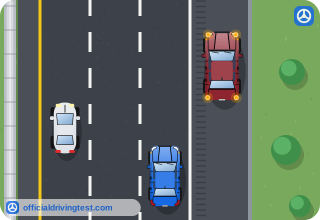
- Stay buckled and face forward
- Unbuckle so you can leave quickly
- Turn to face the rear to watch traffic
- Lie down across the seats
Show answer
Correct answer: Stay buckled and face forward
If you can remain in your vehicle, stay buckled and face forward, because vehicles have safety features that help protect you if another vehicle hits yours.
Source: Maryland Driver’s Manual (October 2025 Edition (DL-002 10-25)), page 44
-
If it is not safe or possible to remain in your vehicle, when should you get out?
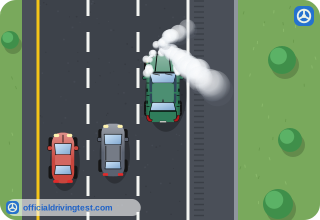
- As soon as the vehicle stops
- Only after the police arrive
- At the safest time for everyone
- After the next vehicle passes you
Show answer
Correct answer: At the safest time for everyone
You should watch what is happening around you and pick the safest time for everyone to get out.
Source: Maryland Driver’s Manual (October 2025 Edition (DL-002 10-25)), page 44
-
After you get out of a disabled vehicle, where should you go?
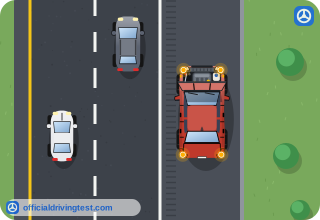
- Behind an embankment, traffic barrier, or guard-rail
- Beside the vehicle, on the side away from traffic
- Behind the vehicle, close to the lane
- In front of the vehicle, on the shoulder
Show answer
Correct answer: Behind an embankment, traffic barrier, or guard-rail
The manual says not to stand near the vehicle but to move quickly away from the road and get behind an embankment, traffic barrier, or guard-rail.
Source: Maryland Driver’s Manual (October 2025 Edition (DL-002 10-25)), page 44
-
When you have left a disabled vehicle and moved away from the road, which way should you face?
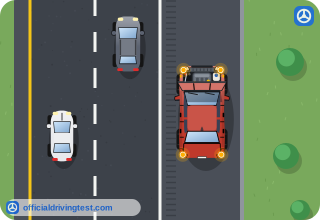
- Away from the road
- Toward your vehicle
- Toward oncoming traffic
- With your back to traffic
Show answer
Correct answer: Toward oncoming traffic
If possible, move to higher ground, face oncoming traffic, and remain alert in case a vehicle veers into your path.
Source: Maryland Driver’s Manual (October 2025 Edition (DL-002 10-25)), page 44