Maryland: Distracted and drowsy driving Practice Test
Cell phones and other distractions, the limits on new drivers’ phone use, and the danger signs of drowsy driving.
Independent educational site · not affiliated with any government agency or DMV
Ready? Test yourself
- Instant feedback with an explanation
- Every answer cites its source in the manual
- Your best score is saved on this device
Questions are original and based on the official manual "Maryland Driver’s Manual" (October 2025 Edition (DL-002 10-25)), Maryland Motor Vehicle Administration.
All 23 questions in this practice test
Take the test above first, then use this list to study. Tap “Show answer” to see the correct answer and explanation.
Show the questions and answersHide the questions
-
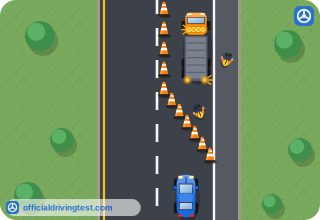
Which of these should you avoid while driving through a work zone?
- Checking your mirrors
- Using your turn signals
- Using a cell phone
- Reading posted signs
Show answer
Correct answer: Using a cell phone
The manual says to minimize distractions in a work zone by avoiding cell phones, changing radio stations, eating and other distractions.
Source: Maryland Driver’s Manual (October 2025 Edition (DL-002 10-25)), page 31
-
Which statement about cell phone use while driving matches the manual?
- Hand-held calls are legal, but texting while driving is not
- Texting is legal as long as you hold the phone below the wheel
- It is illegal to use a hand-held cell phone, including texting
- Using a hand-held phone is illegal only on highways and interstates
Show answer
Correct answer: It is illegal to use a hand-held cell phone, including texting
It is illegal to use a hand-held cell phone, including texting, while driving.
Source: Maryland Driver’s Manual (October 2025 Edition (DL-002 10-25)), page 35
-
If you use your phone hands-free while driving, what does the manual say you should do?
- Use it only on roads with light traffic
- Use it as little as possible
- Use it only when driving slowly
- Use it only for calls from family
Show answer
Correct answer: Use it as little as possible
If you use your phone hands-free, you should use it as little as possible.
Source: Maryland Driver’s Manual (October 2025 Edition (DL-002 10-25)), page 35
-
The manual says to use your cell phone only in what situation, and to have a passenger make the call if possible?
- In heavy traffic
- On long trips
- At night
- In emergencies
Show answer
Correct answer: In emergencies
Use your cell phone only in emergencies and, if possible, have a passenger make the call.
Source: Maryland Driver’s Manual (October 2025 Edition (DL-002 10-25)), page 35
-
If you must make a phone call while driving, what does the manual advise?
- Pull safely off the road and stop before calling
- Slow down and drive in the right lane
- Wait until you are on a straight road
- Wait for a red light and then make the call
Show answer
Correct answer: Pull safely off the road and stop before calling
If you must make a call, pull safely off the road and stop before making the call.
Source: Maryland Driver’s Manual (October 2025 Edition (DL-002 10-25)), page 35
-
Which of these is a cell phone safety tip given in the manual?
- Keep the phone within easy reach on the seat
- Take calls only while the car is moving slowly
- Keep your telephone conversations short
- Answer calls quickly so the caller does not wait
Show answer
Correct answer: Keep your telephone conversations short
One safety tip for phone use while driving is to keep your telephone conversations short.
Source: Maryland Driver’s Manual (October 2025 Edition (DL-002 10-25)), page 35
-
What does the manual advise doing with incoming calls while you are driving?
- Answer them quickly and hang up
- Let your voicemail answer them
- Answer them only at stop signs
- Answer them only if the caller is a family member
Show answer
Correct answer: Let your voicemail answer them
The manual advises letting your voicemail answer incoming calls.
Source: Maryland Driver’s Manual (October 2025 Edition (DL-002 10-25)), page 35
-
What is the only exception to the rule that drivers under 18 may not use a cell phone, even hands-free?
- Making a 911 emergency call
- Calling a parent or guardian
- Using a map or GPS app
- Calling a tow truck service
Show answer
Correct answer: Making a 911 emergency call
The only exception is that a driver under 18 may use a cell phone to make a 911 emergency call.
Source: Maryland Driver’s Manual (October 2025 Edition (DL-002 10-25)), page 35
-
The manual says sleepiness slows reaction time, decreases awareness, and impairs judgment just like what?
- Bad weather
- Loud music
- Drugs or alcohol
- Worn tires
Show answer
Correct answer: Drugs or alcohol
Sleepiness slows reaction time, decreases awareness, and impairs judgment, just like drugs or alcohol.
Source: Maryland Driver’s Manual (October 2025 Edition (DL-002 10-25)), page 35
-
Which driver has a higher risk of feeling sleepy (drowsy)?
- A driver who takes only short daytime trips
- A driver who drives many miles each day
- A driver who always drives with passengers
- A driver who drives only on weekends
Show answer
Correct answer: A driver who drives many miles each day
People who drive many miles each day, people with sleep disorders, and people taking certain medications have a higher risk of drowsiness.
Source: Maryland Driver’s Manual (October 2025 Edition (DL-002 10-25)), page 35
-
Which of these is listed as a danger sign that you may be drowsy?
- You keep a steady speed in your lane
- You notice every sign you pass
- You remember each mile you have driven
- You can’t stop yawning
Show answer
Correct answer: You can’t stop yawning
Not being able to stop yawning is listed as a danger sign of drowsy driving.
Source: Maryland Driver’s Manual (October 2025 Edition (DL-002 10-25)), page 35
-
Which of these is listed as a danger sign that you may be drowsy?
- You don’t remember driving the last few miles
- You recall every turn you made
- You feel more awake with each mile
- You notice each vehicle that passes you
Show answer
Correct answer: You don’t remember driving the last few miles
Not remembering driving the last few miles is listed as a danger sign of drowsy driving.
Source: Maryland Driver’s Manual (October 2025 Edition (DL-002 10-25)), page 35
-
Which of these is listed as a danger sign that you may be drowsy?
- You noticed each landmark you passed
- You signaled every lane change early
- You missed your exit
- You kept the same speed all trip
Show answer
Correct answer: You missed your exit
Missing your exit is listed as a danger sign of drowsy driving.
Source: Maryland Driver’s Manual (October 2025 Edition (DL-002 10-25)), page 35
-
Which of these is listed as a danger sign that you may be drowsy?
- Your hands feel cold on the wheel
- You keep driving out of your lane
- You feel hungry during the trip
- You are listening to the radio
Show answer
Correct answer: You keep driving out of your lane
Repeatedly driving out of your lane is listed as a danger sign of drowsy driving.
Source: Maryland Driver’s Manual (October 2025 Edition (DL-002 10-25)), page 35
-
If you become tired or sleepy while driving, what does the manual say is best?
- Open the window and turn up the radio
- Drive faster to finish the trip sooner
- Keep driving but slow down
- Rest or change drivers
Show answer
Correct answer: Rest or change drivers
If you become tired or sleepy while driving, it is best to rest or change drivers.
Source: Maryland Driver’s Manual (October 2025 Edition (DL-002 10-25)), page 35
-
According to the manual, how does being tired affect your driving?
- It dulls your mind and slows down your reactions
- It sharpens your focus but slows your hands
- It speeds up your reactions but dulls your mind
- It affects your eyesight but not your reactions
Show answer
Correct answer: It dulls your mind and slows down your reactions
Being tired dulls your mind and slows down your reactions, making driving very dangerous.
Source: Maryland Driver’s Manual (October 2025 Edition (DL-002 10-25)), page 35
-
Distracted driving is when you take your eyes, hands, or especially what, away from driving?
- Your feet
- Your voice
- Your mind
- Your ears
Show answer
Correct answer: Your mind
The manual defines distracted driving as taking your eyes, hands, or especially your mind away from driving.
Source: Maryland Driver’s Manual (October 2025 Edition (DL-002 10-25)), page 34
-
According to the manual, which of these causes more crashes reported to the police than anything else?
- Drowsy driving
- Distracted driving
- Aggressive driving
- Driving in bad weather
Show answer
Correct answer: Distracted driving
Distracted driving causes more crashes that are reported to the police than anything else.
Source: Maryland Driver’s Manual (October 2025 Edition (DL-002 10-25)), page 34
-
Which of these is listed as an activity that contributes to distracted driving?
- Checking your mirrors before a lane change
- Keeping both hands on the steering wheel
- Looking well ahead down the road
- Adjusting or programming a GPS
Show answer
Correct answer: Adjusting or programming a GPS
Adjusting or programming a GPS is listed among the activities that contribute to distracted driving.
Source: Maryland Driver’s Manual (October 2025 Edition (DL-002 10-25)), page 34
-
Where should you constantly check for other vehicles?
- In front, behind, and next to you
- Only in front of you and behind you
- Only next to you when you change lanes
- Only behind you at intersections
Show answer
Correct answer: In front, behind, and next to you
You should constantly check where other vehicles are in front, behind, and next to you.
Source: Maryland Driver’s Manual (October 2025 Edition (DL-002 10-25)), page 34
-
Above all, what should you always do when driving?
- Rely on your vehicle’s technology to stay in your lane
- Stay focused and stay in control of your vehicle
- Drive at the speed of the vehicles around you
- Keep your eyes on the dashboard icons
Show answer
Correct answer: Stay focused and stay in control of your vehicle
The manual says above all to always stay focused when driving and stay in control of your vehicle.
Source: Maryland Driver’s Manual (October 2025 Edition (DL-002 10-25)), page 42
-
If you are under 18 and have a Provisional License or a Learner’s Permit, what is the only exception to the ban on using wireless communication devices while driving?
- A 911 emergency call
- A call to a parent or guardian
- A call made through a hands-free phone
- A call to a tow truck service
Show answer
Correct answer: A 911 emergency call
The wireless device restriction, which includes hands-free phones, has only one exception: a 911 emergency call.
Source: Maryland Driver’s Manual (October 2025 Edition (DL-002 10-25)), page 47
-
Which of these may you use while driving?
- Hearing aid devices
- Earplugs in both ears
- Headsets in both ears
- Earphones in both ears
Show answer
Correct answer: Hearing aid devices
The manual prohibits earplugs, headsets, or earphones in both ears but says hearing aid devices are allowed.
Source: Maryland Driver’s Manual (October 2025 Edition (DL-002 10-25)), page 53