Maine: Sharing the road — Part 5 Practice Test
Bicycles and the three-foot passing rule, motorcycles and mopeds, trucks and buses and their No-Zones, school buses, slow-moving vehicles and wildlife. — Part 5
Independent educational site · not affiliated with any government agency or DMV
Ready? Test yourself
- Instant feedback with an explanation
- Every answer cites its source in the manual
- Your best score is saved on this device
Questions are original and based on the official manual "Maine Driver’s License Manual" (Rev 4/24), Maine Bureau of Motor Vehicles.
All 34 questions in this practice test
Take the test above first, then use this list to study. Tap “Show answer” to see the correct answer and explanation.
Show the questions and answersHide the questions
-
How can you avoid wind blast when you meet a truck?
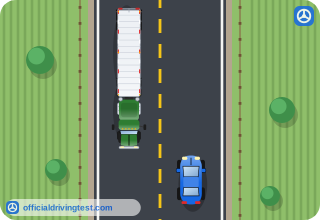
- Move as far left as you can in your lane
- Move as far right as you can in your lane
- Speed up so you meet the truck sooner
- Brake hard just before you meet the truck
Show answer
Correct answer: Move as far right as you can in your lane
To avoid wind blast when meeting a truck, move as far as you can to the rightmost portion of your lane.
Source: Maine Driver’s License Manual (Rev 4/24), page 10-8 · Open this page in the manual (Manual page 10-8)
-
If you are not sure about the speed of an oncoming truck, what is safer before you turn left?
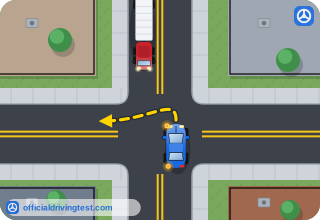
- Turn left quickly in front of it
- Flash your headlights at the driver
- Slow down in the middle of the intersection
- Wait until the truck has gone by
Show answer
Correct answer: Wait until the truck has gone by
Drivers often misjudge a vehicle's speed before turning left, so if you are unsure it is safer to wait until the truck has gone by.
Source: Maine Driver’s License Manual (Rev 4/24), page 10-8 · Open this page in the manual (Manual page 10-8)
-
When sharing the road with large trucks, why are stop lines at intersections placed where they are, according to the manual?
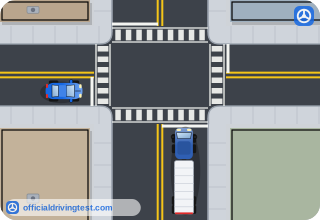
- To give larger vehicles more turning space
- To show where buses must load passengers
- To show where trucks must park
- To give a shorter distance for crossing
Show answer
Correct answer: To give larger vehicles more turning space
Stop lines at intersections are designed to give larger vehicles more turning space, so you should always stop behind them.
Source: Maine Driver’s License Manual (Rev 4/24), page 10-8 · Open this page in the manual (Manual page 10-8)
-
What should you not try to do with a truck at a single-lane construction zone?
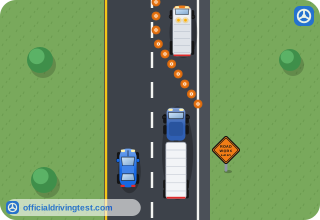
- Follow the truck into the zone
- Let the truck go into it first
- Beat the truck into the zone
- Stay well behind the truck
Show answer
Correct answer: Beat the truck into the zone
The manual says not to try to beat a truck into a single-lane construction zone, because trying to save a few seconds could cost you your life.
Source: Maine Driver’s License Manual (Rev 4/24), page 10-8 · Open this page in the manual (Manual page 10-8)
-
When road conditions are poor or visibility is limited, how much space should you give large vehicles?
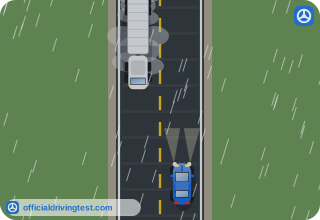
- The same space as in good weather
- An extra margin of space on all sides
- Less space, so the driver can see you
- Extra space only in front of the vehicle
Show answer
Correct answer: An extra margin of space on all sides
In poor weather or when visibility is limited, you should give large vehicles an extra margin of space on all sides.
Source: Maine Driver’s License Manual (Rev 4/24), page 10-8 · Open this page in the manual (Manual page 10-8)
-
What can forcing the driver of a large vehicle to use the brakes lead to when road conditions are poor?
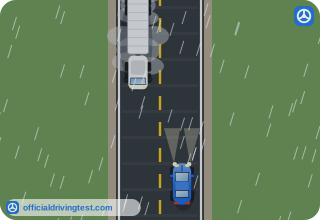
- Instant loss of the vehicle's headlights
- A flat tire on the vehicle
- Louder engine noise
- Skids or jackknife situations
Show answer
Correct answer: Skids or jackknife situations
When road conditions are poor, forcing a large vehicle driver to brake can lead to skids or jackknife situations.
Source: Maine Driver’s License Manual (Rev 4/24), page 10-8 · Open this page in the manual (Manual page 10-8)
-
What is a good rule for judging whether you are following a large vehicle too closely?
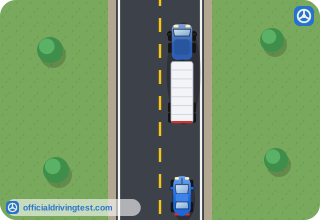
- If you cannot see its mirrors, you are too close
- If you can see its license plate, you are too close
- If you can see its mirrors, you are too close
- If its brake lights are on, you are too close
Show answer
Correct answer: If you cannot see its mirrors, you are too close
If you cannot see the mirrors of the large vehicle you are following, you are too close and in the driver's blind spot.
Source: Maine Driver’s License Manual (Rev 4/24), page 10-8 · Open this page in the manual (Manual page 10-8)
-
Besides the risk if the large vehicle stops quickly, what else does following a large vehicle too closely limit?
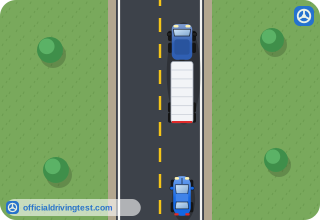
- The driver's use of the brakes
- Your use of the headlights
- Your visibility of the road ahead
- The vehicle's turning space
Show answer
Correct answer: Your visibility of the road ahead
If you follow too closely, it also limits your visibility of the road ahead.
Source: Maine Driver’s License Manual (Rev 4/24), page 10-8 · Open this page in the manual (Manual page 10-8)
-
What should you always do when following a large vehicle at night?
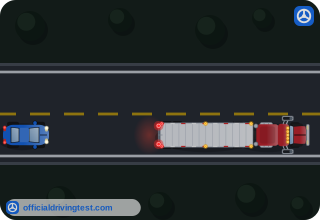
- Turn on your high beams
- Dim your headlights
- Turn off your headlights
- Flash your headlights to the driver
Show answer
Correct answer: Dim your headlights
Bright lights reflect off the mirrors of a large vehicle and make it difficult for the driver to see the road ahead, so always dim your headlights.
Source: Maine Driver’s License Manual (Rev 4/24), page 10-9 · Open this page in the manual (Manual page 10-9)
-
Before passing a large vehicle, where should you check to be sure you have enough room?
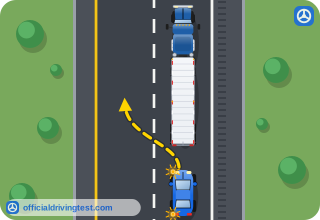
- Only ahead of you, in the direction of travel
- Only behind you, in your rearview mirror
- Only in the mirrors of the large vehicle
- Ahead, behind and in the direction you will move
Show answer
Correct answer: Ahead, behind and in the direction you will move
Before passing a large vehicle, check ahead, behind and in the direction you will move to be sure you have enough room to complete the maneuver.
Source: Maine Driver’s License Manual (Rev 4/24), page 10-9 · Open this page in the manual (Manual page 10-9)
-
When is it acceptable to pass a large vehicle?
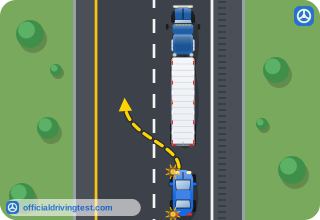
- Only in a legal passing zone, without speeding
- Whenever you are in a hurry to get ahead
- When you can speed to get around it quickly
- Whenever the truck driver gives you a signal
Show answer
Correct answer: Only in a legal passing zone, without speeding
Never pass unless you are in a legal passing zone, and do not pass if you must speed in order to complete the maneuver.
Source: Maine Driver’s License Manual (Rev 4/24), page 10-9 · Open this page in the manual (Manual page 10-9)
-
After you pass a truck or bus, when may you pull back into the lane?
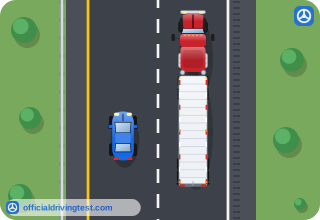
- As soon as your front bumper is past its front wheels
- When its driver flashes the headlights to let you in
- When you can clearly see its front in your rearview mirror
- As soon as the driver slows down to let you return
Show answer
Correct answer: When you can clearly see its front in your rearview mirror
Do not pull back into the lane until you can clearly see the front of the vehicle in your rearview mirror.
Source: Maine Driver’s License Manual (Rev 4/24), page 10-9 · Open this page in the manual (Manual page 10-9)
-
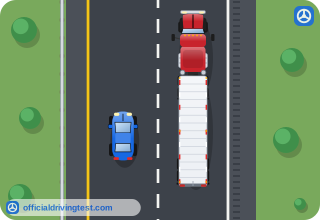
Before returning to the right lane after passing a truck or bus, what else should you do?
- Tap your brakes twice to warn the driver behind you
- Check your blind spot by looking over your shoulder
- Flash your high beams to signal the truck driver
- Turn on your hazard flashers for several seconds
Show answer
Correct answer: Check your blind spot by looking over your shoulder
Check your blind spot by looking over your shoulder before returning to the right lane.
Source: Maine Driver’s License Manual (Rev 4/24), page 10-9 · Open this page in the manual (Manual page 10-9)
-
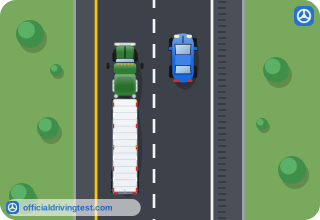
At highway speed, what does a large vehicle push to the side and rear?
- A cloud of exhaust
- A wave of water
- A line of vehicles
- A cushion of air
Show answer
Correct answer: A cushion of air
Because of its size, a large vehicle at highway speed pushes a cushion of air to the side and rear.
Source: Maine Driver’s License Manual (Rev 4/24), page 10-9 · Open this page in the manual (Manual page 10-9)
-
What should you do when a large vehicle passes you?
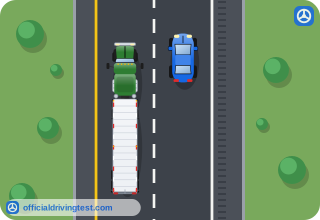
- Maintain your speed or slow down slightly
- Speed up to stay beside it as long as you can
- Brake hard so that it can pass you quickly
- Move to the left edge of your lane
Show answer
Correct answer: Maintain your speed or slow down slightly
Do not speed up when a large vehicle passes you; maintain your speed or slow down slightly to allow it to pass.
Source: Maine Driver’s License Manual (Rev 4/24), page 10-9 · Open this page in the manual (Manual page 10-9)
-
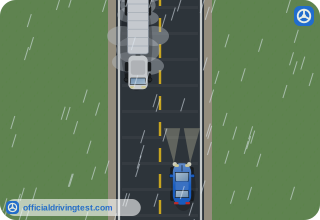
On wet roads, what is a good idea before large vehicles pass you?
- Turn your headlights off completely
- Move onto the shoulder and stop
- Have your windshield wipers on
- Open your windows for better sight
Show answer
Correct answer: Have your windshield wipers on
Large vehicles create a lot of spray on wet roads, so have your windshield wipers on before they pass you.
Source: Maine Driver’s License Manual (Rev 4/24), page 10-9 · Open this page in the manual (Manual page 10-9)
-
What does a fluorescent or reflective orange and red triangle on the rear of a vehicle indicate?
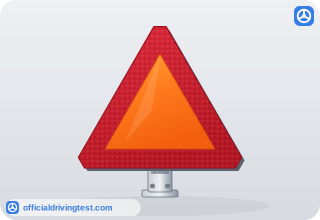
- The vehicle is moving slowly
- The vehicle is carrying a wide load
- The vehicle is a school bus
- The vehicle is stopped for repairs
Show answer
Correct answer: The vehicle is moving slowly
A fluorescent or reflective orange and red triangle on the rear marks a slow-moving vehicle.
Source: Maine Driver’s License Manual (Rev 4/24), page 10-10 · Open this page in the manual (Manual page 10-10)
-
What should you be sure of before you pass a slow-moving vehicle?
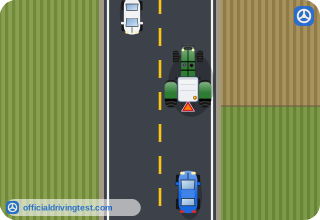
- That the vehicle has pulled over
- That its driver has signaled you
- That it is safe to pass
- That the road is a one-way street
Show answer
Correct answer: That it is safe to pass
Use caution when you see a slow-moving vehicle and be sure it is safe before you pass.
Source: Maine Driver’s License Manual (Rev 4/24), page 10-10 · Open this page in the manual (Manual page 10-10)
-
What should you remember when you pass farm machinery?
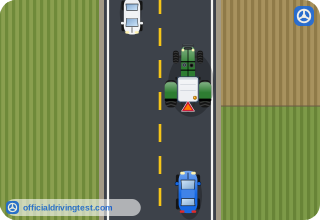
- The driver will move over for you
- The driver may not see or hear your vehicle
- The driver always uses a horn to signal
- The driver can see you in the mirrors
Show answer
Correct answer: The driver may not see or hear your vehicle
Pass farm machinery with care, remembering that the driver may not see or hear your vehicle.
Source: Maine Driver’s License Manual (Rev 4/24), page 10-11 · Open this page in the manual (Manual page 10-11)
-
Why should you slow down and proceed cautiously when you approach or pass animals along the road?
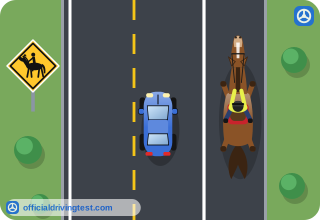
- They always stay calm and still near roads
- They can be controlled easily by their riders
- They are frightened only when a horn is used
- They are easily frightened by passing vehicles
Show answer
Correct answer: They are easily frightened by passing vehicles
Animals driven, ridden, or led along the side of a roadway are easily frightened by passing vehicles.
Source: Maine Driver’s License Manual (Rev 4/24), page 10-11 · Open this page in the manual (Manual page 10-11)
-
What rights do horse drawn vehicles and horseback riders have on the roadway?
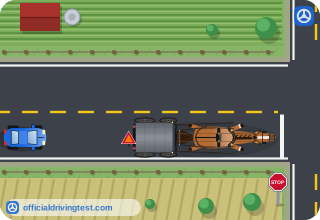
- The same right to the roadway as a motorist
- The right to the roadway only on rural roads
- A greater right than a motorist
- No right to use a public road
Show answer
Correct answer: The same right to the roadway as a motorist
Horse drawn vehicles and horseback riders have the same right to the roadway as a motorist does, and they must follow the same rules as vehicles.
Source: Maine Driver’s License Manual (Rev 4/24), page 10-11 · Open this page in the manual (Manual page 10-11)
-
What should you not do near an animal being ridden or driven on the road?
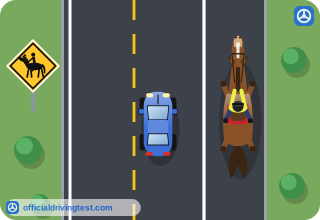
- Slow down and proceed cautiously
- Watch for posted warning signs
- Use your horn or "rev" the engine
- Pass the animal with care
Show answer
Correct answer: Use your horn or "rev" the engine
Do not use your horn or "rev" the engine near an animal, as this may scare it and cause a crash.
Source: Maine Driver’s License Manual (Rev 4/24), page 10-11 · Open this page in the manual (Manual page 10-11)
-
What is against the law near a public way?
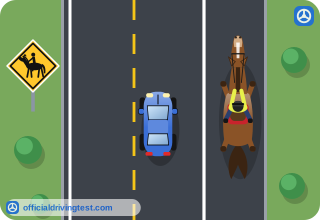
- Passing a horseback rider on any public road
- Purposefully frightening a ridden or driven animal
- Driving slowly behind a horse drawn vehicle
- Stopping to let an animal cross the road ahead
Show answer
Correct answer: Purposefully frightening a ridden or driven animal
It is against the law to purposefully frighten any animal being ridden, driven, or led on or near a public way.
Source: Maine Driver’s License Manual (Rev 4/24), page 10-11 · Open this page in the manual (Manual page 10-11)
-
Where should you watch out for left turns by horse drawn vehicles or riders?
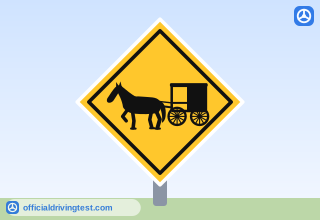
- Onto highway ramps
- Across railroad tracks
- Into parking garages
- Into fields and driveways
Show answer
Correct answer: Into fields and driveways
The manual says to watch out for left turns into fields and driveways in areas where horse drawn vehicles and horseback riders are likely.
Source: Maine Driver’s License Manual (Rev 4/24), page 10-11 · Open this page in the manual (Manual page 10-11)
-
In which month do collisions with deer peak, during breeding season?
- May
- July
- November
- March
Show answer
Correct answer: November
Collisions with deer increase in the autumn, peaking in November, during breeding season.
Source: Maine Driver’s License Manual (Rev 4/24), page 11-7 · Open this page in the manual (Manual page 11-7)
-
Which are the peak moose collision months?
- March and April
- May and June
- July and August
- October and November
Show answer
Correct answer: May and June
Collisions with moose increase dramatically in May and June.
Source: Maine Driver’s License Manual (Rev 4/24), page 11-7 · Open this page in the manual (Manual page 11-7)
-
During how many months of the year can wildlife crashes happen?
- Only the autumn months
- Only May and June
- Only the months of mating season
- All 12 months
Show answer
Correct answer: All 12 months
Wildlife crashes can happen during all 12 months of the year.
Source: Maine Driver’s License Manual (Rev 4/24), page 11-7 · Open this page in the manual (Manual page 11-7)
-
Why are moose even harder to see than deer when it is dark?
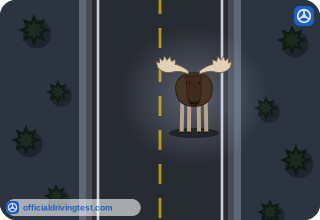
- Moose are so tall that their eyes are not reflected by headlights
- Moose eyes reflect so much light that they blind drivers
- Moose stay far from the road until after midnight
- Moose are completely silent when they move
Show answer
Correct answer: Moose are so tall that their eyes are not reflected by headlights
Because moose are so much taller, their eyes are typically not reflected in the headlights, which gives you less time to avoid a collision.
Source: Maine Driver’s License Manual (Rev 4/24), page 11-7 · Open this page in the manual (Manual page 11-7)
-
When are moose and deer most active?
- At midday
- From mid-morning to late afternoon
- Between dusk and dawn
- Only after midnight
Show answer
Correct answer: Between dusk and dawn
Moose and deer are most active between dusk and dawn as they tend to travel at night.
Source: Maine Driver’s License Manual (Rev 4/24), page 11-7 · Open this page in the manual (Manual page 11-7)
-
Where are Maine's moose and deer crossing signs placed?
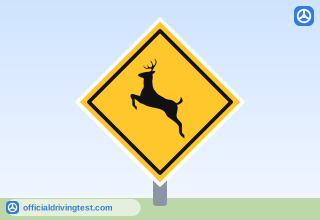
- At every mile marker along the state's rural roads
- Where wildlife is concentrated and collisions are a problem
- Where roads cross rivers, streams or large lakes
- Where hunting is allowed
Show answer
Correct answer: Where wildlife is concentrated and collisions are a problem
The locations are chosen based on high concentrations of wildlife and where collisions are a problem.
Source: Maine Driver’s License Manual (Rev 4/24), page 11-8 · Open this page in the manual (Manual page 11-8)
-
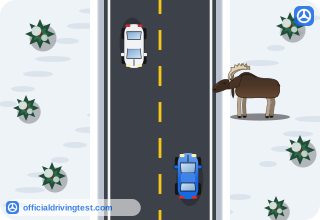
If you see one deer or moose cross the road, what should you expect?
- No other animals will cross
- The animal will cross back at once
- The others will stay away from the road
- More animals nearby that may cross as well
Show answer
Correct answer: More animals nearby that may cross as well
Moose and deer often travel in small groups, so more animals nearby may cross as well.
Source: Maine Driver’s License Manual (Rev 4/24), page 11-8 · Open this page in the manual (Manual page 11-8)
-
During which months does moose mating season run?
- August through October
- May through July
- November through January
- March through May
Show answer
Correct answer: August through October
The manual says mating season runs from August through October, a time for extreme caution around moose.
Source: Maine Driver’s License Manual (Rev 4/24), page 11-8 · Open this page in the manual (Manual page 11-8)
-
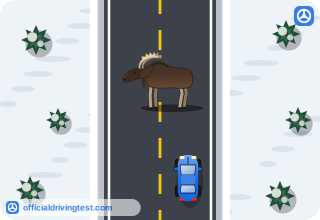
What should you do if you see a moose standing in or near the roadway?
- Drive around it as quickly as you possibly can
- Get out and chase it off the road
- Slow down and give it plenty of room and time to leave
- Get out to observe it from a distance
Show answer
Correct answer: Slow down and give it plenty of room and time to leave
You should slow down, not try to drive around the moose, stay in your vehicle, and give it room and time to wander off.
Source: Maine Driver’s License Manual (Rev 4/24), page 11-8 · Open this page in the manual (Manual page 11-8)
-
Why should you stay in your vehicle when a moose is in or near the roadway?
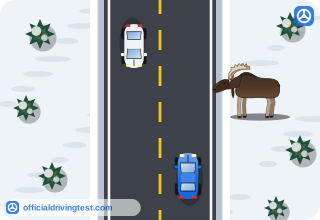
- Moose will not leave the road while people are outside
- Moose are unpredictable and may attack you or your vehicle
- Moose are attracted to the sound of human voices
- Leaving your vehicle is against the law
Show answer
Correct answer: Moose are unpredictable and may attack you or your vehicle
Getting out could put you or other drivers at risk because moose can be unpredictable and may attack you or your vehicle.
Source: Maine Driver’s License Manual (Rev 4/24), page 11-8 · Open this page in the manual (Manual page 11-8)