Maine: Sharing the road — Part 1 Practice Test
Bicycles and the three-foot passing rule, motorcycles and mopeds, trucks and buses and their No-Zones, school buses, slow-moving vehicles and wildlife. — Part 1
Independent educational site · not affiliated with any government agency or DMV
Ready? Test yourself
- Instant feedback with an explanation
- Every answer cites its source in the manual
- Your best score is saved on this device
Questions are original and based on the official manual "Maine Driver’s License Manual" (Rev 4/24), Maine Bureau of Motor Vehicles.
All 34 questions in this practice test
Take the test above first, then use this list to study. Tap “Show answer” to see the correct answer and explanation.
Show the questions and answersHide the questions
-
How does the manual say you should act when other drivers make mistakes or act rude?
- Sound your horn to correct them
- Follow them closely until they notice
- Speed up to pass them
- Be patient and courteous
Show answer
Correct answer: Be patient and courteous
The manual says not to get angry when other drivers make mistakes or act rude, but to be patient and courteous.
Source: Maine Driver’s License Manual (Rev 4/24), page 3-5 · Open this page in the manual (Manual page 3-5)
-
Before turning left, whom must a motor vehicle operator yield to?
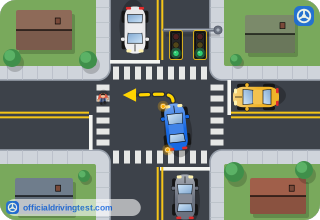
- Nobody, because a driver turning left always has priority over cyclists
- Bicycle and roller ski operators approaching from the opposite direction
- Only pedestrians on the far sidewalk
- Only vehicles parked at the curb
Show answer
Correct answer: Bicycle and roller ski operators approaching from the opposite direction
Motor vehicle operators turning left must yield to bicycle and roller ski operators approaching from the opposite direction.
Source: Maine Driver’s License Manual (Rev 4/24), page 6-2 · Open this page in the manual (Manual page 6-2)
-
On any section of the Maine Turnpike or Interstate-95 that has three lanes in one direction, which lanes may trucks, including truck tractors, operate in?
- Only the two farthest left-hand lanes
- Only the two farthest right-hand lanes
- Any of the three lanes without any restriction
- Only the middle lane of the three lanes
Show answer
Correct answer: Only the two farthest right-hand lanes
On three-lane sections of the Maine Turnpike or I-95, trucks may only operate in the two farthest right-hand lanes.
Source: Maine Driver’s License Manual (Rev 4/24), page 6-9 · Open this page in the manual (Manual page 6-9)
-
On a three-lane section of the Maine Turnpike or Interstate-95, which type of truck is excluded from the two-right-lanes restriction?
- Truck tractors
- Tank trucks
- Delivery vans
- Pickup trucks
Show answer
Correct answer: Pickup trucks
The rule for three-lane sections of the Maine Turnpike and I-95 applies to trucks, including truck tractors, but excludes pickup trucks.
Source: Maine Driver’s License Manual (Rev 4/24), page 6-9 · Open this page in the manual (Manual page 6-9)
-
When you pass a bicycle, Maine law requires at least how much space between the right side of your vehicle and the bicycle?
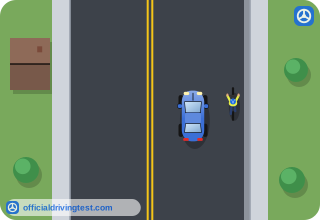
- One foot
- Two feet
- Five feet
- Three feet
Show answer
Correct answer: Three feet
Maine law requires at least three feet of space between the right side of your vehicle and the bicycle as you pass.
Source: Maine Driver’s License Manual (Rev 4/24), page 7-8 · Open this page in the manual (Manual page 7-8)
-
What should you do when passing bicyclists?
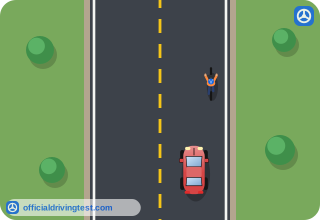
- Slow down and give them as much space as you can
- Pass quickly to limit your time in their lane
- Sound your horn and stay near the center line
- Keep your speed and move only slightly left
Show answer
Correct answer: Slow down and give them as much space as you can
When passing bicyclists, you should slow down and give them as much space as you can.
Source: Maine Driver’s License Manual (Rev 4/24), page 7-8 · Open this page in the manual (Manual page 7-8)
-
According to the manual, on which of these is it illegal to pass a stopped school bus with red lights flashing?
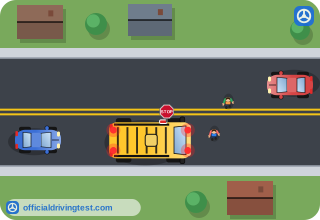
- Only highways posted with a school zone sign
- Only highways with a speed limit under 40 mph
- Any undivided highway
- Only highways with no roadside shoulder
Show answer
Correct answer: Any undivided highway
It is illegal to pass a stopped school bus with red lights flashing on any undivided highway.
Source: Maine Driver’s License Manual (Rev 4/24), page 7-8 · Open this page in the manual (Manual page 7-8)
-
Besides on any undivided highway, where else is it illegal in Maine to pass a stopped school bus with red lights flashing?
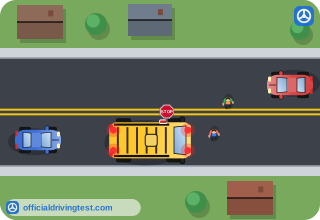
- Only on school property
- On school property and in any parking area
- Only in parking areas with marked bus stops
- Only within 500 feet of a school
Show answer
Correct answer: On school property and in any parking area
It is illegal to pass a stopped school bus with red lights flashing on school property, on any undivided highway or parking area in Maine.
Source: Maine Driver’s License Manual (Rev 4/24), page 7-8 · Open this page in the manual (Manual page 7-8)
-
You approach a stopped school bus with its red lights flashing from either direction. What must you do?
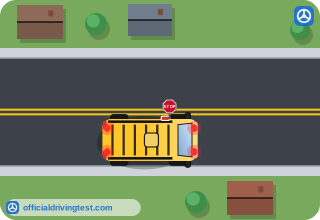
- Slow down and pass with great care
- Stop only if you are traveling behind the bus
- Pull to the right and go on when no children are visible
- Come to a complete stop in front of or behind the bus
Show answer
Correct answer: Come to a complete stop in front of or behind the bus
You must bring your vehicle to a complete stop to the front or to the rear of the school bus.
Source: Maine Driver’s License Manual (Rev 4/24), page 7-8 · Open this page in the manual (Manual page 7-8)
-
How long must you wait when stopped for a school bus with its red lights flashing?
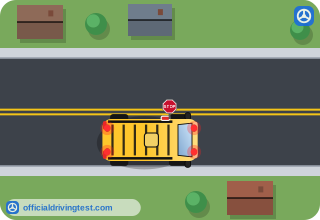
- While children are getting on or off the bus
- Until the bus has been stopped for one minute
- Until all other traffic has passed
- Until the next car behind you stops
Show answer
Correct answer: While children are getting on or off the bus
You must wait while children are getting on or off the bus.
Source: Maine Driver’s License Manual (Rev 4/24), page 7-8 · Open this page in the manual (Manual page 7-8)
-
After stopping for a school bus, when may you proceed?
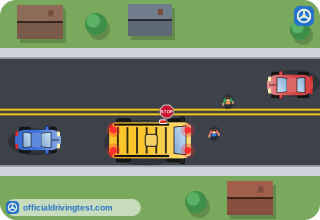
- When the children are out of sight
- Once the bus has been stopped for a full minute
- When the bus resumes motion or its driver signals you
- When no children are in the roadway
Show answer
Correct answer: When the bus resumes motion or its driver signals you
You must not proceed until the bus resumes motion or until signaled by the school bus driver to do so.
Source: Maine Driver’s License Manual (Rev 4/24), page 7-8 · Open this page in the manual (Manual page 7-8)
-
What does the manual say about violations of the rules for stopping for school buses?
- They carry only a warning for a first offense
- They carry severe penalties
- They carry penalties only on school property
- They are not penalized when no children are present
Show answer
Correct answer: They carry severe penalties
Violations of the school bus rules carry severe penalties.
Source: Maine Driver’s License Manual (Rev 4/24), page 7-8 · Open this page in the manual (Manual page 7-8)
-
On a multi-lane divided highway, which signals from a school bus require you to stop?
- Amber warning lights flashing by themselves
- The bus headlights flashing on and off
- Hazard lights flashing by themselves
- Red lights flashing and/or stop arm extended
Show answer
Correct answer: Red lights flashing and/or stop arm extended
You must stop for a school bus with red lights flashing and/or stop arm extended.
Source: Maine Driver’s License Manual (Rev 4/24), page 7-9 · Open this page in the manual (Manual page 7-9)
-
On a multi-lane divided highway, what may you do after the school bus red lights have stopped flashing and the stop arm is no longer visible?
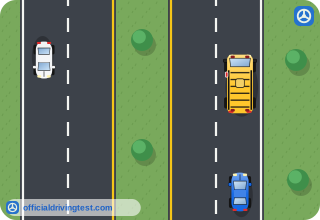
- Go ahead slowly while watching for children
- Go ahead at the normal speed of traffic
- Go ahead only after counting to ten
- Go ahead and sound your horn
Show answer
Correct answer: Go ahead slowly while watching for children
After the red lights stop flashing and the stop arm is no longer visible, you may go ahead slowly while watching for children.
Source: Maine Driver’s License Manual (Rev 4/24), page 7-9 · Open this page in the manual (Manual page 7-9)
-
What must you do if the roadway has a solid divider between you and a school bus with red lights flashing?
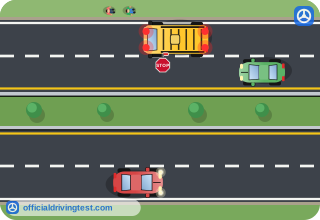
- You must stop and wait for the driver's signal
- You must slow to 10 mph and pass
- You do not have to stop
- You must stop but may then go at once
Show answer
Correct answer: You do not have to stop
If the roadway has a solid divider between you and the bus, you do not have to stop.
Source: Maine Driver’s License Manual (Rev 4/24), page 7-9 · Open this page in the manual (Manual page 7-9)
-
Scanning the roadside helps you see which of the following?
- Whether a vehicle behind you is following too closely
- The condition of your own tires
- Gaps in traffic on the other side of town
- Signs warning of conditions ahead
Show answer
Correct answer: Signs warning of conditions ahead
Scanning the roadside helps you see signs warning of conditions ahead, as well as vehicles, people and animals near the road.
Source: Maine Driver’s License Manual (Rev 4/24), page 8-2 · Open this page in the manual (Manual page 8-2)
-
In which two months do many cars strike deer, especially?
- January and February
- October and November
- March and April
- June and July
Show answer
Correct answer: October and November
The manual says many cars strike deer, especially in October and November.
Source: Maine Driver’s License Manual (Rev 4/24), page 8-2 · Open this page in the manual (Manual page 8-2)
-
If you see a deer, what should you do?
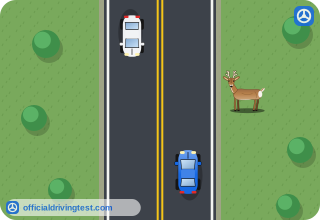
- Speed up to pass it quickly and keep going
- Turn off your headlights and wait in the lane
- Sound the horn and look for other deer following
- Swerve into the opposite lane to go around it
Show answer
Correct answer: Sound the horn and look for other deer following
The manual says if you see a deer, sound the horn and look for other deer following.
Source: Maine Driver’s License Manual (Rev 4/24), page 8-2 · Open this page in the manual (Manual page 8-2)
-
Why is it useful to see someone getting into a parked car well ahead of time?
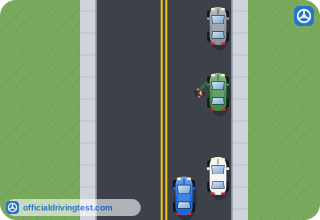
- The door might open again, or the car might move into your lane
- The driver will always wait until you have passed the car
- The driver will probably pull out behind you after you pass
- The car will stay parked for several minutes after you pass
Show answer
Correct answer: The door might open again, or the car might move into your lane
If you see it early, you know the car door might open again or the car might suddenly move into your lane.
Source: Maine Driver’s License Manual (Rev 4/24), page 8-2 · Open this page in the manual (Manual page 8-2)
-
Why is it very important to look to the sides when there is a lot of activity along the side of the road?
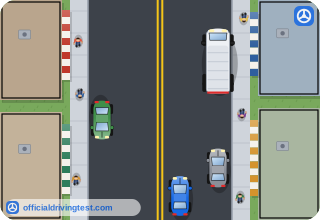
- Drivers behind you are more likely to speed up
- There is a good chance that someone will cross or enter
- Posted speed limits are usually higher there
- Traffic signals are less likely to work
Show answer
Correct answer: There is a good chance that someone will cross or enter
The manual says that with a lot of roadside activity there is a good chance someone will cross or enter.
Source: Maine Driver’s License Manual (Rev 4/24), page 8-3 · Open this page in the manual (Manual page 8-3)
-
What kind of problem driver is someone backing out of a driveway or parking space?
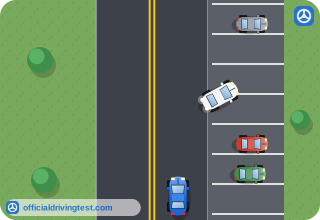
- A driver who is confused
- A driver who is distracted
- A driver who cannot see you
- A driver who is in trouble
Show answer
Correct answer: A driver who cannot see you
The manual lists drivers backing out of driveways or parking spaces among drivers who cannot see you.
Source: Maine Driver’s License Manual (Rev 4/24), page 8-4 · Open this page in the manual (Manual page 8-4)
-
Which of these drivers may not be able to see you?
- A driver who is traveling at exactly the posted speed limit
- A driver who is using a turn signal well before a turn
- A driver whose windows are covered with snow or ice
- A driver with the headlights and wipers turned on
Show answer
Correct answer: A driver whose windows are covered with snow or ice
The manual lists drivers whose windows are covered with snow or ice among people who cannot see you.
Source: Maine Driver’s License Manual (Rev 4/24), page 8-4 · Open this page in the manual (Manual page 8-4)
-
Even when others can see you, what should you do if you think they may be distracted?
- Allow extra room
- Sound your horn continuously
- Speed up to pass them
- Flash your high beams
Show answer
Correct answer: Allow extra room
The manual says to allow extra room if you think people may be distracted.
Source: Maine Driver’s License Manual (Rev 4/24), page 8-4 · Open this page in the manual (Manual page 8-4)
-
Children who often run into the street without looking are an example of people who may be what?
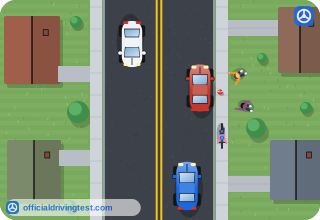
- Confused
- Unable to see you
- In trouble
- Distracted
Show answer
Correct answer: Distracted
The manual lists children who often run into the street without looking among people who may be distracted.
Source: Maine Driver’s License Manual (Rev 4/24), page 8-4 · Open this page in the manual (Manual page 8-4)
-
What is a person who is confused very likely to do?
- Stop and wait for you to pass
- Make a move without looking
- Signal before every move
- Slow down well ahead of time
Show answer
Correct answer: Make a move without looking
A person who is confused is very likely to make a move without looking.
Source: Maine Driver’s License Manual (Rev 4/24), page 8-5 · Open this page in the manual (Manual page 8-5)
-
Tourists at complicated intersections are an example of people who may be what?
- Confused
- Distracted
- Unable to see you
- In trouble
Show answer
Correct answer: Confused
The manual lists tourists, often at complicated intersections, among people who may be confused.
Source: Maine Driver’s License Manual (Rev 4/24), page 8-5 · Open this page in the manual (Manual page 8-5)
-
A driver pulls into the exit lane and then brakes suddenly. What should you be careful of?
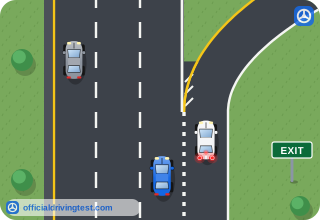
- The car is leaving the expressway and will not return
- The driver is helping you merge
- The car may swing back into your lane
- The driver is signaling for you to pass on the right
Show answer
Correct answer: The car may swing back into your lane
Be careful because the car may swing back into your lane.
Source: Maine Driver’s License Manual (Rev 4/24), page 8-5 · Open this page in the manual (Manual page 8-5)
-
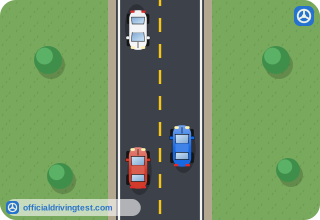
Another driver passes as you approach a curve or an oncoming car. What should you do?
- Speed up to stay ahead of them
- Slow down and let them back in your lane
- Hold your speed and flash your lights
- Move toward the center line to give them room
Show answer
Correct answer: Slow down and let them back in your lane
The manual says to slow down and let drivers who pass near a curve or oncoming car back in your lane.
Source: Maine Driver’s License Manual (Rev 4/24), page 8-5 · Open this page in the manual (Manual page 8-5)
-
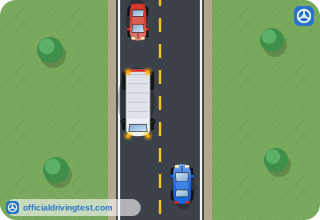
Another driver may be forced into your lane by an obstruction or a narrowing of the roadway. What should you do?
- Slow down and move left as far as you can
- Hold your speed and stay in the center of your lane
- Speed up and pass before the road narrows
- Slow down and move to the right as much as you can
Show answer
Correct answer: Slow down and move to the right as much as you can
The manual says to slow down and move to the right as much as you can.
Source: Maine Driver’s License Manual (Rev 4/24), page 8-5 · Open this page in the manual (Manual page 8-5)
-
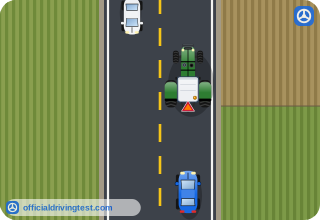
What should you do when you see a slow-moving vehicle ahead?
- Wait until you are right behind it to slow down
- Flash your headlights to make it speed up
- Move to the left lane immediately
- Adjust your speed before you reach it
Show answer
Correct answer: Adjust your speed before you reach it
When you see slow vehicles ahead, adjust your speed before you reach them, because slowing suddenly is one cause of traffic accidents.
Source: Maine Driver’s License Manual (Rev 4/24), page 8-10 · Open this page in the manual (Manual page 8-10)
-
Which vehicles may lose speed on long or steep hills and take longer to get up to speed when entering traffic?
- Large trucks and small cars
- Motorcycles and sports cars
- Pickup trucks and vans
- Mid-size cars and taxis
Show answer
Correct answer: Large trucks and small cars
Large trucks and small cars may lose speed on long or steep hills and, when entering traffic, they take longer to get up to speed.
Source: Maine Driver’s License Manual (Rev 4/24), page 8-10 · Open this page in the manual (Manual page 8-10)
-
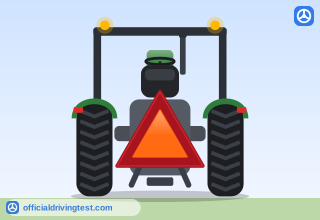
What is the red-edged orange triangle posted on the back of a farm tractor called?
- A wide-load warning
- A farm-equipment permit
- A hazard-ahead sign
- A slow-moving vehicle sign
Show answer
Correct answer: A slow-moving vehicle sign
The red-edged orange triangle posted on the back of farm tractors, animal-drawn carts and roadway maintenance vehicles is the slow-moving vehicle sign.
Source: Maine Driver’s License Manual (Rev 4/24), page 8-10 · Open this page in the manual (Manual page 8-10)
-
Why should you increase your following distance when following motorcycles or bicycles?
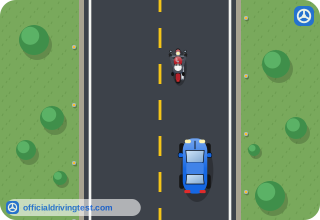
- Cyclists always ride at the speed limit
- Cyclists cannot see vehicles behind them
- Cyclists stop at every intersection
- A cyclist may fall and you need extra room
Show answer
Correct answer: A cyclist may fall and you need extra room
If the cyclist should fall, you will need extra distance to avoid striking the rider.
Source: Maine Driver’s License Manual (Rev 4/24), page 8-11 · Open this page in the manual (Manual page 8-11)
-
On which surface are the chances of a cyclist's fall greatest?
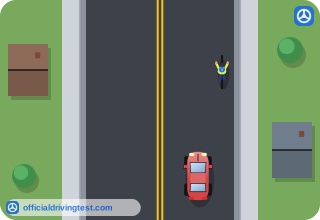
- Metal surfaces such as bridge gratings
- Smooth, dry asphalt in daylight
- Dry concrete on a straight road
- Level, dry pavement with no gravel
Show answer
Correct answer: Metal surfaces such as bridge gratings
The chances of a fall are greatest on wet or icy roads, metal surfaces such as bridge gratings or railroad tracks, or on gravel.
Source: Maine Driver’s License Manual (Rev 4/24), page 8-11 · Open this page in the manual (Manual page 8-11)