Maine: Right-of-way and turning — Part 4 Practice Test
Who yields at intersections and four-way stops, turning lanes, traffic circles and roundabouts, passing and turning around. — Part 4
Independent educational site · not affiliated with any government agency or DMV
Ready? Test yourself
- Instant feedback with an explanation
- Every answer cites its source in the manual
- Your best score is saved on this device
Questions are original and based on the official manual "Maine Driver’s License Manual" (Rev 4/24), Maine Bureau of Motor Vehicles.
All 33 questions in this practice test
Take the test above first, then use this list to study. Tap “Show answer” to see the correct answer and explanation.
Show the questions and answersHide the questions
-
When approaching which of these should you never pass?
- A road with a wide shoulder
- A railroad crossing or bridge
- A long straight section of road
- A sign showing the speed limit
Show answer
Correct answer: A railroad crossing or bridge
The manual lists approaching a railroad crossing or bridge among the places where you should never pass.
Source: Maine Driver’s License Manual (Rev 4/24), page 7-7 · Open this page in the manual (Manual page 7-7)
-
Which of these might make you lose your space for passing?
- A wide, dry paved shoulder
- A long, straight, empty road
- Light traffic behind you
- A patch of ice or broken pavement
Show answer
Correct answer: A patch of ice or broken pavement
The manual says you might lose your space for passing due to people or bikers near the road, a narrow bridge, or a patch of ice, broken pavement, or something on the road.
Source: Maine Driver’s License Manual (Rev 4/24), page 7-7 · Open this page in the manual (Manual page 7-7)
-
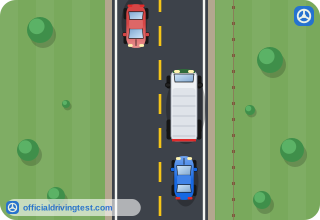
What must you know before you pull out to pass?
- That the other driver will speed up
- That other drivers will make room for your return
- That you have enough space to return
- That you can pass several cars at once
Show answer
Correct answer: That you have enough space to return
The manual says not to pull out to pass unless you know you have enough space to return.
Source: Maine Driver’s License Manual (Rev 4/24), page 7-7 · Open this page in the manual (Manual page 7-7)
-
When can a street, alley or driveway be used for a two-point turnaround?
- When there is heavy traffic behind you
- When you cannot drive around the block
- When you are on a divided highway
- When you have missed your exit
Show answer
Correct answer: When you cannot drive around the block
A street, alley or driveway can be used to turn around when you cannot drive around the block.
Source: Maine Driver’s License Manual (Rev 4/24), page 7-13 · Open this page in the manual (Manual page 7-13)
-
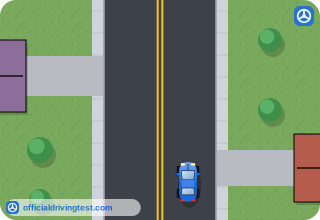
In a reverse two-point turnaround, how far past the driveway or alley do you drive before backing in?
- Two car lengths
- Half a car length
- Three car lengths
- One car length
Show answer
Correct answer: One car length
You drive one car length past the driveway or alley before backing in.
Source: Maine Driver’s License Manual (Rev 4/24), page 7-13 · Open this page in the manual (Manual page 7-13)
-
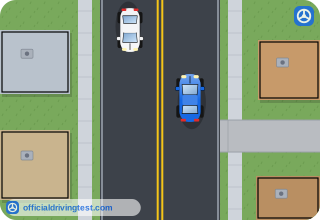
In a reverse two-point turnaround, which turn do you signal before driving past the driveway or alley?
- A right turn
- A left turn
- Hazard lights
- No signal
Show answer
Correct answer: A right turn
You signal a right turn before driving one car length past the driveway or alley.
Source: Maine Driver’s License Manual (Rev 4/24), page 7-13 · Open this page in the manual (Manual page 7-13)
-
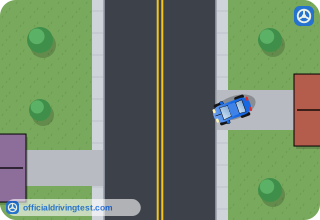
In a reverse two-point turnaround, what do you do after backing into the driveway and when the way is clear?
- Signal right, then turn right into the proper lane and drive away
- Signal left and back up farther into the driveway
- Signal left, then turn left into the proper lane and drive away
- Turn left without signaling and drive away
Show answer
Correct answer: Signal left, then turn left into the proper lane and drive away
When it is clear, you signal left, and then turn left into the proper lane and drive away.
Source: Maine Driver’s License Manual (Rev 4/24), page 7-13 · Open this page in the manual (Manual page 7-13)
-
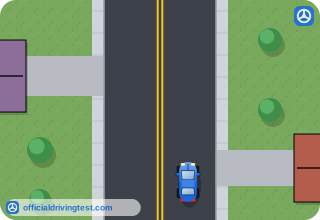
In a forward two-point turnaround, which turn do you signal after checking that there is no oncoming traffic?
- A right turn
- A left turn
- Hazard lights
- No signal is needed
Show answer
Correct answer: A left turn
You check that there is no oncoming traffic and signal a left turn.
Source: Maine Driver’s License Manual (Rev 4/24), page 7-13 · Open this page in the manual (Manual page 7-13)
-
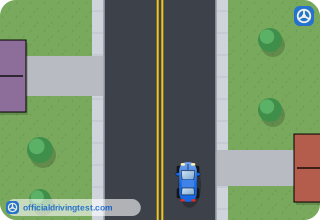
In a forward two-point turnaround, where do you turn as you enter the driveway or alley?
- Along the left side of the drive
- Right in the exact center of the drive or alley
- Only far enough to clear the road edge
- As near as possible to the right side of the drive
Show answer
Correct answer: As near as possible to the right side of the drive
You turn as near as possible to the right side of the drive.
Source: Maine Driver’s License Manual (Rev 4/24), page 7-13 · Open this page in the manual (Manual page 7-13)
-
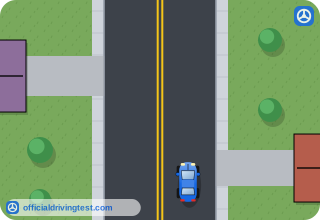
In a forward two-point turnaround, when do you stop in the driveway?
- As the rear of the vehicle clears the curb or edge of the driveway
- As soon as the front wheels pass the curb
- When the front bumper reaches the far end of the driveway
- When the vehicle is centered in the driveway
Show answer
Correct answer: As the rear of the vehicle clears the curb or edge of the driveway
You stop as the rear of the vehicle clears the curb or edge of the driveway.
Source: Maine Driver’s License Manual (Rev 4/24), page 7-13 · Open this page in the manual (Manual page 7-13)
-
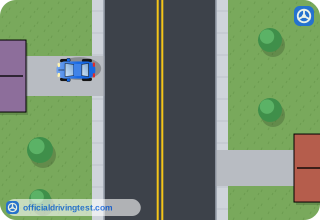
In a forward two-point turnaround, how do you turn the steering wheel as you back up into the street?
- Slowly all the way to the left
- Quickly all the way to the left
- Quickly all the way to the right
- Slowly, a quarter turn to the right
Show answer
Correct answer: Quickly all the way to the right
You back up while turning the steering wheel quickly all the way to the right.
Source: Maine Driver’s License Manual (Rev 4/24), page 7-13 · Open this page in the manual (Manual page 7-13)
-
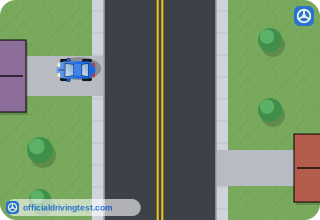
In a forward two-point turnaround, when do you straighten your wheels and stop after backing into the street?
- When your rear bumper reaches the center line
- When you are centered in the lane
- When your front wheels touch the curb
- When the driveway is fully behind you
Show answer
Correct answer: When you are centered in the lane
You straighten your wheels and stop when you are centered in the lane.
Source: Maine Driver’s License Manual (Rev 4/24), page 7-13 · Open this page in the manual (Manual page 7-13)
-
When should you use a three-point turnaround?
- Only if you cannot find a parking space
- Only if the road has more than two lanes
- Only if you are on a one-way street
- Only if the road is too narrow for a U-turn
Show answer
Correct answer: Only if the road is too narrow for a U-turn
A three-point turnaround is used only if the road is too narrow for a U-turn.
Source: Maine Driver’s License Manual (Rev 4/24), page 7-13 · Open this page in the manual (Manual page 7-13)
-
Instead of a three-point turnaround, what does the manual say is best if you can?
- Go around the block
- Make a U-turn across the center line
- Stop and wait for traffic to clear
- Turn around in an intersection
Show answer
Correct answer: Go around the block
The manual says it is best to go around the block if you can rather than make a three-point turnaround.
Source: Maine Driver’s License Manual (Rev 4/24), page 7-13 · Open this page in the manual (Manual page 7-13)
-
On what kind of road should a three-point turnaround only be used?
- A divided highway
- A four-lane road
- A two-lane road
- A one-way street
Show answer
Correct answer: A two-lane road
A three-point turnaround should only be used on a two-lane road.
Source: Maine Driver’s License Manual (Rev 4/24), page 7-13 · Open this page in the manual (Manual page 7-13)
-
How does a three-point turnaround begin?
- Signal a left turn, check traffic and stop on the left side of the road
- Check the mirrors, signal a right turn and stop on the right side of the road
- Signal a right turn and stop in the center of the road
- Turn on the hazard lights and stop in your lane
Show answer
Correct answer: Check the mirrors, signal a right turn and stop on the right side of the road
A three-point turnaround begins by checking the mirrors, signaling a right turn and stopping on the right side of the road.
Source: Maine Driver’s License Manual (Rev 4/24), page 7-13 · Open this page in the manual (Manual page 7-13)
-
In a three-point turnaround, how do you turn when you drive across to the other side of the road?
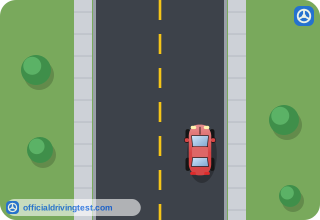
- Hard right
- A gradual left
- Straight ahead
- Hard left
Show answer
Correct answer: Hard left
You turn hard left and drive to the other side of the road and stop.
Source: Maine Driver’s License Manual (Rev 4/24), page 7-13 · Open this page in the manual (Manual page 7-13)
-
In a three-point turnaround, what do you check before backing up?
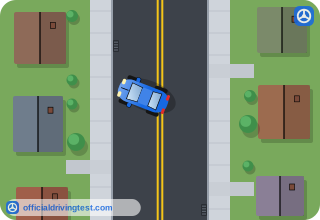
- Traffic and your blind spots to both sides
- Only the traffic ahead and the rearview mirror
- Only your left blind spot and oncoming traffic
- Traffic behind you, without checking blind spots
Show answer
Correct answer: Traffic and your blind spots to both sides
After shifting to reverse, you check traffic and your blind spots to both sides.
Source: Maine Driver’s License Manual (Rev 4/24), page 7-13 · Open this page in the manual (Manual page 7-13)
-
In a three-point turnaround, how do you turn when you back up to the other side of the road?
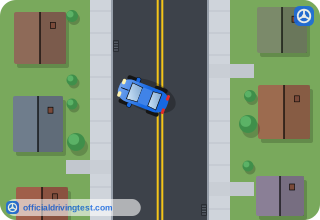
- Hard left
- A gradual right
- Hard right
- Straight back
Show answer
Correct answer: Hard right
When traffic is clear, you turn hard right and back up to the other side of the road and stop.
Source: Maine Driver’s License Manual (Rev 4/24), page 7-13 · Open this page in the manual (Manual page 7-13)
-
In the last step of a three-point turnaround, which lane do you drive forward into?
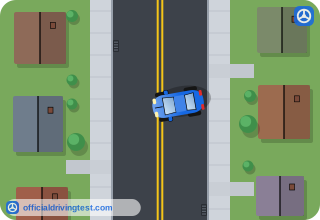
- The left lane heading in the new direction
- The right lane heading in the new direction
- The same lane you started in
- The center of the road
Show answer
Correct answer: The right lane heading in the new direction
You turn hard left and drive forward into the right lane heading in the new direction.
Source: Maine Driver’s License Manual (Rev 4/24), page 7-13 · Open this page in the manual (Manual page 7-13)
-
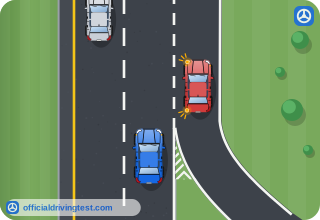
When you merge with traffic, cross traffic, or pass other vehicles, what must you do about the right of way?
- Claim it if you signal first
- Take it if you are in the larger vehicle
- Take it if you are already moving
- Yield the right of way to the other cars
Show answer
Correct answer: Yield the right of way to the other cars
Whenever you merge, cross or enter traffic, or pass, you must yield the right of way to the other cars.
Source: Maine Driver’s License Manual (Rev 4/24), page 8-14 · Open this page in the manual (Manual page 8-14)
-
If you must cross several lanes, how should you change lanes?
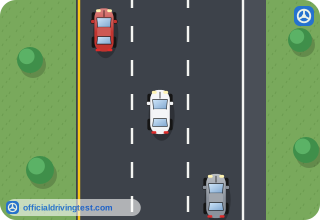
- One at a time
- All at once in a single move
- By stopping until all lanes are clear
- From the shoulder
Show answer
Correct answer: One at a time
The manual says to change lanes one at a time; stopping to wait until all lanes are clear ties up traffic and may cause a collision.
Source: Maine Driver’s License Manual (Rev 4/24), page 8-15 · Open this page in the manual (Manual page 8-15)
-
To get moving from a full stop on city streets, you need a gap of about how much?
- About two car lengths
- About a quarter of a block
- About a half a block
- About three blocks
Show answer
Correct answer: About a half a block
To get moving from a full stop you need about a half a block on city streets.
Source: Maine Driver’s License Manual (Rev 4/24), page 8-15 · Open this page in the manual (Manual page 8-15)
-
To get moving from a full stop on the highway, you need a gap of about how much?
- About two car lengths
- About a full block
- About a quarter of a block
- About three blocks
Show answer
Correct answer: About a full block
To get moving from a full stop you need about a full block on the highway.
Source: Maine Driver’s License Manual (Rev 4/24), page 8-15 · Open this page in the manual (Manual page 8-15)
-
To enter a lane of existing traffic in the city, you need a gap of about how much?
- About one car length
- About a quarter of a block
- About three blocks
- About two-thirds of a block
Show answer
Correct answer: About two-thirds of a block
Entering a lane of existing traffic takes a little more time, so you need about two-thirds of a block in the city.
Source: Maine Driver’s License Manual (Rev 4/24), page 8-15 · Open this page in the manual (Manual page 8-15)
-
To enter a lane of existing traffic on the highway, you need a gap of about how much?
- About two blocks
- About one car length
- About a quarter of a block
- About four blocks
Show answer
Correct answer: About two blocks
Entering a lane of existing traffic takes a little more time, so you need about two blocks on the highway.
Source: Maine Driver’s License Manual (Rev 4/24), page 8-15 · Open this page in the manual (Manual page 8-15)
-
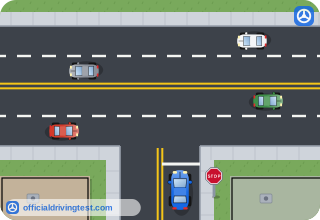
When is stopping halfway across traffic safe?
- Whenever you have the green light for the crossing
- When oncoming traffic has slowed down for you
- Only when a median divider is large enough to hold your car
- Whenever the road ahead of you is clear
Show answer
Correct answer: Only when a median divider is large enough to hold your car
Stopping halfway across is only safe when there is a median divider large enough to hold your car.
Source: Maine Driver’s License Manual (Rev 4/24), page 8-15 · Open this page in the manual (Manual page 8-15)
-
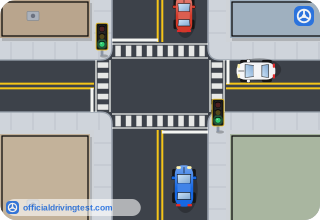
When should you not start across an intersection even though you have the green light?
- If another car has its turn signal on
- If cars are blocking your way
- If you are in the left lane
- If the light has been green for a while
Show answer
Correct answer: If cars are blocking your way
Even with a green light, do not start across if cars are blocking your way; if the light changes while you are in the intersection, you will block traffic.
Source: Maine Driver’s License Manual (Rev 4/24), page 8-15 · Open this page in the manual (Manual page 8-15)
-
An approaching car has a turn signal on. What should you do?
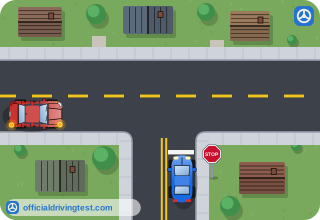
- Go ahead, since the driver is about to turn away from you
- Turn immediately because the signal shows the car is turning
- Pull out in front, since the driver has signaled the turn
- Wait until the other driver starts to turn before making your move
Show answer
Correct answer: Wait until the other driver starts to turn before making your move
The driver may plan to turn just beyond you or may have left the signal on from an earlier turn, so wait until the other driver starts to turn.
Source: Maine Driver’s License Manual (Rev 4/24), page 8-15 · Open this page in the manual (Manual page 8-15)
-
A signal left on from an earlier turn is especially likely with which kind of vehicle?
- Motorcycles
- Large trucks
- School buses
- Tractor-trailers
Show answer
Correct answer: Motorcycles
This is likely to happen with motorcycles because their signals are not always self-cancelling.
Source: Maine Driver’s License Manual (Rev 4/24), page 8-15 · Open this page in the manual (Manual page 8-15)
-
Who has the right-of-way when crossing a single lane bridge?
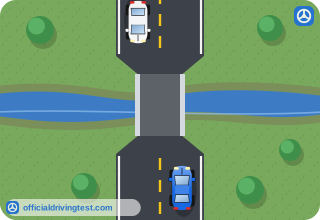
- The driver in the larger vehicle
- The driver traveling uphill
- The first driver to the bridge
- The faster driver
Show answer
Correct answer: The first driver to the bridge
When crossing a single lane bridge the first driver to the bridge has right-of-way, and drivers take turns.
Source: Maine Driver’s License Manual (Rev 4/24), page 11-3 · Open this page in the manual (Manual page 11-3)
-
Which description fits an uncontrolled intersection?
- It lacks traffic lights, stop signs and yield signs
- It has only a yield sign at the crossing road
- It has a flashing red light
- It has a flagger directing traffic
Show answer
Correct answer: It lacks traffic lights, stop signs and yield signs
Uncontrolled intersections lack traffic lights, stop or yield signs, which makes them very dangerous.
Source: Maine Driver’s License Manual (Rev 4/24), page 11-3 · Open this page in the manual (Manual page 11-3)
-
How should you approach an uncontrolled intersection on a rural road?
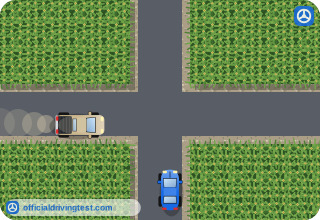
- Keep your speed so other traffic can predict you
- Speed up to clear the intersection quickly
- Slow down and be ready to stop for crossing traffic
- Sound your horn and continue through
Show answer
Correct answer: Slow down and be ready to stop for crossing traffic
You should approach with caution, slowing down and being ready to stop for crossing or oncoming traffic indicating a turn.
Source: Maine Driver’s License Manual (Rev 4/24), page 11-3 · Open this page in the manual (Manual page 11-3)