Maine: Right-of-way and turning — Part 1 Practice Test
Who yields at intersections and four-way stops, turning lanes, traffic circles and roundabouts, passing and turning around. — Part 1
Independent educational site · not affiliated with any government agency or DMV
Ready? Test yourself
- Instant feedback with an explanation
- Every answer cites its source in the manual
- Your best score is saved on this device
Questions are original and based on the official manual "Maine Driver’s License Manual" (Rev 4/24), Maine Bureau of Motor Vehicles.
All 34 questions in this practice test
Take the test above first, then use this list to study. Tap “Show answer” to see the correct answer and explanation.
Show the questions and answersHide the questions
-
At a 4-way stop, which driver gets to go first?
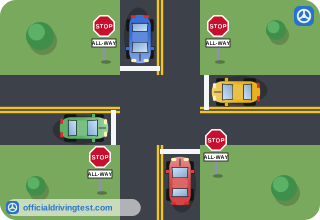
- The driver who arrived earliest
- The driver in the biggest vehicle
- The driver traveling the fastest
- The driver who is the oldest
Show answer
Correct answer: The driver who arrived earliest
At a 4-way stop, the driver reaching the intersection first goes first, although all vehicles must stop.
Source: Maine Driver’s License Manual (Rev 4/24), page 6-1 · Open this page in the manual (Manual page 6-1)
-
Two cars approach an intersection at the same time from opposite directions, and one driver is signaling for a turn. Which car has the right-of-way?
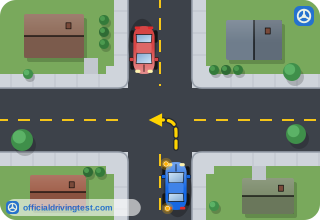
- The car that is signaling for a turn
- The larger of the two vehicles
- The car going straight
- The car that honks first
Show answer
Correct answer: The car going straight
When one driver is signaling a turn, the right-of-way belongs to the car going straight.
Source: Maine Driver’s License Manual (Rev 4/24), page 6-1 · Open this page in the manual (Manual page 6-1)
-
Two drivers arrive at a four-way stop at the same time, beside each other. Which driver has the right-of-way?
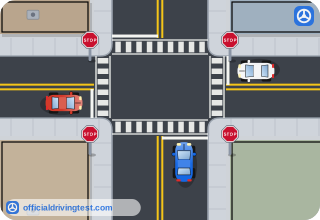
- The driver on your left
- The driver on your right
- The driver in the older vehicle
- The driver who signals first
Show answer
Correct answer: The driver on your right
At a four-way stop, the driver on your right has the right-of-way if both of you arrive at the same time beside each other.
Source: Maine Driver’s License Manual (Rev 4/24), page 6-1 · Open this page in the manual (Manual page 6-1)
-
Cars entering from a private drive or road must yield to whom?
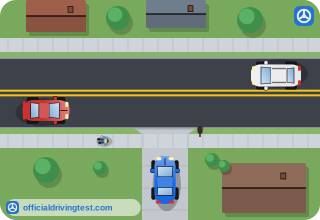
- Only pedestrians on a sidewalk
- Only vehicles traveling at the speed limit
- Only vehicles that are larger than theirs
- Any vehicle or pedestrian on a public way
Show answer
Correct answer: Any vehicle or pedestrian on a public way
Cars entering from a private drive or road must yield to any vehicle or pedestrian on a public way.
Source: Maine Driver’s License Manual (Rev 4/24), page 6-2 · Open this page in the manual (Manual page 6-2)
-
How must you enter a street or highway?
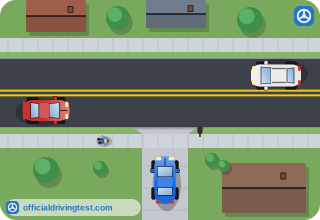
- Without interfering with other traffic
- By sounding your horn to warn other drivers
- By entering as fast as you can
- By moving in front of the nearest car
Show answer
Correct answer: Without interfering with other traffic
If you are entering a street or highway you must do so without interfering with other traffic.
Source: Maine Driver’s License Manual (Rev 4/24), page 6-2 · Open this page in the manual (Manual page 6-2)
-
You are on an interstate highway entrance ramp. Who has the right-of-way?
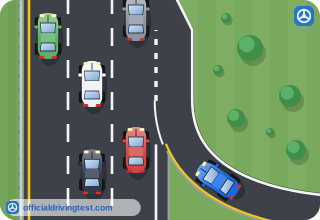
- Drivers on the entrance ramp
- Whichever vehicle is faster
- Drivers already on the interstate highway
- Whichever driver reaches the merge point first
Show answer
Correct answer: Drivers already on the interstate highway
Drivers already on an interstate highway have the right-of-way over a driver on the entrance ramp.
Source: Maine Driver’s License Manual (Rev 4/24), page 6-2 · Open this page in the manual (Manual page 6-2)
-
What should you do when starting from a parked position?
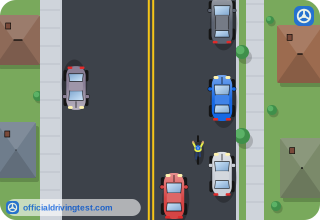
- Signal and pull out ahead of the next car
- Wait for all moving traffic to pass
- Pull out as soon as traffic slows down
- Sound your horn and move out
Show answer
Correct answer: Wait for all moving traffic to pass
When starting from a parked position, you wait for all moving traffic to pass.
Source: Maine Driver’s License Manual (Rev 4/24), page 6-2 · Open this page in the manual (Manual page 6-2)
-
Two cars enter an uncontrolled intersection at about the same time. Which car must you yield to?
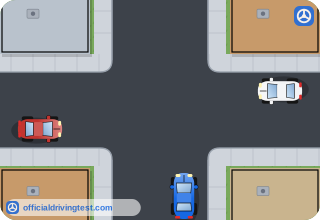
- The car on your right
- The car on your left
- The slower car
- The smaller car
Show answer
Correct answer: The car on your right
If two cars enter an uncontrolled intersection at about the same time, you yield to the car on your right.
Source: Maine Driver’s License Manual (Rev 4/24), page 6-2 · Open this page in the manual (Manual page 6-2)
-
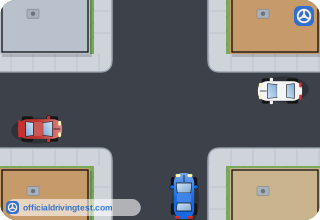
When approaching an intersection, to which vehicles must you yield the right-of-way?
- Vehicles that are traveling faster than you are
- Vehicles that are about to enter from a side street
- Vehicles that have already entered the intersection
- Trucks and buses that are waiting behind you
Show answer
Correct answer: Vehicles that have already entered the intersection
When approaching an intersection, you yield the right-of-way to vehicles which have already entered the intersection.
Source: Maine Driver’s License Manual (Rev 4/24), page 6-2 · Open this page in the manual (Manual page 6-2)
-
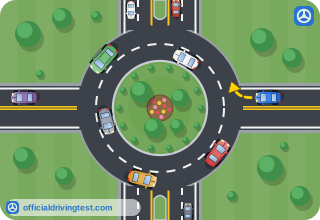
Who has the right-of-way when you are entering a traffic circle?
- The vehicle entering the circle
- The vehicle already in the circle
- The largest vehicle at the entrance
- The vehicle with the most passengers
Show answer
Correct answer: The vehicle already in the circle
When entering a traffic circle, the vehicle which is already in the circle has the right-of-way.
Source: Maine Driver’s License Manual (Rev 4/24), page 6-2 · Open this page in the manual (Manual page 6-2)
-
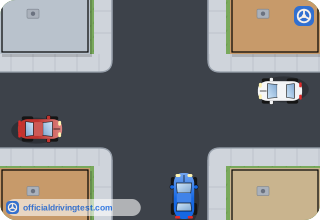
When there are no signs, symbols, or police present, what determines who has the right-of-way where two or more streets come together?
- The size of each vehicle
- The speed of each vehicle
- The order in which the drivers signal
- Set right-of-way rules
Show answer
Correct answer: Set right-of-way rules
When there are no signs, symbols, or police present, set rules determine who has the right-of-way when two or more streets come together.
Source: Maine Driver’s License Manual (Rev 4/24), page 6-1 · Open this page in the manual (Manual page 6-1)
-
Right-of-way rules have the force of law. What should a good driver still do?
- Never depend exclusively on them for safety
- Depend on them fully, since they are the law
- Insist on them every time another driver ignores them
- Treat them as optional on quiet streets
Show answer
Correct answer: Never depend exclusively on them for safety
A good driver never depends exclusively on right-of-way rules for safety, even though they have the force of law.
Source: Maine Driver’s License Manual (Rev 4/24), page 6-1 · Open this page in the manual (Manual page 6-1)
-
What should a driver who has the right of way do with it?
- Insist on it so other drivers learn the rules
- Use it only when police are present
- Use it sensibly and never insist on it
- Use it only on streets that have no signs
Show answer
Correct answer: Use it sensibly and never insist on it
A driver who has the right of way should use it sensibly, never insist on it.
Source: Maine Driver’s License Manual (Rev 4/24), page 6-1 · Open this page in the manual (Manual page 6-1)
-
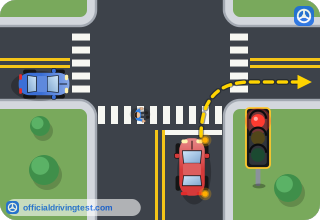
When is a right turn at a red light permitted?
- Without stopping, if the way is clear
- Only when a sign says it is allowed
- After stopping, unless posted otherwise
- Only at night, after stopping
Show answer
Correct answer: After stopping, unless posted otherwise
A right turn at a red light is permitted, after stopping, unless posted otherwise.
Source: Maine Driver’s License Manual (Rev 4/24), page 6-3 · Open this page in the manual (Manual page 6-3)
-
Vehicles making a right turn on red must yield to whom?
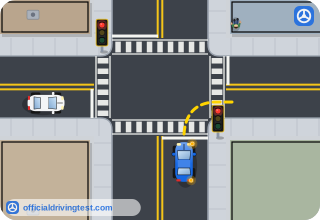
- Only pedestrians
- Pedestrians and all vehicle traffic
- Only vehicles that have a green light
- Only vehicles coming from the left
Show answer
Correct answer: Pedestrians and all vehicle traffic
Vehicles making a right turn on red must yield to pedestrians and all vehicle traffic.
Source: Maine Driver’s License Manual (Rev 4/24), page 6-3 · Open this page in the manual (Manual page 6-3)
-
At a stop sign, where must you stop if there is a stop line or crosswalk?
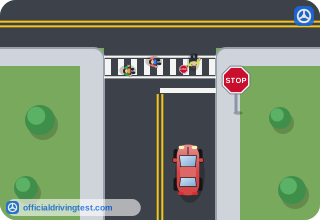
- Behind the stop line or crosswalk
- Over the stop line, to see traffic better
- In the middle of the crosswalk
- At the edge of the intersection
Show answer
Correct answer: Behind the stop line or crosswalk
You must stop behind the stop line or crosswalk if there is one.
Source: Maine Driver’s License Manual (Rev 4/24), page 6-6 · Open this page in the manual (Manual page 6-6)
-
At a stop sign with no crosswalk or stop line, where should you stop?
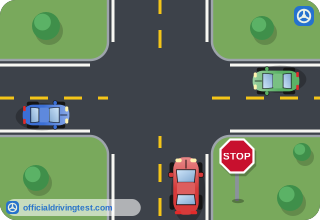
- At the point where you can see the next sign ahead
- Well back from the intersection so you do not block other traffic
- At the point nearest the intersection that lets you see approaching traffic
- At the curb closest to the opposite lane of travel
Show answer
Correct answer: At the point nearest the intersection that lets you see approaching traffic
You stop at the point nearest the intersection that lets you see approaching traffic on the intersecting roadway.
Source: Maine Driver’s License Manual (Rev 4/24), page 6-6 · Open this page in the manual (Manual page 6-6)
-
At a stop sign, when must your stop be made?
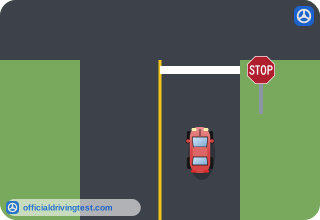
- Once your front wheels are inside the intersection
- Before any part of your vehicle has entered the intersection
- After your vehicle has fully entered the intersection
- Just before the far side of the intersection
Show answer
Correct answer: Before any part of your vehicle has entered the intersection
The stop must be made before any portion of your vehicle has entered the intersection.
Source: Maine Driver’s License Manual (Rev 4/24), page 6-6 · Open this page in the manual (Manual page 6-6)
-
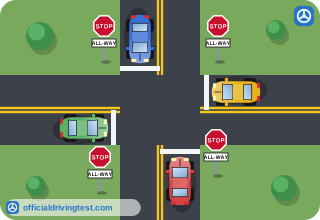
What should you do at a four-way stop?
- Sound your horn before entering
- Flash your headlights to signal others
- Stop only if other vehicles are waiting
- Wait your turn
Show answer
Correct answer: Wait your turn
At a four-way stop you wait your turn.
Source: Maine Driver’s License Manual (Rev 4/24), page 6-6 · Open this page in the manual (Manual page 6-6)
-
At a stop sign, what must you do if vehicles or pedestrians are present?
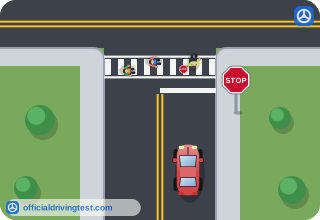
- Yield the right-of-way
- Slow down and go around them
- Flash your lights and continue
- Move up into the intersection and then continue
Show answer
Correct answer: Yield the right-of-way
Look for vehicles and pedestrians and, if any are present, yield the right-of-way.
Source: Maine Driver’s License Manual (Rev 4/24), page 6-6 · Open this page in the manual (Manual page 6-6)
-
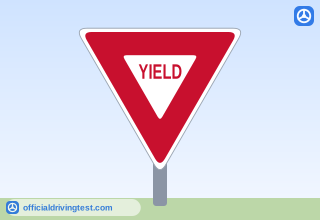
What does a yield sign mean?
- Stop completely and stay stopped until the other road is empty
- Slow down to wait for traffic to clear on the road you enter or cross
- Speed up to merge ahead of the traffic on the other road
- Drive on only if the other road has a stop sign
Show answer
Correct answer: Slow down to wait for traffic to clear on the road you enter or cross
A yield sign means you should slow down to wait for traffic to clear on the road you are entering or crossing.
Source: Maine Driver’s License Manual (Rev 4/24), page 6-6 · Open this page in the manual (Manual page 6-6)
-
During ordinary driving, which lane should you use?
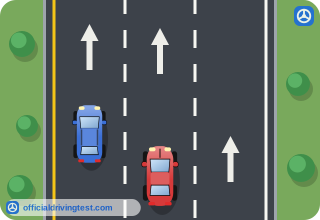
- The lane with the smoothest flow of traffic
- The lane closest to the center line
- The lane with the most vehicles
- The lane that is the farthest from the curb
Show answer
Correct answer: The lane with the smoothest flow of traffic
You should drive in the lane that has the smoothest flow of traffic, with the least stopping and starting.
Source: Maine Driver’s License Manual (Rev 4/24), page 6-8 · Open this page in the manual (Manual page 6-8)
-
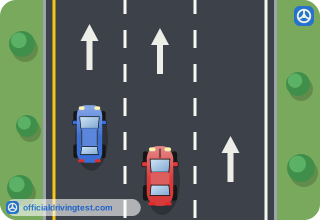
On a road with three or more lanes going in one direction, which lane or lanes are usually the smoothest?
- The left lane
- The middle lane or lanes
- The right lane
- The lane next to the shoulder
Show answer
Correct answer: The middle lane or lanes
With three or more lanes in one direction, the middle lane, or lanes, is usually the smoothest.
Source: Maine Driver’s License Manual (Rev 4/24), page 6-9 · Open this page in the manual (Manual page 6-9)
-
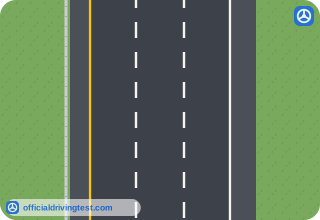
On a road with three or more lanes going in one direction, who should use the left lane?
- Drivers who go slower than the traffic
- Drivers who are entering the road
- Drivers who plan to park
- Drivers who want to pass or turn left
Show answer
Correct answer: Drivers who want to pass or turn left
The left lane is for drivers who want to pass or turn left.
Source: Maine Driver’s License Manual (Rev 4/24), page 6-9 · Open this page in the manual (Manual page 6-9)
-
On a road with three or more lanes going in one direction, who uses the right lane?
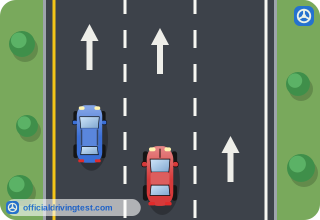
- Drivers who go slower or who are entering or turning off the road
- Drivers who want to pass slower vehicles or to turn left
- Drivers who want to turn left at the next corner
- Only trucks and buses that are traveling slowly
Show answer
Correct answer: Drivers who go slower or who are entering or turning off the road
The right lane is used by drivers who go slower or who are entering or turning off the road.
Source: Maine Driver’s License Manual (Rev 4/24), page 6-9 · Open this page in the manual (Manual page 6-9)
-
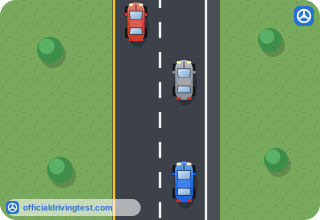
On a road with only two lanes in one direction, which lane generally has the smoothest traffic flow?
- The left lane
- The center line
- The right lane
- The lane with the most turning cars
Show answer
Correct answer: The right lane
If a road has only two lanes in one direction, the right lane generally has the smoothest traffic flow.
Source: Maine Driver’s License Manual (Rev 4/24), page 6-9 · Open this page in the manual (Manual page 6-9)
-
Why do some roads have special left turn lanes at intersections?
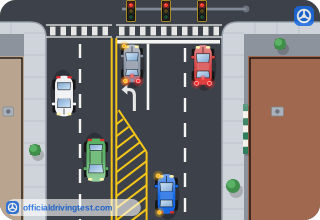
- They let drivers pass on the right on busy roads
- They help keep traffic moving smoothly in both directions
- They give trucks a place to park during rush hour
- They show where pedestrians may cross the road
Show answer
Correct answer: They help keep traffic moving smoothly in both directions
Special left turn lanes at intersections help keep traffic moving smoothly in both directions.
Source: Maine Driver’s License Manual (Rev 4/24), page 6-9 · Open this page in the manual (Manual page 6-9)
-
In general, on which side should you pass another vehicle?
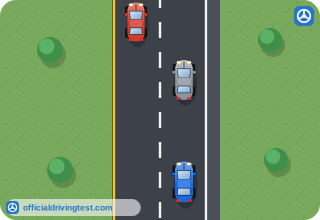
- On the right
- On whichever side has more room
- On the shoulder
- On the left
Show answer
Correct answer: On the left
In general, you should pass on the left.
Source: Maine Driver’s License Manual (Rev 4/24), page 6-9 · Open this page in the manual (Manual page 6-9)
-
Why can passing on the right be dangerous?
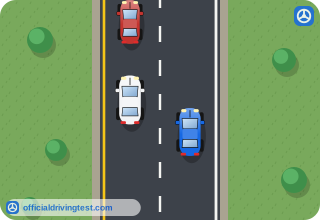
- Other drivers don't expect it
- The right lane is always narrower
- Vehicles on the right always travel faster
- It is always against the law
Show answer
Correct answer: Other drivers don't expect it
Passing on the right can be dangerous because other drivers don't expect it and cars on the right are harder for them to see.
Source: Maine Driver’s License Manual (Rev 4/24), page 6-9 · Open this page in the manual (Manual page 6-9)
-
Which is something you must never do when passing a vehicle?
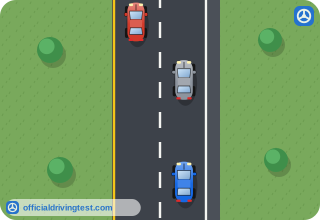
- Signal and check your blind spot before changing lanes
- Drive off the pavement or main traveled portion of the roadway
- Pass on the left
- Check your mirrors first
Show answer
Correct answer: Drive off the pavement or main traveled portion of the roadway
Never pass a vehicle by driving off the pavement or main traveled portion of the roadway.
Source: Maine Driver’s License Manual (Rev 4/24), page 6-9 · Open this page in the manual (Manual page 6-9)
-
A sign limits use of the center lane to turning only. What must you never do in that lane?
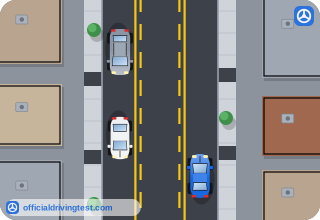
- Turn left from it
- Wait in it to turn
- Enter it to make a turn
- Pass a vehicle using it
Show answer
Correct answer: Pass a vehicle using it
Never pass a vehicle using a lane designated by an official sign or traffic control device that limits the use of the center lane to turning only.
Source: Maine Driver’s License Manual (Rev 4/24), page 6-9 · Open this page in the manual (Manual page 6-9)
-
When may you pass another motor vehicle on the right?
- When the car ahead is turning left and there is room for two or more lanes going your way
- When the car you are passing is slowing down for any reason and there is room on the right
- When the car you are passing is driving below the speed limit and there is a wide shoulder
- When the road has a wide shoulder on the right and the car ahead has stopped
Show answer
Correct answer: When the car ahead is turning left and there is room for two or more lanes going your way
You may pass on the right when the car ahead is making a left turn and there is room for two or more lanes to move in the same direction.
Source: Maine Driver’s License Manual (Rev 4/24), page 6-9 · Open this page in the manual (Manual page 6-9)
-
Which is one of the exceptions that lets you pass another motor vehicle on the right?
- The car you are passing is in the right lane of a two-lane road with one lane each way
- The car you are passing is stopped on the shoulder to let a passenger out of the vehicle
- The car you are passing is in the left lane of a street with two or more marked lanes going your way
- The car you are passing is moving too slowly for the traffic around it on a two-lane road
Show answer
Correct answer: The car you are passing is in the left lane of a street with two or more marked lanes going your way
You may pass on the right when the car you are passing is in the left lane on a street or highway with two or more marked lanes for traffic to move in the same direction.
Source: Maine Driver’s License Manual (Rev 4/24), page 6-9 · Open this page in the manual (Manual page 6-9)
-
What is the safest way to turn?
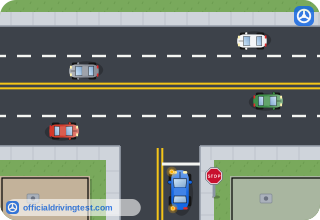
- By crossing as few lanes of traffic as you can
- By turning from the fastest lane
- By turning as quickly as possible
- By starting from the center of the road
Show answer
Correct answer: By crossing as few lanes of traffic as you can
The safest way to turn is by crossing as few lanes of traffic as you can.
Source: Maine Driver’s License Manual (Rev 4/24), page 6-9 · Open this page in the manual (Manual page 6-9)