Maine: Pavement markings Practice Test
Yellow and white lines, passing and no-passing lines, crosswalks and stop lines.
Independent educational site · not affiliated with any government agency or DMV
Ready? Test yourself
- Instant feedback with an explanation
- Every answer cites its source in the manual
- Your best score is saved on this device
Questions are original and based on the official manual "Maine Driver’s License Manual" (Rev 4/24), Maine Bureau of Motor Vehicles.
All 15 questions in this practice test
Take the test above first, then use this list to study. Tap “Show answer” to see the correct answer and explanation.
Show the questions and answersHide the questions
-
What does a single broken yellow line down the center of a two-direction roadway tell drivers?
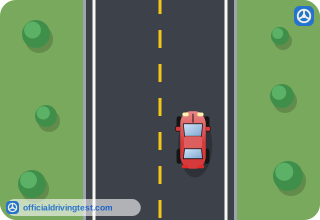
- Passing is permitted
- Passing is prohibited in both directions
- Passing is permitted only for trucks
- Passing is allowed only at night
Show answer
Correct answer: Passing is permitted
On a two-direction roadway with a broken yellow center line, passing is permitted.
Source: Maine Driver’s License Manual (Rev 4/24), page 6-8 · Open this page in the manual (Manual page 6-8)
-
On a two-direction roadway, the center has a solid yellow line next to a broken yellow line. When is passing permitted?
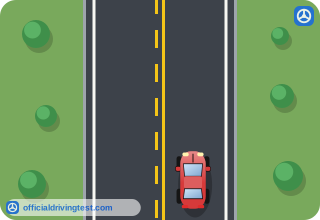
- When the solid line is on your side
- Only when there is no oncoming traffic in sight
- When the dashed line is on your side
- Never, in either direction
Show answer
Correct answer: When the dashed line is on your side
Passing is permitted on a two-direction roadway only when the dashed line is on your side of the center markings.
Source: Maine Driver’s License Manual (Rev 4/24), page 6-8 · Open this page in the manual (Manual page 6-8)
-
What does a center marking of two solid yellow lines side by side mean on a two-direction roadway?
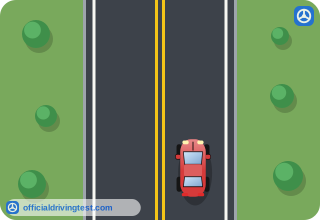
- Passing is permitted from either side
- Passing is prohibited in both directions
- Passing is permitted on the right only
- Passing is permitted when the road is clear
Show answer
Correct answer: Passing is prohibited in both directions
Two solid yellow lines on a two-direction roadway mean passing is prohibited in both directions.
Source: Maine Driver’s License Manual (Rev 4/24), page 6-8 · Open this page in the manual (Manual page 6-8)
-
On a one-direction roadway, a broken white line separates the lanes. What does it show about passing?
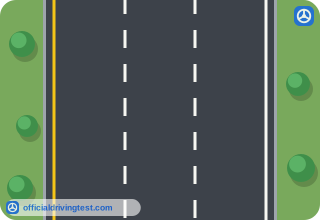
- Passing is prohibited
- Passing is permitted only on the shoulder
- Passing is permitted only for slow vehicles
- Passing is permitted
Show answer
Correct answer: Passing is permitted
A one-direction roadway marked with a broken white line is one where passing is permitted.
Source: Maine Driver’s License Manual (Rev 4/24), page 6-8 · Open this page in the manual (Manual page 6-8)
-
Which of these is something pavement markings show?
- Which drivers have the right of way at all times
- Where to stop for signs or traffic signals
- How many passengers a vehicle may carry
- The legal speed for each lane
Show answer
Correct answer: Where to stop for signs or traffic signals
Pavement markings show where to stop for signs or traffic signals, as well as turn lanes and crosswalks.
Source: Maine Driver’s License Manual (Rev 4/24), page 6-8 · Open this page in the manual (Manual page 6-8)
-
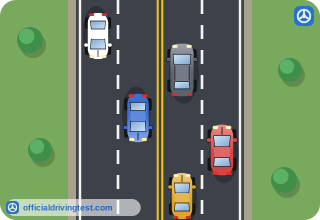
Which of these do pavement markings help drivers find?
- Where the nearest gas station or rest area is
- Which roads are closed for the winter season
- How far it is to the next town on the road
- Where they may pass other vehicles or change lanes
Show answer
Correct answer: Where they may pass other vehicles or change lanes
Marks on the road divide lanes and show where you may pass other vehicles or change lanes.
Source: Maine Driver’s License Manual (Rev 4/24), page 6-8 · Open this page in the manual (Manual page 6-8)
-
What do solid white lines painted on the roadway do?
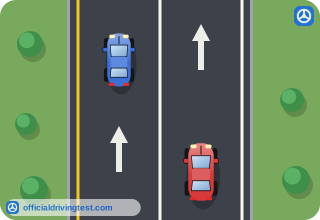
- Separate lanes going in the same direction that have different uses
- Separate traffic going in opposite directions on the road
- Show where passing is always permitted
- Mark the place where parking is allowed
Show answer
Correct answer: Separate lanes going in the same direction that have different uses
Solid white lines separate lanes going in the same direction that have different uses, and they discourage changing lanes.
Source: Maine Driver’s License Manual (Rev 4/24), page 6-11 · Open this page in the manual (Manual page 6-11)
-
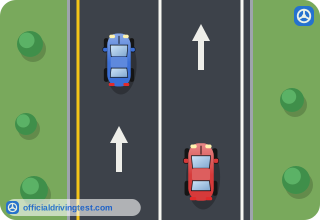
How do solid white lines affect lane changes?
- They require you to change lanes
- They discourage changing lanes
- They allow safe lane changes
- They mean a lane change is prohibited at night only
Show answer
Correct answer: They discourage changing lanes
Solid white lines discourage changing lanes.
Source: Maine Driver’s License Manual (Rev 4/24), page 6-11 · Open this page in the manual (Manual page 6-11)
-
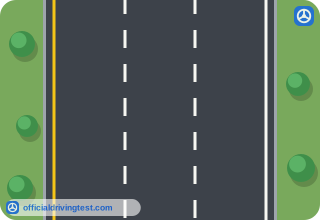
What do broken white lines indicate?
- The edge of the roadway
- Lanes for traffic going in opposite directions on a road
- Multiple lanes going the same way, with safe lane changes allowed
- A lane where lane changes are discouraged
Show answer
Correct answer: Multiple lanes going the same way, with safe lane changes allowed
Broken white lines simply indicate multiple lanes going in the same direction and they allow safe lane changes.
Source: Maine Driver’s License Manual (Rev 4/24), page 6-11 · Open this page in the manual (Manual page 6-11)
-
What type of lines may a reversible lane have to either side?
- Solid white lines
- Double dashed yellow lines
- A single solid yellow line
- Double solid yellow lines
Show answer
Correct answer: Double dashed yellow lines
A reversible lane may have double dashed yellow lines to either side.
Source: Maine Driver’s License Manual (Rev 4/24), page 6-12 · Open this page in the manual (Manual page 6-12)
-
What do yellow road markings divide?
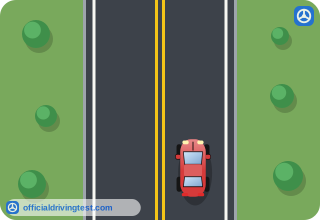
- Lanes of traffic going in opposite directions
- Lanes of traffic going in the same direction
- The roadway from the sidewalk
- Parking spaces from the driving lanes
Show answer
Correct answer: Lanes of traffic going in opposite directions
Yellow road markings divide lanes of traffic going in opposite directions.
Source: Maine Driver’s License Manual (Rev 4/24), page 7-8 · Open this page in the manual (Manual page 7-8)
-
What does Maine law require about a pass and the beginning of a no passing zone?
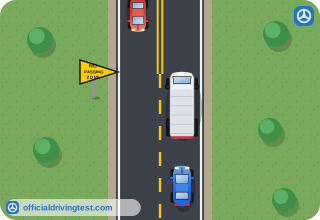
- Start the pass only after you enter the zone
- Finish the pass within 100 feet after the zone begins
- Complete the pass before you reach the zone
- Slow to half speed before the zone begins
Show answer
Correct answer: Complete the pass before you reach the zone
Maine law requires that you complete a pass before you reach the beginning of a no passing zone.
Source: Maine Driver’s License Manual (Rev 4/24), page 7-8 · Open this page in the manual (Manual page 7-8)
-
What does a solid center line on your side of the road mean for passing?
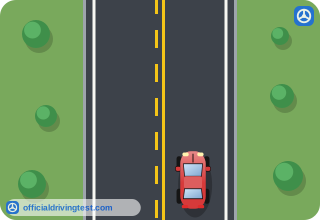
- You may pass when there are no oncoming cars
- You should not pass
- You may pass only if you signal first
- You may pass if the other driver slows down
Show answer
Correct answer: You should not pass
You should not pass when there is a solid center line on your side of the road.
Source: Maine Driver’s License Manual (Rev 4/24), page 7-8 · Open this page in the manual (Manual page 7-8)
-
If there is a broken center line on your side of the road, what must be true before you pass?
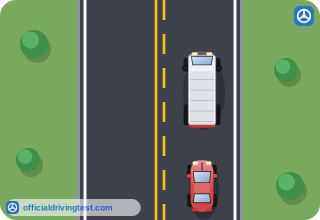
- You have sounded your horn first
- The vehicle ahead is slower than 30 mph
- You are at least one mile past the last curve
- There are no oncoming cars in the passing lanes
Show answer
Correct answer: There are no oncoming cars in the passing lanes
You may pass if there is a broken center line on your side of the road, but only if there are no oncoming cars in the passing lanes.
Source: Maine Driver’s License Manual (Rev 4/24), page 7-8 · Open this page in the manual (Manual page 7-8)
-
According to the manual, what can tell you when it is safe to pass?
- Only you, the driver
- The signs along the road
- The driver of the vehicle ahead
- The vehicles behind you
Show answer
Correct answer: Only you, the driver
Lane markings and signs can tell you when it is unsafe to pass, but only you can tell when it is safe.
Source: Maine Driver’s License Manual (Rev 4/24), page 7-8 · Open this page in the manual (Manual page 7-8)