Maine: Parking rules
Where Maine law forbids parking, accessible parking, parking on hills, and angle, perpendicular and parallel parking. Split into 3 shorter tests so you're not stuck in one long quiz.
Independent educational site · not affiliated with any government agency or DMV
Choose a part
Parking rules — Part 1
Questions in this part include: “How much space does the manual say to leave between your car and vehicles parked in front or behind?”
StartParking rules — Part 2
Questions in this part include: “What must be displayed when you park in a disability parking spot with an access aisle?”
StartParking rules — Part 3
Questions in this part include: “When you are done with parallel parking, about how far from the curb should you be?”
StartAll 49 Parking rules questions with answers
Choose a part above to take a practice test, or study every question and answer here.
Show the questions and answersHide the questions
-
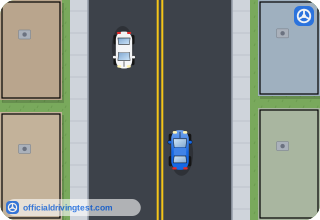
Except where angle parking lines are painted on the roadway, how must you park on a public road?
- At an angle to the curb
- Parallel to the road
- Perpendicular to the road
- With the front wheels turned toward traffic
Show answer
Correct answer: Parallel to the road
You must park parallel to the road except where angle parking lines are painted on the roadway.
Source: Maine Driver’s License Manual (Rev 4/24), page 7-9 · Open this page in the manual (Manual page 7-9)
-
How much space does the manual say to leave between your car and vehicles parked in front or behind?
- At least six inches
- At least one foot
- At least three inches
- At least two feet
Show answer
Correct answer: At least two feet
You must leave at least two feet of space between your car and vehicles parked in front or behind.
Source: Maine Driver’s License Manual (Rev 4/24), page 7-9 · Open this page in the manual (Manual page 7-9)
-
Where should you always park?
- In a marked parking area
- Anywhere close to your destination
- Wherever other cars are parked
- On the left side of the road
Show answer
Correct answer: In a marked parking area
The manual says to always park in a marked parking area.
Source: Maine Driver’s License Manual (Rev 4/24), page 7-9 · Open this page in the manual (Manual page 7-9)
-
If there is a curb, you should park as close to it as you can and no more than how far away?
- 24 inches
- 30 inches
- 18 inches
- 36 inches
Show answer
Correct answer: 18 inches
When there is a curb, park as close to it as you can and no more than 18 inches away.
Source: Maine Driver’s License Manual (Rev 4/24), page 7-9 · Open this page in the manual (Manual page 7-9)
-
If there is a roadside shoulder, how far onto it should you pull when you park?
- Only far enough to clear the traffic lane
- As far onto it as you can
- Halfway onto it
- Just far enough to leave the right lane
Show answer
Correct answer: As far onto it as you can
If there is a roadside shoulder, you should pull as far onto it as you can.
Source: Maine Driver’s License Manual (Rev 4/24), page 7-9 · Open this page in the manual (Manual page 7-9)
-
What should you do to make sure your parked car can't move?
- Turn the wheels straight and leave the car in neutral
- Leave the engine running in neutral
- Shift to drive and release the parking brake
- Set the parking brake and shift gears to park
Show answer
Correct answer: Set the parking brake and shift gears to park
To make sure your car can't move, set your parking brake and shift gears to park.
Source: Maine Driver’s License Manual (Rev 4/24), page 7-10 · Open this page in the manual (Manual page 7-10)
-
In a manual shift car, which gear do you use for the "park" step when you leave the car?
- First or reverse
- Neutral or second
- Neutral only
- Third or neutral
Show answer
Correct answer: First or reverse
In a manual shift car, you shift to first or reverse in place of park.
Source: Maine Driver’s License Manual (Rev 4/24), page 7-10 · Open this page in the manual (Manual page 7-10)
-
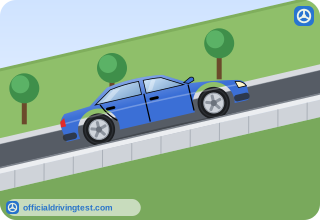
Which way should you turn your wheels when parking uphill with a curb?
- To the right
- Straight ahead
- To the left
- Parallel to the curb
Show answer
Correct answer: To the left
The manual says to turn the wheels to the left when parking uphill with a curb.
Source: Maine Driver’s License Manual (Rev 4/24), page 7-10 · Open this page in the manual (Manual page 7-10)
-
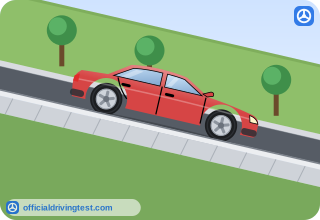
Which way should you turn your wheels when parking downhill?
- To the left
- To the right
- Straight ahead
- Toward the center line
Show answer
Correct answer: To the right
The manual says to turn the wheels to the right when parking downhill.
Source: Maine Driver’s License Manual (Rev 4/24), page 7-10 · Open this page in the manual (Manual page 7-10)
-
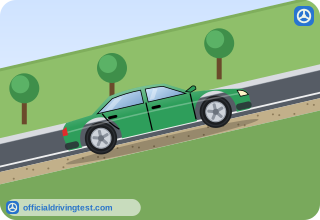
If you park on a hill with no curb, how should the wheels be turned?
- So the car would roll straight back toward the lane
- So the front wheels point toward the center line
- So the wheels are parallel to the road
- So the car would turn off the road, not into traffic
Show answer
Correct answer: So the car would turn off the road, not into traffic
Without a curb, the wheels should turn the car off the road (not into traffic) if it moves.
Source: Maine Driver’s License Manual (Rev 4/24), page 7-10 · Open this page in the manual (Manual page 7-10)
-
Which side of your parked car should you get out of if you can?
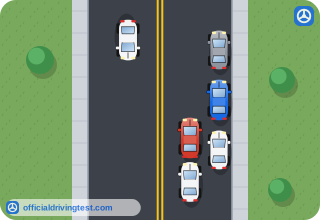
- The curb side
- The street side
- The driver's side
- Whichever side has the key lock
Show answer
Correct answer: The curb side
The manual says to get out of your car on the curb side if you can.
Source: Maine Driver’s License Manual (Rev 4/24), page 7-10 · Open this page in the manual (Manual page 7-10)
-
If you must get out on the street side, what should you do before you open the door?
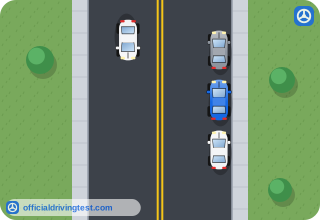
- Sound the horn once to warn drivers
- Turn on your hazard lights
- Check for traffic behind you, especially bicycles
- Lower the window and signal with your arm
Show answer
Correct answer: Check for traffic behind you, especially bicycles
If you must use the street side, check for traffic behind you, especially bicycles, before you open the door.
Source: Maine Driver’s License Manual (Rev 4/24), page 7-10 · Open this page in the manual (Manual page 7-10)
-
What should you do when you leave a car?
- Turn off the engine and leave the key in the ignition
- Turn off the engine and remove the key
- Leave the engine running if you will be quick
- Turn off the engine and hide the key inside
Show answer
Correct answer: Turn off the engine and remove the key
You should turn off the engine and remove the key when you leave a car.
Source: Maine Driver’s License Manual (Rev 4/24), page 7-10 · Open this page in the manual (Manual page 7-10)
-
If your parked car will be out of your sight, what would be wise to do?
- Leave the lights on
- Roll down a window
- Leave a note inside
- Lock it
Show answer
Correct answer: Lock it
If the car will be out of your sight, you would be wise to lock it.
Source: Maine Driver’s License Manual (Rev 4/24), page 7-10 · Open this page in the manual (Manual page 7-10)
-
What fine does the manual list for parking in an area reserved for persons with disabilities without a special parking permit or plates?
- $100
- $50
- $150
- $300
Show answer
Correct answer: $100
The manual lists a $100 fine for parking in a disability area without a special permit or plates.
Source: Maine Driver’s License Manual (Rev 4/24), page 7-10 · Open this page in the manual (Manual page 7-10)
-
What fine does the manual list under State law for misuse of disability plates and placards?
- $25
- $250
- $100
- $500
Show answer
Correct answer: $100
State law prohibits misuse of disability plates and placards, with a $100 fine.
Source: Maine Driver’s License Manual (Rev 4/24), page 7-10 · Open this page in the manual (Manual page 7-10)
-
Which of these is a place where some municipal ordinances do not allow you to park?
- On a street with no curb
- In a loading zone
- In front of your own home
- On a one-way street
Show answer
Correct answer: In a loading zone
Some municipal ordinances do not allow you to park in a loading zone.
Source: Maine Driver’s License Manual (Rev 4/24), page 7-10 · Open this page in the manual (Manual page 7-10)
-
Some municipal ordinances do not allow you to park within how many feet of a fire hydrant?
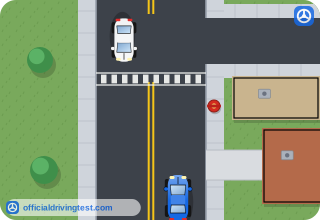
- 5 feet
- 20 feet
- 25 feet
- 10 feet
Show answer
Correct answer: 10 feet
Some municipal ordinances do not allow parking within 10 feet of a fire hydrant.
Source: Maine Driver’s License Manual (Rev 4/24), page 7-10 · Open this page in the manual (Manual page 7-10)
-
Some municipal ordinances do not allow parking within how many feet of a driveway entrance to a fire station, or directly across from the entrance?
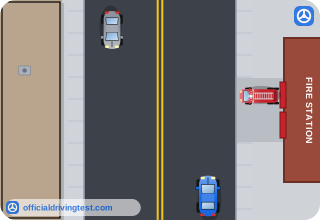
- 15 feet
- 5 feet
- 20 feet
- 25 feet
Show answer
Correct answer: 15 feet
Some municipal ordinances do not allow parking within 15 feet of a fire station driveway entrance or directly across from it.
Source: Maine Driver’s License Manual (Rev 4/24), page 7-10 · Open this page in the manual (Manual page 7-10)
-
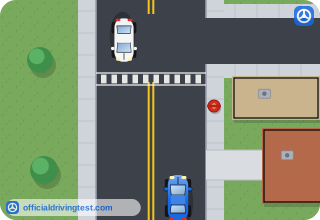
Some municipal ordinances do not allow parking within how many feet of a crosswalk?
- 5 feet
- 20 feet
- 15 feet
- 25 feet
Show answer
Correct answer: 15 feet
Some municipal ordinances do not allow parking within 15 feet of a crosswalk.
Source: Maine Driver’s License Manual (Rev 4/24), page 7-10 · Open this page in the manual (Manual page 7-10)
-
When do some municipal ordinances ban parking at an entrance to a school, church, theater, hotel, hospital or public place?
- At all times of day
- During hours designated
- Only on weekends
- Only when the building is closed
Show answer
Correct answer: During hours designated
Some municipal ordinances do not allow parking at those entrances during hours designated.
Source: Maine Driver’s License Manual (Rev 4/24), page 7-10 · Open this page in the manual (Manual page 7-10)
-
What must be displayed when you park in a disability parking spot with an access aisle?
- A doctor's letter on the dashboard
- A sign stating the driver's medical condition
- A municipal parking sticker
- A disability plate or placard
Show answer
Correct answer: A disability plate or placard
A disability plate or placard must be displayed.
Source: Maine Driver’s License Manual (Rev 4/24), page 7-10 · Open this page in the manual (Manual page 7-10)
-
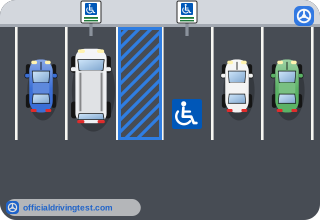
What is the access aisle next to a disability parking spot used for?
- To enter or exit when using a platform lift or mobility device
- As an extra parking space when the lot is full
- As a place to stop briefly while waiting for a passenger
- As a place to load packages into the vehicle quickly
Show answer
Correct answer: To enter or exit when using a platform lift or mobility device
The access aisle is used when it is needed to enter or exit the vehicle with a platform lift or other mobility device.
Source: Maine Driver’s License Manual (Rev 4/24), page 7-10 · Open this page in the manual (Manual page 7-10)
-
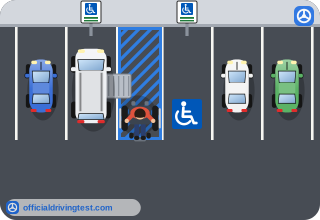
What does the manual say about parking in an access aisle?
- It is allowed briefly
- It is allowed for loading
- It is prohibited
- It is allowed with a placard
Show answer
Correct answer: It is prohibited
Parking in an access aisle is prohibited.
Source: Maine Driver’s License Manual (Rev 4/24), page 7-10 · Open this page in the manual (Manual page 7-10)
-
Misuse of an access aisle is a traffic infraction with a fine of not less than what amount?
- $50
- $200
- $100
- $150
Show answer
Correct answer: $200
Misuse of an access aisle is a traffic infraction subject to a fine of not less than $200.
Source: Maine Driver’s License Manual (Rev 4/24), page 7-10 · Open this page in the manual (Manual page 7-10)
-
How can you tell whether parking is banned or limited somewhere?
- Look only for lines painted in the center of the road
- Assume parking is allowed unless a police officer says otherwise
- Check the registration sticker for local rules
- Check for signs or painted curbs
Show answer
Correct answer: Check for signs or painted curbs
You should check for signs or painted curbs that may ban or limit parking.
Source: Maine Driver’s License Manual (Rev 4/24), page 7-11 · Open this page in the manual (Manual page 7-11)
-
Some no parking zones are indicated by what?
- Colored curb markings
- Flashing pavement lights
- Orange traffic cones
- Dashed white lines across the lane
Show answer
Correct answer: Colored curb markings
Some no parking zones are indicated by colored curb markings.
Source: Maine Driver’s License Manual (Rev 4/24), page 7-11 · Open this page in the manual (Manual page 7-11)
-
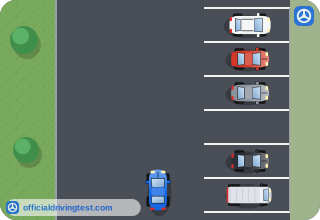
When entering a perpendicular or angle parking space, how should you position your vehicle in the space?
- As close as possible to the vehicle on your left
- Near the right edge of the space
- Center it in the parking space
- Angled slightly toward the street
Show answer
Correct answer: Center it in the parking space
When entering a perpendicular or angle space, you center your vehicle in the parking space.
Source: Maine Driver’s License Manual (Rev 4/24), page 7-11 · Open this page in the manual (Manual page 7-11)
-
When entering a perpendicular or angle parking space, how far forward do you move before stopping?
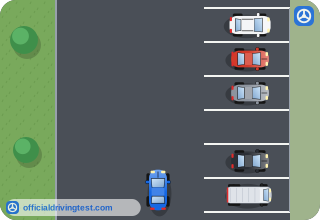
- Halfway into the space
- To the front of the space
- Only until your front wheels are inside
- Until your rear bumper clears the lane
Show answer
Correct answer: To the front of the space
You move to the front of the space and stop.
Source: Maine Driver’s License Manual (Rev 4/24), page 7-11 · Open this page in the manual (Manual page 7-11)
-
When leaving a perpendicular or angle parking space, how far do you back up before turning the wheel?
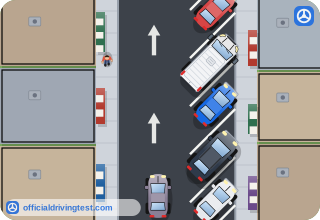
- Until your rear wheels reach the center of the aisle
- Until you can see the entire road behind you
- Until your car is straight in the aisle
- Until your front bumper clears the vehicle beside you
Show answer
Correct answer: Until your front bumper clears the vehicle beside you
You back up until your front bumper clears the vehicle beside you.
Source: Maine Driver’s License Manual (Rev 4/24), page 7-11 · Open this page in the manual (Manual page 7-11)
-
When backing out of a perpendicular or angle space, which way do you turn the steering wheel sharply?
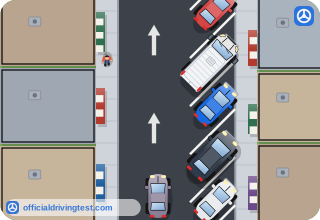
- In the direction you want the rear of your vehicle to move
- In the direction you want the front of your vehicle to move
- Away from the direction the rear should move
- Straight until the rear clears the space
Show answer
Correct answer: In the direction you want the rear of your vehicle to move
You turn the steering wheel sharply in the direction you want the rear of your vehicle to move.
Source: Maine Driver’s License Manual (Rev 4/24), page 7-11 · Open this page in the manual (Manual page 7-11)
-
When your vehicle clears the perpendicular or angle parking space, what do you do?
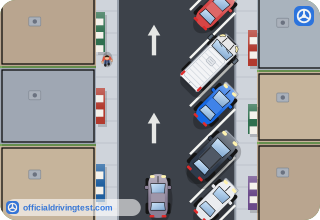
- Keep backing while turning into the lane
- Straighten the wheels and keep backing
- Stop, shift to drive and move ahead
- Shift to drive without stopping
Show answer
Correct answer: Stop, shift to drive and move ahead
When your vehicle clears the parking space, you stop, shift to drive and move ahead.
Source: Maine Driver’s License Manual (Rev 4/24), page 7-11 · Open this page in the manual (Manual page 7-11)
-
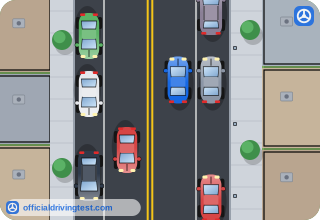
When entering a parallel parking space, how far from the vehicle you will be parking behind do you stop beside it?
- About 6 inches away
- About 2 feet away
- About 5 feet away
- About 10 feet away
Show answer
Correct answer: About 2 feet away
You pull up parallel to the vehicle you will park behind and stop even with it, about 2 feet away.
Source: Maine Driver’s License Manual (Rev 4/24), page 7-11 · Open this page in the manual (Manual page 7-11)
-
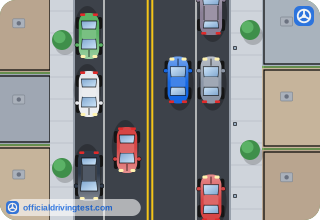
In parallel parking, after you shift to reverse and look to the rear, how do you turn the wheels at first?
- Sharply left, looking over your left shoulder
- Slightly right, looking only in the mirror
- Straight, backing until the bumpers meet
- Sharply right, looking over your right shoulder
Show answer
Correct answer: Sharply right, looking over your right shoulder
You turn the wheels sharply right, look over your right shoulder and back slowly toward the car behind.
Source: Maine Driver’s License Manual (Rev 4/24), page 7-12 · Open this page in the manual (Manual page 7-12)
-
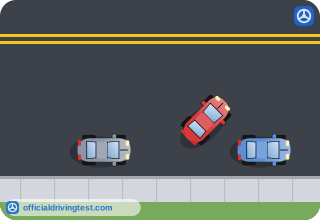
In parallel parking, what do you do when your front door passes the back bumper of the car ahead?
- Quickly straighten the wheels and back straight
- Turn the wheels sharply left and stop backing
- Shift to drive and pull forward
- Turn the wheels farther to the right
Show answer
Correct answer: Quickly straighten the wheels and back straight
When your front door passes the back bumper of the car ahead, you quickly straighten the wheels and continue to back straight.
Source: Maine Driver’s License Manual (Rev 4/24), page 7-12 · Open this page in the manual (Manual page 7-12)
-
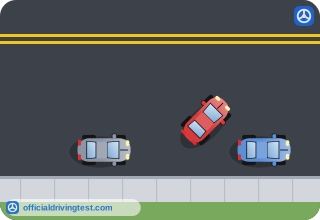
In parallel parking, what do you do when you are clear of the car ahead?
- Turn the wheels sharply right and back up quickly toward the curb
- Straighten the wheels and back quickly
- Turn the wheels sharply left and back slowly toward the car behind
- Turn the wheels sharply left and pull forward
Show answer
Correct answer: Turn the wheels sharply left and back slowly toward the car behind
When clear of the car ahead, you turn the wheels sharply left and back slowly to the car behind.
Source: Maine Driver’s License Manual (Rev 4/24), page 7-12 · Open this page in the manual (Manual page 7-12)
-
In parallel parking, when should you stop backing toward the vehicle behind you?
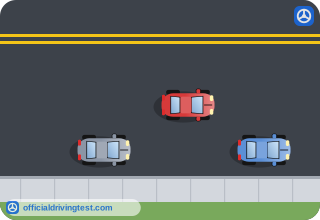
- When your rear bumper is even with its front bumper
- Before touching its bumper
- When your mirror is even with its headlight
- When the front wheels are straight
Show answer
Correct answer: Before touching its bumper
You stop before touching the bumper of the vehicle behind you.
Source: Maine Driver’s License Manual (Rev 4/24), page 7-12 · Open this page in the manual (Manual page 7-12)
-
In parallel parking, what do you do after you stop behind the vehicle?
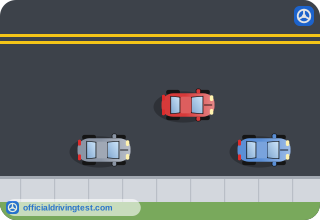
- Turn the wheels sharply left and pull forward to the curb
- Straighten the wheels and back up to the curb
- Pull forward to the car ahead and stop
- Turn the wheels sharply right and pull forward to the center
Show answer
Correct answer: Turn the wheels sharply right and pull forward to the center
After stopping behind the vehicle, you turn the wheels sharply right and pull forward toward the center of the parking space.
Source: Maine Driver’s License Manual (Rev 4/24), page 7-12 · Open this page in the manual (Manual page 7-12)
-
When you are done with parallel parking, about how far from the curb should you be?
- 6 inches
- 2 feet
- 3 feet
- 4 feet
Show answer
Correct answer: 6 inches
You should be about 6 inches from the curb when done parking.
Source: Maine Driver’s License Manual (Rev 4/24), page 7-12 · Open this page in the manual (Manual page 7-12)
-
When finishing parallel parking, in which case do you not straighten the wheels?
- When the curb is painted
- When you are parked near a driveway
- When you are on a hill
- When another car is parked ahead
Show answer
Correct answer: When you are on a hill
You straighten the wheels unless you are on a hill.
Source: Maine Driver’s License Manual (Rev 4/24), page 7-12 · Open this page in the manual (Manual page 7-12)
-
When exiting an offset or parallel parking space, what do you do after checking traffic and applying the brake?
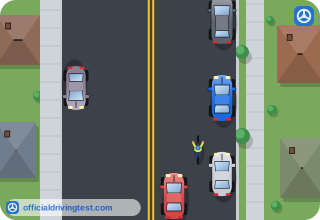
- Shift to drive and pull out into the roadway at once
- Shift to reverse and back up close to the car behind
- Turn the wheels sharply right and wait
- Signal and pull out at once
Show answer
Correct answer: Shift to reverse and back up close to the car behind
After checking traffic and applying the brake, you shift to reverse and back up close to the vehicle parked behind you.
Source: Maine Driver’s License Manual (Rev 4/24), page 7-12 · Open this page in the manual (Manual page 7-12)
-
When exiting a parallel parking space, how do you move forward and steer out?
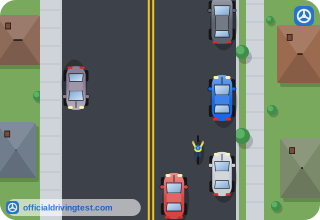
- Move forward quickly and steer out at once
- Stay in reverse and steer out backward
- Move forward in a straight line until the road is clear
- Move forward slowly and steer out into the roadway
Show answer
Correct answer: Move forward slowly and steer out into the roadway
After checking for traffic and signaling, you shift to drive, move forward slowly and steer out into the roadway.
Source: Maine Driver’s License Manual (Rev 4/24), page 7-12 · Open this page in the manual (Manual page 7-12)
-
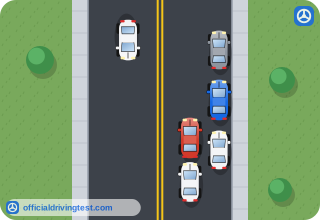
If the front bumper of your vehicle will not clear the vehicle ahead when you leave a parallel space, what do you do?
- Shift to reverse and readjust
- Turn the wheels sharply and scrape past
- Sound the horn and wait
- Shift to park and wait for the car to move
Show answer
Correct answer: Shift to reverse and readjust
If the front bumper will not clear the vehicle ahead, you shift to reverse and readjust.
Source: Maine Driver’s License Manual (Rev 4/24), page 7-12 · Open this page in the manual (Manual page 7-12)
-
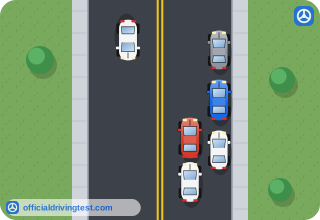
When exiting a parallel parking space, when do you move quickly into the traffic lane?
- When your front bumper passes the rear bumper of the car ahead of you
- When your rear wheels leave the curb
- When the doorpost of your vehicle clears the rear bumper of the car ahead
- When the traffic behind you has stopped
Show answer
Correct answer: When the doorpost of your vehicle clears the rear bumper of the car ahead
You move quickly into the traffic lane when the doorpost of your vehicle clears the rear bumper of the vehicle ahead of you.
Source: Maine Driver’s License Manual (Rev 4/24), page 7-12 · Open this page in the manual (Manual page 7-12)
-
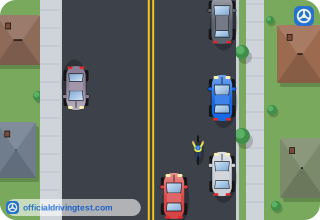
If you are parked on the right-hand side of the road, over which shoulder do you look after starting your vehicle?
- Your right shoulder
- Your left shoulder
- Only the rearview mirror
- Only the outside mirror
Show answer
Correct answer: Your left shoulder
You look over your left shoulder, not through your rearview mirror only.
Source: Maine Driver’s License Manual (Rev 4/24), page 7-12 · Open this page in the manual (Manual page 7-12)
-
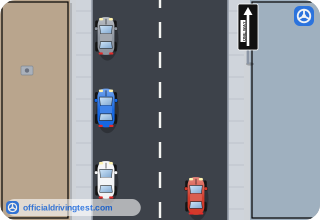
If you are parked at the left curb, over which shoulder do you look before you enter the roadway?
- Your left shoulder
- Only the rearview mirror
- Neither; the side mirror is enough
- Your right shoulder
Show answer
Correct answer: Your right shoulder
From the left curb, you look over your right shoulder as you enter the roadway.
Source: Maine Driver’s License Manual (Rev 4/24), page 7-12 · Open this page in the manual (Manual page 7-12)
-
When the way is clear as you start from a parking place, how do you pull out?
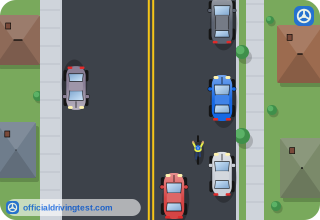
- Signal, then pull slowly out into the correct lane as soon as possible
- Signal, then pull out quickly and straddle the lane lines
- Pull out first, then signal once you are in the lane
- Pull slowly into the left lane and then move over to the right
Show answer
Correct answer: Signal, then pull slowly out into the correct lane as soon as possible
You give the appropriate signal and pull slowly out into the street and into the correct lane as soon as possible.
Source: Maine Driver’s License Manual (Rev 4/24), page 7-12 · Open this page in the manual (Manual page 7-12)
-
Whatever the type of street, the lane you are about to enter must be free of traffic for how far?
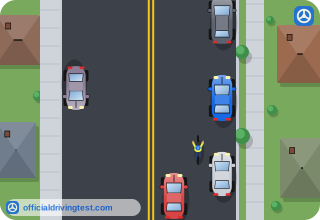
- One city block
- At least one mile
- A safe distance
- Three car lengths
Show answer
Correct answer: A safe distance
You always make sure the lane you are about to enter is free of traffic for a safe distance.
Source: Maine Driver’s License Manual (Rev 4/24), page 7-12 · Open this page in the manual (Manual page 7-12)
-
What should you check before you slow down to pull into a parking space?
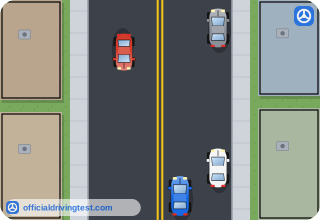
- Whether the parking meter has time left
- Your tire pressure
- Your oil pressure
- Traffic behind you
Show answer
Correct answer: Traffic behind you
Stopping to pull into a parking space is one of the situations when you need to check behind before slowing.
Source: Maine Driver’s License Manual (Rev 4/24), page 8-4 · Open this page in the manual (Manual page 8-4)