Louisiana: Speed and following distance — Part 6 Practice Test
Louisiana speed limits, stopping distances, the 3-second rule, space around your vehicle, night and rural driving. — Part 6
Independent educational site · not affiliated with any government agency or DMV
Ready? Test yourself
- Instant feedback with an explanation
- Every answer cites its source in the manual
- Your best score is saved on this device
Questions are original and based on the official manual "Class D & E Driver’s Guide" (Revised August 2025 (DPSMV2052 R08/25)), Louisiana Office of Motor Vehicles.
All 35 questions in this practice test
Take the test above first, then use this list to study. Tap “Show answer” to see the correct answer and explanation.
Show the questions and answersHide the questions
-
Before you reach the crest of a hill or enter a curve on a rural road, what should you do?
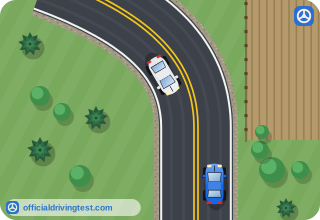
- Speed up and stay near the center line to see the road ahead
- Slow down and move to the right side of the road
- Move to the center of the road so you can see farther ahead
- Stay in your lane and sound your horn all the way through
Show answer
Correct answer: Slow down and move to the right side of the road
The manual says to slow down, move to the right side of the road and watch for oncoming vehicles before a hill crest or curve.
Source: Class D & E Driver’s Guide (Revised August 2025 (DPSMV2052 R08/25)), page 103 · Open this page in the manual (Manual page 103)
-
What can overloading a vehicle cause?
- Harm to the brakes and damage to the suspension
- Faster tire wear but no effect on braking
- Better traction on slick and wet roads
- Lower fuel use and shorter stops
Show answer
Correct answer: Harm to the brakes and damage to the suspension
The manual says an overloaded vehicle can harm your brakes, making it hard to stop or slow down, and can damage your suspension.
Source: Class D & E Driver’s Guide (Revised August 2025 (DPSMV2052 R08/25)), page 106 · Open this page in the manual (Manual page 106)
-
If you are renting a moving trailer, what does the manual say to ask?
- How many miles it can safely be towed in a single day
- How fast it may be towed on an interstate highway
- How much it weighs when empty and how much weight it can hold
- What size tires and wheels it comes equipped with
Show answer
Correct answer: How much it weighs when empty and how much weight it can hold
The manual says to ask how much the trailer weighs when empty and how much weight it can hold to help determine total weight.
Source: Class D & E Driver’s Guide (Revised August 2025 (DPSMV2052 R08/25)), page 106 · Open this page in the manual (Manual page 106)
-
Where can you find your vehicle’s gross vehicle weight rating (GVWR)?
- On your driver’s license
- In your owner’s manual
- On your inspection sticker
- On your spare tire’s sidewall
Show answer
Correct answer: In your owner’s manual
You can find the GVWR in your owner’s manual; it should also appear on your title and registration documents.
Source: Class D & E Driver’s Guide (Revised August 2025 (DPSMV2052 R08/25)), page 106 · Open this page in the manual (Manual page 106)
-
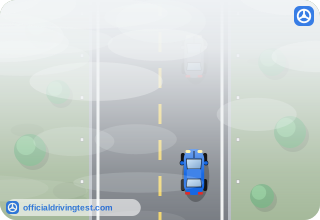
If fog is so dense that it impairs your vision, what does the manual say you should do?
- Not drive at all
- Drive at 10 to 20 miles per hour on the highway
- Follow the taillights ahead of you
- Use your high beam headlights
Show answer
Correct answer: Not drive at all
The manual says that if the fog is so dense that it impairs your vision, you should not drive at all.
Source: Class D & E Driver’s Guide (Revised August 2025 (DPSMV2052 R08/25)), page 106 · Open this page in the manual (Manual page 106)
-
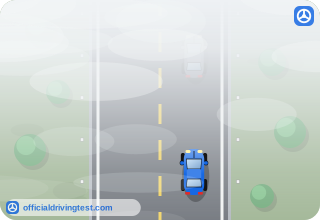
If you must drive in dense fog, where should you drive?
- To the end of your trip, keeping to a steady speed
- Along the center line, using it for guidance
- To the nearest place you can get off the highway
- Along the left edge of the road, using it as a guide
Show answer
Correct answer: To the nearest place you can get off the highway
The manual says that if you must drive, you should slow down and drive to the nearest place where you can get off the highway and stop.
Source: Class D & E Driver’s Guide (Revised August 2025 (DPSMV2052 R08/25)), page 106 · Open this page in the manual (Manual page 106)
-
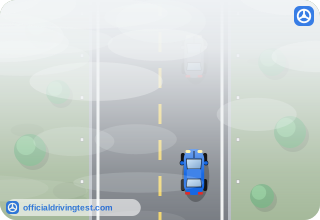
What does the manual say about creeping along at 10 to 20 miles per hour on the highway in fog?
- It is the safest speed in fog
- You are risking your life
- It is required by law in fog
- It is dangerous only at night
Show answer
Correct answer: You are risking your life
The manual says you are risking your life by creeping along at 10 to 20 miles per hour on the highway.
Source: Class D & E Driver’s Guide (Revised August 2025 (DPSMV2052 R08/25)), page 106 · Open this page in the manual (Manual page 106)
-
In bad weather, what may red tail-lights ahead be?
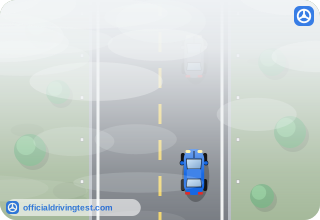
- A vehicle that is moving at the posted speed limit
- A vehicle that is about to leave the interstate
- A vehicle that is in the deceleration lane ahead
- A vehicle stopped on the roadway or just barely moving
Show answer
Correct answer: A vehicle stopped on the roadway or just barely moving
The manual says red tail-lights may be a vehicle that is stopped on the roadway or just barely moving.
Source: Class D & E Driver’s Guide (Revised August 2025 (DPSMV2052 R08/25)), page 106 · Open this page in the manual (Manual page 106)
-
In bad weather, how can you make drivers coming up behind you aware of your vehicle?
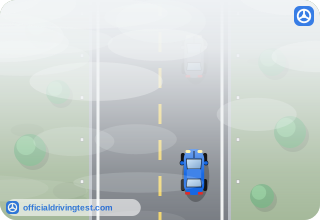
- Tap your brakes
- Flash your high beams
- Sound your horn
- Increase your speed
Show answer
Correct answer: Tap your brakes
The manual says vehicles behind may be driving too fast, so you should tap your brakes to make these drivers aware of your vehicle.
Source: Class D & E Driver’s Guide (Revised August 2025 (DPSMV2052 R08/25)), page 106 · Open this page in the manual (Manual page 106)
-
What should you develop the ability to do at night?
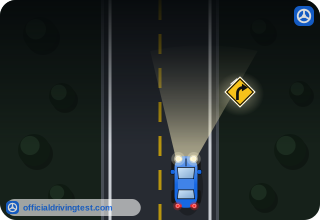
- Glance well ahead of your headlight beams for dark shapes
- Watch only the area lit by your headlights and no farther
- Look only at the center line and nowhere else on the road
- Stare at the pavement just ahead of your bumper
Show answer
Correct answer: Glance well ahead of your headlight beams for dark shapes
The manual says to develop the ability to glance well ahead of your headlight beams, looking for dark shapes on the roadway.
Source: Class D & E Driver’s Guide (Revised August 2025 (DPSMV2052 R08/25)), page 107 · Open this page in the manual (Manual page 107)
-
At night, why should you glance occasionally to the right and left?
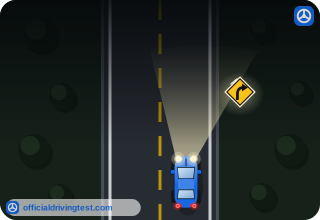
- To check for vehicles that are following close behind you
- To read the road signs on both sides of the road
- To find the edge of the pavement and hazards from the sides
- To rest your eyes from the glare of the headlights
Show answer
Correct answer: To find the edge of the pavement and hazards from the sides
The manual says to glance occasionally right and left to determine the location of the edge of the pavement and hazards that may come from the sides.
Source: Class D & E Driver’s Guide (Revised August 2025 (DPSMV2052 R08/25)), page 107 · Open this page in the manual (Manual page 107)
-
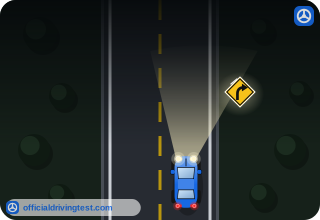
In the country or in rural areas at night, within what distance should you be able to stop?
- Within one block
- Within the distance lit by the vehicle ahead
- Within the distance of your low beams only
- Within the distance lit by your headlights
Show answer
Correct answer: Within the distance lit by your headlights
The manual warns it is easy to out-drive your headlights and says you should be able to stop within the distance lit by your headlights.
Source: Class D & E Driver’s Guide (Revised August 2025 (DPSMV2052 R08/25)), page 107 · Open this page in the manual (Manual page 107)
-
What are open conditions?
- A zone that is not available for your path of travel
- A space or larger area in which to drive without restrictions
- Moderate to heavy traffic with limited view
- A situation that changes as speed limits change
Show answer
Correct answer: A space or larger area in which to drive without restrictions
The manual defines open conditions as having a space or a larger area in which to drive that is without restrictions.
Source: Class D & E Driver’s Guide (Revised August 2025 (DPSMV2052 R08/25)), page 107 · Open this page in the manual (Manual page 107)
-
What is a closed zone?
- A wide open area with no restrictions around your car at all
- A zone where the driving situation changes from open to closed
- A zone that you would encounter only on the interstate
- One that is unavailable for your path of travel or limits your view
Show answer
Correct answer: One that is unavailable for your path of travel or limits your view
The manual says a closed zone is not available for your car’s path of travel, restricts the driver’s view or has unavailable space, and is met in moderate to heavy traffic.
Source: Class D & E Driver’s Guide (Revised August 2025 (DPSMV2052 R08/25)), page 107 · Open this page in the manual (Manual page 107)
-
What are changing conditions?
- They often occur when an open zone changes to a closed zone
- Wide open spaces with no restrictions around your car
- Zones that are never available for your path of travel
- Conditions you meet only in moderate to heavy traffic
Show answer
Correct answer: They often occur when an open zone changes to a closed zone
The manual says changing conditions often occur when the driving situation changes from an open to a closed zone.
Source: Class D & E Driver’s Guide (Revised August 2025 (DPSMV2052 R08/25)), page 107 · Open this page in the manual (Manual page 107)
-
Why is the urban driving environment typically more challenging to the novice driver?
- There are higher speed limits on every road
- There are fewer road signs and signals to read
- There are more stimuli to be sorted and reacted to
- There is less traffic to watch at each moment
Show answer
Correct answer: There are more stimuli to be sorted and reacted to
The manual says urban driving is typically more challenging to the novice driver because there are more stimuli to be sorted and react to.
Source: Class D & E Driver’s Guide (Revised August 2025 (DPSMV2052 R08/25)), page 107 · Open this page in the manual (Manual page 107)
-
In urban driving, why does reducing speed help?
- It lets you pay less attention to pedestrians and traffic flow
- It allows more time to see details, analyze and react to hazards
- It allows you to change lanes without having to signal
- It keeps other drivers from following you too closely
Show answer
Correct answer: It allows more time to see details, analyze and react to hazards
The manual says reducing speed allows more time to see details, analyze and predict what might happen, react to hazards and execute decisions.
Source: Class D & E Driver’s Guide (Revised August 2025 (DPSMV2052 R08/25)), page 108 · Open this page in the manual (Manual page 108)
-
According to the manual, what is the best way to extend the life of your vehicle and save on fuel?
- Drive it only on the interstate
- Drive it at the minimum posted speed
- Warm it up before every trip
- Use it as little as possible
Show answer
Correct answer: Use it as little as possible
The manual says the best way to extend the life of your vehicle and save on fuel is to use it as little as possible.
Source: Class D & E Driver’s Guide (Revised August 2025 (DPSMV2052 R08/25)), page 108 · Open this page in the manual (Manual page 108)
-
Why does the manual say to avoid driving during heavy traffic?
- It causes extra wear and tear on you and the vehicle
- It is against the law on most state highways
- It lowers the following distance you need
- It makes your trip shorter
Show answer
Correct answer: It causes extra wear and tear on you and the vehicle
The manual says avoiding heavy traffic cuts down on extra wear and tear on you and the vehicle.
Source: Class D & E Driver’s Guide (Revised August 2025 (DPSMV2052 R08/25)), page 108 · Open this page in the manual (Manual page 108)
-
What does the manual say to do with your errands to cut down on driving?
- Make a separate trip for each errand
- Run each errand as it comes up
- Plan, and then combine your trips
- Drive to the farthest place first and return home
Show answer
Correct answer: Plan, and then combine your trips
The manual says to plan and then combine your trips, going to as many places as possible on one trip.
Source: Class D & E Driver’s Guide (Revised August 2025 (DPSMV2052 R08/25)), page 108 · Open this page in the manual (Manual page 108)
-
Why does the manual say to call ahead before going out to pick up what you need?
- To reserve a parking space close to the door
- To make sure they have what you need or it is ready
- To avoid paying a fee for what you pick up there
- To learn the speed limit on the route to take
Show answer
Correct answer: To make sure they have what you need or it is ready
The manual says to call ahead to make sure they have what you need or that what you are picking up is ready.
Source: Class D & E Driver’s Guide (Revised August 2025 (DPSMV2052 R08/25)), page 108 · Open this page in the manual (Manual page 108)
-
Which of these should you check to prepare a vehicle for any trip?
- Seat covers
- Floor mats
- Radio presets
- Belts and hoses
Show answer
Correct answer: Belts and hoses
The manual lists windshields and windows, lights, tires, all fluid levels, belts, hoses and brakes as components to check before a trip.
Source: Class D & E Driver’s Guide (Revised August 2025 (DPSMV2052 R08/25)), page 108 · Open this page in the manual (Manual page 108)
-
Why does the manual say to consider the time of day before going on a trip?
- To avoid congestion in city areas
- To find the lowest fuel prices
- To use the left lane more often
- To avoid using your headlights
Show answer
Correct answer: To avoid congestion in city areas
The manual says to consider the time of day to avoid congestion in city areas.
Source: Class D & E Driver’s Guide (Revised August 2025 (DPSMV2052 R08/25)), page 108 · Open this page in the manual (Manual page 108)
-
What should your trip route plan include?
- Only the street address of your destination
- Only the names of the towns on the route you drive
- The route number and the entrance and exit numbers
- Only the total miles you plan to drive each day
Show answer
Correct answer: The route number and the entrance and exit numbers
The manual says to have a plan for the route including the route number and the entrance and exit numbers of the final destination.
Source: Class D & E Driver’s Guide (Revised August 2025 (DPSMV2052 R08/25)), page 108 · Open this page in the manual (Manual page 108)
-
What happens when you travel on secondary roads that go through towns and cities, or through mountains?
- It will take longer to get to your destination
- It will take less time to get to your destination
- You can drive more miles every two hours
- You do not need breaks
Show answer
Correct answer: It will take longer to get to your destination
The manual says travel on secondary roads through towns and cities or through mountains will take longer to get to your destination.
Source: Class D & E Driver’s Guide (Revised August 2025 (DPSMV2052 R08/25)), page 108 · Open this page in the manual (Manual page 108)
-
What is the maximum speed for any vehicle in Louisiana unless an exception applies?
- 65 mph
- 70 mph
- 60 mph
- 55 mph
Show answer
Correct answer: 70 mph
The manual gives 70 mph as the maximum speed for any vehicle in Louisiana, with listed exceptions.
Source: Class D & E Driver’s Guide (Revised August 2025 (DPSMV2052 R08/25)), page 128 · Open this page in the manual (Manual page 128)
-
What is the speed limit when pulling or towing another motor vehicle?
- 40 mph
- 50 mph
- 55 mph
- 45 mph
Show answer
Correct answer: 45 mph
When pulling or towing another motor vehicle, the speed limit is 45 mph.
Source: Class D & E Driver’s Guide (Revised August 2025 (DPSMV2052 R08/25)), page 128 · Open this page in the manual (Manual page 128)
-
School buses are limited to what speed when frequently stopping to load or unload children?
- 25 mph
- 30 mph
- 35 mph
- 40 mph
Show answer
Correct answer: 35 mph
School buses are limited to 35 mph when frequently stopping to load or unload children.
Source: Class D & E Driver’s Guide (Revised August 2025 (DPSMV2052 R08/25)), page 128 · Open this page in the manual (Manual page 128)
-
What is the speed limit on portions of I-49, according to the Class D chauffeur's license section?
- 75 mph
- 65 mph
- 70 mph
- 80 mph
Show answer
Correct answer: 75 mph
The manual lists 75 as the speed limit on portions of I-49 as an exception to the 70 mph maximum.
Source: Class D & E Driver’s Guide (Revised August 2025 (DPSMV2052 R08/25)), page 129 · Open this page in the manual (Manual page 129)
-
On rural highways outside residential areas or business districts, motor trucks must not follow within how far of one another except to pass?
- 200 feet
- 300 feet
- 500 feet
- 400 feet
Show answer
Correct answer: 400 feet
On rural highways, drivers of motor trucks must not follow within 400 feet of one another except to pass.
Source: Class D & E Driver’s Guide (Revised August 2025 (DPSMV2052 R08/25)), page 129 · Open this page in the manual (Manual page 129)
-
With air brakes, about how long does it take for the air to flow through the lines to the brakes?
- About two seconds or more
- About ten seconds or more
- About one minute or more
- One half second or more
Show answer
Correct answer: One half second or more
With air brakes, it takes a little time (one half second or more) for the air to flow through the lines to the brakes.
Source: Class D & E Driver’s Guide (Revised August 2025 (DPSMV2052 R08/25)), page 132 · Open this page in the manual (Manual page 132)
-
Which distance is part of the total stopping distance for vehicles with air brake systems, in addition to perception, reaction and effective braking distance?
- Parking brake distance
- Spring brake distance
- Brake lag distance
- Compressor lag distance
Show answer
Correct answer: Brake lag distance
The total stopping distance with air brakes is perception distance plus reaction distance plus brake lag distance plus effective braking distance.
Source: Class D & E Driver’s Guide (Revised August 2025 (DPSMV2052 R08/25)), page 132 · Open this page in the manual (Manual page 132)
-
At 55 mph on dry pavement, about how much does the air brake lag distance add?
- About 32 feet
- About 10 feet
- About 100 feet
- About 200 feet
Show answer
Correct answer: About 32 feet
The air brake lag distance at 55 mph on dry pavement adds about 32 feet.
Source: Class D & E Driver’s Guide (Revised August 2025 (DPSMV2052 R08/25)), page 132 · Open this page in the manual (Manual page 132)
-
For an average driver at 55 mph with good traction and brake condition, the total stopping distance for a vehicle with air brakes is about how long?
- About 100 feet
- About 200 feet
- About 32 feet
- Over 300 feet
Show answer
Correct answer: Over 300 feet
At 55 mph for an average driver under good traction and brake condition, the total stopping distance is over 300 feet, longer than a football field.
Source: Class D & E Driver’s Guide (Revised August 2025 (DPSMV2052 R08/25)), page 132 · Open this page in the manual (Manual page 132)
-
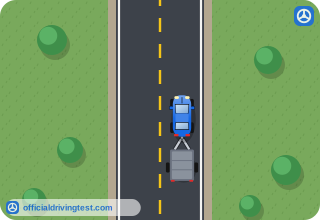
When you tow a trailer, the overall weight of your vehicle changes. What does the manual say you must take into account?
- Your driving speed and stopping distance
- The color of your license plate
- The number of passengers you may carry
- The time of day you may drive
Show answer
Correct answer: Your driving speed and stopping distance
Towing a vehicle changes the overall weight of the vehicle, so you need to adjust your driving speed and stopping distance.
Source: Class D & E Driver’s Guide (Revised August 2025 (DPSMV2052 R08/25)), page 133 · Open this page in the manual (Manual page 133)