Louisiana: Speed and following distance — Part 4 Practice Test
Louisiana speed limits, stopping distances, the 3-second rule, space around your vehicle, night and rural driving. — Part 4
Independent educational site · not affiliated with any government agency or DMV
Ready? Test yourself
- Instant feedback with an explanation
- Every answer cites its source in the manual
- Your best score is saved on this device
Questions are original and based on the official manual "Class D & E Driver’s Guide" (Revised August 2025 (DPSMV2052 R08/25)), Louisiana Office of Motor Vehicles.
All 36 questions in this practice test
Take the test above first, then use this list to study. Tap “Show answer” to see the correct answer and explanation.
Show the questions and answersHide the questions
-
Why can passing on the right be dangerous?
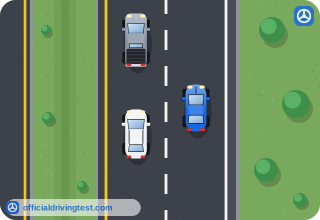
- The other driver may not see you and decide to change lanes
- The other driver is allowed to speed up when you pass on the right
- Oncoming vehicles cannot see you in the right lane at night
- The lane to the right is always narrower than the left lane
Show answer
Correct answer: The other driver may not see you and decide to change lanes
The manual says passing on the right can be dangerous if the other driver does not see you and decides to change lanes.
Source: Class D & E Driver’s Guide (Revised August 2025 (DPSMV2052 R08/25)), page 72 · Open this page in the manual (Manual page 72)
-
On multi-lane roads, which lane is intended to be used for passing slower vehicles?
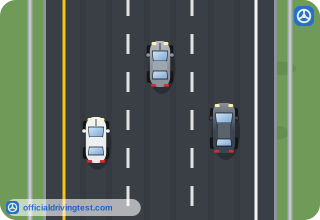
- The right-most lane
- The center lane only
- The left-most lane
- Any lane that is empty
Show answer
Correct answer: The left-most lane
The manual says that on multi-lane roads the left-most lane is intended to be used for passing slower vehicles.
Source: Class D & E Driver’s Guide (Revised August 2025 (DPSMV2052 R08/25)), page 72 · Open this page in the manual (Manual page 72)
-
The manual says never to pass on the shoulder. Which shoulders does this cover?
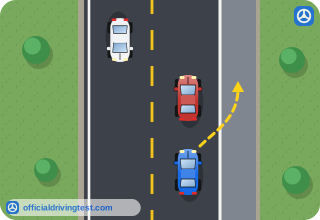
- Only unpaved shoulders
- Whether it is paved or not
- Only shoulders on two-lane roads
- Only shoulders at night
Show answer
Correct answer: Whether it is paved or not
The manual says to never pass on the shoulder, whether it is paved or not, because it is dangerous.
Source: Class D & E Driver’s Guide (Revised August 2025 (DPSMV2052 R08/25)), page 72 · Open this page in the manual (Manual page 72)
-
Why is it dangerous to pass on the shoulder?
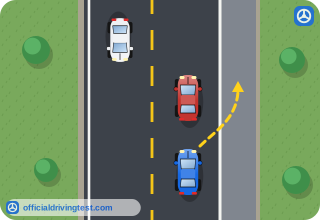
- Shoulders are always too narrow for a car to travel on safely
- Police cannot see vehicles that are driving on the shoulder
- Shoulder surfaces are always slippery when wet or dry
- Other drivers may pull off the road without looking for your vehicle
Show answer
Correct answer: Other drivers may pull off the road without looking for your vehicle
The manual says other drivers may pull off the road without looking for your vehicle.
Source: Class D & E Driver’s Guide (Revised August 2025 (DPSMV2052 R08/25)), page 72 · Open this page in the manual (Manual page 72)
-
Why should you not pull up closely behind a large truck or bus you intend to pass?
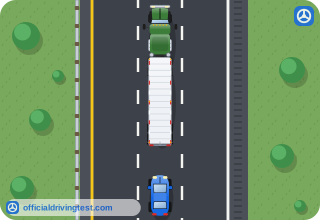
- Trucks are not allowed to be passed
- You may be in the truck’s blind spot only at night
- Your vision may be obstructed
- It is illegal to follow within one car length
Show answer
Correct answer: Your vision may be obstructed
The manual says not to pull up closely behind the vehicle you intend to pass, especially a large truck or bus, because your vision may be obstructed.
Source: Class D & E Driver’s Guide (Revised August 2025 (DPSMV2052 R08/25)), page 72 · Open this page in the manual (Manual page 72)
-
How should you follow a vehicle you intend to pass until you can pass?
- At a safe distance until you can see far enough ahead to pass safely
- Closely, so you can pass at the first chance
- Closely, with your lights flashing
- At a safe distance, then pass at once with the horn sounding
Show answer
Correct answer: At a safe distance until you can see far enough ahead to pass safely
The manual says to follow at a safe distance until you can see far enough ahead to insure safe passing.
Source: Class D & E Driver’s Guide (Revised August 2025 (DPSMV2052 R08/25)), page 72 · Open this page in the manual (Manual page 72)
-
You are thinking about passing and you can see an oncoming vehicle. What should you do?
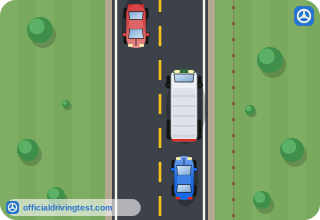
- Pass quickly before it comes closer
- Flash your headlights and pass
- Pass only if the vehicle is a small car
- Do not attempt to pass
Show answer
Correct answer: Do not attempt to pass
The manual says that if you can see an oncoming vehicle, you should not attempt to pass.
Source: Class D & E Driver’s Guide (Revised August 2025 (DPSMV2052 R08/25)), page 72 · Open this page in the manual (Manual page 72)
-
Why is it hard to judge whether it is safe to pass when you see an oncoming vehicle?
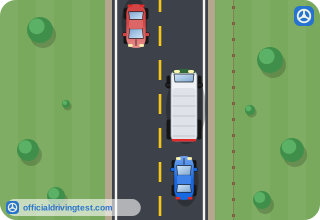
- Oncoming vehicles always travel faster than the posted speed limit on two-lane roads
- It is difficult to judge the speed of oncoming vehicles, even for experienced drivers
- Oncoming vehicles usually use their high beams even during the day
- Oncoming vehicles have the right of way on two-lane roads
Show answer
Correct answer: It is difficult to judge the speed of oncoming vehicles, even for experienced drivers
The manual says it is difficult to determine the speed of oncoming vehicles, even for experienced drivers.
Source: Class D & E Driver’s Guide (Revised August 2025 (DPSMV2052 R08/25)), page 72 · Open this page in the manual (Manual page 72)
-
An oncoming vehicle that is more than 25 seconds from your vehicle generally appears to be what?
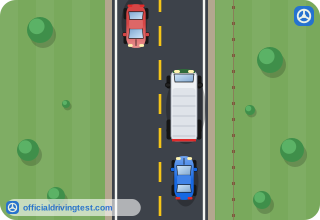
- Moving faster than it really is
- Standing still
- Moving toward the shoulder
- Slowing down
Show answer
Correct answer: Standing still
The manual says an oncoming vehicle more than 25 seconds away generally appears to be standing still.
Source: Class D & E Driver’s Guide (Revised August 2025 (DPSMV2052 R08/25)), page 73 · Open this page in the manual (Manual page 73)
-
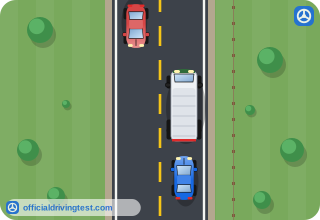
You can actually see an oncoming vehicle coming closer. How far away is it probably?
- Exactly 25 seconds
- Farther than 25 seconds
- More than a minute
- Closer than 25 seconds
Show answer
Correct answer: Closer than 25 seconds
The manual says that if you can actually see the oncoming vehicle coming closer, it is probably closer than 25 seconds.
Source: Class D & E Driver’s Guide (Revised August 2025 (DPSMV2052 R08/25)), page 73 · Open this page in the manual (Manual page 73)
-
Before you pass, what should you make sure of about the vehicles around you?
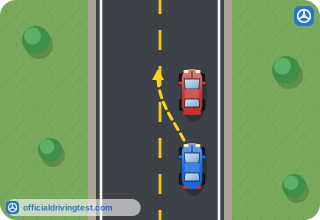
- That no car is passing you, by checking your left or right rear blind spot
- That all vehicles behind you are far away from your rear bumper
- That the vehicle ahead has its turn signal on
- That the vehicle ahead is slowing down
Show answer
Correct answer: That no car is passing you, by checking your left or right rear blind spot
The manual says to make certain no car is passing you by checking your left or right rear blind spot.
Source: Class D & E Driver’s Guide (Revised August 2025 (DPSMV2052 R08/25)), page 73 · Open this page in the manual (Manual page 73)
-
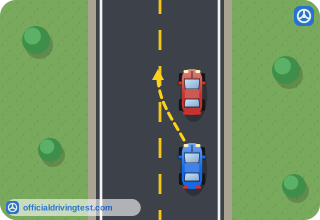
Before you pass, whom should you signal your intention to?
- Only the vehicle you are passing
- Only oncoming traffic
- The vehicle following you
- Nobody, if the road is clear
Show answer
Correct answer: The vehicle following you
The manual says to signal your intention to pass to the vehicle following you.
Source: Class D & E Driver’s Guide (Revised August 2025 (DPSMV2052 R08/25)), page 73 · Open this page in the manual (Manual page 73)
-
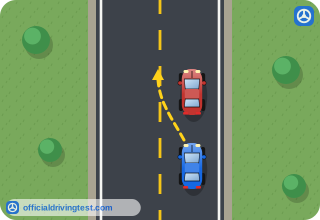
What does the manual say is a safe practice to avoid surprising the driver you are overtaking?
- Flash your high beams repeatedly
- Sound a long horn blast
- Pull close behind with your signal on
- Tap the horn lightly
Show answer
Correct answer: Tap the horn lightly
The manual says it is safe practice to tap the horn lightly to avoid surprising the overtaken driver.
Source: Class D & E Driver’s Guide (Revised August 2025 (DPSMV2052 R08/25)), page 73 · Open this page in the manual (Manual page 73)
-
After passing, what is an accepted rule for knowing when to return to the proper lane?
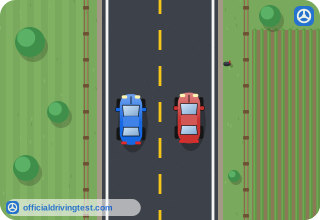
- Return as soon as your front bumper passes the other car
- Wait until you see the other car in your rear view mirror
- Return when the other driver flashes the headlights
- Return once you have passed the other car’s mirror
Show answer
Correct answer: Wait until you see the other car in your rear view mirror
The manual says an accepted rule is to wait until you see the other car in your rear view mirror before returning to the proper lane.
Source: Class D & E Driver’s Guide (Revised August 2025 (DPSMV2052 R08/25)), page 73 · Open this page in the manual (Manual page 73)
-
Why should you pass another vehicle as quickly and safely as possible?
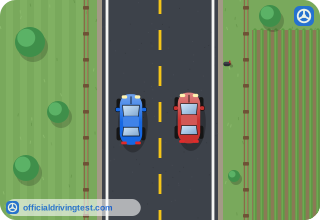
- The longer you stay alongside, the longer the other vehicle can move toward your lane
- The longer you stay alongside, the more fuel your vehicle uses up while passing
- Slower passes are against the law
- The other driver is required to speed up
Show answer
Correct answer: The longer you stay alongside, the longer the other vehicle can move toward your lane
The manual says the longer your vehicle stays alongside the other vehicle, the longer you are in danger of it moving toward your lane.
Source: Class D & E Driver’s Guide (Revised August 2025 (DPSMV2052 R08/25)), page 73 · Open this page in the manual (Manual page 73)
-
When you are about to pass, from how far behind the vehicle should you start the pass?
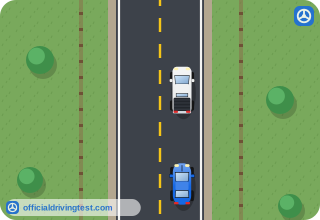
- At least two seconds
- At least one second
- At least five seconds
- At least ten seconds
Show answer
Correct answer: At least two seconds
The manual says to pass from at least two seconds behind the vehicle to be passed to avoid striking its rear side.
Source: Class D & E Driver’s Guide (Revised August 2025 (DPSMV2052 R08/25)), page 73 · Open this page in the manual (Manual page 73)
-
How long should you continue to pass before signaling to return to your lane?
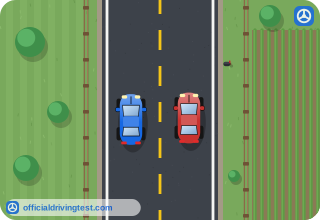
- Until the headlights of the passed vehicle are no longer visible at night
- Until you are one car length ahead of the passed vehicle
- Until the complete front of the passed vehicle is visible in your rearview mirror
- Until the passed vehicle slows down
Show answer
Correct answer: Until the complete front of the passed vehicle is visible in your rearview mirror
The manual says to continue to pass until the complete front of the passed vehicle is visible in your rearview mirror, then signal and return to the lane.
Source: Class D & E Driver’s Guide (Revised August 2025 (DPSMV2052 R08/25)), page 73 · Open this page in the manual (Manual page 73)
-
When are road surfaces most slippery in wet weather?
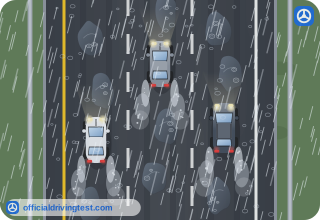
- Immediately after the rain begins to fall
- After it has rained steadily for several hours
- Once the rain stops and the road starts drying
- Only when the rain turns to a light mist at night
Show answer
Correct answer: Immediately after the rain begins to fall
Road surfaces are most slippery immediately after the rain begins to fall, because the oil and grease on the pavement have not yet been washed away.
Source: Class D & E Driver’s Guide (Revised August 2025 (DPSMV2052 R08/25)), page 74 · Open this page in the manual (Manual page 74)
-
Why is the road so slippery just after rain starts to fall?
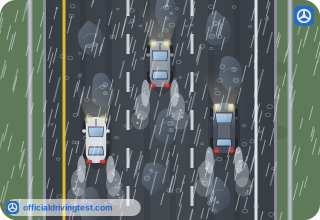
- The road surface is still too hot to absorb the water
- Rain falls hardest during the first few minutes
- Oil and grease on the pavement have not been washed away
- Other drivers have not yet turned on their headlights
Show answer
Correct answer: Oil and grease on the pavement have not been washed away
The oil and grease on the pavement have not yet been washed away, and a road covered with oil and water can be like ice.
Source: Class D & E Driver’s Guide (Revised August 2025 (DPSMV2052 R08/25)), page 74 · Open this page in the manual (Manual page 74)
-
Driving on a road covered with oil and water can be like driving on what?
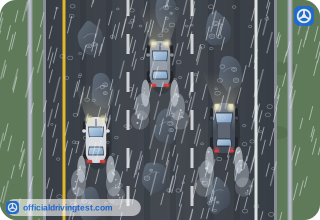
- Loose gravel
- Ice
- Fresh asphalt
- Deep sand
Show answer
Correct answer: Ice
A road covered with oil and water can be like ice, so you should reduce your speed and use extra caution.
Source: Class D & E Driver’s Guide (Revised August 2025 (DPSMV2052 R08/25)), page 74 · Open this page in the manual (Manual page 74)
-
How can you prevent skids on wet pavement?
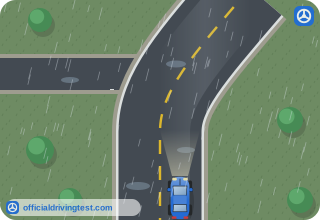
- Speed up through curves to keep traction
- Drive slowly and carefully, especially on curves
- Brake hard just before every curve
- Switch on your high beams in the rain
Show answer
Correct answer: Drive slowly and carefully, especially on curves
You can prevent skids by driving slowly and carefully, especially on curves, and by reducing speed in wet driving conditions.
Source: Class D & E Driver’s Guide (Revised August 2025 (DPSMV2052 R08/25)), page 74 · Open this page in the manual (Manual page 74)
-
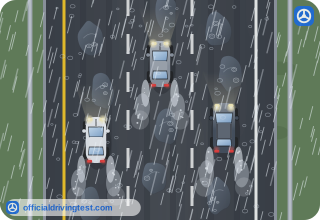
At about what speed does partial hydroplaning start?
- 20 miles per hour
- 45 miles per hour
- 65 miles per hour
- 35 miles per hour
Show answer
Correct answer: 35 miles per hour
Up to 35 mph, tires with good tread wipe water off the road; partial hydroplaning starts at about 35 mph and increases with speed.
Source: Class D & E Driver’s Guide (Revised August 2025 (DPSMV2052 R08/25)), page 74 · Open this page in the manual (Manual page 74)
-
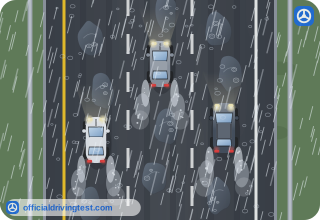
In heavy rain, at about what speed may your tires lose all contact with the pavement?
- 25 mph
- 55 mph
- 45 mph
- 75 mph
Show answer
Correct answer: 55 mph
Partial hydroplaning increases with speed until, at 55 mph, the tires may lose all contact with the pavement.
Source: Class D & E Driver’s Guide (Revised August 2025 (DPSMV2052 R08/25)), page 74 · Open this page in the manual (Manual page 74)
-
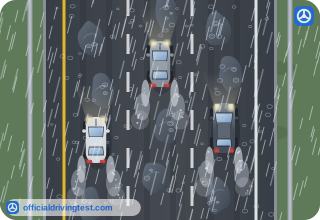
What is "hydroplaning"?
- Brakes overheating on a long downhill grade
- Wheels locking after hard braking on dry roads
- The rear of the car swinging out on a curve
- Tires riding up on a layer of water, like water skis
Show answer
Correct answer: Tires riding up on a layer of water, like water skis
As speed increases, the water cannot be removed fast enough and the tires ride up on the layer of water much like water skis; this is called hydroplaning.
Source: Class D & E Driver’s Guide (Revised August 2025 (DPSMV2052 R08/25)), page 74 · Open this page in the manual (Manual page 74)
-
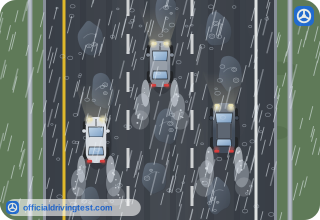
Which of these helps prevent hydroplaning?
- Driving faster to get through standing water
- Steering around water when possible
- Letting some air out of the tires for grip
- Choosing tires with very shallow tread
Show answer
Correct answer: Steering around water when possible
To prevent hydroplaning, steer around water when possible, reduce speed, keep tires at the recommended pressure and have good tread.
Source: Class D & E Driver’s Guide (Revised August 2025 (DPSMV2052 R08/25)), page 74 · Open this page in the manual (Manual page 74)
-
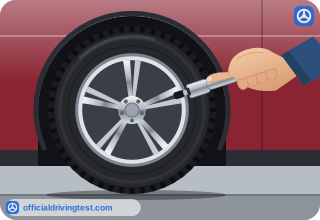
To help prevent hydroplaning, how should your tires be inflated?
- Slightly below the recommended pressure for grip
- Well above the recommended pressure
- Lower in front than in the rear
- To the recommended air pressure
Show answer
Correct answer: To the recommended air pressure
Having tires inflated to the recommended air pressure is one of the ways to prevent hydroplaning.
Source: Class D & E Driver’s Guide (Revised August 2025 (DPSMV2052 R08/25)), page 74 · Open this page in the manual (Manual page 74)
-
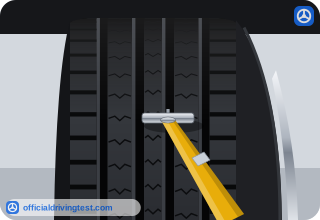
Why is good tire tread important for avoiding hydroplaning?
- It keeps the tires cool when roads are wet
- It lets you brake later before a stop
- It helps water escape quickly through the grooves
- It lets you drive faster in heavy rain
Show answer
Correct answer: It helps water escape quickly through the grooves
Good tire tread helps water escape quickly through the grooves of the tire, which helps prevent hydroplaning.
Source: Class D & E Driver’s Guide (Revised August 2025 (DPSMV2052 R08/25)), page 74 · Open this page in the manual (Manual page 74)
-
You hear a sloshing sound from your tires on a wet road, especially when changing directions. What should you do?
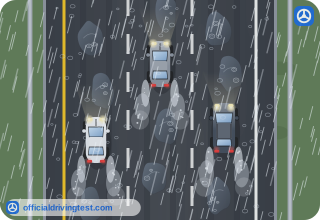
- Slow down
- Speed up slightly
- Change lanes quickly
- Turn on your flashers
Show answer
Correct answer: Slow down
If you hear a sloshing sound from the tires, especially when changing directions, slow down to help prevent hydroplaning.
Source: Class D & E Driver’s Guide (Revised August 2025 (DPSMV2052 R08/25)), page 74 · Open this page in the manual (Manual page 74)
-
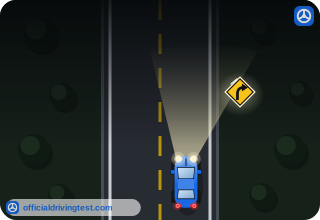
When driving at night, you must be able to stop within what distance?
- The distance to the next intersection or stop sign
- The distance you can see ahead with your headlights
- Three car lengths behind the vehicle ahead of you
- Half the distance your high beam headlights light up
Show answer
Correct answer: The distance you can see ahead with your headlights
At night you must be able to stop within the distance you can see ahead with your headlights; reducing speed based on headlight distance is critical.
Source: Class D & E Driver’s Guide (Revised August 2025 (DPSMV2052 R08/25)), page 75 · Open this page in the manual (Manual page 75)
-
How should you change your following distance for night driving conditions?
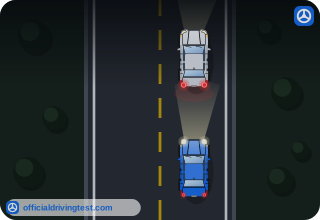
- Add at least half an additional second
- Keep it the same if your headlights are on
- Add at least one additional second
- Shorten it to keep the car ahead in view
Show answer
Correct answer: Add at least one additional second
Increase your following distance by adding at least one additional second for night driving conditions.
Source: Class D & E Driver’s Guide (Revised August 2025 (DPSMV2052 R08/25)), page 75 · Open this page in the manual (Manual page 75)
-
When driving on unfamiliar roadways at night, how much should you add to your following distance?
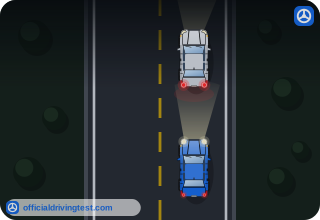
- At least half an additional second
- Nothing, if the road is well lit
- Nothing, if you use high beams
- At least two additional seconds
Show answer
Correct answer: At least two additional seconds
Add at least two additional seconds to your following distance when driving on unfamiliar roadways at night.
Source: Class D & E Driver’s Guide (Revised August 2025 (DPSMV2052 R08/25)), page 75 · Open this page in the manual (Manual page 75)
-
How does a dirty windshield affect night driving?
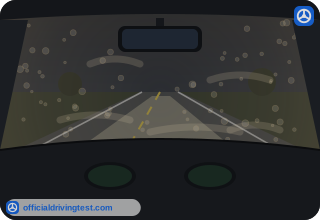
- It reduces glare from oncoming headlights
- It has no effect if your wipers work well
- It increases glare and obscures the road
- It matters only when driving in daylight
Show answer
Correct answer: It increases glare and obscures the road
A dirty windshield increases glare and obscures the road, signs and other motorists, so keep your windshield and windows clean, inside and out.
Source: Class D & E Driver’s Guide (Revised August 2025 (DPSMV2052 R08/25)), page 75 · Open this page in the manual (Manual page 75)
-
What does the manual say to do about your following distance behind a bicyclist?
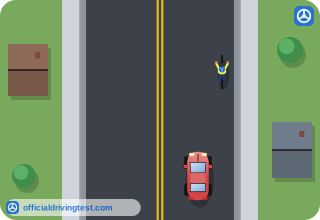
- Decrease it, so the bicyclist can see your vehicle in the mirror
- Increase it, because bicycle-stopping distances are shorter than automobiles
- Keep it the same as when following a car at the same speed
- Decrease it, so you can pass the bicyclist as soon as possible
Show answer
Correct answer: Increase it, because bicycle-stopping distances are shorter than automobiles
The manual says to increase following distances behind bicyclists because bicycle-stopping distances are shorter than those of automobiles.
Source: Class D & E Driver’s Guide (Revised August 2025 (DPSMV2052 R08/25)), page 80 · Open this page in the manual (Manual page 80)
-
What should a driver do with speed and following distance when encountering bicyclists?
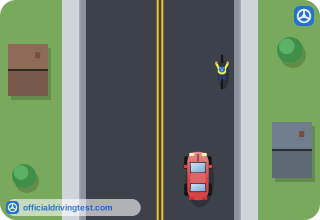
- Hold speed and stay close behind
- Reduce speed and never tailgate
- Speed up and pass them quickly
- Reduce speed but follow closely
Show answer
Correct answer: Reduce speed and never tailgate
The manual says to reduce speed when encountering bicyclists and never tailgate.
Source: Class D & E Driver’s Guide (Revised August 2025 (DPSMV2052 R08/25)), page 80 · Open this page in the manual (Manual page 80)
-
When driving behind a motorcycle, what following distance does the manual say to allow at least?
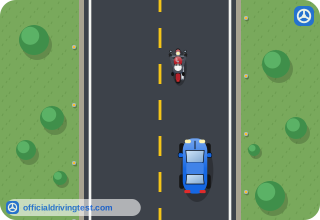
- One second
- Four seconds
- Two seconds
- Three seconds
Show answer
Correct answer: Four seconds
The manual says to allow at least a four-second following distance behind a motorcycle, and this is even more important in wet driving conditions.
Source: Class D & E Driver’s Guide (Revised August 2025 (DPSMV2052 R08/25)), page 82 · Open this page in the manual (Manual page 82)
-
In good road and weather conditions, what gap should you leave between your vehicle and the truck in front of you?
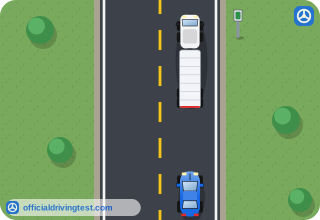
- One to two seconds
- Two to three seconds
- Four to five seconds
- Three seconds
Show answer
Correct answer: Four to five seconds
The manual says to leave a gap of at least four to five seconds behind a truck in good road and weather conditions, and an even longer gap when conditions are poor.
Source: Class D & E Driver’s Guide (Revised August 2025 (DPSMV2052 R08/25)), page 84 · Open this page in the manual (Manual page 84)