Louisiana: Speed and following distance — Part 1 Practice Test
Louisiana speed limits, stopping distances, the 3-second rule, space around your vehicle, night and rural driving. — Part 1
Independent educational site · not affiliated with any government agency or DMV
Ready? Test yourself
- Instant feedback with an explanation
- Every answer cites its source in the manual
- Your best score is saved on this device
Questions are original and based on the official manual "Class D & E Driver’s Guide" (Revised August 2025 (DPSMV2052 R08/25)), Louisiana Office of Motor Vehicles.
All 36 questions in this practice test
Take the test above first, then use this list to study. Tap “Show answer” to see the correct answer and explanation.
Show the questions and answersHide the questions
-
People who drive at unsafe speeds are a major hazard, particularly on which kinds of roads?
- Residential streets and alleys
- Parish roads and county roads
- Freeways and expressways
- Parking lots and driveways
Show answer
Correct answer: Freeways and expressways
The manual says people who drive at unsafe speeds are a major hazard, particularly on freeways and expressways.
Source: Class D & E Driver’s Guide (Revised August 2025 (DPSMV2052 R08/25)), page 19 · Open this page in the manual (Manual page 19)
-
A driver who is under the posted speed limit can still be driving too fast for what?
- The age, size and weight of the vehicle that is being driven
- Existing weather, traffic conditions or his or her own physical health
- The number of lanes and the width of the shoulder on the road
- The class of license and the restrictions the driver holds
Show answer
Correct answer: Existing weather, traffic conditions or his or her own physical health
The manual says a driver may be under the posted speed limit and still be too fast for existing weather, traffic conditions or even his or her own physical health.
Source: Class D & E Driver’s Guide (Revised August 2025 (DPSMV2052 R08/25)), page 20 · Open this page in the manual (Manual page 20)
-
Why are good pavement conditions important?
- They make speed limit signs easier to see
- They keep tolls lower on busy highways
- They let drivers safely choose a higher speed
- They help with traction and stopping quickly
Show answer
Correct answer: They help with traction and stopping quickly
The manual says good pavement conditions are important for traction and stopping quickly.
Source: Class D & E Driver’s Guide (Revised August 2025 (DPSMV2052 R08/25)), page 20 · Open this page in the manual (Manual page 20)
-
Which is a hazard drivers face on poorly maintained roadways?
- Shoulder drop offs
- Retro reflective signs
- Rumble strips
- Breakaway poles
Show answer
Correct answer: Shoulder drop offs
The manual lists swerving to avoid potholes, staying out of ruts and watching for shoulder drop offs as hazards on poorly maintained roadways.
Source: Class D & E Driver’s Guide (Revised August 2025 (DPSMV2052 R08/25)), page 20 · Open this page in the manual (Manual page 20)
-
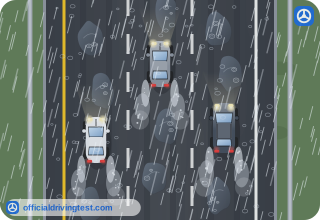
What can rain, even a drizzle, cause a vehicle’s tires to do?
- Overheat
- Become under-inflated
- Lose traction
- Grip the road better
Show answer
Correct answer: Lose traction
The manual says rain, even a drizzle, can cause a vehicle’s tires to lose traction.
Source: Class D & E Driver’s Guide (Revised August 2025 (DPSMV2052 R08/25)), page 20 · Open this page in the manual (Manual page 20)
-
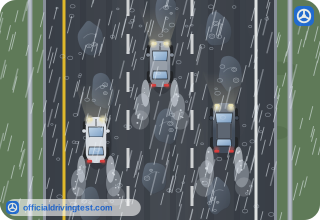
What is it called when too much water on the road causes tires to skim on the surface of the water instead of gripping the road?
- Fishtailing
- Hydroplaning
- Wheel lock
- Tire slippage
Show answer
Correct answer: Hydroplaning
The manual calls the condition in which tires skim on the surface of the water instead of gripping the road hydroplaning.
Source: Class D & E Driver’s Guide (Revised August 2025 (DPSMV2052 R08/25)), page 20 · Open this page in the manual (Manual page 20)
-
To help eliminate the hazard of tires skimming on water, what do engineers design roadways to do?
- Hold the water in grooves beside the lane
- Keep the water on the surface to cool tires
- Slope the road toward the center line
- Carry the water away quickly
Show answer
Correct answer: Carry the water away quickly
The manual says engineers design roadways to carry the water away quickly to help eliminate hydroplaning.
Source: Class D & E Driver’s Guide (Revised August 2025 (DPSMV2052 R08/25)), page 20 · Open this page in the manual (Manual page 20)
-
How do engineers construct the face of the pavement to help tires maintain better traction and avoid skids?
- With grooves and a rough texture
- With a smooth, polished surface
- With a layer of loose gravel
- With raised metal strips
Show answer
Correct answer: With grooves and a rough texture
The manual says engineers construct the face of the pavement with grooves and rough texture to help tires maintain better traction and avoid skids.
Source: Class D & E Driver’s Guide (Revised August 2025 (DPSMV2052 R08/25)), page 21 · Open this page in the manual (Manual page 21)
-
When should the maximum posted speed limit be driven?
- At all times when the road is clear of traffic
- Only during daylight hours
- Only in ideal driving conditions
- Only on interstate highways
Show answer
Correct answer: Only in ideal driving conditions
The maximum limit should be driven only in ideal driving conditions, and you must reduce your speed when weather or traffic conditions require it.
Source: Class D & E Driver’s Guide (Revised August 2025 (DPSMV2052 R08/25)), page 27 · Open this page in the manual (Manual page 27)
-
Which of these is a condition in which you should reduce your speed?
- A dry, clear road
- Icy conditions
- Light traffic on a straight road
- Daytime driving
Show answer
Correct answer: Icy conditions
The manual says to reduce your speed when the roadway is slippery, during rain, snow, icy conditions and foggy conditions.
Source: Class D & E Driver’s Guide (Revised August 2025 (DPSMV2052 R08/25)), page 27 · Open this page in the manual (Manual page 27)
-
What are you legally required to do on a high-speed road that has a minimum speed limit?
- Travel no faster than that
- Travel in the left lane only
- Use your hazard lights
- Travel at least that fast
Show answer
Correct answer: Travel at least that fast
On roads with minimum speed limits you must travel at least that fast so as not to be a hazard to other drivers.
Source: Class D & E Driver’s Guide (Revised August 2025 (DPSMV2052 R08/25)), page 27 · Open this page in the manual (Manual page 27)
-
When must you obey the reduced speed limit shown on a school speed limit sign posted before a school?
- Only when the sign is flashing
- At all times
- Only when children are visible
- Only during school bus loading
Show answer
Correct answer: Only when the sign is flashing
The school speed limit is required only when the sign is flashing; otherwise you obey the roadway's speed limit.
Source: Class D & E Driver’s Guide (Revised August 2025 (DPSMV2052 R08/25)), page 27 · Open this page in the manual (Manual page 27)
-
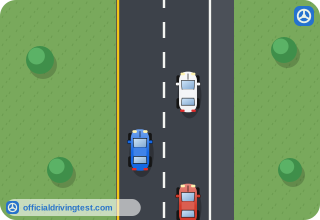
What does the manual say about the speed of a vehicle driven in the left hand lane?
- It shall not exceed the speed of the vehicles to its right
- It shall be the posted speed limit at all times
- It shall be at least 10 mph above the vehicles to its right
- It shall not be slower than the vehicles traveling to its right
Show answer
Correct answer: It shall not be slower than the vehicles traveling to its right
The manual says no vehicle driven in the left hand lane shall be driven at speeds slower than vehicles traveling to its right.
Source: Class D & E Driver’s Guide (Revised August 2025 (DPSMV2052 R08/25)), page 35 · Open this page in the manual (Manual page 35)
-
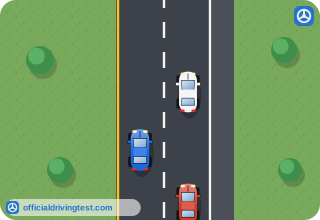
Which lane must a vehicle use if it is traveling at a speed less than the normal speed of traffic?
- The right lane only
- The left lane only
- The center lane only
- Any lane that is open
Show answer
Correct answer: The right lane only
Any vehicle traveling at a speed less than the normal speed of traffic shall travel in the right lane only.
Source: Class D & E Driver’s Guide (Revised August 2025 (DPSMV2052 R08/25)), page 35 · Open this page in the manual (Manual page 35)
-
Speed also plays a factor in the severity of a crash. As speeds get higher, what happens?
- Injuries become less severe because the crumple zones work harder
- Only the occupants of the lighter vehicle are injured more seriously
- Injuries stay the same as long as every occupant is belted
- Crashes result in more serious injury for all individuals involved
Show answer
Correct answer: Crashes result in more serious injury for all individuals involved
As speeds get higher, crashes result in more serious injury for all individuals involved in the crash.
Source: Class D & E Driver’s Guide (Revised August 2025 (DPSMV2052 R08/25)), page 38 · Open this page in the manual (Manual page 38)
-
According to Newton's 1st law of motion, what does a body in motion do unless an external force acts on it?
- Continues to move at a constant speed in a straight line
- Gradually slows down and comes to rest on its own
- Speeds up until it reaches a higher speed
- Turns toward the heaviest object that is nearby on the road
Show answer
Correct answer: Continues to move at a constant speed in a straight line
A body in motion continues to move at a constant speed in a straight line unless it is acted upon by an external force.
Source: Class D & E Driver’s Guide (Revised August 2025 (DPSMV2052 R08/25)), page 38 · Open this page in the manual (Manual page 38)
-
How does the manual define momentum?
- Mass divided by velocity
- Velocity divided by time
- Weight times distance
- Mass times velocity
Show answer
Correct answer: Mass times velocity
Momentum is equal to mass times velocity.
Source: Class D & E Driver’s Guide (Revised August 2025 (DPSMV2052 R08/25)), page 38 · Open this page in the manual (Manual page 38)
-
In a collision between two vehicles, which one has the much greater change in velocity?
- The heavier vehicle
- The lighter vehicle
- The faster vehicle
- Neither, both change equally
Show answer
Correct answer: The lighter vehicle
Each car experiences the same force, but the change in velocity is much greater on the lighter of the two vehicles, which means greater damage to it.
Source: Class D & E Driver’s Guide (Revised August 2025 (DPSMV2052 R08/25)), page 39 · Open this page in the manual (Manual page 39)
-
What does Newton's 3rd law of motion say about the forces between two crashing cars?
- They are equal in opposite directions
- The heavier car receives the greater force
- The faster car receives the greater force
- Only the car that is hit receives a force
Show answer
Correct answer: They are equal in opposite directions
For every action there is an equal and opposite reaction, so the forces between two crashing cars are equal in opposite directions.
Source: Class D & E Driver’s Guide (Revised August 2025 (DPSMV2052 R08/25)), page 39 · Open this page in the manual (Manual page 39)
-
How far away from the vehicle in front of you should you stop?
- Far enough that you can see its license plate
- About one car length
- Close enough to see its brake lights clearly
- Far enough that you can see the bottom of its tires
Show answer
Correct answer: Far enough that you can see the bottom of its tires
The manual says to stop far enough from the vehicle in front that you can see the bottom of its tires.
Source: Class D & E Driver’s Guide (Revised August 2025 (DPSMV2052 R08/25)), page 46 · Open this page in the manual (Manual page 46)
-
In spring, what should a driver do when mist begins to fall?
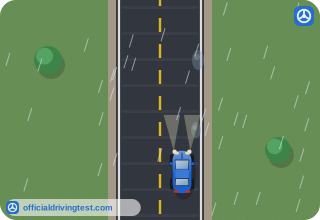
- Wait until the road is flooded before slowing down
- Speed up slightly to leave the wet area sooner
- Slow down and increase the following distance
- Keep the same speed until the pavement is fully wet
Show answer
Correct answer: Slow down and increase the following distance
The manual says to slow down on slick roads and increase following distance even when mist begins to fall.
Source: Class D & E Driver’s Guide (Revised August 2025 (DPSMV2052 R08/25)), page 51 · Open this page in the manual (Manual page 51)
-
According to the spring driving tips, a small amount of water on the road can mix with what to create slippery conditions?
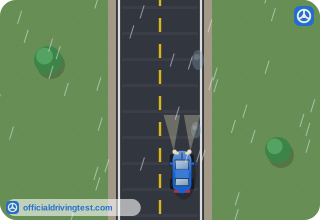
- Sand and gravel
- Oil and grease
- Dust and pollen
- Salt and road paint
Show answer
Correct answer: Oil and grease
Just a small amount of water can mix with oil and grease on the road to create slippery conditions.
Source: Class D & E Driver’s Guide (Revised August 2025 (DPSMV2052 R08/25)), page 51 · Open this page in the manual (Manual page 51)
-
If you are driving on a road with excess water, what does the manual say to do?
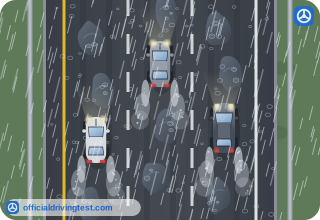
- Keep your speed and brake firmly to shed the water from the tires
- Steer sharply back and forth to clear water from the tires quickly
- Speed up so that the tires ride on top of the water on the road
- Slow down and avoid sudden movements with the steering wheel or brake pedal
Show answer
Correct answer: Slow down and avoid sudden movements with the steering wheel or brake pedal
On a road with excess water, slow down and avoid sudden movements with the steering wheel or brake pedal.
Source: Class D & E Driver’s Guide (Revised August 2025 (DPSMV2052 R08/25)), page 52 · Open this page in the manual (Manual page 52)
-
In unfavorable winter driving conditions, how should you adjust your speed and the distance to the car in front?
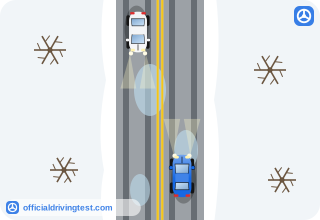
- Reduce your speed and allow the distance to increase
- Reduce your speed but keep the distance the same
- Keep your speed and allow the distance to decrease
- Increase your speed and allow the distance to increase
Show answer
Correct answer: Reduce your speed and allow the distance to increase
The manual says to reduce your speed and allow the distance between your car and the one in front to increase.
Source: Class D & E Driver’s Guide (Revised August 2025 (DPSMV2052 R08/25)), page 52 · Open this page in the manual (Manual page 52)
-
What does the manual remind drivers about stopping on icy roads?
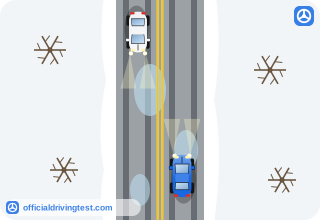
- It takes less time to stop with all-season tires
- It takes the same time as on wet roads
- It takes more time to stop
- It takes more time only when ice is melting
Show answer
Correct answer: It takes more time to stop
The manual reminds drivers that it takes more time to stop on icy roads.
Source: Class D & E Driver’s Guide (Revised August 2025 (DPSMV2052 R08/25)), page 52 · Open this page in the manual (Manual page 52)
-
In winter, what does looking ahead give you?
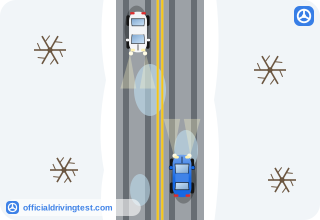
- A chance to drive faster than the other traffic on the road
- Enough time to react safely without suddenly braking or skidding
- Less need to keep your headlights clean and free of ice
- A reason to keep the windows closed and the heater on high
Show answer
Correct answer: Enough time to react safely without suddenly braking or skidding
Looking ahead gives you enough time to react safely to situations without suddenly braking or skidding.
Source: Class D & E Driver’s Guide (Revised August 2025 (DPSMV2052 R08/25)), page 52 · Open this page in the manual (Manual page 52)
-
What does defensive driving involve, according to the manual?
- Reacting as fast as possible once a hazard appears in your path
- Driving at the same speed as the other traffic around you
- A proactive attitude and anticipating potential hazards
- Relying on your vehicle’s safety features to handle any hazards
Show answer
Correct answer: A proactive attitude and anticipating potential hazards
Defensive driving means a proactive attitude behind the wheel and anticipating potential hazards instead of simply reacting to them.
Source: Class D & E Driver’s Guide (Revised August 2025 (DPSMV2052 R08/25)), page 54 · Open this page in the manual (Manual page 54)
-
One of the National Safety Council’s guidelines for reducing your risks on the road is to do which of these?
- Keep the radio volume high
- Drive in the left lane whenever possible
- Leave the doors unlocked in heavy traffic
- Lock all doors
Show answer
Correct answer: Lock all doors
Locking all doors is one of the National Safety Council’s suggested guidelines to reduce your risks on the road.
Source: Class D & E Driver’s Guide (Revised August 2025 (DPSMV2052 R08/25)), page 54 · Open this page in the manual (Manual page 54)
-
What does the manual say about driving too fast or too slow?
- Only driving too fast increases the likelihood of collisions
- Only driving too slow increases the likelihood of collisions
- Either one can increase the likelihood of collisions
- Neither one matters when the road is clear
Show answer
Correct answer: Either one can increase the likelihood of collisions
The manual says driving too fast or too slow can increase the likelihood of collisions.
Source: Class D & E Driver’s Guide (Revised August 2025 (DPSMV2052 R08/25)), page 54 · Open this page in the manual (Manual page 54)
-
An oncoming car appears to be crossing into your lane. What does the manual say to do?
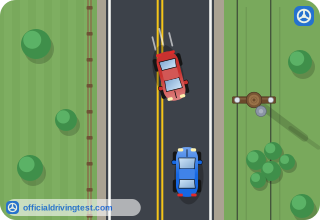
- Pull over, sound the horn and flash your lights
- Speed up to get past it as quickly as possible
- Stop in your lane and wait for it to pass
- Turn left to get out of its way
Show answer
Correct answer: Pull over, sound the horn and flash your lights
The manual says to pull over to the roadside, sound the horn and flash your lights if an oncoming car appears to be crossing into your lane.
Source: Class D & E Driver’s Guide (Revised August 2025 (DPSMV2052 R08/25)), page 54 · Open this page in the manual (Manual page 54)
-
What does the manual say to do after you see a motorist who is driving suspiciously or recklessly?
- Follow the driver to get the license plate number
- Flash your headlights at the driver
- Notify the police immediately
- Wait until your trip is over and then report it
Show answer
Correct answer: Notify the police immediately
The manual says to notify the police immediately after seeing a motorist who is driving suspiciously or recklessly.
Source: Class D & E Driver’s Guide (Revised August 2025 (DPSMV2052 R08/25)), page 54 · Open this page in the manual (Manual page 54)
-
How does the manual say you should behave when merging with other traffic?
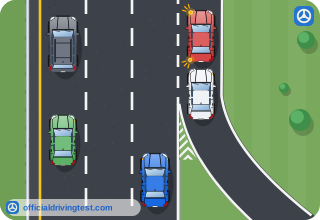
- Speed up to keep your place in line
- Do not contest the right of way or try to race another car
- Hold your position so the other driver must yield
- Flash your headlights to claim the space
Show answer
Correct answer: Do not contest the right of way or try to race another car
The manual says to follow the rules of the road, not to contest the right of way and not to race another car during a merge.
Source: Class D & E Driver’s Guide (Revised August 2025 (DPSMV2052 R08/25)), page 54 · Open this page in the manual (Manual page 54)
-
In the SIPDE method, what does the “S” step have you do?
- Slow down whenever you see any hazard ahead
- Signal every move well in advance of turning
- Stop and wait for hazards to clear the road
- Sweep, search and scan, keeping your eyes moving
Show answer
Correct answer: Sweep, search and scan, keeping your eyes moving
In SIPDE, S stands for sweep, search and scan, which means keeping your eyes moving at all times to see imminent danger.
Source: Class D & E Driver’s Guide (Revised August 2025 (DPSMV2052 R08/25)), page 55 · Open this page in the manual (Manual page 55)
-
In the SIPDE method, what do you do in the “I” step?
- Ignore hazards that are far away from your car
- Inspect your vehicle’s lights and tires before moving
- Identify hazards and what is happening on the road
- Increase your speed to leave hazards behind you
Show answer
Correct answer: Identify hazards and what is happening on the road
The I in SIPDE stands for identify hazards, which means taking notice of things that could cause trouble.
Source: Class D & E Driver’s Guide (Revised August 2025 (DPSMV2052 R08/25)), page 55 · Open this page in the manual (Manual page 55)
-
In the SIPDE method, what are the two things you predict in the “P” step?
- The worst case scenario and actions
- Your own speed and your stopping distance
- The weather and the time of day
- The color of the signals and the road signs
Show answer
Correct answer: The worst case scenario and actions
The P in SIPDE stands for predict, and the manual says to predict two things: the worst case scenario and actions.
Source: Class D & E Driver’s Guide (Revised August 2025 (DPSMV2052 R08/25)), page 55 · Open this page in the manual (Manual page 55)
-
In the SIPDE method, what do you do in the “D” step?
- Drive faster to get past the hazard
- Delay any reaction until the hazard is close
- Divide your attention equally among all hazards
- Decide on a safe action
Show answer
Correct answer: Decide on a safe action
The D in SIPDE stands for decide on a safe action, such as deciding what to do should a dog run across the road.
Source: Class D & E Driver’s Guide (Revised August 2025 (DPSMV2052 R08/25)), page 55 · Open this page in the manual (Manual page 55)