Louisiana: Signals and vehicle controls — Part 9 Practice Test
Checking your vehicle, tires, starting and stopping, steering, signaling, safety features, seasonal care, air brakes and towing a trailer. — Part 9
Independent educational site · not affiliated with any government agency or DMV
Ready? Test yourself
- Instant feedback with an explanation
- Every answer cites its source in the manual
- Your best score is saved on this device
Questions are original and based on the official manual "Class D & E Driver’s Guide" (Revised August 2025 (DPSMV2052 R08/25)), Louisiana Office of Motor Vehicles.
All 35 questions in this practice test
Take the test above first, then use this list to study. Tap “Show answer” to see the correct answer and explanation.
Show the questions and answersHide the questions
-
On a vehicle with spring brakes, what happens if the air pressure is removed?
- The springs put on the brakes
- The springs release the brakes
- The brakes stay as they were
- The compressor starts at once
Show answer
Correct answer: The springs put on the brakes
When driving, powerful springs are held back by air pressure, and if the air pressure is removed the springs put on the brakes.
Source: Class D & E Driver’s Guide (Revised August 2025 (DPSMV2052 R08/25)), page 131 · Open this page in the manual (Manual page 131)
-
In newer vehicles with air brakes, which control do you use to engage the parking brakes?
- A round, red push-pull knob
- A square, blue pull lever
- A diamond-shaped, yellow foot pedal
- A diamond-shaped, yellow push-pull knob
Show answer
Correct answer: A diamond-shaped, yellow push-pull knob
In newer vehicles with air brakes, you engage the parking brakes using a diamond shaped, yellow, push-pull control knob.
Source: Class D & E Driver’s Guide (Revised August 2025 (DPSMV2052 R08/25)), page 131 · Open this page in the manual (Manual page 131)
-
With the push-pull control knob in a newer vehicle with air brakes, how do you put the parking brakes on?
- Push the knob in
- Pull the knob out
- Turn the knob a quarter turn
- Press the knob and the brake pedal together
Show answer
Correct answer: Pull the knob out
You pull the knob out to put the parking brakes (spring brakes) on, and push it in to release them.
Source: Class D & E Driver’s Guide (Revised August 2025 (DPSMV2052 R08/25)), page 131 · Open this page in the manual (Manual page 131)
-
What should you never do when the spring brakes are on?
- Push the brake pedal down
- Turn the key to the on position
- Check the air pressure gauge
- Release the tractor protection valve
Show answer
Correct answer: Push the brake pedal down
If you push the brake pedal down when the spring brakes are on, the brakes could be damaged.
Source: Class D & E Driver’s Guide (Revised August 2025 (DPSMV2052 R08/25)), page 131 · Open this page in the manual (Manual page 131)
-
In Step 1 of the three-part air brake check (single vehicle), you hold the foot brake fully applied for how long and check whether the air pressure drops more than what amount?
- One minute; ten pounds
- Five minutes; three pounds
- One minute; three pounds
- Thirty seconds; ten pounds
Show answer
Correct answer: One minute; three pounds
In Step 1 you fully apply the foot brake and hold it for one minute, checking whether the air pressure drops more than three pounds in one minute for a single vehicle.
Source: Class D & E Driver’s Guide (Revised August 2025 (DPSMV2052 R08/25)), page 131 · Open this page in the manual (Manual page 131)
-
In Step 1 of the three-part air brake check, to what pressure do you build the air pressure with the engine running?
- Safety valve release (150 psi)
- Governed cut-out (100-125 psi)
- Low air warning level (60 psi)
- Parking brake valve level (20-40 psi)
Show answer
Correct answer: Governed cut-out (100-125 psi)
Step 1 starts with the engine running and the air pressure built to governed cut-out, which is 100-125 psi.
Source: Class D & E Driver’s Guide (Revised August 2025 (DPSMV2052 R08/25)), page 131 · Open this page in the manual (Manual page 131)
-
In Step 2 of the three-part air brake check, how do you fan off the air pressure?
- By holding the foot brake down for one minute
- By pulling the parking brake knob out and in
- By opening the manual draining valve
- By rapidly applying and releasing the foot brake
Show answer
Correct answer: By rapidly applying and releasing the foot brake
In Step 2 you turn the key on without starting the engine and fan off the air pressure by rapidly applying and releasing the foot brake.
Source: Class D & E Driver’s Guide (Revised August 2025 (DPSMV2052 R08/25)), page 131 · Open this page in the manual (Manual page 131)
-
In Step 3 of the three-part air brake check, at approximately what pressure should the parking brake valve close (pop out)?
- 60-80 psi
- 100-125 psi
- 20-40 psi
- 85-100 psi
Show answer
Correct answer: 20-40 psi
While you continue to fan off the pressure, the parking brake valve should close at approximately 20-40 psi.
Source: Class D & E Driver’s Guide (Revised August 2025 (DPSMV2052 R08/25)), page 131 · Open this page in the manual (Manual page 131)
-
Which of these must also be inspected before operating a vehicle equipped with air brakes, in addition to the three-part air brake check?
- Manual slack adjusters on S-cam brakes
- The windshield washer fluid level
- The pressure of the spare tire
- The battery cable terminals
Show answer
Correct answer: Manual slack adjusters on S-cam brakes
Manual slack adjusters on S-cam brakes are on the list of items inspected before operating a vehicle with air brakes.
Source: Class D & E Driver’s Guide (Revised August 2025 (DPSMV2052 R08/25)), page 131 · Open this page in the manual (Manual page 131)
-
Before operating a vehicle equipped with air brakes, with the engine at operating RPM, the pressure should build from 85 to 100 psi within how long (or the manufacturer's specifications)?
- 10 seconds
- 90 seconds
- 3 minutes
- 45 seconds
Show answer
Correct answer: 45 seconds
The rate of air pressure buildup should take the pressure from 85 to 100 psi within 45 seconds or the manufacturer’s specifications.
Source: Class D & E Driver’s Guide (Revised August 2025 (DPSMV2052 R08/25)), page 131 · Open this page in the manual (Manual page 131)
-
On a vehicle with air brakes, what can cause the brakes to fade or fail?
- Excessive heat from using them too much
- Cold air reaching the brake drums on a long straight road
- Pushing the pedal down slowly and smoothly each time
- Using only the parking brake when stopping
Show answer
Correct answer: Excessive heat from using them too much
Brakes can fade or fail from excessive heat caused by using them too much and not relying on the engine braking effect, or from improper adjustment.
Source: Class D & E Driver’s Guide (Revised August 2025 (DPSMV2052 R08/25)), page 132 · Open this page in the manual (Manual page 132)
-
When parking a vehicle with air brakes, in which case should you not use the parking brakes?
- When the vehicle is parked on a downhill grade
- When the air tanks are completely full
- When the brakes are very hot from a steep grade
- When the tires are cold after a long rest
Show answer
Correct answer: When the brakes are very hot from a steep grade
Any time you park you use the parking brakes unless the brakes are very hot from having come down a steep grade, or very wet in freezing temperatures.
Source: Class D & E Driver’s Guide (Revised August 2025 (DPSMV2052 R08/25)), page 132 · Open this page in the manual (Manual page 132)
-
When parking a vehicle with air brakes, in which other case should you not use the parking brakes?
- When the vehicle will be parked overnight at a yard
- When the brakes are very wet in freezing temperatures
- When the air pressure is above 100 psi on the gauge
- When the trailer is empty and the tanks are full
Show answer
Correct answer: When the brakes are very wet in freezing temperatures
Any time you park you use the parking brakes unless the brakes are very hot from a steep grade, or very wet in freezing temperatures.
Source: Class D & E Driver’s Guide (Revised August 2025 (DPSMV2052 R08/25)), page 132 · Open this page in the manual (Manual page 132)
-
What should you check before towing a trailer to make sure your vehicle is properly equipped to tow it?
- The posted speed limit sign
- The trailer's license plate
- The vehicle owner's manual
- The fuel gauge
Show answer
Correct answer: The vehicle owner's manual
The manual tells you to check the vehicle owner's manual to ensure your vehicle is properly equipped to tow your trailer.
Source: Class D & E Driver’s Guide (Revised August 2025 (DPSMV2052 R08/25)), page 133 · Open this page in the manual (Manual page 133)
-
What is the most common type of trailer hitch?
- The pin and bracket
- The ball and coupler
- The hook and loop
- The plate and bolt
Show answer
Correct answer: The ball and coupler
The most common type of hitch is the ball and coupler.
Source: Class D & E Driver’s Guide (Revised August 2025 (DPSMV2052 R08/25)), page 133 · Open this page in the manual (Manual page 133)
-
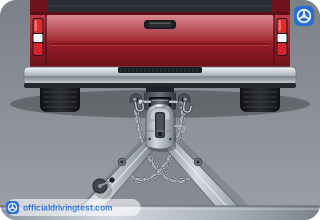
Why is it important that the size of the hitch ball and the coupler match?
- To reduce the fuel used while towing
- To let the trailer lights work without a connector
- To make the trailer brakes unnecessary
- To prevent separation of the towed vehicle during transport
Show answer
Correct answer: To prevent separation of the towed vehicle during transport
Matching sizes prevent the towed vehicle from separating during transport.
Source: Class D & E Driver’s Guide (Revised August 2025 (DPSMV2052 R08/25)), page 133 · Open this page in the manual (Manual page 133)
-
A trailer hitch needs provisions for connecting safety chains or other approved safety devices. How strong must they be?
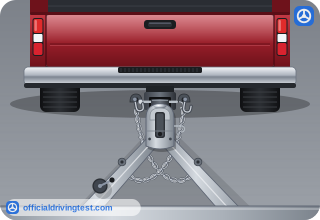
- Strong enough to hold the trailer behind your vehicle if the connection detaches
- Strong enough to hold only the weight of the trailer tongue when parked
- Strong enough to pull the trailer up a steep hill without slipping
- Strong enough to take the place of the trailer brakes entirely
Show answer
Correct answer: Strong enough to hold the trailer behind your vehicle if the connection detaches
Safety chains or other approved safety devices must be of sufficient strength to hold the trailer behind your vehicle if the connection between the two vehicles detaches.
Source: Class D & E Driver’s Guide (Revised August 2025 (DPSMV2052 R08/25)), page 133 · Open this page in the manual (Manual page 133)
-
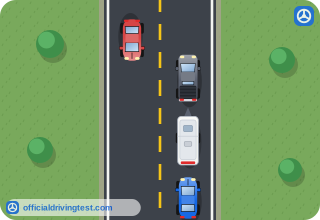
When trailer safety chains are connected, how should they hang?
- Pulled tight so that they cannot move at all while driving
- Hanging loose so that they drag on the road behind the trailer
- With some slack for sharp turns, but not dragging on the road
- Looped twice around the trailer axle to keep them off the road
Show answer
Correct answer: With some slack for sharp turns, but not dragging on the road
Safety chains should have some slack to permit sharp turns but should not drag on the road.
Source: Class D & E Driver’s Guide (Revised August 2025 (DPSMV2052 R08/25)), page 133 · Open this page in the manual (Manual page 133)
-
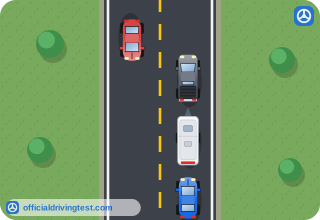
Where should trailer safety chains cross, according to the manual?
- Over the trailer tongue
- Under the trailer tongue
- Around the trailer wheels
- Behind the license plate
Show answer
Correct answer: Under the trailer tongue
Safety chains should cross under the trailer tongue to help prevent the tongue from dropping to the road if the trailer separates from your vehicle.
Source: Class D & E Driver’s Guide (Revised August 2025 (DPSMV2052 R08/25)), page 133 · Open this page in the manual (Manual page 133)
-
What does crossing safety chains under the trailer tongue help prevent?
- The trailer lights from shorting out when the trailer is bumped
- The trailer from backing up crooked on a narrow road
- The trailer from swaying from side to side at high speed
- The tongue dropping to the road if the trailer separates
Show answer
Correct answer: The tongue dropping to the road if the trailer separates
Chains that cross under the tongue help prevent the tongue from dropping to the road in the event the trailer separates from your vehicle.
Source: Class D & E Driver’s Guide (Revised August 2025 (DPSMV2052 R08/25)), page 133 · Open this page in the manual (Manual page 133)
-
At what gross weight must a trailer be equipped with brakes?
- 3,000 pounds or more
- 1,500 pounds or more
- 6,000 pounds or more
- 10,000 pounds or more
Show answer
Correct answer: 3,000 pounds or more
All trailers with a gross weight of 3,000 pounds or more are required to be equipped with brakes.
Source: Class D & E Driver’s Guide (Revised August 2025 (DPSMV2052 R08/25)), page 133 · Open this page in the manual (Manual page 133)
-
Trailer brakes must be designed so that they can be applied by whom, and from where?
- A passenger riding in the trailer
- The driver, from a switch on the trailer tongue
- The driver of the towing motor vehicle, from its cab
- The driver, from outside the vehicle only
Show answer
Correct answer: The driver of the towing motor vehicle, from its cab
Trailer brakes shall be designed to be applied by the driver of the towing motor vehicle from its cab.
Source: Class D & E Driver’s Guide (Revised August 2025 (DPSMV2052 R08/25)), page 133 · Open this page in the manual (Manual page 133)
-
What must happen to trailer brakes if the towed vehicle accidentally breaks away from the towing vehicle?
- They must release so the trailer can roll free
- They must be applied automatically
- They must stay as they were set by the driver
- They must be applied only if the driver presses the pedal
Show answer
Correct answer: They must be applied automatically
The brakes shall be designed and connected so that they are automatically applied in an accidental breakaway of the towed vehicle.
Source: Class D & E Driver’s Guide (Revised August 2025 (DPSMV2052 R08/25)), page 133 · Open this page in the manual (Manual page 133)
-
Trailers are required to have taillights, brake lights, turn signals, and side and rear reflectors. Which other lights must they have?
- Headlights
- Fog lights
- Interior dome lights
- Side marker lights
Show answer
Correct answer: Side marker lights
Trailers are required to have taillights, brake lights, side marker lights, turn signals, and side and rear reflectors.
Source: Class D & E Driver’s Guide (Revised August 2025 (DPSMV2052 R08/25)), page 133 · Open this page in the manual (Manual page 133)
-
What must you ensure about the electrical connector on your vehicle when you tow a trailer?
- It matches the electrical connector of the trailer
- It is a different size from the trailer connector
- It is covered while the trailer is moving
- It is wired only to the brake lights
Show answer
Correct answer: It matches the electrical connector of the trailer
You must ensure that the electrical connector on your vehicle matches the electrical connector of the trailer.
Source: Class D & E Driver’s Guide (Revised August 2025 (DPSMV2052 R08/25)), page 133 · Open this page in the manual (Manual page 133)
-
When you check the electrical connection between your vehicle and a trailer, what should you make sure of?
- It is pulled tight so that it cannot swing around corners
- It hangs low enough that it can touch the road surface
- It is not dragging the ground and has enough slack for sharp turns
- It is wrapped tightly around the safety chains of the trailer
Show answer
Correct answer: It is not dragging the ground and has enough slack for sharp turns
The electrical connection should not drag the ground and should have enough slack to allow for sharp turns.
Source: Class D & E Driver’s Guide (Revised August 2025 (DPSMV2052 R08/25)), page 133 · Open this page in the manual (Manual page 133)
-
What should you always do about the lights on your trailer before towing?
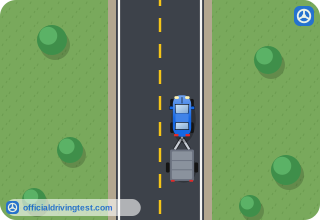
- Turn them off to save the battery
- Make sure they are functioning properly
- Cover the reflectors with tape
- Check them only at night
Show answer
Correct answer: Make sure they are functioning properly
Always make sure the lights on your trailer are functioning properly before towing.
Source: Class D & E Driver’s Guide (Revised August 2025 (DPSMV2052 R08/25)), page 133 · Open this page in the manual (Manual page 133)
-
What does the manual say about mixing types of tires on a trailer?
- Mix bias-belted and radial tires to improve grip
- Use radial tires on one side and bias-belted on the other
- Use any mix as long as the sizes match
- Do not mix bias-belted and radial tires
Show answer
Correct answer: Do not mix bias-belted and radial tires
All trailer tires should be the same type, size, and construction, so bias-belted and radial tires must not be mixed.
Source: Class D & E Driver’s Guide (Revised August 2025 (DPSMV2052 R08/25)), page 134 · Open this page in the manual (Manual page 134)
-
Where do you find the size, type, and load range to buy when you select tires for your trailer?
- On the trailer's certification label or in the owner's manual
- On the license plate of the vehicle that is towing the trailer
- On the ball of the hitch that holds the trailer coupler
- On the inspection sticker of the vehicle that is towing
Show answer
Correct answer: On the trailer's certification label or in the owner's manual
You buy the size, type, and load range found on the trailer's certification label or in the owner's manual.
Source: Class D & E Driver’s Guide (Revised August 2025 (DPSMV2052 R08/25)), page 134 · Open this page in the manual (Manual page 134)
-
What does a tire's load rating indicate?
- The top speed the tire may be driven at
- The number of miles the tire will last
- The amount of weight the tire can carry safely
- The air pressure the tire must hold
Show answer
Correct answer: The amount of weight the tire can carry safely
Tires have a load rating that indicates the amount of weight they can carry safely.
Source: Class D & E Driver’s Guide (Revised August 2025 (DPSMV2052 R08/25)), page 134 · Open this page in the manual (Manual page 134)
-
Your vehicle's tires may require a higher tire pressure for what kind of driving, according to the manual?
- Driving alone on a dry road
- Towing, especially heavy loads
- Driving slowly in a parking lot
- Driving with a light load only
Show answer
Correct answer: Towing, especially heavy loads
Your vehicle's tires may require a higher tire pressure for towing, especially heavy loads.
Source: Class D & E Driver’s Guide (Revised August 2025 (DPSMV2052 R08/25)), page 134 · Open this page in the manual (Manual page 134)
-
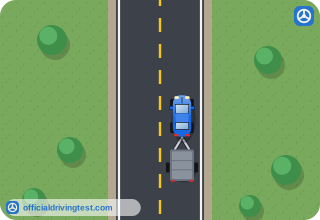
What improves your ability to handle and control your vehicle and trailer?
- Cargo placed only at the front of the trailer
- A trailer loaded as full as possible
- Tires inflated to the highest possible pressure
- Cargo that is properly loaded and distributed
Show answer
Correct answer: Cargo that is properly loaded and distributed
Your ability to handle and control your vehicle and trailer is greatly improved when the cargo is properly loaded and distributed.
Source: Class D & E Driver’s Guide (Revised August 2025 (DPSMV2052 R08/25)), page 134 · Open this page in the manual (Manual page 134)
-
Where does the manual tell you to look to find out how to balance weight from side to side and distribute cargo evenly along a trailer?
- Your vehicle and trailer owner's manuals
- The license plate registration form
- The trailer's inspection sticker
- The driver's license application
Show answer
Correct answer: Your vehicle and trailer owner's manuals
The manual says to refer to your vehicle and trailer owner's manual for how to balance and distribute the weight.
Source: Class D & E Driver’s Guide (Revised August 2025 (DPSMV2052 R08/25)), page 134 · Open this page in the manual (Manual page 134)
-
When you load a trailer, what should you do with all items?
- Stack them loosely so they can shift to balance the load
- Leave them unsecured if the trip is short
- Secure and brace them so they cannot move or fall off during travel
- Place them as high as possible
Show answer
Correct answer: Secure and brace them so they cannot move or fall off during travel
All items should be secured and braced to prevent them from moving or falling off during travel.
Source: Class D & E Driver’s Guide (Revised August 2025 (DPSMV2052 R08/25)), page 134 · Open this page in the manual (Manual page 134)
-
Which device is mentioned as a way to apply load leveling when towing?
- Extra trailer reflectors
- Weight distributing hitch bars
- A longer electrical connector
- A second set of safety chains
Show answer
Correct answer: Weight distributing hitch bars
The manual lists load leveling with weight distributing hitch bars.
Source: Class D & E Driver’s Guide (Revised August 2025 (DPSMV2052 R08/25)), page 134 · Open this page in the manual (Manual page 134)