Louisiana: Signals and vehicle controls — Part 8 Practice Test
Checking your vehicle, tires, starting and stopping, steering, signaling, safety features, seasonal care, air brakes and towing a trailer. — Part 8
Independent educational site · not affiliated with any government agency or DMV
Ready? Test yourself
- Instant feedback with an explanation
- Every answer cites its source in the manual
- Your best score is saved on this device
Questions are original and based on the official manual "Class D & E Driver’s Guide" (Revised August 2025 (DPSMV2052 R08/25)), Louisiana Office of Motor Vehicles.
All 35 questions in this practice test
Take the test above first, then use this list to study. Tap “Show answer” to see the correct answer and explanation.
Show the questions and answersHide the questions
-
What is the minimum fire extinguisher a vehicle transporting passengers for hire must carry?
- A type 1-BC
- A type 3-BC
- A type 2-BC
- A type 5-BC
Show answer
Correct answer: A type 2-BC
Vehicles transporting passengers for hire must have at least a type 2-BC fire extinguisher, completely filled and in working condition.
Source: Class D & E Driver’s Guide (Revised August 2025 (DPSMV2052 R08/25)), page 129 · Open this page in the manual (Manual page 129)
-
What is the minimum fire extinguisher a tow truck must carry?
- One 4-BC
- One 2-BC
- One 3-BC
- One 1-BC
Show answer
Correct answer: One 4-BC
Tow trucks must carry at least one 4-BC fire extinguisher capable of extinguishing flammable liquid fires, completely filled and in working condition.
Source: Class D & E Driver’s Guide (Revised August 2025 (DPSMV2052 R08/25)), page 129 · Open this page in the manual (Manual page 129)
-
What is the minimum fire extinguisher rating for a motor vehicle transporting explosives?
- 4-BC
- 5-BC
- 2-BC
- 10-BC
Show answer
Correct answer: 10-BC
Motor vehicles transporting explosives must have at least one fire extinguisher rated at least 10-BC, completely filled and in working condition.
Source: Class D & E Driver’s Guide (Revised August 2025 (DPSMV2052 R08/25)), page 129 · Open this page in the manual (Manual page 129)
-
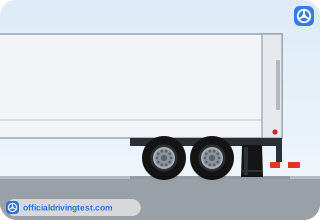
What is the purpose of the device called a mud flap, which every truck must have?
- To reduce wind resistance when driving at highway speed
- To minimize spray or splash of water or mud to the rear
- To protect the fuel tank from damage in a collision
- To keep the load from sliding off the rear
Show answer
Correct answer: To minimize spray or splash of water or mud to the rear
Every truck must have a mud flap to minimize the spray or splash of water, mud or loose road surface material to the rear.
Source: Class D & E Driver’s Guide (Revised August 2025 (DPSMV2052 R08/25)), page 129 · Open this page in the manual (Manual page 129)
-
Freight carrying vehicles and passenger buses must carry how many flares, electric red lanterns or red portable reflectors?
- Three
- Two
- Four
- Six
Show answer
Correct answer: Three
Freight carrying vehicles and passenger buses must carry three flares, three electric red lanterns or three red portable reflectors.
Source: Class D & E Driver’s Guide (Revised August 2025 (DPSMV2052 R08/25)), page 129 · Open this page in the manual (Manual page 129)
-
Besides flares, lanterns or reflectors, what must freight carrying vehicles and passenger buses carry?
- One 24-inch square orange cloth flag with a standard
- Four 6-inch square white cloth flags with standards
- Two 12-inch square red cloth flags with standards
- Two 6-inch square yellow cloth flags with standards
Show answer
Correct answer: Two 12-inch square red cloth flags with standards
These vehicles must also carry two 12-inch square red cloth flags with standards.
Source: Class D & E Driver’s Guide (Revised August 2025 (DPSMV2052 R08/25)), page 129 · Open this page in the manual (Manual page 129)
-
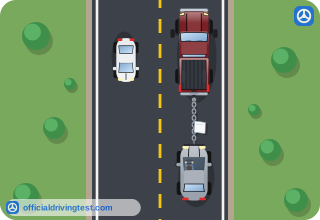
When a Class D chauffeur's vehicle tows another vehicle, how long may the draw bar or other connection be, in general?
- No more than 10 feet
- No more than 15 feet
- No more than 20 feet
- No more than 25 feet
Show answer
Correct answer: No more than 15 feet
The draw bar or other connection must not exceed 15 feet, with an exception for objects that cannot be readily dismembered.
Source: Class D & E Driver’s Guide (Revised August 2025 (DPSMV2052 R08/25)), page 129 · Open this page in the manual (Manual page 129)
-
When towing another vehicle, in which case can the distance of the draw bar or other connection exceed 15 feet?
- When moving poles, pipes or machinery that cannot be readily dismembered
- When towing a vehicle that has its own working brakes installed
- When driving on a rural highway outside any business district
- When the towed vehicle weighs less than 3,000 pounds in total
Show answer
Correct answer: When moving poles, pipes or machinery that cannot be readily dismembered
The distance can exceed 15 feet when transporting poles, pipes, machinery or other objects which cannot be readily dismembered.
Source: Class D & E Driver’s Guide (Revised August 2025 (DPSMV2052 R08/25)), page 129 · Open this page in the manual (Manual page 129)
-
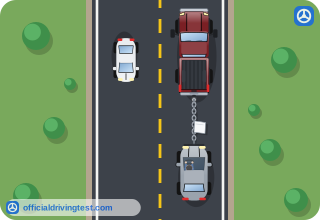
When towing another vehicle, what must the draw bar or other connection be strong enough to do?
- Pull only the empty weight of the towed vehicle
- Hold the towed vehicle only while it is parked
- Pull all of the towed weight
- Carry the full weight of the towed vehicle's load
Show answer
Correct answer: Pull all of the towed weight
The draw bar or other connection must be of sufficient strength to pull all towed weight.
Source: Class D & E Driver’s Guide (Revised August 2025 (DPSMV2052 R08/25)), page 129 · Open this page in the manual (Manual page 129)
-
Under the Class D chauffeur's license section, a rear view mirror must reflect a view of the highway for how far to the rear, regardless of the load of the vehicle?
- 100 feet
- 200 feet
- 300 feet
- 500 feet
Show answer
Correct answer: 200 feet
A rear view mirror must reflect a view of the highway for a distance of 200 feet to the rear, regardless of the load.
Source: Class D & E Driver’s Guide (Revised August 2025 (DPSMV2052 R08/25)), page 129 · Open this page in the manual (Manual page 129)
-
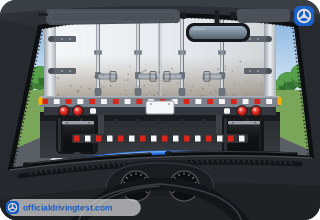
What can make it unlawful to drive a motor vehicle because of its required lamps or reflectors?
- A lamp that stays lit while the vehicle is parked
- A reflector mounted on the rear bumper
- A mirror adjusted for a driver of lower height
- A tailboard, part of the load or dirt hiding them
Show answer
Correct answer: A tailboard, part of the load or dirt hiding them
A motor vehicle shall not be driven when any required lamp or reflector is obscured by the tailboard, by any part of the load, by dirt or otherwise.
Source: Class D & E Driver’s Guide (Revised August 2025 (DPSMV2052 R08/25)), page 130 · Open this page in the manual (Manual page 130)
-
All trailers or semi-trailers of at least what weight must have brakes adequate to stop and hold them?
- 1,000 pounds
- 5,000 pounds
- 3,000 pounds
- 10,000 pounds
Show answer
Correct answer: 3,000 pounds
Trailers and semi-trailers with a gross vehicle weight rating of 3,000 pounds or more must have brakes adequate to stop and hold them.
Source: Class D & E Driver’s Guide (Revised August 2025 (DPSMV2052 R08/25)), page 130 · Open this page in the manual (Manual page 130)
-
According to the Class D chauffeur's license section, what should drivers use as the principal means of controlling speed on long grades?
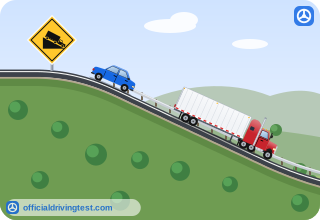
- Engine compression
- Continuous service braking
- The parking brake
- The hand brake
Show answer
Correct answer: Engine compression
Drivers should avoid excessive use of brakes on long downgrades and use engine compression as the principal means of controlling speed.
Source: Class D & E Driver’s Guide (Revised August 2025 (DPSMV2052 R08/25)), page 130 · Open this page in the manual (Manual page 130)
-
What do air brakes use to make the brakes work?
- Hydraulic fluid
- Compressed air
- Engine vacuum
- An electric motor
Show answer
Correct answer: Compressed air
Air brakes use compressed air to make the brakes work.
Source: Class D & E Driver’s Guide (Revised August 2025 (DPSMV2052 R08/25)), page 130 · Open this page in the manual (Manual page 130)
-
Air brake systems combine which three braking systems?
- Service, parking and emergency brake systems
- Service, parking and anti-lock brake systems
- Service, trailer and exhaust brake systems
- Primary, secondary and engine brake systems
Show answer
Correct answer: Service, parking and emergency brake systems
Air brake systems are three braking systems combined: the service brake system, the parking brake system, and the emergency brake system.
Source: Class D & E Driver’s Guide (Revised August 2025 (DPSMV2052 R08/25)), page 130 · Open this page in the manual (Manual page 130)
-
In an air brake system, which system applies and releases the brakes when you use the brake pedal during normal driving?
- Parking brake system
- Emergency brake system
- Service brake system
- Spring brake system
Show answer
Correct answer: Service brake system
The service brake system applies and releases the brakes when you use the brake pedal during normal driving.
Source: Class D & E Driver’s Guide (Revised August 2025 (DPSMV2052 R08/25)), page 130 · Open this page in the manual (Manual page 130)
-
In an air brake system, which system applies and releases the parking brakes when you use the parking brake control?
- Service brake system
- Parking brake system
- Emergency brake system
- Supply brake system
Show answer
Correct answer: Parking brake system
The parking brake system applies and releases the parking brakes when you use the parking brake control.
Source: Class D & E Driver’s Guide (Revised August 2025 (DPSMV2052 R08/25)), page 130 · Open this page in the manual (Manual page 130)
-
In an air brake system, which system uses part of the service and parking brake system to stop the vehicle if the brake system fails?
- Supply brake system
- Reserve brake system
- Application brake system
- Emergency brake system
Show answer
Correct answer: Emergency brake system
The emergency brake system uses part of the service and parking brake’s system to stop the vehicle in the event of a brake system failure.
Source: Class D & E Driver’s Guide (Revised August 2025 (DPSMV2052 R08/25)), page 130 · Open this page in the manual (Manual page 130)
-
Which part of an air brake system pumps air into the air storage tanks?
- Air compressor governor
- Safety valve
- Air compressor
- Supply pressure gauge
Show answer
Correct answer: Air compressor
The air compressor pumps air into the air storage tanks (reservoirs).
Source: Class D & E Driver’s Guide (Revised August 2025 (DPSMV2052 R08/25)), page 130 · Open this page in the manual (Manual page 130)
-
Which part of an air brake system controls when the air compressor will pump air into the air storage tanks?
- Air compressor governor
- Safety valve
- Application pressure gauge
- Air tank drain
Show answer
Correct answer: Air compressor governor
The air compressor governor controls when the air compressor will pump air into the air storage tanks.
Source: Class D & E Driver’s Guide (Revised August 2025 (DPSMV2052 R08/25)), page 130 · Open this page in the manual (Manual page 130)
-
What are the air storage tanks of an air brake system used for?
- To hold brake fluid
- To cool the brake drums
- To control the air pressure
- To hold compressed air
Show answer
Correct answer: To hold compressed air
Air storage tanks are used to hold compressed air.
Source: Class D & E Driver’s Guide (Revised August 2025 (DPSMV2052 R08/25)), page 130 · Open this page in the manual (Manual page 130)
-
For an air brake system with manual air tank drains, when must you drain the tanks yourself?
- At the start of each trip
- At the end of each day of driving
- Only when the safety valve opens
- Once at the end of each week
Show answer
Correct answer: At the end of each day of driving
With manual drains, you must drain the tanks yourself at the end of each day of driving.
Source: Class D & E Driver’s Guide (Revised August 2025 (DPSMV2052 R08/25)), page 130 · Open this page in the manual (Manual page 130)
-
How is a manual air tank drain operated?
- By turning a quarter turn or by pulling a cable
- By pressing the brake pedal several times
- By pushing in the yellow push-pull control knob
- By turning the key to the on position first
Show answer
Correct answer: By turning a quarter turn or by pulling a cable
A manual drain is operated by turning a quarter turn or by pulling a cable.
Source: Class D & E Driver’s Guide (Revised August 2025 (DPSMV2052 R08/25)), page 130 · Open this page in the manual (Manual page 130)
-
What do automatic air tank drains do?
- Automatically refill the tank with air
- Automatically apply the parking brakes
- Automatically expel the water and oil
- Automatically open the safety valve
Show answer
Correct answer: Automatically expel the water and oil
With automatic air tank drains, the water and oil is automatically expelled.
Source: Class D & E Driver’s Guide (Revised August 2025 (DPSMV2052 R08/25)), page 130 · Open this page in the manual (Manual page 130)
-
What does the safety valve of an air brake system protect?
- The compressor from running without air in the tanks
- The tank and the rest of the system from too much pressure
- The brake drums from becoming too hot
- The driver from using the pedal too often
Show answer
Correct answer: The tank and the rest of the system from too much pressure
The safety valve protects the tank and the rest of the system from too much pressure.
Source: Class D & E Driver’s Guide (Revised August 2025 (DPSMV2052 R08/25)), page 130 · Open this page in the manual (Manual page 130)
-
The safety valve of an air brake system is usually set to open at about what pressure?
- 60 psi
- 100 psi
- 125 psi
- 150 psi
Show answer
Correct answer: 150 psi
The safety valve is usually set to open at 150 psi.
Source: Class D & E Driver’s Guide (Revised August 2025 (DPSMV2052 R08/25)), page 130 · Open this page in the manual (Manual page 130)
-
If the safety valve of an air brake system releases air, what does that mean?
- The tanks are empty
- The brakes are working normally
- Something is wrong
- The parking brakes are on
Show answer
Correct answer: Something is wrong
If the safety valve releases air, something is wrong.
Source: Class D & E Driver’s Guide (Revised August 2025 (DPSMV2052 R08/25)), page 130 · Open this page in the manual (Manual page 130)
-
In an air brake system, what happens when you push the brake pedal down harder?
- More air pressure is applied
- Less air pressure is applied
- The compressor shuts off
- The spring brakes are applied
Show answer
Correct answer: More air pressure is applied
Pushing the pedal down harder applies more air pressure, and letting up reduces the air pressure and releases the brakes.
Source: Class D & E Driver’s Guide (Revised August 2025 (DPSMV2052 R08/25)), page 130 · Open this page in the manual (Manual page 130)
-
What can happen if you press and release the brake pedal of an air brake system unnecessarily?
- The compressor can run for too long and then overheat
- The safety valve can close and then stay closed for good
- The brake drums can lose their linings from friction
- Air can leave faster than the compressor can replace it
Show answer
Correct answer: Air can leave faster than the compressor can replace it
Pressing and releasing the pedal unnecessarily can let air out faster than the compressor can replace it, and if the pressure gets too low the brakes won’t work.
Source: Class D & E Driver’s Guide (Revised August 2025 (DPSMV2052 R08/25)), page 130 · Open this page in the manual (Manual page 130)
-
On a vehicle with air brakes, which gauge tells you how much pressure is in the air tanks?
- Application pressure gauge
- Supply pressure gauge
- Low air warning gauge
- Governor pressure gauge
Show answer
Correct answer: Supply pressure gauge
All vehicles equipped with air brakes have a supply pressure gauge connected to the air tank that tells how much pressure is in the tanks.
Source: Class D & E Driver’s Guide (Revised August 2025 (DPSMV2052 R08/25)), page 130 · Open this page in the manual (Manual page 130)
-
Which air brake gauge shows how much air pressure you are applying to the brakes?
- Application pressure gauge
- Supply pressure gauge
- Safety valve gauge
- Compressor cutout gauge
Show answer
Correct answer: Application pressure gauge
The application pressure gauge shows how much air pressure you are applying to the brakes, and it is not on all vehicles.
Source: Class D & E Driver’s Guide (Revised August 2025 (DPSMV2052 R08/25)), page 130 · Open this page in the manual (Manual page 130)
-
A low air pressure warning signal on a vehicle with air brakes must come on before the air pressure in the tanks falls below what level?
- 20 psi
- 100 psi
- 60 psi
- 150 psi
Show answer
Correct answer: 60 psi
A warning signal you can see must come on before the air pressure in the tanks falls below 60 psi.
Source: Class D & E Driver’s Guide (Revised August 2025 (DPSMV2052 R08/25)), page 130 · Open this page in the manual (Manual page 130)
-
What form does the low air pressure warning of an air brake system usually take?
- A flashing green light
- A visible red light
- A yellow dashboard dial
- A recorded voice message
Show answer
Correct answer: A visible red light
The low air pressure warning is usually a visible red light, and a buzzer may also come on.
Source: Class D & E Driver’s Guide (Revised August 2025 (DPSMV2052 R08/25)), page 130 · Open this page in the manual (Manual page 130)
-
On older vehicles with air brakes, the low air pressure warning must come on before the pressure falls below what level?
- One quarter of the compressor governor cutout pressure
- Twice the compressor governor cutout pressure
- The pressure at which the safety valve opens
- One half the compressor governor cutout pressure
Show answer
Correct answer: One half the compressor governor cutout pressure
On older vehicles, the low air pressure warning must come on before pressure falls below one half the compressor governor cutout pressure.
Source: Class D & E Driver’s Guide (Revised August 2025 (DPSMV2052 R08/25)), page 130 · Open this page in the manual (Manual page 130)
-
How must the emergency brakes and parking brakes on all trucks be held on?
- By air pressure
- By hydraulic fluid
- By mechanical force
- By the driver's foot
Show answer
Correct answer: By mechanical force
All trucks must have emergency brakes and parking brakes held on by mechanical force; spring brakes are usually used for this.
Source: Class D & E Driver’s Guide (Revised August 2025 (DPSMV2052 R08/25)), page 131 · Open this page in the manual (Manual page 131)