Louisiana: Signals and vehicle controls — Part 7 Practice Test
Checking your vehicle, tires, starting and stopping, steering, signaling, safety features, seasonal care, air brakes and towing a trailer. — Part 7
Independent educational site · not affiliated with any government agency or DMV
Ready? Test yourself
- Instant feedback with an explanation
- Every answer cites its source in the manual
- Your best score is saved on this device
Questions are original and based on the official manual "Class D & E Driver’s Guide" (Revised August 2025 (DPSMV2052 R08/25)), Louisiana Office of Motor Vehicles.
All 36 questions in this practice test
Take the test above first, then use this list to study. Tap “Show answer” to see the correct answer and explanation.
Show the questions and answersHide the questions
-
Which kind of vehicle load does the manual say you must not drive with?
- One that blocks your view or interferes with your control
- One that includes more than two passengers in the back seat
- One that includes any cargo carried in the trunk
- One that weighs more than 100 pounds above its empty weight
Show answer
Correct answer: One that blocks your view or interferes with your control
The manual says you must not drive a vehicle overloaded with passengers or anything that obstructs your view in any direction or interferes with your control.
Source: Class D & E Driver’s Guide (Revised August 2025 (DPSMV2052 R08/25)), page 96 · Open this page in the manual (Manual page 96)
-
Having non-transparent material on the front windshield or front side-windows is illegal unless what?
- It was installed by the vehicle's manufacturer
- It is prescribed by a physician
- It covers less than half of the glass
- The vehicle has two outside mirrors
Show answer
Correct answer: It is prescribed by a physician
The manual says non-transparent material on the front windshield or front side-windows is illegal unless prescribed by a physician.
Source: Class D & E Driver’s Guide (Revised August 2025 (DPSMV2052 R08/25)), page 96 · Open this page in the manual (Manual page 96)
-
When is riding in a house trailer not allowed?
- While it is parked on the shoulder of a highway
- Only when it is moved on an interstate highway
- While it is being moved upon a highway
- Only when it is being towed at night
Show answer
Correct answer: While it is being moved upon a highway
The manual says riding in a house trailer is not allowed while it is being moved upon a highway in this state.
Source: Class D & E Driver’s Guide (Revised August 2025 (DPSMV2052 R08/25)), page 96 · Open this page in the manual (Manual page 96)
-
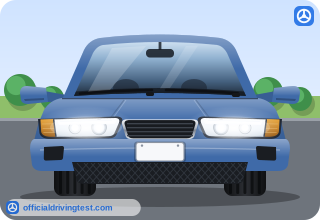
When does Louisiana law say you must have your headlights on (low beam) in connection with windshield wipers?
- Only when the wipers are on their high speed
- When your windshield wipers are required
- Only when it is raining heavily
- Only when snow or ice is falling
Show answer
Correct answer: When your windshield wipers are required
The manual says Louisiana law requires headlights on (low beam) when your windshield wipers are required.
Source: Class D & E Driver’s Guide (Revised August 2025 (DPSMV2052 R08/25)), page 97 · Open this page in the manual (Manual page 97)
-
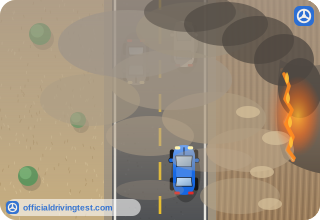
When gravel roads become extremely dusty, which headlights does the manual recommend using?
- High beam headlights
- Parking lights
- Low beam headlights
- Hazard flashers
Show answer
Correct answer: Low beam headlights
The manual recommends low beam headlights in dust to make your vehicle more visible, and also to slow down and increase your following distance.
Source: Class D & E Driver’s Guide (Revised August 2025 (DPSMV2052 R08/25)), page 103 · Open this page in the manual (Manual page 103)
-
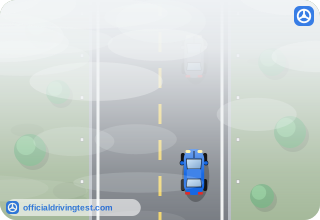
What should you do when you drive in a heavy downpour or in fog?
- Slow down and use your high beam headlights
- Keep your speed and use only parking lights
- Keep your speed and turn on your low beam headlights
- Slow down and turn on your low beam headlights
Show answer
Correct answer: Slow down and turn on your low beam headlights
The manual says to slow down and turn on your low beam headlights in a heavy downpour or in fog.
Source: Class D & E Driver’s Guide (Revised August 2025 (DPSMV2052 R08/25)), page 106 · Open this page in the manual (Manual page 106)
-
At night, when does the manual say to use your high beams?
- Only on the interstate
- Only in fog
- Whenever there are no oncoming vehicles
- Only when following another vehicle
Show answer
Correct answer: Whenever there are no oncoming vehicles
The manual says to use your high beams whenever there are no oncoming vehicles.
Source: Class D & E Driver’s Guide (Revised August 2025 (DPSMV2052 R08/25)), page 107 · Open this page in the manual (Manual page 107)
-
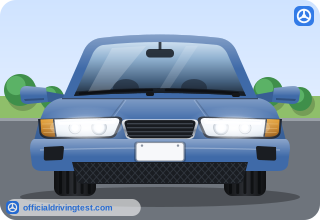
Compared with low beams, how far do high beams let you see?
- Three times as far
- Twice as far
- One and a half times as far
- The same distance
Show answer
Correct answer: Twice as far
The manual says high beams let you see twice as far as low beams.
Source: Class D & E Driver’s Guide (Revised August 2025 (DPSMV2052 R08/25)), page 107 · Open this page in the manual (Manual page 107)
-
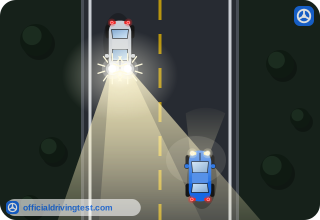
If an oncoming driver fails to dim high beams, where should you look?
- Directly at the headlights
- At the center line
- Toward the left side of the road
- Toward the right side of the road
Show answer
Correct answer: Toward the right side of the road
The manual says to look toward the right side of the road to keep from being blinded.
Source: Class D & E Driver’s Guide (Revised August 2025 (DPSMV2052 R08/25)), page 107 · Open this page in the manual (Manual page 107)
-
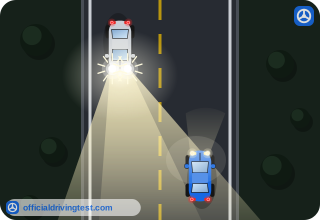
Why should you not keep your bright lights on to get back at a driver who has not dimmed?
- Both of you may be blinded, possibly causing a collision
- The other driver will be fined for not dimming first
- Your headlights may be damaged if they stay on high beam
- The other driver will dim their lights sooner if you do
Show answer
Correct answer: Both of you may be blinded, possibly causing a collision
The manual says that if you keep your bright lights on, both of you may be blinded, possibly causing a collision.
Source: Class D & E Driver’s Guide (Revised August 2025 (DPSMV2052 R08/25)), page 107 · Open this page in the manual (Manual page 107)
-
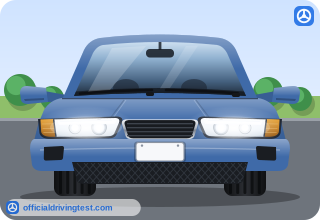
Which of these is a situation in which the manual says to use low beams?
- When driving alone on a dark rural road
- When no vehicles are ahead or oncoming
- When following another vehicle
- When parked at night
Show answer
Correct answer: When following another vehicle
The manual says to use low beams when following another vehicle, in heavy traffic, in fog, or when it is snowing or raining hard.
Source: Class D & E Driver’s Guide (Revised August 2025 (DPSMV2052 R08/25)), page 107 · Open this page in the manual (Manual page 107)
-
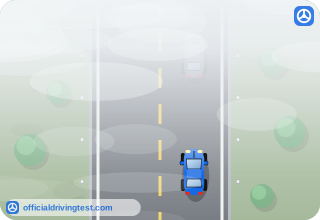
Why should you use low beams in fog, snow or rain?
- High beams burn out faster in rain and snow
- Light from high beams reflects back, causing glare
- Low beams light the road farther than high beams
- High beams are not allowed on state highways
Show answer
Correct answer: Light from high beams reflects back, causing glare
The manual says light from high beams will reflect back, causing glare and making it more difficult to see ahead.
Source: Class D & E Driver’s Guide (Revised August 2025 (DPSMV2052 R08/25)), page 107 · Open this page in the manual (Manual page 107)
-
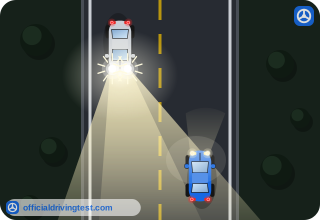
Why should you avoid looking directly into oncoming headlights?
- It makes the other driver’s lights brighter
- It blocks your view of the road edge
- It dims your own headlights
- It can cause momentary blindness from the glare
Show answer
Correct answer: It can cause momentary blindness from the glare
The manual says looking directly into oncoming headlights can cause momentary blindness from the glare.
Source: Class D & E Driver’s Guide (Revised August 2025 (DPSMV2052 R08/25)), page 107 · Open this page in the manual (Manual page 107)
-
Why should you not wear sunglasses or colored glasses when driving at night or on dark days?
- They make oncoming headlights look much brighter to you
- They make your eyes adjust more slowly and can reduce vision
- They block your view of the mirrors and the dashboard
- They make dark shapes on the road look brighter
Show answer
Correct answer: They make your eyes adjust more slowly and can reduce vision
The manual says colored lenses cause your eyes to adjust even more slowly and can reduce your vision.
Source: Class D & E Driver’s Guide (Revised August 2025 (DPSMV2052 R08/25)), page 107 · Open this page in the manual (Manual page 107)
-
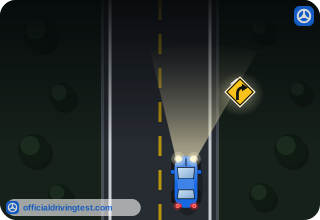
What can make a big difference to your visibility when driving at night?
- A tinted windshield
- Dark colored glasses
- A clean windshield
- Dimmed dashboard lights
Show answer
Correct answer: A clean windshield
The manual says a clean windshield can make a big difference to visibility.
Source: Class D & E Driver’s Guide (Revised August 2025 (DPSMV2052 R08/25)), page 107 · Open this page in the manual (Manual page 107)
-
What does ESP stand for in a vehicle?
- Electronic Stability Program
- Emergency Stopping Procedure
- Engine Speed Protection System
- Extra Steering Power
Show answer
Correct answer: Electronic Stability Program
ESP stands for Electronic Stability Program.
Source: Class D & E Driver’s Guide (Revised August 2025 (DPSMV2052 R08/25)), page 116 · Open this page in the manual (Manual page 116)
-
The ESP in a vehicle works in conjunction with which system?
- The cruise control system
- The power steering system
- The ABS brake system
- The air bag system
Show answer
Correct answer: The ABS brake system
Many vehicles have an ESP that works in conjunction with the ABS brake system.
Source: Class D & E Driver’s Guide (Revised August 2025 (DPSMV2052 R08/25)), page 116 · Open this page in the manual (Manual page 116)
-
The ESP computer compares where the driver is steering the vehicle with what?
- Where the vehicle is actually going
- How fast the engine is turning
- How much air is in the tires
- Where the nearest lane marking is located
Show answer
Correct answer: Where the vehicle is actually going
ESP electronically compares where the driver is steering with where the vehicle is actually going.
Source: Class D & E Driver’s Guide (Revised August 2025 (DPSMV2052 R08/25)), page 116 · Open this page in the manual (Manual page 116)
-
What does ESP do when it senses a traction problem?
- Locks all four wheels at once to bring the car to a quick and complete stop
- Raises engine speed so the car can drive out of the slide
- Turns the steering wheel for the driver to keep the lane
- Selectively applies one of the brakes to reduce the chance of a skid
Show answer
Correct answer: Selectively applies one of the brakes to reduce the chance of a skid
When ESP senses traction problems, it selectively applies any one of the vehicle brakes to reduce the possibility of a skid.
Source: Class D & E Driver’s Guide (Revised August 2025 (DPSMV2052 R08/25)), page 116 · Open this page in the manual (Manual page 116)
-
Under the vehicle size limits in the Class D chauffeur's license section, what is the maximum width for most vehicles?
- 7 feet
- 9 feet
- 10 feet
- 8 feet
Show answer
Correct answer: 8 feet
The maximum width is 8 feet for most vehicles, with 8 feet 6 inches allowed for buses.
Source: Class D & E Driver’s Guide (Revised August 2025 (DPSMV2052 R08/25)), page 128 · Open this page in the manual (Manual page 128)
-
Under the Class D chauffeur's vehicle size limits, a load on most vehicles will not project more than how far beyond the width of the body?
- 3 inches
- 12 inches
- 6 inches
- 2 feet
Show answer
Correct answer: 6 inches
For most vehicles the load will not project more than 6 inches beyond the width of the body.
Source: Class D & E Driver’s Guide (Revised August 2025 (DPSMV2052 R08/25)), page 128 · Open this page in the manual (Manual page 128)
-
Under the vehicle size limits in the Class D chauffeur's license section, what is the maximum width for buses?
- 8 feet 6 inches
- 8 feet
- 9 feet
- 9 feet 6 inches
Show answer
Correct answer: 8 feet 6 inches
The maximum width for buses is 8 feet 6 inches.
Source: Class D & E Driver’s Guide (Revised August 2025 (DPSMV2052 R08/25)), page 128 · Open this page in the manual (Manual page 128)
-
Under the vehicle size limits in the Class D chauffeur's license section, what is the maximum height for all vehicles?
- 12 feet 6 inches
- 14 feet 6 inches
- 11 feet 6 inches
- 13 feet 6 inches
Show answer
Correct answer: 13 feet 6 inches
The maximum height is 13 feet 6 inches for all vehicles.
Source: Class D & E Driver’s Guide (Revised August 2025 (DPSMV2052 R08/25)), page 128 · Open this page in the manual (Manual page 128)
-
Under the vehicle size limits in the Class D chauffeur's license section, what is the maximum length for any single vehicle, including the load?
- 35 feet
- 40 feet
- 45 feet
- 50 feet
Show answer
Correct answer: 40 feet
A single vehicle, including its load, may be no longer than 40 feet.
Source: Class D & E Driver’s Guide (Revised August 2025 (DPSMV2052 R08/25)), page 128 · Open this page in the manual (Manual page 128)
-
Under the vehicle size limits in the Class D chauffeur's license section, what is the maximum length for a truck-tractor and trailer combination?
- 65 feet
- 55 feet
- 60 feet
- 75 feet
Show answer
Correct answer: 65 feet
The maximum length for a truck-tractor and trailer combination is 65 feet.
Source: Class D & E Driver’s Guide (Revised August 2025 (DPSMV2052 R08/25)), page 128 · Open this page in the manual (Manual page 128)
-
Which of these is named in the Class D chauffeur's license section as not subject to the vehicle width, height and length limits?
- A passenger bus
- A tow truck
- An auto carrier
- A truck-tractor with a trailer
Show answer
Correct answer: An auto carrier
The limits do not apply to auto carriers, trailers hauling poles or pilings, or trailers hauling logs when operating during daylight hours.
Source: Class D & E Driver’s Guide (Revised August 2025 (DPSMV2052 R08/25)), page 128 · Open this page in the manual (Manual page 128)
-
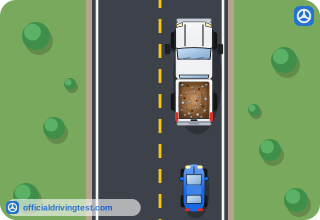
Which statement about securing loads on a Class D chauffeur's vehicle is correct?
- Contents may shift during the trip if the load stays under the height limit
- Contents must not be allowed to drop, shift, leak or otherwise escape
- A load needs no covering when it is lower than the cab of the vehicle
- Leaks are allowed if the load is not hazardous to other motorists
Show answer
Correct answer: Contents must not be allowed to drop, shift, leak or otherwise escape
The manual says the contents of a load must not be allowed to drop, shift, leak or otherwise escape.
Source: Class D & E Driver’s Guide (Revised August 2025 (DPSMV2052 R08/25)), page 128 · Open this page in the manual (Manual page 128)
-
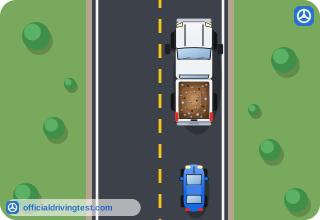
How must a load be fastened on a Class D chauffeur's vehicle?
- Loosely enough that the covering can be removed in an emergency
- Only with chains, so that a covering is never needed
- Tightly at the front only, since the rear of the load is visible
- Securely, so the covering or load does not come loose or become a hazard
Show answer
Correct answer: Securely, so the covering or load does not come loose or become a hazard
The load must be securely fastened so the covering or load does not come loose or become a hazard to other motorists.
Source: Class D & E Driver’s Guide (Revised August 2025 (DPSMV2052 R08/25)), page 128 · Open this page in the manual (Manual page 128)
-
On a Class D chauffeur's vehicle, a load must not extend more than how far to the front of the vehicle?
- 2 feet
- 6 feet
- 4 feet
- 10 feet
Show answer
Correct answer: 4 feet
A load must not extend more than 4 feet to the front of the vehicle.
Source: Class D & E Driver’s Guide (Revised August 2025 (DPSMV2052 R08/25)), page 128 · Open this page in the manual (Manual page 128)
-
On a Class D chauffeur's vehicle, a load (other than poles, pilings and logs) must not extend more than how far beyond the rear of the vehicle?
- 8 feet
- 6 feet
- 10 feet
- 12 feet
Show answer
Correct answer: 8 feet
A load must not extend more than 8 feet beyond the rear of the vehicle, except poles, pilings and logs.
Source: Class D & E Driver’s Guide (Revised August 2025 (DPSMV2052 R08/25)), page 128 · Open this page in the manual (Manual page 128)
-
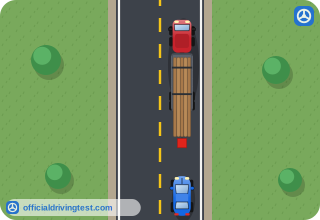
How far beyond the rearmost part of the trailer may poles, pilings and logs project?
- 10 feet
- 12 feet
- 20 feet
- 15 feet
Show answer
Correct answer: 15 feet
Poles, pilings and logs may project 15 feet beyond the rearmost part of the trailer.
Source: Class D & E Driver’s Guide (Revised August 2025 (DPSMV2052 R08/25)), page 128 · Open this page in the manual (Manual page 128)
-
During daylight hours, what must be attached to the extreme rear of a load that extends four or more feet past the bed or body of a vehicle?
- A red flag 6 inches square
- A red flag 12 inches square
- A white flag 12 inches square
- An orange flag 18 inches square
Show answer
Correct answer: A red flag 12 inches square
If a load extends four or more feet past the bed or body of any vehicle, a red flag 12 inches square must be attached to the extreme rear during daylight hours.
Source: Class D & E Driver’s Guide (Revised August 2025 (DPSMV2052 R08/25)), page 128 · Open this page in the manual (Manual page 128)
-
How much of the red flag attached to the rear of a projecting load must be visible?
- The entire area of the flag
- At least half of the flag
- Only the top corner of the flag
- At least three quarters of the flag
Show answer
Correct answer: The entire area of the flag
The manual says the entire area of the flag must be visible.
Source: Class D & E Driver’s Guide (Revised August 2025 (DPSMV2052 R08/25)), page 128 · Open this page in the manual (Manual page 128)
-
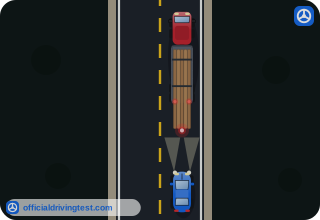
At night, a red light attached to the extreme rear of a projecting load must be visible for at least how far to the sides and rear?
- 100 feet
- 300 feet
- 500 feet
- 1,000 feet
Show answer
Correct answer: 500 feet
At night, a red light must be attached to the extreme rear of the load and visible for at least 500 feet to the sides and rear.
Source: Class D & E Driver’s Guide (Revised August 2025 (DPSMV2052 R08/25)), page 128 · Open this page in the manual (Manual page 128)
-
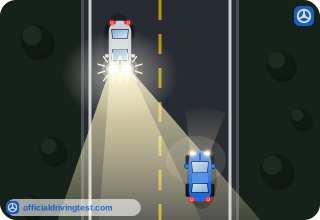
How far from oncoming traffic, and how far from a vehicle being followed, must high beam headlights be dimmed under the Class D chauffeur's license section?
- 200 feet from oncoming traffic and 500 feet from a vehicle being followed
- 500 feet from oncoming traffic and 200 feet from a vehicle being followed
- 500 feet from oncoming traffic and 500 feet from a vehicle being followed
- 200 feet from oncoming traffic and 200 feet from a vehicle being followed
Show answer
Correct answer: 500 feet from oncoming traffic and 200 feet from a vehicle being followed
High beams must be dimmed no less than 500 feet from oncoming traffic and 200 feet from a vehicle being followed.
Source: Class D & E Driver’s Guide (Revised August 2025 (DPSMV2052 R08/25)), page 129 · Open this page in the manual (Manual page 129)
-
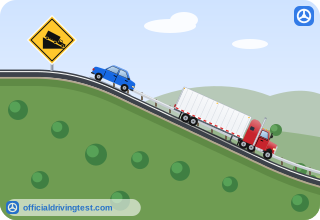
Which of these must you not do when going downhill in a Class D chauffeur's vehicle?
- Coast with the clutch disengaged or in neutral
- Use engine compression to slow the vehicle
- Downshift to a lower gear on a downgrade
- Stay in a lower gear while going downhill
Show answer
Correct answer: Coast with the clutch disengaged or in neutral
You must not let your vehicle coast downhill with the clutch disengaged or the gear in neutral.
Source: Class D & E Driver’s Guide (Revised August 2025 (DPSMV2052 R08/25)), page 129 · Open this page in the manual (Manual page 129)