Louisiana: Signals and vehicle controls — Part 6 Practice Test
Checking your vehicle, tires, starting and stopping, steering, signaling, safety features, seasonal care, air brakes and towing a trailer. — Part 6
Independent educational site · not affiliated with any government agency or DMV
Ready? Test yourself
- Instant feedback with an explanation
- Every answer cites its source in the manual
- Your best score is saved on this device
Questions are original and based on the official manual "Class D & E Driver’s Guide" (Revised August 2025 (DPSMV2052 R08/25)), Louisiana Office of Motor Vehicles.
All 36 questions in this practice test
Take the test above first, then use this list to study. Tap “Show answer” to see the correct answer and explanation.
Show the questions and answersHide the questions
-
In some vehicles a lever releases the foot-pedal parking brake. Where is that lever?
- On the steering column
- In the center console
- On the dashboard to the right of the radio
- Near the parking brake pedal
Show answer
Correct answer: Near the parking brake pedal
The manual says that in some vehicles you must pull a brake release lever located near the parking brake pedal.
Source: Class D & E Driver’s Guide (Revised August 2025 (DPSMV2052 R08/25)), page 68 · Open this page in the manual (Manual page 68)
-
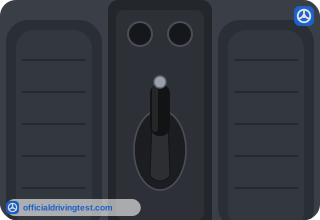
What should become a habit regarding the parking brake?
- Setting it only on hills and releasing it once the engine warms up
- Setting it when you park and disengaging it before you drive
- Setting it only at night and releasing it in the morning
- Setting it only when the car is manual and releasing it at each stop
Show answer
Correct answer: Setting it when you park and disengaging it before you drive
The manual says setting the parking brake when you park and disengaging it before you drive should become habit.
Source: Class D & E Driver’s Guide (Revised August 2025 (DPSMV2052 R08/25)), page 68 · Open this page in the manual (Manual page 68)
-
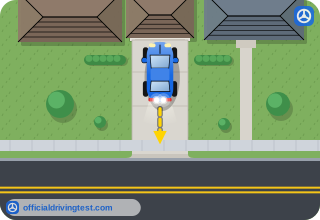
What should you not depend on when you check behind your vehicle before backing?
- Your turn signal
- Your mirrors
- Your horn
- Your passengers
Show answer
Correct answer: Your mirrors
The manual says to check behind your vehicle before backing and not to depend on your mirrors.
Source: Class D & E Driver’s Guide (Revised August 2025 (DPSMV2052 R08/25)), page 73 · Open this page in the manual (Manual page 73)
-
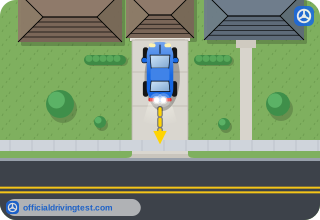
While you back slowly, what should you always be prepared to do?
- Honk the horn
- Accelerate
- Stop
- Turn off the engine
Show answer
Correct answer: Stop
The manual says to back slowly and always be prepared to stop.
Source: Class D & E Driver’s Guide (Revised August 2025 (DPSMV2052 R08/25)), page 73 · Open this page in the manual (Manual page 73)
-
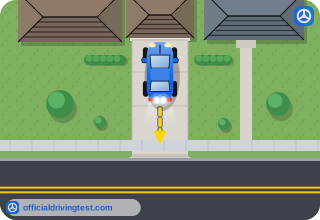
What is the best way to increase visibility when backing up?
- Turn your head and look out the rear window
- Rely on your side mirrors
- Use only the rearview mirror
- Lean toward the passenger-side window
Show answer
Correct answer: Turn your head and look out the rear window
The manual says the best way to increase visibility when backing up is to turn your head and look out the rear window, not to depend on mirrors.
Source: Class D & E Driver’s Guide (Revised August 2025 (DPSMV2052 R08/25)), page 73 · Open this page in the manual (Manual page 73)
-
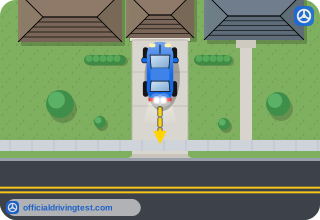
Before backing, what does the manual say is a good idea?
- Warm up the engine for at least a minute before you shift into reverse
- Roll down all the windows
- Turn on the hazard flashers
- Walk around the car to make sure a child, pet or object is not in the way
Show answer
Correct answer: Walk around the car to make sure a child, pet or object is not in the way
The manual says it is a good idea to walk around the car before backing to make sure a child, pet, object, etc. is not in the way.
Source: Class D & E Driver’s Guide (Revised August 2025 (DPSMV2052 R08/25)), page 73 · Open this page in the manual (Manual page 73)
-
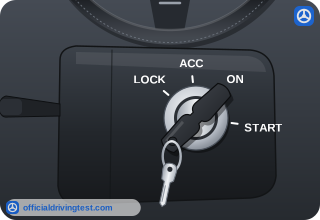
What can happen if you turn the ignition key to the lock position while the vehicle is moving?
- The brakes lock and the car stops at once
- The steering locks and you may lose control
- The headlights and flashers switch off
- Nothing, since the key cannot turn while moving
Show answer
Correct answer: The steering locks and you may lose control
Never turn the ignition key to the lock position while the vehicle is in motion; the steering will lock, quite possibly causing loss of control.
Source: Class D & E Driver’s Guide (Revised August 2025 (DPSMV2052 R08/25)), page 74 · Open this page in the manual (Manual page 74)
-
With the Two-Hand Button steering lock system, where is the button you depress?
- On top of the gear shift knob
- On the dashboard above the radio
- Under the front edge of the driver seat
- Below the steering column
Show answer
Correct answer: Below the steering column
The Two-Hand Button System requires two hands: depress the button below the steering column, then turn the key to LOCK and remove it.
Source: Class D & E Driver’s Guide (Revised August 2025 (DPSMV2052 R08/25)), page 74 · Open this page in the manual (Manual page 74)
-
With the Push-in steering lock system, what do you do before turning the key to LOCK?
- Turn the key to OFF and push it in
- Press the brake pedal three times
- Pull the key halfway out of the switch
- Turn the steering wheel fully left
Show answer
Correct answer: Turn the key to OFF and push it in
With the Push-in System, turn the key to OFF, push it in, then turn the key to LOCK and remove it.
Source: Class D & E Driver’s Guide (Revised August 2025 (DPSMV2052 R08/25)), page 74 · Open this page in the manual (Manual page 74)
-
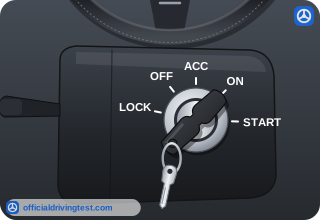
With the Transmission Park steering lock system, what must you do before turning the key to LOCK?
- Shift the transmission into neutral
- Turn the steering wheel to the right
- Shift the transmission into park
- Hold the brake and rev the engine
Show answer
Correct answer: Shift the transmission into park
With the Transmission Park System, shift the transmission into the park position, then turn the key to LOCK and remove it.
Source: Class D & E Driver’s Guide (Revised August 2025 (DPSMV2052 R08/25)), page 74 · Open this page in the manual (Manual page 74)
-
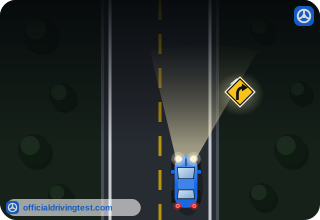
About how far ahead do your lower beam headlights let you see clearly?
- 50 to 100 feet
- 250 to 300 feet
- 500 to 600 feet
- 150 to 200 feet
Show answer
Correct answer: 150 to 200 feet
Lower beam headlights let you see clearly about 150 to 200 feet ahead.
Source: Class D & E Driver’s Guide (Revised August 2025 (DPSMV2052 R08/25)), page 75 · Open this page in the manual (Manual page 75)
-
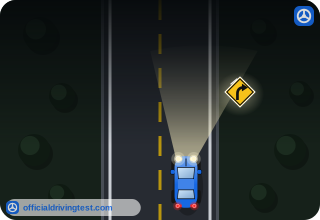
About how far ahead do your high beam headlights let you see clearly?
- 350 to 400 feet
- 100 to 150 feet
- 600 to 700 feet
- 900 to 1,000 feet
Show answer
Correct answer: 350 to 400 feet
High beam headlights let you see clearly about 350 to 400 feet ahead.
Source: Class D & E Driver’s Guide (Revised August 2025 (DPSMV2052 R08/25)), page 75 · Open this page in the manual (Manual page 75)
-
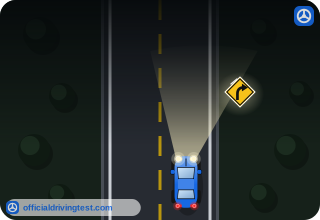
Louisiana law requires your headlights (not just parking lights) to be on during which period?
- From one hour after sunset until dawn
- Only on roads without streetlights
- Only on highways outside city limits
- Between sunset and sunrise
Show answer
Correct answer: Between sunset and sunrise
Louisiana law requires that your headlights, not just parking lights, be on between sunset and sunrise.
Source: Class D & E Driver’s Guide (Revised August 2025 (DPSMV2052 R08/25)), page 75 · Open this page in the manual (Manual page 75)
-
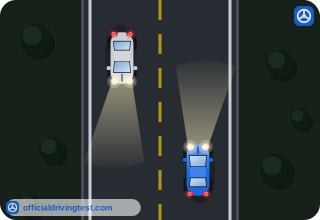
By law, you must switch to lower headlight beams when approaching within how many feet of an oncoming vehicle?
- 100 feet
- 500 feet
- 300 feet
- 1,000 feet
Show answer
Correct answer: 500 feet
You are required by law to use lower beams, not your bright lights, when approaching within 500 feet of another vehicle.
Source: Class D & E Driver’s Guide (Revised August 2025 (DPSMV2052 R08/25)), page 75 · Open this page in the manual (Manual page 75)
-
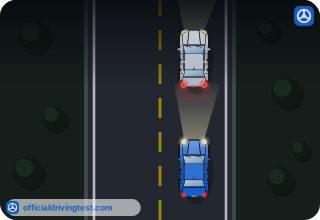
By law, you must use lower headlight beams when following within how many feet of another vehicle?
- 50 feet
- 100 feet
- 200 feet
- 300 feet
Show answer
Correct answer: 200 feet
You must use lower beams, not your bright lights, when following within 200 feet of another vehicle.
Source: Class D & E Driver’s Guide (Revised August 2025 (DPSMV2052 R08/25)), page 75 · Open this page in the manual (Manual page 75)
-
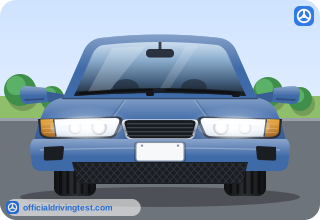
Besides between sunset and sunrise, when else does Louisiana law require your headlights to be on?
- When moisture or precipitation makes you use your wipers
- Whenever you drive on any interstate highway
- Whenever you carry a passenger under 17 years old
- Whenever you drive through a school zone
Show answer
Correct answer: When moisture or precipitation makes you use your wipers
Headlights are required when moisture in the air or precipitation makes the use of windshield wipers necessary, and when weather conditions are unfavorable.
Source: Class D & E Driver’s Guide (Revised August 2025 (DPSMV2052 R08/25)), page 75 · Open this page in the manual (Manual page 75)
-
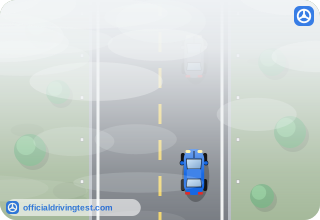
The law requires headlights in weather that makes it hard for others to see your vehicle clearly from what distance?
- 100 feet
- 1,500 feet
- 500 feet
- 50 feet
Show answer
Correct answer: 500 feet
Your headlights must be on when weather makes it difficult for other people to see your vehicle clearly from a distance of 500 feet.
Source: Class D & E Driver’s Guide (Revised August 2025 (DPSMV2052 R08/25)), page 75 · Open this page in the manual (Manual page 75)
-
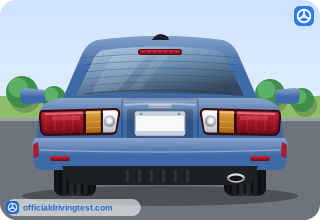
When should you drive with your emergency signal lights (flashers) on?
- Whenever it is raining
- Only when there is a need
- Whenever you drive at night
- Whenever you drive in a city
Show answer
Correct answer: Only when there is a need
Do not drive with your emergency signal lights (flashers) on unless there is a need.
Source: Class D & E Driver’s Guide (Revised August 2025 (DPSMV2052 R08/25)), page 75 · Open this page in the manual (Manual page 75)
-
What color is a rear fog light?
- White
- Amber
- Blue
- Red
Show answer
Correct answer: Red
A rear fog light is red because of the higher luminance level of this light, so your vehicle can be recognized sooner.
Source: Class D & E Driver’s Guide (Revised August 2025 (DPSMV2052 R08/25)), page 75 · Open this page in the manual (Manual page 75)
-
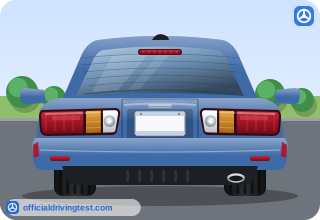
When may a rear fog light be used?
- Whenever you drive at night on dark rural roads
- Only in dense fog or similar seriously reduced visibility
- Whenever another car is following you too closely
- Whenever you park on the shoulder at night
Show answer
Correct answer: Only in dense fog or similar seriously reduced visibility
A rear fog light must only be used in dense fog or a similar hazardous condition that results in seriously reduced visibility.
Source: Class D & E Driver’s Guide (Revised August 2025 (DPSMV2052 R08/25)), page 75 · Open this page in the manual (Manual page 75)
-
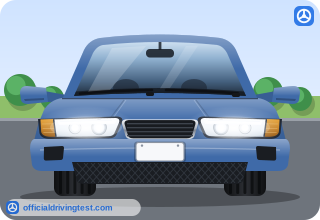
What is the flat, low-reach yet wide beam of front fog lights designed to do?
- Light the road far beyond the high beams
- Signal oncoming drivers to dim their lights
- Light up road signs high above the road
- Show up the edges of the roadway
Show answer
Correct answer: Show up the edges of the roadway
Front fog lights have a flat, low reach yet wide beam pattern designed to show up the edges of a roadway more efficiently than low beams alone.
Source: Class D & E Driver’s Guide (Revised August 2025 (DPSMV2052 R08/25)), page 75 · Open this page in the manual (Manual page 75)
-
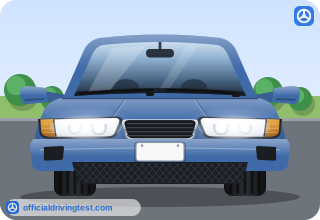
What should you do with your fog lights when visibility improves?
- Switch them off
- Leave them on until you park
- Use them together with high beams
- Switch to the rear fog light only
Show answer
Correct answer: Switch them off
You should switch off the fog lights when the visibility improves.
Source: Class D & E Driver’s Guide (Revised August 2025 (DPSMV2052 R08/25)), page 75 · Open this page in the manual (Manual page 75)
-
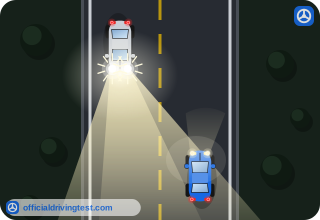
At night, an oncoming driver refuses to dim the high beams. What should you do?
- Flash your high beams until the driver dims
- Look directly at the oncoming headlights
- Speed up to get past the car quickly
- Look to the right edge of the road and slow down
Show answer
Correct answer: Look to the right edge of the road and slow down
If a stubborn driver refuses to dim the lights, look to the right edge of the road as a guide and slow down.
Source: Class D & E Driver’s Guide (Revised August 2025 (DPSMV2052 R08/25)), page 75 · Open this page in the manual (Manual page 75)
-
It is unlawful to negligently fail to do what?
- Maintain reasonable and proper control of your vehicle
- Stay in the same lane for at least one mile at a time
- Match the speed of the vehicle in front of you at all times
- Use your horn before every lane change
Show answer
Correct answer: Maintain reasonable and proper control of your vehicle
The guide says it is unlawful to negligently fail to maintain reasonable and proper control of your vehicle.
Source: Class D & E Driver’s Guide (Revised August 2025 (DPSMV2052 R08/25)), page 86 · Open this page in the manual (Manual page 86)
-
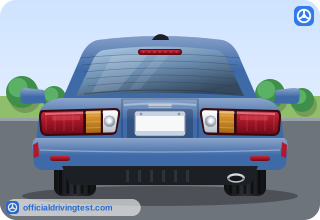
When must you give a signal to other drivers?
- Whenever you plan to turn, change lanes, slow down or stop
- Only when another vehicle is close behind you
- Only when you turn at an intersection with a traffic signal
- Only when you plan to turn or stop on a road with more than two lanes
Show answer
Correct answer: Whenever you plan to turn, change lanes, slow down or stop
The guide says you must always give a signal to other drivers when you plan to turn, change lanes, slow down or stop.
Source: Class D & E Driver’s Guide (Revised August 2025 (DPSMV2052 R08/25)), page 92 · Open this page in the manual (Manual page 92)
-
What may you use to signal your intentions to other drivers?
- Only mechanical signal lights
- Either mechanical signal lights or the right arm
- Either mechanical signal lights or the left arm
- Only the horn and the headlights
Show answer
Correct answer: Either mechanical signal lights or the left arm
The guide says you can use either mechanical signal lights or the left arm.
Source: Class D & E Driver’s Guide (Revised August 2025 (DPSMV2052 R08/25)), page 92 · Open this page in the manual (Manual page 92)
-
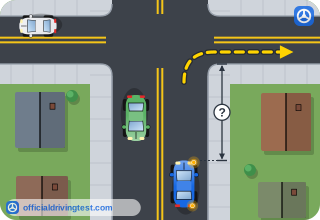
Beyond the 100 feet minimum, when does the guide suggest giving a turn signal over a greater distance?
- When driving at night or in the rain
- When driving at faster speeds or in heavy traffic
- When turning at an intersection with a traffic signal
- When following a large truck or bus
Show answer
Correct answer: When driving at faster speeds or in heavy traffic
The guide says a greater signaling distance is suggested when driving at faster speeds or in heavy traffic.
Source: Class D & E Driver’s Guide (Revised August 2025 (DPSMV2052 R08/25)), page 92 · Open this page in the manual (Manual page 92)
-
When should the left turn signal always be used?
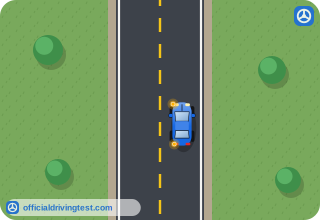
- When pulling over to the right curb to park along the street
- When returning to the right lane after you have passed a vehicle
- When driving straight through an intersection with a green light
- When driving from a curbside parallel parking space into the flow of traffic
Show answer
Correct answer: When driving from a curbside parallel parking space into the flow of traffic
The guide says the left turn signal should always be used when driving from a curbside parallel parking space into the flow of traffic or moving to the left lane to pass.
Source: Class D & E Driver’s Guide (Revised August 2025 (DPSMV2052 R08/25)), page 92 · Open this page in the manual (Manual page 92)
-
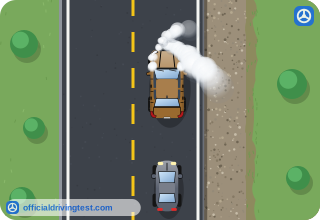
What is it illegal to do with your turn signals on a parked or disabled vehicle?
- Flash them on just one side of the vehicle
- Flash them on both sides of the vehicle
- Flash them while the engine is off
- Flash them for more than one minute
Show answer
Correct answer: Flash them on just one side of the vehicle
The guide says it is illegal to flash your turn signals on just one side of a parked or disabled vehicle.
Source: Class D & E Driver’s Guide (Revised August 2025 (DPSMV2052 R08/25)), page 92 · Open this page in the manual (Manual page 92)
-
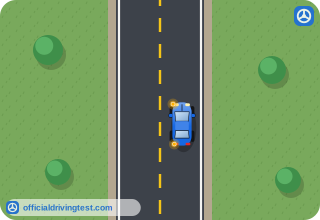
For which purpose is it illegal to flash your turn signals?
- To show that you plan to change lanes
- To warn drivers behind you that you are slowing down
- As a signal to another vehicle to pass you
- To show that you are pulling out from a curbside parking space
Show answer
Correct answer: As a signal to another vehicle to pass you
The guide says it is illegal to flash your turn signals as a signal to another vehicle to pass you.
Source: Class D & E Driver’s Guide (Revised August 2025 (DPSMV2052 R08/25)), page 92 · Open this page in the manual (Manual page 92)
-
Which arm hand signal does a driver give to show a left turn?
- Arm held straight out
- Arm bent upward
- Arm bent downward
- Arm held straight up
Show answer
Correct answer: Arm held straight out
In the manual's hand-signal diagram, an arm held straight out is the signal for a left turn.
Source: Class D & E Driver’s Guide (Revised August 2025 (DPSMV2052 R08/25)), page 93 · Open this page in the manual (Manual page 93)
-
Which arm hand signal does a driver give to show a right turn?
- Arm held straight out
- Arm bent downward
- Arm held straight down
- Arm bent upward
Show answer
Correct answer: Arm bent upward
In the manual's hand-signal diagram, an arm bent up is the signal for a right turn.
Source: Class D & E Driver’s Guide (Revised August 2025 (DPSMV2052 R08/25)), page 93 · Open this page in the manual (Manual page 93)
-
What does a driver's arm bent downward out of the window signal?
- A left turn
- Slowing or stopping
- A right turn
- Backing up
Show answer
Correct answer: Slowing or stopping
In the manual's hand-signal diagram, an arm bent downward is the signal for slowing or stopping.
Source: Class D & E Driver’s Guide (Revised August 2025 (DPSMV2052 R08/25)), page 93 · Open this page in the manual (Manual page 93)
-
Where is backing up not permitted at all?
- On any road with a posted speed limit above 35 mph
- On the shoulder or roadway of any controlled-access highway
- On any street that has a crosswalk
- On any road with more than two lanes
Show answer
Correct answer: On the shoulder or roadway of any controlled-access highway
The manual says backing up is not permitted on the shoulder or roadway of any controlled-access highway.
Source: Class D & E Driver’s Guide (Revised August 2025 (DPSMV2052 R08/25)), page 96 · Open this page in the manual (Manual page 96)
-
At places other than a controlled-access highway, when is backing up prohibited?
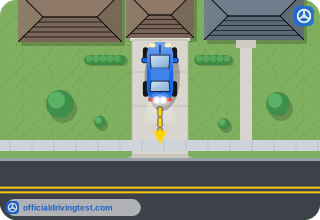
- Unless you have a passenger watching behind the vehicle
- Unless you back up at less than 5 mph
- Unless it can be done safely without interfering with traffic
- Unless you sound the horn first
Show answer
Correct answer: Unless it can be done safely without interfering with traffic
The manual says backing up is prohibited at any other place unless it can be done safely without interfering with traffic.
Source: Class D & E Driver’s Guide (Revised August 2025 (DPSMV2052 R08/25)), page 96 · Open this page in the manual (Manual page 96)
-
What is the greatest number of persons the law allows to occupy the front seat of a moving vehicle?
- Two
- Four
- Three
- Five
Show answer
Correct answer: Three
The manual says it is against the law for more than three persons to occupy the front seat of a moving vehicle.
Source: Class D & E Driver’s Guide (Revised August 2025 (DPSMV2052 R08/25)), page 96 · Open this page in the manual (Manual page 96)