Louisiana: Signals and vehicle controls — Part 5 Practice Test
Checking your vehicle, tires, starting and stopping, steering, signaling, safety features, seasonal care, air brakes and towing a trailer. — Part 5
Independent educational site · not affiliated with any government agency or DMV
Ready? Test yourself
- Instant feedback with an explanation
- Every answer cites its source in the manual
- Your best score is saved on this device
Questions are original and based on the official manual "Class D & E Driver’s Guide" (Revised August 2025 (DPSMV2052 R08/25)), Louisiana Office of Motor Vehicles.
All 36 questions in this practice test
Take the test above first, then use this list to study. Tap “Show answer” to see the correct answer and explanation.
Show the questions and answersHide the questions
-
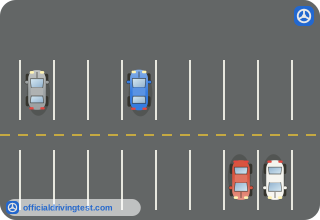
Why does the manual say to use a sun shield underneath the windshield when parked in summer?
- To keep the engine from overheating while the car is parked
- To keep heat to a minimum and protect the vehicle's interior
- To prevent the tire pressure from rising in the heat
- To stop the windshield glass from cracking in the sun
Show answer
Correct answer: To keep heat to a minimum and protect the vehicle's interior
In summer months it is important to keep heat to a minimum and to protect your vehicle's interior.
Source: Class D & E Driver’s Guide (Revised August 2025 (DPSMV2052 R08/25)), page 51 · Open this page in the manual (Manual page 51)
-
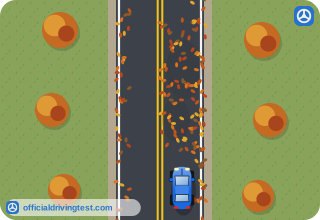
According to the fall driving tips, what can wet leaves present?
- Slippery and dangerous driving conditions
- Better traction on the pavement
- No danger unless they are piled high
- A hazard only on gravel roads
Show answer
Correct answer: Slippery and dangerous driving conditions
Once leaves become wet, they can present slippery and dangerous driving conditions.
Source: Class D & E Driver’s Guide (Revised August 2025 (DPSMV2052 R08/25)), page 52 · Open this page in the manual (Manual page 52)
-
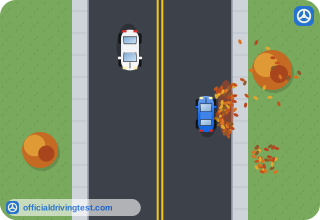
In fall, why does the manual say to avoid parking your vehicle near leaf piles?
- To keep leaves from clogging the windshield wipers and the air vents
- To avoid scratches on the paint from dry leaves blowing about
- To prevent fires that could start from the vehicle's catalytic converter
- To stop wet leaves from freezing to the tires and the wheels
Show answer
Correct answer: To prevent fires that could start from the vehicle's catalytic converter
Avoiding parking near leaf piles prevents fires that could start from the vehicle's catalytic converter.
Source: Class D & E Driver’s Guide (Revised August 2025 (DPSMV2052 R08/25)), page 52 · Open this page in the manual (Manual page 52)
-
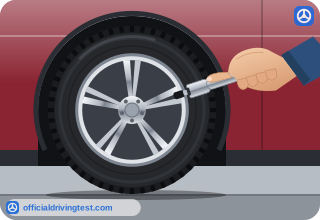
Why does the manual say to check your tire pressure in the fall?
- Falling leaves can puncture the tires and let the air out of them quickly
- Cooler air always makes tires gain air pressure as the weather changes
- Tire tread wears away faster in cool weather than in warm weather
- Weather and temperature changes can make tires expand, contract and lose air pressure
Show answer
Correct answer: Weather and temperature changes can make tires expand, contract and lose air pressure
With frequent weather and temperature changes, tires can expand and contract, causing them to lose air pressure.
Source: Class D & E Driver’s Guide (Revised August 2025 (DPSMV2052 R08/25)), page 52 · Open this page in the manual (Manual page 52)
-
What does the manual suggest to reduce glare when night driving cannot be avoided?
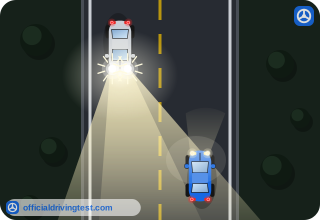
- Lenses with anti-reflective coating
- Dark sunglasses worn after sunset
- Colored glasses for night driving
- A tinted film on the windshield
Show answer
Correct answer: Lenses with anti-reflective coating
The manual suggests considering lenses with anti-reflective coating to reduce glare when night driving cannot be avoided.
Source: Class D & E Driver’s Guide (Revised August 2025 (DPSMV2052 R08/25)), page 52 · Open this page in the manual (Manual page 52)
-
On rainy, snowy or foggy days, what makes your vehicle easier for other drivers to see?
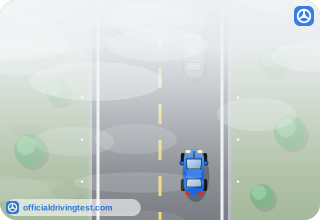
- Headlights
- Hazard flashers
- A clean windshield
- Parking lights
Show answer
Correct answer: Headlights
On rainy, snowy or foggy days headlights make your vehicle easier to see.
Source: Class D & E Driver’s Guide (Revised August 2025 (DPSMV2052 R08/25)), page 52 · Open this page in the manual (Manual page 52)
-
What does the manual advise about driving in bad winter weather?
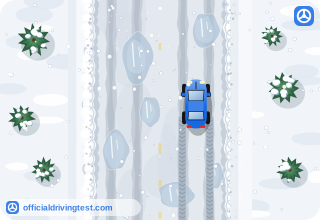
- Drive as usual if the vehicle has chains
- Drive only at night when roads are less crowded
- Avoid it whenever you can do so
- Drive only on freeways and avoid side roads
Show answer
Correct answer: Avoid it whenever you can do so
The manual says to avoid driving in bad winter weather whenever you can do so, and that a reliable vehicle is essential if you must.
Source: Class D & E Driver’s Guide (Revised August 2025 (DPSMV2052 R08/25)), page 52 · Open this page in the manual (Manual page 52)
-
When cooler temperatures become a factor, which items does the manual say to check to winterize a vehicle?
- Air-conditioning system, sun shield, and payload capacity
- Brakes, wipers, defroster, headlights, and heater
- Flares, blankets, and a first-aid kit
- Sunglasses, tire tread, and window tint
Show answer
Correct answer: Brakes, wipers, defroster, headlights, and heater
Winterizing a vehicle means making sure the brakes, wipers, defroster, headlights, and heater are all working properly.
Source: Class D & E Driver’s Guide (Revised August 2025 (DPSMV2052 R08/25)), page 52 · Open this page in the manual (Manual page 52)
-
What does the manual say to do in winter to avoid skidding when stopping?
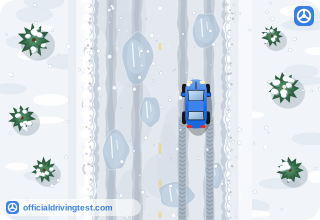
- Brake firmly and hold
- Shift into neutral first
- Brake with the wheels turned
- Stop gently
Show answer
Correct answer: Stop gently
The winter tip is to stop gently to avoid skidding.
Source: Class D & E Driver’s Guide (Revised August 2025 (DPSMV2052 R08/25)), page 52 · Open this page in the manual (Manual page 52)
-
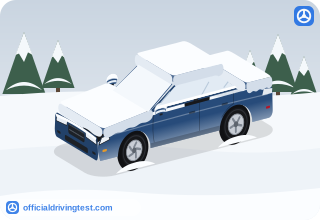
Before driving in winter, what does the manual say to clear of ice and snow?
- The windshield and mirrors only
- The windows and wipers only
- The hood and trunk only
- The vehicle's hood, windows and roof
Show answer
Correct answer: The vehicle's hood, windows and roof
Before driving, clear ice and snow from the vehicle's hood, windows and roof.
Source: Class D & E Driver’s Guide (Revised August 2025 (DPSMV2052 R08/25)), page 52 · Open this page in the manual (Manual page 52)
-
What does the manual recommend using in winter for better traction and smoother stopping?
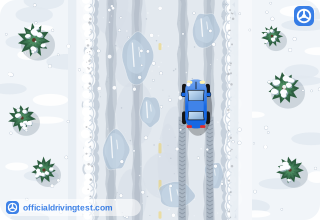
- Snow or all-season tires or chains
- Summer tires with the pressure reduced
- Wheel covers or hubcaps
- Wider tires inflated above normal
Show answer
Correct answer: Snow or all-season tires or chains
The manual says to use snow or all-season tires or chains for better traction and smoother stopping.
Source: Class D & E Driver’s Guide (Revised August 2025 (DPSMV2052 R08/25)), page 52 · Open this page in the manual (Manual page 52)
-
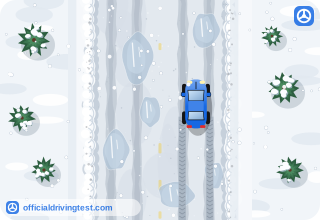
Can snow tires let a driver drive on snow or ice at normal speeds?
- Yes, snow tires allow normal speeds on snow but not on ice
- Yes, if chains are also fitted to all four tires on the vehicle
- No, no snow tires allow you to drive on snow or ice at normal speeds
- Yes, as long as the road is dry underneath the layer of snow
Show answer
Correct answer: No, no snow tires allow you to drive on snow or ice at normal speeds
The manual says no snow tires allow you to drive on snow or ice at normal speeds.
Source: Class D & E Driver’s Guide (Revised August 2025 (DPSMV2052 R08/25)), page 52 · Open this page in the manual (Manual page 52)
-
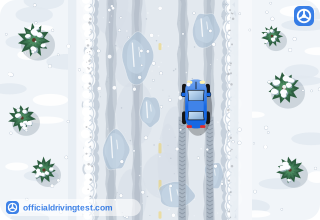
Which places does the manual say can freeze first and remain icy longer than roadways?
- Intersections, curves and hilltops
- Bridges, overpasses and shaded areas
- Road shoulders, driveways and parking lots
- Tunnels, rest areas and toll plazas
Show answer
Correct answer: Bridges, overpasses and shaded areas
The manual says bridges, overpasses and shaded areas can freeze first and remain icy longer than roadways.
Source: Class D & E Driver’s Guide (Revised August 2025 (DPSMV2052 R08/25)), page 52 · Open this page in the manual (Manual page 52)
-
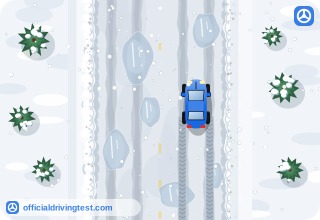
A road on which ice and snow are completely frozen provides more traction than a road with what?
- Dry, clean pavement
- Melting ice
- Dry concrete in summer
- Freshly paved dry asphalt
Show answer
Correct answer: Melting ice
A road on which ice and snow are completely frozen is slippery, even though it provides more traction than a road with melting ice.
Source: Class D & E Driver’s Guide (Revised August 2025 (DPSMV2052 R08/25)), page 52 · Open this page in the manual (Manual page 52)
-
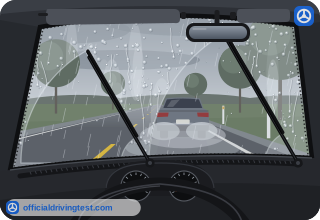
In wet driving conditions, how fast should you drive in relation to the windshield wipers?
- Not faster than the wipers can clear water from the windshield
- Fast enough that the wipers can stay on the low setting
- At the speed limit as long as the headlights are on
- At any speed when the defroster is on
Show answer
Correct answer: Not faster than the wipers can clear water from the windshield
The manual says not to drive faster than the windshield wipers can clear water from the windshield.
Source: Class D & E Driver’s Guide (Revised August 2025 (DPSMV2052 R08/25)), page 52 · Open this page in the manual (Manual page 52)
-
How often does the manual say to replace wiper blades?
- Every two years
- Every five years
- Yearly
- Only when they tear
Show answer
Correct answer: Yearly
The manual says to make sure wiper blades are in good shape and to replace them yearly.
Source: Class D & E Driver’s Guide (Revised August 2025 (DPSMV2052 R08/25)), page 52 · Open this page in the manual (Manual page 52)
-
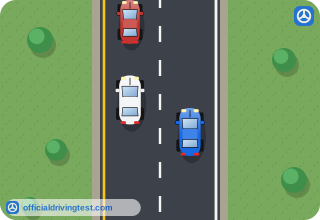
What are blind spots?
- Areas more than 400 feet ahead of your front bumper
- Areas you can see only when you use your high beams
- Areas around your vehicle you cannot see in your mirrors
- Areas hidden by the sun visor or the roof of the car
Show answer
Correct answer: Areas around your vehicle you cannot see in your mirrors
Blind spots are areas around your vehicle that you cannot see with your mirrors.
Source: Class D & E Driver’s Guide (Revised August 2025 (DPSMV2052 R08/25)), page 63 · Open this page in the manual (Manual page 63)
-
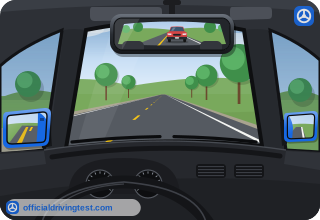
How did the 1995 Society of Automotive Engineers research recommend adjusting the side mirrors to eliminate blind spots?
- Straight back so that they show the sides of your own car and the road
- Downward so they show the road beside the wheels
- As far outward as you can, so they just overlap the center mirror's view
- Inward so they show the same area as the center mirror
Show answer
Correct answer: As far outward as you can, so they just overlap the center mirror's view
The research showed you should adjust the side mirrors as far outward as you can so their viewing angle just overlaps the view of the center rearview mirror.
Source: Class D & E Driver’s Guide (Revised August 2025 (DPSMV2052 R08/25)), page 64 · Open this page in the manual (Manual page 64)
-
Which mirror is the primary mirror?
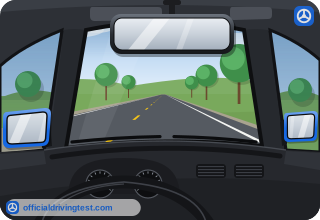
- The driver's side mirror
- The center inside rearview mirror
- The passenger's side mirror
- Both outside mirrors equally
Show answer
Correct answer: The center inside rearview mirror
The center inside rearview mirror is the primary mirror, used to see what is coming up from behind.
Source: Class D & E Driver’s Guide (Revised August 2025 (DPSMV2052 R08/25)), page 64 · Open this page in the manual (Manual page 64)
-
When adjusting your mirrors properly, how should you first set the rearview mirror?
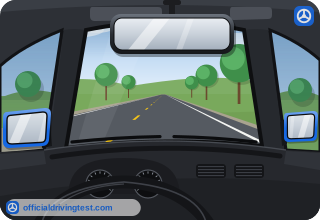
- So that it shows mostly the roof
- So that it points at the back seat
- So that it shows the side window
- So that it frames the rear window
Show answer
Correct answer: So that it frames the rear window
The first step is to adjust the rearview mirror so that it frames the rear window and shows the traffic flow behind the vehicle.
Source: Class D & E Driver’s Guide (Revised August 2025 (DPSMV2052 R08/25)), page 64 · Open this page in the manual (Manual page 64)
-
How do you adjust the driver's side mirror properly?
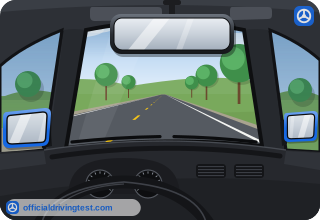
- Head against the driver's side window; barely see the driver's side of your car
- Sit upright and adjust it so you can see the entire side of your car
- Lean toward the center of the car and adjust it to show the rear bumper
- Adjust it to show the front tire
Show answer
Correct answer: Head against the driver's side window; barely see the driver's side of your car
With your head against the driver's side window, you adjust the driver's side mirror so you can barely see the driver's side of your car.
Source: Class D & E Driver’s Guide (Revised August 2025 (DPSMV2052 R08/25)), page 64 · Open this page in the manual (Manual page 64)
-
How do you adjust the passenger's side mirror properly?
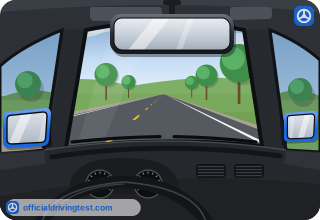
- Place your head against the passenger window and adjust it to show the rear tire
- Sit upright and adjust it to show the whole side of your car
- Head near the center of the car; barely see the passenger's side of your car
- Lean forward and adjust it to show the front bumper
Show answer
Correct answer: Head near the center of the car; barely see the passenger's side of your car
With your head as close to the center of the car as possible, you adjust the passenger's side mirror so you can barely see the passenger's side of your car.
Source: Class D & E Driver’s Guide (Revised August 2025 (DPSMV2052 R08/25)), page 64 · Open this page in the manual (Manual page 64)
-
To test your mirror adjustments, what should you see when a car passes you in the next lane?
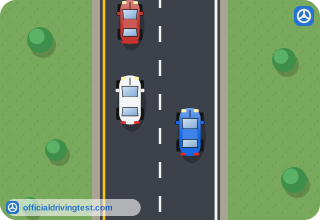
- The car in your side mirror only after it leaves your center mirror
- The car in your side mirror before it fully leaves the center rearview mirror
- The car in both side mirrors at the same time
- The car in your center mirror only
Show answer
Correct answer: The car in your side mirror before it fully leaves the center rearview mirror
To test your adjustments, the passing car should appear in your side mirror before it fully leaves the center rearview mirror.
Source: Class D & E Driver’s Guide (Revised August 2025 (DPSMV2052 R08/25)), page 64 · Open this page in the manual (Manual page 64)
-
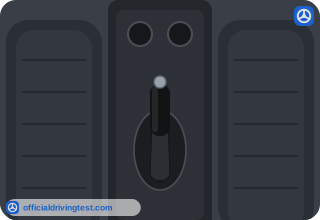
When should you use your parking brake?
- Only when you park on a hill
- Only when your car has a manual transmission
- Only when you park on a hill or your car has a manual transmission
- Every time you park, whether manual or automatic, hilly or flat
Show answer
Correct answer: Every time you park, whether manual or automatic, hilly or flat
The manual says it is incorrect to limit the parking brake to hills or manual cars; you should use it every time you park.
Source: Class D & E Driver’s Guide (Revised August 2025 (DPSMV2052 R08/25)), page 67 · Open this page in the manual (Manual page 67)
-
What is another name for the parking brake?
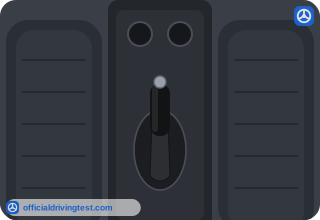
- The emergency brake
- The hill-holder brake
- The transmission brake
- The anti-lock brake
Show answer
Correct answer: The emergency brake
The manual says the parking brake is also called the emergency brake.
Source: Class D & E Driver’s Guide (Revised August 2025 (DPSMV2052 R08/25)), page 67 · Open this page in the manual (Manual page 67)
-
What holds a car in “park” inside the transmission?
- A constant velocity (CV) joint
- The parking brake cable
- A device called a parking pawl
- The transaxle housing
Show answer
Correct answer: A device called a parking pawl
A car is held in “park” by a device inside the transmission called a parking pawl, which can break or become dislodged.
Source: Class D & E Driver’s Guide (Revised August 2025 (DPSMV2052 R08/25)), page 67 · Open this page in the manual (Manual page 67)
-
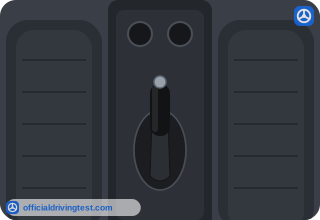
Compared with only putting the car in “park”, how strong a hold does the parking brake give?
- The same hold
- A weaker hold
- A hold only on hills
- A stronger hold
Show answer
Correct answer: A stronger hold
The manual says a parking brake is capable of a stronger hold than only putting the car in “park”.
Source: Class D & E Driver’s Guide (Revised August 2025 (DPSMV2052 R08/25)), page 67 · Open this page in the manual (Manual page 67)
-
Which parts does the parking brake help protect?
- The radiator, battery and alternator in the engine compartment
- The transaxle, constant velocity (CV) joints and transmission
- The steering column, windshield wipers and horn button
- The tires, springs and shock absorbers of the vehicle
Show answer
Correct answer: The transaxle, constant velocity (CV) joints and transmission
The manual says the parking brake helps protect the transaxle, CV joints and transmission.
Source: Class D & E Driver’s Guide (Revised August 2025 (DPSMV2052 R08/25)), page 67 · Open this page in the manual (Manual page 67)
-
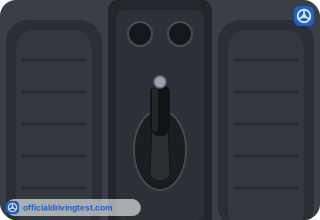
If your parked car is hit by another vehicle, how does the parking brake help?
- It locks the steering wheel so the car cannot turn
- It turns on the hazard flashers automatically
- It gives further stability and lessens the risk of your car rolling away
- It prevents the other vehicle from moving your car forward at all
Show answer
Correct answer: It gives further stability and lessens the risk of your car rolling away
The manual says that if your parked car is hit, the parking brake provides further stability and lessens the risk of it rolling away.
Source: Class D & E Driver’s Guide (Revised August 2025 (DPSMV2052 R08/25)), page 67 · Open this page in the manual (Manual page 67)
-
When should you set the parking brake in relation to shifting into “park”?
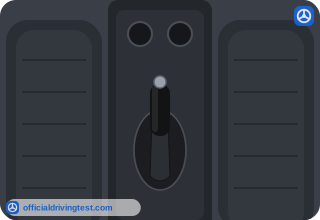
- While your foot is still on the brake pedal and before shifting into “park”
- After shifting into “park” and taking your foot off the brake pedal
- After you turn off the engine and step out of the car
- Only after the car has rolled a few inches
Show answer
Correct answer: While your foot is still on the brake pedal and before shifting into “park”
Setting the brake with your foot on the brake pedal and before shifting into “park” reduces the strain on the parking pawl.
Source: Class D & E Driver’s Guide (Revised August 2025 (DPSMV2052 R08/25)), page 67 · Open this page in the manual (Manual page 67)
-
Even when you use the parking brake, what else do you still need to do?
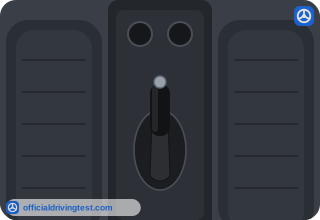
- Put the car in “park”
- Leave the car in neutral
- Turn the wheels toward the road
- Leave the engine idling
Show answer
Correct answer: Put the car in “park”
The manual says that although the parking brake holds more strongly, you still need to put the car in “park”.
Source: Class D & E Driver’s Guide (Revised August 2025 (DPSMV2052 R08/25)), page 67 · Open this page in the manual (Manual page 67)
-
Where are most parking brakes located?
- A foot pedal on the far right of the pedal area
- A button on the steering wheel
- A hand-operated lever in the center console
- A lever on the steering column
Show answer
Correct answer: A hand-operated lever in the center console
The manual says most parking brakes are hand-operated levers located in the center console.
Source: Class D & E Driver’s Guide (Revised August 2025 (DPSMV2052 R08/25)), page 67 · Open this page in the manual (Manual page 67)
-
How do you release a hand-operated parking brake lever?
- Pull the lever up until it clicks into place twice
- Press the button on the end of the handle and lower the lever
- Turn the lever a quarter turn to the right and lift
- Push the lever forward and hold it there until released
Show answer
Correct answer: Press the button on the end of the handle and lower the lever
To release the parking brake lever you press the button on the end of the brake handle and lower the lever.
Source: Class D & E Driver’s Guide (Revised August 2025 (DPSMV2052 R08/25)), page 67 · Open this page in the manual (Manual page 67)
-
In some vehicles the parking brake is a foot pedal. Where is it located?
- Between the brake and accelerator pedals
- On the far right side of the driver’s pedal area
- Under the steering column
- On the far left side of the driver’s pedal area
Show answer
Correct answer: On the far left side of the driver’s pedal area
The manual says a foot-pedal parking brake is located on the far left side of the driver’s pedal area.
Source: Class D & E Driver’s Guide (Revised August 2025 (DPSMV2052 R08/25)), page 67 · Open this page in the manual (Manual page 67)
-
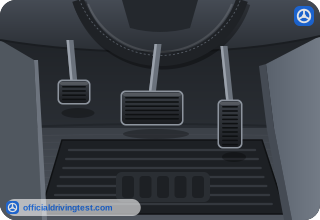
How do you set a foot-pedal parking brake?
- Pull up on the pedal
- Pull the release lever near the pedal
- Push firmly on the pedal
- Press a button on the end of the pedal
Show answer
Correct answer: Push firmly on the pedal
To set a foot-pedal parking brake you push firmly on the pedal.
Source: Class D & E Driver’s Guide (Revised August 2025 (DPSMV2052 R08/25)), page 67 · Open this page in the manual (Manual page 67)
-
In some vehicles, how is a foot-pedal parking brake released?
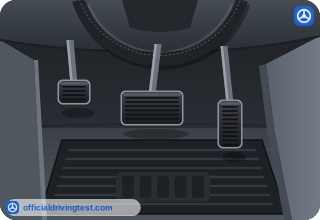
- The pedal is pushed down until you hear a click
- The pedal is lifted with your toe
- The ignition key is turned to the off position
- The brake pedal is pressed twice
Show answer
Correct answer: The pedal is pushed down until you hear a click
The manual says that in some vehicles the parking brake pedal is pushed down until you hear a click to release it.
Source: Class D & E Driver’s Guide (Revised August 2025 (DPSMV2052 R08/25)), page 68 · Open this page in the manual (Manual page 68)