Louisiana: Signals and vehicle controls — Part 3 Practice Test
Checking your vehicle, tires, starting and stopping, steering, signaling, safety features, seasonal care, air brakes and towing a trailer. — Part 3
Independent educational site · not affiliated with any government agency or DMV
Ready? Test yourself
- Instant feedback with an explanation
- Every answer cites its source in the manual
- Your best score is saved on this device
Questions are original and based on the official manual "Class D & E Driver’s Guide" (Revised August 2025 (DPSMV2052 R08/25)), Louisiana Office of Motor Vehicles.
All 36 questions in this practice test
Take the test above first, then use this list to study. Tap “Show answer” to see the correct answer and explanation.
Show the questions and answersHide the questions
-
How should you slow down, according to the manual?
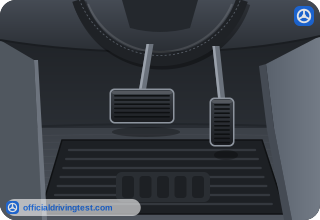
- Release the accelerator and brake as hard as you can
- Ease off the accelerator and slowly press the brake
- Shift into neutral and coast
- Pump the brake pedal quickly several times
Show answer
Correct answer: Ease off the accelerator and slowly press the brake
The manual says to decelerate smoothly, not brake suddenly, easing up on the accelerator and slowly applying pressure to the brake.
Source: Class D & E Driver’s Guide (Revised August 2025 (DPSMV2052 R08/25)), page 46 · Open this page in the manual (Manual page 46)
-
What does the manual say you must do before you move your car?
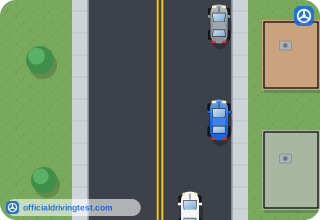
- Look around for pedestrians and oncoming traffic, then signal
- Sound your horn to warn others, then move into traffic
- Move into traffic first, then signal that you are leaving
- Check only your rear view mirror, then signal and go
Show answer
Correct answer: Look around for pedestrians and oncoming traffic, then signal
The manual says never to move your car until you have looked around for pedestrians and oncoming traffic, then signal and move into traffic when safe.
Source: Class D & E Driver’s Guide (Revised August 2025 (DPSMV2052 R08/25)), page 46 · Open this page in the manual (Manual page 46)
-
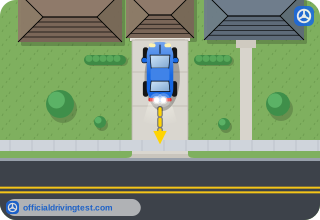
When you back up, what does the manual say to do?
- Look only into the rear view mirror and trust it
- Look only at the side mirrors while backing
- Turn your head and look back, not only in the mirror
- Rely on a passenger to tell you when to stop
Show answer
Correct answer: Turn your head and look back, not only in the mirror
The manual says to turn your head and look back when backing up, not just look into the rear view mirror.
Source: Class D & E Driver’s Guide (Revised August 2025 (DPSMV2052 R08/25)), page 46 · Open this page in the manual (Manual page 46)
-
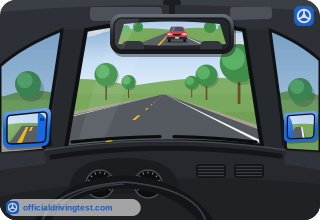
When you check that your mirror is in the correct position, the manual says the proper angle can change from morning to evening, especially if you are what?
- Driving fast
- Tired
- Carrying passengers
- Driving in rain
Show answer
Correct answer: Tired
The manual says the proper mirror angle can change from morning to evening, especially if you are tired.
Source: Class D & E Driver’s Guide (Revised August 2025 (DPSMV2052 R08/25)), page 46 · Open this page in the manual (Manual page 46)
-
What happens if you turn the ignition to the “lock” position while the vehicle is still in motion?
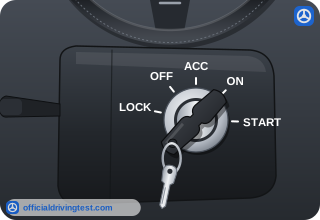
- The brakes lock and the car stops quickly
- The headlights turn off and the engine stalls
- The engine restarts by itself and the car stalls
- The steering locks if you turn the wheel
Show answer
Correct answer: The steering locks if you turn the wheel
Turning the ignition to the lock position while the vehicle is moving will cause the steering to lock if you try to turn the steering wheel.
Source: Class D & E Driver’s Guide (Revised August 2025 (DPSMV2052 R08/25)), page 46 · Open this page in the manual (Manual page 46)
-
Which of these is one of the three basic skills of the driving task?
- Social skill
- Financial skill
- Mechanical skill
- Emotional skill
Show answer
Correct answer: Social skill
The manual names physical skill, social skill and mental skill as the three basic skills of the driving task.
Source: Class D & E Driver’s Guide (Revised August 2025 (DPSMV2052 R08/25)), page 46 · Open this page in the manual (Manual page 46)
-
How does the manual describe physical skill in driving?
- The decision making required every second behind the wheel
- The interaction with others on the highways
- The person’s coordination with the vehicle
- The knowledge of how to repair the vehicle
Show answer
Correct answer: The person’s coordination with the vehicle
The manual defines physical skill as the person’s coordination with the vehicle.
Source: Class D & E Driver’s Guide (Revised August 2025 (DPSMV2052 R08/25)), page 46 · Open this page in the manual (Manual page 46)
-
Which basic driving skill involves decision making every second you are behind the wheel?
- Physical skill
- Social skill
- Technical skill
- Mental skill
Show answer
Correct answer: Mental skill
The manual says driving is a mental skill that involves decision making every second behind the wheel.
Source: Class D & E Driver’s Guide (Revised August 2025 (DPSMV2052 R08/25)), page 46 · Open this page in the manual (Manual page 46)
-
According to the manual, why are driving habits formed?
- The same physical actions are required again and again
- New drivers copy the habits of their instructors
- Traffic laws change often from year to year
- Drivers pay less attention on routine trips over time
Show answer
Correct answer: The same physical actions are required again and again
The manual says driving habits are formed because the same physical actions are required repeatedly, and the tendency to reduce them forms bad habits.
Source: Class D & E Driver’s Guide (Revised August 2025 (DPSMV2052 R08/25)), page 47 · Open this page in the manual (Manual page 47)
-
In the manual’s three categories of poor driving efficiency, which decisions include engine tuning, tire pressure and motor oil use?
- Tactical decisions
- Operational decisions
- Strategic decisions
- Mechanical decisions
Show answer
Correct answer: Strategic decisions
The manual lists engine tuning, tire pressure and motor oil use as strategic decisions.
Source: Class D & E Driver’s Guide (Revised August 2025 (DPSMV2052 R08/25)), page 47 · Open this page in the manual (Manual page 47)
-
In the manual’s three categories of poor driving efficiency, which decisions include route selection, traffic congestion and load weight?
- Strategic decisions
- Tactical decisions
- Operational decisions
- Financial decisions
Show answer
Correct answer: Tactical decisions
The manual lists route selection, traffic congestion and load weight as tactical decisions.
Source: Class D & E Driver’s Guide (Revised August 2025 (DPSMV2052 R08/25)), page 47 · Open this page in the manual (Manual page 47)
-
In the manual’s three categories of poor driving efficiency, which decisions include idling, speed, aggressive driving, and cruise control and air conditioner use?
- Strategic decisions
- Tactical decisions
- Mechanical decisions
- Operational decisions
Show answer
Correct answer: Operational decisions
The manual lists idling, speed, aggressive driving, and cruise control and air conditioner use as operational decisions.
Source: Class D & E Driver’s Guide (Revised August 2025 (DPSMV2052 R08/25)), page 47 · Open this page in the manual (Manual page 47)
-
Which of these factors does the manual say have the highest potential to sap fuel economy?
- Route selection, speed, and engine tuning
- Tire pressure, motor oil use, and load weight
- Idling, cruise control, and air conditioner use
- Traffic congestion, carpooling, and parking location
Show answer
Correct answer: Route selection, speed, and engine tuning
The manual says route selection, speed and engine tuning have the highest potential to sap fuel economy.
Source: Class D & E Driver’s Guide (Revised August 2025 (DPSMV2052 R08/25)), page 47 · Open this page in the manual (Manual page 47)
-
According to the manual, what is the greatest factor in determining automobile transportation efficiency?
- Vehicle color
- Engine size
- Vehicle occupancy
- Tire brand
Show answer
Correct answer: Vehicle occupancy
The manual says the greatest factor in determining automobile transportation efficiency is vehicle occupancy.
Source: Class D & E Driver’s Guide (Revised August 2025 (DPSMV2052 R08/25)), page 47 · Open this page in the manual (Manual page 47)
-
According to the manual, what can be just as powerful a fuel-saver as buying a green car?
- Driving only on weekends to avoid peak traffic
- Good car maintenance, smart driving and carpooling
- Using the air conditioner at all times to stay alert
- Idling the engine before each trip to warm it up
Show answer
Correct answer: Good car maintenance, smart driving and carpooling
The manual says good maintenance, smart driving and carpooling can be just as powerful a fuel-saver as buying a green car.
Source: Class D & E Driver’s Guide (Revised August 2025 (DPSMV2052 R08/25)), page 47 · Open this page in the manual (Manual page 47)
-
Which of these is one of the manual’s tips for more efficient driving and improving fuel economy?
- Drive during peak traffic
- Drive slightly above the speed limit
- Add extra weight for better traction
- Combine errands
Show answer
Correct answer: Combine errands
The manual’s fuel economy tips include combining errands, avoiding peak traffic, observing the speed limit and removing excess weight.
Source: Class D & E Driver’s Guide (Revised August 2025 (DPSMV2052 R08/25)), page 47 · Open this page in the manual (Manual page 47)
-
For which kind of driving do the manual’s fuel economy tips recommend using cruise control?
- Highway driving
- Stop and go driving
- Heavy city traffic
- Driving on icy roads
Show answer
Correct answer: Highway driving
The manual’s tips say to use cruise control on highway driving and to avoid stop and go driving.
Source: Class D & E Driver’s Guide (Revised August 2025 (DPSMV2052 R08/25)), page 47 · Open this page in the manual (Manual page 47)
-
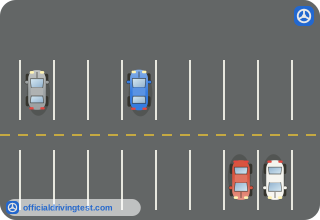
Where do the manual’s fuel economy tips say to park?
- Close to the exit of the lot
- Facing the sun
- In the shade
- Next to a large vehicle
Show answer
Correct answer: In the shade
The manual’s fuel economy tips include parking in the shade.
Source: Class D & E Driver’s Guide (Revised August 2025 (DPSMV2052 R08/25)), page 47 · Open this page in the manual (Manual page 47)
-
Which grade of motor oil do the manual’s fuel economy tips say to use?
- The thickest grade
- The recommended grade
- The thinnest grade
- Any grade on sale
Show answer
Correct answer: The recommended grade
The manual’s tips say to use the recommended grade of motor oil.
Source: Class D & E Driver’s Guide (Revised August 2025 (DPSMV2052 R08/25)), page 47 · Open this page in the manual (Manual page 47)
-
Which type of tire is described as suitable for all types of usage and working regardless of wet or dry condition?
- The high-performance summer tire
- The studded winter tire
- The all season or standard tire
- The run-flat tire
Show answer
Correct answer: The all season or standard tire
The manual describes the all season or standard tire as suitable for all types of usage, wet or dry.
Source: Class D & E Driver’s Guide (Revised August 2025 (DPSMV2052 R08/25)), page 48 · Open this page in the manual (Manual page 48)
-
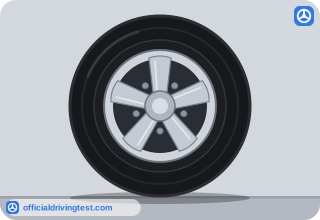
The manual says the all season or standard tire is not always the best choice for which condition?
- Dry road conditions
- Icy road conditions
- Wet road conditions
- Normal everyday usage
Show answer
Correct answer: Icy road conditions
The manual says the all season tire is not always the best tire to use for icy road conditions.
Source: Class D & E Driver’s Guide (Revised August 2025 (DPSMV2052 R08/25)), page 48 · Open this page in the manual (Manual page 48)
-
Which type of tire does the manual say to use only if you live in a dry area with little rain throughout the year?
- The all season tire
- The winter tire
- The run-flat tire
- The performance tire
Show answer
Correct answer: The performance tire
The manual says the performance tire is durable in dry weather but not suitable for wet weather, so use it only in a dry area with little rain.
Source: Class D & E Driver’s Guide (Revised August 2025 (DPSMV2052 R08/25)), page 48 · Open this page in the manual (Manual page 48)
-
Which type of tire does the manual say is used for faster cars?
- The performance tire
- The all season tire
- The winter tire
- The radial tire
Show answer
Correct answer: The performance tire
The manual says the performance tire is the one used for faster cars.
Source: Class D & E Driver’s Guide (Revised August 2025 (DPSMV2052 R08/25)), page 48 · Open this page in the manual (Manual page 48)
-
Which type of tire is not to be used in dry conditions because it will get damaged on the road?
- The all season tire
- The performance tire
- The winter tire
- The radial tire
Show answer
Correct answer: The winter tire
The manual says the winter tire is extremely durable against snow and ice but should not be used in dry conditions because it will get damaged.
Source: Class D & E Driver’s Guide (Revised August 2025 (DPSMV2052 R08/25)), page 48 · Open this page in the manual (Manual page 48)
-
According to the manual, what is the angle between a tire’s actual path and its natural path called?
- Its cornering angle
- Its slip angle
- Its traction limit
- Its steering angle
Show answer
Correct answer: Its slip angle
The manual calls the angle between the tires’ actual path and its natural path the slip angle, which warns the driver of a coming skid.
Source: Class D & E Driver’s Guide (Revised August 2025 (DPSMV2052 R08/25)), page 48 · Open this page in the manual (Manual page 48)
-
As tires approach their traction limits, what does the manual say they tend to do?
- Grip the road more firmly
- Stop turning completely
- Lift off the road surface
- Slip sideways across the road
Show answer
Correct answer: Slip sideways across the road
The manual says that as the tires approach the traction limits, they tend to slip sideways across the road.
Source: Class D & E Driver’s Guide (Revised August 2025 (DPSMV2052 R08/25)), page 48 · Open this page in the manual (Manual page 48)
-
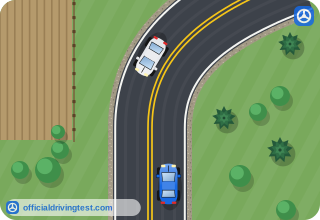
What is it called when the rear tires lose traction before the front wheels during cornering, so the car turns more than expected?
- Oversteer
- Understeer
- Hydroplaning
- Slip angle
Show answer
Correct answer: Oversteer
The manual says over steer is when the car turns more than expected because the rear tires lose traction before the front wheels during cornering.
Source: Class D & E Driver’s Guide (Revised August 2025 (DPSMV2052 R08/25)), page 48 · Open this page in the manual (Manual page 48)
-
Which vehicles does the manual say are more prone to oversteer?
- Front wheel drive vehicles
- Rear wheel drive vehicles
- Vehicles with winter tires
- Vehicles with an automatic transmission
Show answer
Correct answer: Rear wheel drive vehicles
The manual says rear wheel drive vehicles are more prone to oversteer because the rear tires handle both cornering force and engine torque.
Source: Class D & E Driver’s Guide (Revised August 2025 (DPSMV2052 R08/25)), page 48 · Open this page in the manual (Manual page 48)
-
Why are rear wheel drive vehicles more prone to oversteer?
- The front tires carry less weight
- The rear tires have less tread than the front tires
- The steering wheel turns the rear tires
- The rear tires handle both cornering force and engine torque
Show answer
Correct answer: The rear tires handle both cornering force and engine torque
The manual says the rear tires of a rear wheel drive vehicle handle both cornering force and engine torque, so they reach their traction limit more rapidly.
Source: Class D & E Driver’s Guide (Revised August 2025 (DPSMV2052 R08/25)), page 48 · Open this page in the manual (Manual page 48)
-
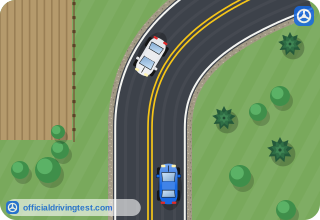
What is it called when the front tires approach the traction limit more rapidly, so the front of the car takes a wider curve than the driver intended?
- Oversteer
- Understeer
- Hydroplaning
- Slip angle
Show answer
Correct answer: Understeer
The manual says that when the front tires approach the traction limit more rapidly, the car is said to under steer.
Source: Class D & E Driver’s Guide (Revised August 2025 (DPSMV2052 R08/25)), page 48 · Open this page in the manual (Manual page 48)
-
Which is safer according to the manual?
- Oversteer is safer than understeer
- Both are equally safe
- Neither affects the stability of the car
- Understeer is safer than oversteer
Show answer
Correct answer: Understeer is safer than oversteer
The manual states that under steer is safer than over steer.
Source: Class D & E Driver’s Guide (Revised August 2025 (DPSMV2052 R08/25)), page 48 · Open this page in the manual (Manual page 48)
-
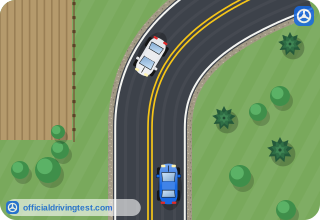
If a car understeers and no correction is made, what is the result?
- A wider corner than intended; the car stays stable
- A smaller corner than intended, ending in a spin
- The rear wheels lose total grip and the car spins
- The front wheels lock and the car slides straight
Show answer
Correct answer: A wider corner than intended; the car stays stable
The manual says that with understeer and no correction, the result is a wider corner than intended and the car remains stable.
Source: Class D & E Driver’s Guide (Revised August 2025 (DPSMV2052 R08/25)), page 48 · Open this page in the manual (Manual page 48)
-
How many methods of steering does the Louisiana manual describe?
- Four
- Two
- Three
- Six
Show answer
Correct answer: Four
The manual says there are four methods of steering: hand-to-hand, hand-over-hand, evasive action and one hand steering.
Source: Class D & E Driver’s Guide (Revised August 2025 (DPSMV2052 R08/25)), page 49 · Open this page in the manual (Manual page 49)
-
What is hand-to-hand steering commonly called?
- Shuffle steering
- Cross-arm steering
- Push/pull steering
- Rotational steering
Show answer
Correct answer: Push/pull steering
The manual says hand-to-hand steering is commonly called push/pull steering.
Source: Class D & E Driver’s Guide (Revised August 2025 (DPSMV2052 R08/25)), page 49 · Open this page in the manual (Manual page 49)
-
The manual says to use hand-to-hand steering when turning the wheel during normal forward driving above what speed?
- 25-30 mph
- 10-15 mph
- 40-45 mph
- 5-10 mph
Show answer
Correct answer: 10-15 mph
Hand-to-hand steering is used for normal forward driving above 10-15 mph.
Source: Class D & E Driver’s Guide (Revised August 2025 (DPSMV2052 R08/25)), page 49 · Open this page in the manual (Manual page 49)
-
When does the manual say to use hand-over-hand steering?
- Only at highway speeds when driving on a straight road
- Only when evading a hazard at a high rate of speed
- Only when backing up in a straight line behind you
- At low speeds, such as at an intersection or when parking
Show answer
Correct answer: At low speeds, such as at an intersection or when parking
Hand-over-hand steering is for turning the wheel at low speeds, such as at an intersection or when parking the vehicle.
Source: Class D & E Driver’s Guide (Revised August 2025 (DPSMV2052 R08/25)), page 49 · Open this page in the manual (Manual page 49)