Louisiana: Signals and vehicle controls — Part 1 Practice Test
Checking your vehicle, tires, starting and stopping, steering, signaling, safety features, seasonal care, air brakes and towing a trailer. — Part 1
Independent educational site · not affiliated with any government agency or DMV
Ready? Test yourself
- Instant feedback with an explanation
- Every answer cites its source in the manual
- Your best score is saved on this device
Questions are original and based on the official manual "Class D & E Driver’s Guide" (Revised August 2025 (DPSMV2052 R08/25)), Louisiana Office of Motor Vehicles.
All 36 questions in this practice test
Take the test above first, then use this list to study. Tap “Show answer” to see the correct answer and explanation.
Show the questions and answersHide the questions
-
Besides a vehicle’s equipment and age, what else affects its handling?
- The number of previous owners the vehicle has had
- The color and style of the vehicle’s paint job
- The price paid when the vehicle was first purchased
- Whether regular maintenance has been performed on it
Show answer
Correct answer: Whether regular maintenance has been performed on it
The manual says the vehicle’s equipment, its age and whether regular maintenance has been performed all affect its handling.
Source: Class D & E Driver’s Guide (Revised August 2025 (DPSMV2052 R08/25)), page 19 · Open this page in the manual (Manual page 19)
-
What should you do as you exit a roundabout?
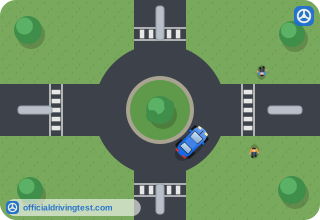
- Look to your left, sound your horn and come to a stop
- Look to your right, check your mirror and use your turn signal
- Speed up and change to the outermost lane at once
- Turn off your signal and look straight ahead only
Show answer
Correct answer: Look to your right, check your mirror and use your turn signal
To exit a roundabout, look to your right, check your mirror and use your turn signal.
Source: Class D & E Driver’s Guide (Revised August 2025 (DPSMV2052 R08/25)), page 37 · Open this page in the manual (Manual page 37)
-
What do headrests protect vehicle occupants from?
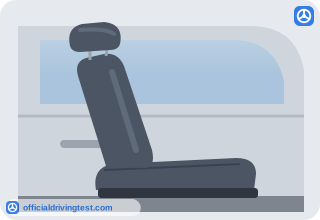
- Whiplash
- Windshield glare
- Side impacts
- Rear window glare
Show answer
Correct answer: Whiplash
Headrests protect vehicle occupants from whiplash.
Source: Class D & E Driver’s Guide (Revised August 2025 (DPSMV2052 R08/25)), page 42 · Open this page in the manual (Manual page 42)
-
How are steering wheels being designed to protect the driver in a crash?
- To stay completely rigid so that the driver cannot move forward in a crash
- To fold flat against the dashboard just before the driver strikes the wheel
- To absorb the impact of the driver being thrown against them rather than remaining rigid
- To lock in a straight position as soon as the vehicle starts to skid out
Show answer
Correct answer: To absorb the impact of the driver being thrown against them rather than remaining rigid
Steering wheels are being designed to absorb the impact of the driver being thrown against them rather than remaining rigid.
Source: Class D & E Driver’s Guide (Revised August 2025 (DPSMV2052 R08/25)), page 42 · Open this page in the manual (Manual page 42)
-
Which of these is a design feature of newer model vehicles that further protects occupants?
- Projecting knobs for interior equipment placed within reach of the driver
- Padding on the dash and front ends that crumple during a crash
- Rigid steering wheels that do not move or give way in a crash
- Bare, hard dashboards that resist denting in a collision
Show answer
Correct answer: Padding on the dash and front ends that crumple during a crash
Newer model vehicles are designed with non-projecting knobs, padding on the dash and front ends that crumple during a crash.
Source: Class D & E Driver’s Guide (Revised August 2025 (DPSMV2052 R08/25)), page 42 · Open this page in the manual (Manual page 42)
-
Which feature offered on some models lets you know when someone is crossing your path as you back out?
- Lane departure detection
- Adaptive headlamps
- Tire pressure monitoring
- Cross path detection
Show answer
Correct answer: Cross path detection
Cross path detection lets you know when someone is crossing your path when you are backing out.
Source: Class D & E Driver’s Guide (Revised August 2025 (DPSMV2052 R08/25)), page 42 · Open this page in the manual (Manual page 42)
-
Which feature offered on some models applies the brakes when you do not stop in time before hitting an object in front of you?
- Lane departure detection
- Cross path detection
- Crash avoidance
- Traction control
Show answer
Correct answer: Crash avoidance
The crash avoidance feature applies the brakes when you do not stop in time before hitting an object in front of you.
Source: Class D & E Driver’s Guide (Revised August 2025 (DPSMV2052 R08/25)), page 42 · Open this page in the manual (Manual page 42)
-
What does "active safety" refer to in automotive safety?
- Technology assisting in the prevention of a crash
- Components of the vehicle that help protect occupants during a crash
- Rules that apply only while the vehicle is moving on the road
- Training that teaches drivers to stay alert behind the wheel
Show answer
Correct answer: Technology assisting in the prevention of a crash
Active safety refers to technology assisting in the prevention of a crash.
Source: Class D & E Driver’s Guide (Revised August 2025 (DPSMV2052 R08/25)), page 42 · Open this page in the manual (Manual page 42)
-
What does "passive safety" refer to in automotive safety?
- Technology that assists in the prevention of a crash, such as warning systems and braking aids
- Systems that keep the vehicle's tires, brakes and lights in good working order every day
- Rules that require occupants to stay seated and belted while the vehicle is moving
- Components such as airbags, seatbelts and the vehicle's structure that protect occupants in a crash
Show answer
Correct answer: Components such as airbags, seatbelts and the vehicle's structure that protect occupants in a crash
Passive safety refers to components of the vehicle, primarily airbags, seatbelts and the physical structure, that help protect occupants during a crash.
Source: Class D & E Driver’s Guide (Revised August 2025 (DPSMV2052 R08/25)), page 42 · Open this page in the manual (Manual page 42)
-
What do crash avoidance systems and devices do?
- Reduce injuries once a crash is already happening
- Help the driver to avoid a collision
- Absorb the force of a collision away from the passengers
- Record how fast the vehicle was moving before a crash
Show answer
Correct answer: Help the driver to avoid a collision
Crash avoidance systems and devices help the driver to avoid a collision.
Source: Class D & E Driver’s Guide (Revised August 2025 (DPSMV2052 R08/25)), page 42 · Open this page in the manual (Manual page 42)
-
Which of these is a crash avoidance device?
- The vehicle's mirrors
- Crumple zones
- Side impact protection beams
- Padding of the instrument panel
Show answer
Correct answer: The vehicle's mirrors
Crash avoidance devices include the vehicle's headlamps, reflectors, lights and signals, mirrors, and brakes, steering and suspension systems.
Source: Class D & E Driver’s Guide (Revised August 2025 (DPSMV2052 R08/25)), page 42 · Open this page in the manual (Manual page 42)
-
What do driver assistance systems help the driver do?
- Reduce injuries by cushioning the impact during a crash
- Plan trips and avoid congested roads
- Detect ordinarily hidden obstacles and control the vehicle
- Judge the speed limit on roads the driver does not know
Show answer
Correct answer: Detect ordinarily hidden obstacles and control the vehicle
Driver assistance systems help the driver to detect ordinarily hidden obstacles and to control the vehicle.
Source: Class D & E Driver’s Guide (Revised August 2025 (DPSMV2052 R08/25)), page 42 · Open this page in the manual (Manual page 42)
-
What do Automatic Braking Systems do?
- Restore traction if driven wheels begin to spin
- Prevent or reduce the severity of a collision
- Maintain a safe distance from the vehicle in front
- Alert the driver of an unintended departure from the lane
Show answer
Correct answer: Prevent or reduce the severity of a collision
Automatic Braking Systems are driver assistance systems that prevent or reduce the severity of a collision.
Source: Class D & E Driver’s Guide (Revised August 2025 (DPSMV2052 R08/25)), page 42 · Open this page in the manual (Manual page 42)
-
What do infrared night vision systems do?
- Control the direction and range of the headlight beams in curves
- Alert drivers to objects in their path when they are reversing
- Light the driver's way without the use of any headlamps
- Increase seeing distance beyond headlamp range
Show answer
Correct answer: Increase seeing distance beyond headlamp range
Infrared night vision systems increase seeing distance beyond headlamp range.
Source: Class D & E Driver’s Guide (Revised August 2025 (DPSMV2052 R08/25)), page 42 · Open this page in the manual (Manual page 42)
-
What do adaptive headlamps do?
- Increase seeing distance beyond headlamp range by using infrared technology at night
- Turn the headlamps on automatically whenever the vehicle is started in the middle of the day
- Light the driver's way through curves and maximize seeing distance without glaring others
- Alert the driver when the headlamps need to be cleaned or aimed again
Show answer
Correct answer: Light the driver's way through curves and maximize seeing distance without glaring others
Adaptive headlamps control the direction and range of the beams to light the driver's way through curves and maximize seeing distance without glaring other drivers.
Source: Class D & E Driver’s Guide (Revised August 2025 (DPSMV2052 R08/25)), page 42 · Open this page in the manual (Manual page 42)
-
What do reverse backup sensors do?
- Alert drivers to difficult-to-see objects in their path when reversing
- Apply the brakes automatically when the vehicle backs into an object
- Keep the vehicle a safe distance from the vehicle behind it
- Show the driver a picture of the area behind the vehicle
Show answer
Correct answer: Alert drivers to difficult-to-see objects in their path when reversing
Reverse backup sensors alert drivers to difficult-to-see objects in their path when reversing.
Source: Class D & E Driver’s Guide (Revised August 2025 (DPSMV2052 R08/25)), page 42 · Open this page in the manual (Manual page 42)
-
What does adaptive cruise control do?
- Keeps the vehicle centered between the lane lines
- Brings the vehicle to a stop at every red light
- Raises the speed to match the fastest vehicle nearby
- Maintains a safe distance from the vehicle in front
Show answer
Correct answer: Maintains a safe distance from the vehicle in front
Adaptive cruise control maintains a safe distance from the vehicle in front.
Source: Class D & E Driver’s Guide (Revised August 2025 (DPSMV2052 R08/25)), page 42 · Open this page in the manual (Manual page 42)
-
Which driver assistance system alerts the driver of an unintended departure from the intended lane of travel?
- Tire pressure monitoring systems
- Lane departure warning systems
- Adaptive cruise control
- Reverse backup sensors
Show answer
Correct answer: Lane departure warning systems
Lane departure warning systems alert the driver of an unintended departure from the intended lane of travel.
Source: Class D & E Driver’s Guide (Revised August 2025 (DPSMV2052 R08/25)), page 42 · Open this page in the manual (Manual page 42)
-
What do traction control systems do?
- Restore traction if driven wheels begin to spin
- Intervene to avert an impending loss of control
- Prevent or reduce the severity of a collision
- Monitor the air pressure in each tire
Show answer
Correct answer: Restore traction if driven wheels begin to spin
Traction control systems restore traction if driven wheels begin to spin.
Source: Class D & E Driver’s Guide (Revised August 2025 (DPSMV2052 R08/25)), page 43 · Open this page in the manual (Manual page 43)
-
What does Electronic Stability Control do?
- Restores traction if driven wheels begin to spin
- Alerts the driver of an unintended lane departure
- Intervenes to avert an impending loss of control
- Maintains a safe distance from the vehicle in front
Show answer
Correct answer: Intervenes to avert an impending loss of control
Electronic Stability Control intervenes to avert an impending loss of control.
Source: Class D & E Driver’s Guide (Revised August 2025 (DPSMV2052 R08/25)), page 43 · Open this page in the manual (Manual page 43)
-
What do crashworthy systems and devices do?
- Help the driver avoid a collision by detecting hidden obstacles ahead of the vehicle
- Prevent or reduce the severity of injuries when a crash is imminent or happening
- Keep the vehicle from losing traction on wet or icy pavement surfaces
- Measure how far the vehicle can travel before it must be refueled again
Show answer
Correct answer: Prevent or reduce the severity of injuries when a crash is imminent or happening
Crashworthy systems and devices prevent or reduce the severity of injuries when a crash is imminent or actually happening.
Source: Class D & E Driver’s Guide (Revised August 2025 (DPSMV2052 R08/25)), page 43 · Open this page in the manual (Manual page 43)
-
How is crashworthiness measured?
- By how quickly the vehicle can stop on dry pavement surfaces
- By the number of safety features listed for each vehicle model sold
- By how many crash test dummies the vehicle can carry
- By a structure's ability to protect its occupants during an impact
Show answer
Correct answer: By a structure's ability to protect its occupants during an impact
Crashworthiness is measured by a structure's ability to protect its occupants or users during an impact.
Source: Class D & E Driver’s Guide (Revised August 2025 (DPSMV2052 R08/25)), page 43 · Open this page in the manual (Manual page 43)
-
What is the advantage of a laminated windshield in a crash?
- It remains in one piece when impacted, preventing passage of unbelted occupants' heads
- It breaks into granules with minimally sharp edges when it is struck in a crash
- It absorbs and dissipates the force of the collision before it reaches occupants
- It reduces headlamp glare from vehicles that are approaching at night
Show answer
Correct answer: It remains in one piece when impacted, preventing passage of unbelted occupants' heads
Laminated windshields remain in one piece when impacted, preventing the passage of unbelted occupants' heads.
Source: Class D & E Driver’s Guide (Revised August 2025 (DPSMV2052 R08/25)), page 43 · Open this page in the manual (Manual page 43)
-
What happens when tempered glass side and rear windows break?
- They splinter into jagged fragments like ordinary glass
- They remain in one piece and stay in the window frame
- They crumple and absorb the force of the collision
- They break into granules with minimally sharp edges
Show answer
Correct answer: They break into granules with minimally sharp edges
Tempered glass side and rear windows break into granules with minimally sharp edges, rather than splintering into jagged fragments as ordinary glass does.
Source: Class D & E Driver’s Guide (Revised August 2025 (DPSMV2052 R08/25)), page 43 · Open this page in the manual (Manual page 43)
-
What do crumple zones do in a collision?
- Keep the vehicle's body rigid so that it does not change shape in a collision
- Absorb and dissipate the force, diverting it away from the passenger compartment
- Limit the forward motion of an occupant and slow down the occupant's deceleration
- Inflate to cushion the occupant's impact with parts of the vehicle's interior
Show answer
Correct answer: Absorb and dissipate the force, diverting it away from the passenger compartment
Crumple zones absorb and dissipate the force of a collision, diverting it away from the passenger compartment and reducing the impact force on the occupants.
Source: Class D & E Driver’s Guide (Revised August 2025 (DPSMV2052 R08/25)), page 43 · Open this page in the manual (Manual page 43)
-
At which locations will vehicles include crumple zones?
- Front and rear, and sometimes the sides
- Only at the roof and the doors
- Only at the front, never at the rear
- Only at the sides of the vehicle
Show answer
Correct answer: Front and rear, and sometimes the sides
Vehicles will include a front, rear and sometimes side crumple zones.
Source: Class D & E Driver’s Guide (Revised August 2025 (DPSMV2052 R08/25)), page 43 · Open this page in the manual (Manual page 43)
-
What do side impact protection beams do?
- Sit in front of the engine to absorb the force of a frontal crash in the vehicle
- Keep the doors locked after a crash so that passengers cannot fall out of the vehicle
- Run throughout the sides of the vehicle and add to the protection of passengers in a crash
- Hold the side windows in one piece when they are struck by flying debris
Show answer
Correct answer: Run throughout the sides of the vehicle and add to the protection of passengers in a crash
Side impact protection beams run throughout the sides of the vehicle and add to the protection of passengers in a crash.
Source: Class D & E Driver’s Guide (Revised August 2025 (DPSMV2052 R08/25)), page 43 · Open this page in the manual (Manual page 43)
-
What do collapsible universally jointed steering columns reduce the risk of?
- Whiplash injuries to occupants in a rear-end crash
- Driver impalement on the column in a frontal crash
- A loss of steering control on wet pavement
- The driver being ejected through the windshield
Show answer
Correct answer: Driver impalement on the column in a frontal crash
Collapsible universally jointed steering columns reduce the risk and severity of driver impalement on the column in a frontal crash.
Source: Class D & E Driver’s Guide (Revised August 2025 (DPSMV2052 R08/25)), page 43 · Open this page in the manual (Manual page 43)
-
What do cargo barriers provide in vehicles such as SUVs, station wagons and vans?
- A cover that hides the cargo from the view of other drivers on the road
- A rack that holds cargo on top of the vehicle's roof for long trips
- A strap that holds the passengers in their seats during a crash
- A physical barrier between the passenger and cargo compartments
Show answer
Correct answer: A physical barrier between the passenger and cargo compartments
Cargo barriers are sometimes fitted to provide a physical barrier between the passenger and cargo compartments, helping prevent injuries from unsecured cargo.
Source: Class D & E Driver’s Guide (Revised August 2025 (DPSMV2052 R08/25)), page 43 · Open this page in the manual (Manual page 43)
-
Besides marking a vehicle's presence, position, width, length and direction of travel, what do its lights and reflectors convey?
- The vehicle's weight class to inspectors at a weigh station
- The vehicle's speed to law enforcement officers on the road
- The driver's intent and actions to other drivers
- The condition of the tires to other drivers behind it
Show answer
Correct answer: The driver's intent and actions to other drivers
Vehicle lights and reflectors mark the vehicle's presence, position, width, length and direction of travel, and convey the driver's intent and actions to other drivers.
Source: Class D & E Driver’s Guide (Revised August 2025 (DPSMV2052 R08/25)), page 43 · Open this page in the manual (Manual page 43)
-
Which vehicles in North America are required to bear retro reflective strips outlining their side and rear perimeters for greater visibility at night?
- School buses and semi-trailer trucks
- Passenger cars and motorcycles on public roads
- Taxis and delivery vans in city traffic
- Tow trucks and ambulances on the roadway
Show answer
Correct answer: School buses and semi-trailer trucks
School buses and semi-trailer trucks are required to bear retro reflective strips outlining their side and rear perimeters for greater visibility at night.
Source: Class D & E Driver’s Guide (Revised August 2025 (DPSMV2052 R08/25)), page 43 · Open this page in the manual (Manual page 43)
-
What does NHTSA do?
- Issues driver's licenses and registers vehicles in each state's offices
- Sets and enforces safety performance standards for vehicle manufacturers
- Sets the speed limits on state highways and interstate roads nationwide
- Inspects each new vehicle at the dealership before it is sold to a buyer
Show answer
Correct answer: Sets and enforces safety performance standards for vehicle manufacturers
The National Highway Traffic Safety Administration establishes and enforces safety performance standards for vehicle manufacturers.
Source: Class D & E Driver’s Guide (Revised August 2025 (DPSMV2052 R08/25)), page 38 · Open this page in the manual (Manual page 38)
-
Why does NHTSA conduct tests on new vehicle lines using crash test dummies?
- To evaluate the damage that can occur to the human body during impact
- To measure how quickly a driver reacts to a hazard in the roadway ahead
- To measure how far a vehicle travels before it stops after braking hard
- To test how loudly warning devices sound inside the vehicle
Show answer
Correct answer: To evaluate the damage that can occur to the human body during impact
The dummies are used to evaluate the damage that can occur to the human body during impact, which has resulted in safer vehicles.
Source: Class D & E Driver’s Guide (Revised August 2025 (DPSMV2052 R08/25)), page 38 · Open this page in the manual (Manual page 38)
-
How soon should a defect that may affect the safe operation of a vehicle be corrected?
- As soon as possible
- At the next scheduled oil change
- When the vehicle fails an inspection
- Within the next month
Show answer
Correct answer: As soon as possible
The manual says any defect that may affect the safe operation of the vehicle should be corrected as soon as possible.
Source: Class D & E Driver’s Guide (Revised August 2025 (DPSMV2052 R08/25)), page 44 · Open this page in the manual (Manual page 44)
-
If the engine coolant, engine oil, battery water, tire pressure and condition, and vehicle lamps have not been checked in the previous week, what should you do?
- Wait for the monthly checks and then check them all together
- Check them only before your next long trip out of town
- Check them or have them checked at an automotive repair center
- Check them only if a dashboard warning light comes on
Show answer
Correct answer: Check them or have them checked at an automotive repair center
The manual says to check these items, or have them checked at an automotive repair center, if they were not checked in the previous week.
Source: Class D & E Driver’s Guide (Revised August 2025 (DPSMV2052 R08/25)), page 44 · Open this page in the manual (Manual page 44)
-
What does the manual say about simply discarding a used battery or used motor oil?
- It is safe if the amount is small
- It is not environmentally safe
- It is allowed if you leave it at a gas station
- It is required by local regulations
Show answer
Correct answer: It is not environmentally safe
The manual says it is not environmentally safe to just discard used oil or batteries, and it tells you to check local regulations about disposal.
Source: Class D & E Driver’s Guide (Revised August 2025 (DPSMV2052 R08/25)), page 44 · Open this page in the manual (Manual page 44)