Louisiana: Sharing the road — Part 5 Practice Test
Bicyclists, motorcycles, big trucks and their No Zones, school buses, slow-moving vehicles, farm machinery, horses and animals on the road. — Part 5
Independent educational site · not affiliated with any government agency or DMV
Ready? Test yourself
- Instant feedback with an explanation
- Every answer cites its source in the manual
- Your best score is saved on this device
Questions are original and based on the official manual "Class D & E Driver’s Guide" (Revised August 2025 (DPSMV2052 R08/25)), Louisiana Office of Motor Vehicles.
All 33 questions in this practice test
Take the test above first, then use this list to study. Tap “Show answer” to see the correct answer and explanation.
Show the questions and answersHide the questions
-
How must bicyclists ride on a roadway?
- As near to the right side as safely possible
- In the center of the lane at all times
- As near to the left side as safely possible
- In the middle of the roadway except when turning
Show answer
Correct answer: As near to the right side as safely possible
The manual says all bicyclists must ride as near to the right side of the roadway as safely possible.
Source: Class D & E Driver’s Guide (Revised August 2025 (DPSMV2052 R08/25)), page 97 · Open this page in the manual (Manual page 97)
-
Bicyclists must not ride more than how many abreast, except on roadways set aside for exclusive bicycle use?
- One
- Three
- Four
- Two
Show answer
Correct answer: Two
The manual says bicyclists must not ride more than two abreast except on roadways set aside for exclusive bicycle use.
Source: Class D & E Driver’s Guide (Revised August 2025 (DPSMV2052 R08/25)), page 97 · Open this page in the manual (Manual page 97)
-
Children under what age must wear approved helmets when operating a bicycle or riding as a passenger?
- Ten
- Twelve
- Sixteen
- Eighteen
Show answer
Correct answer: Twelve
The manual says children under the age of twelve must wear approved helmets when operating a bicycle or riding as a passenger.
Source: Class D & E Driver’s Guide (Revised August 2025 (DPSMV2052 R08/25)), page 97 · Open this page in the manual (Manual page 97)
-
What does the manual say a child's bicycle helmet must do?
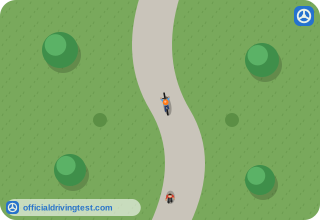
- Fit loosely enough for the child to remove it easily
- Cover the child's ears and the back of the neck
- Fit properly and be fastened securely with its straps
- Be fastened only when the child rides on a roadway
Show answer
Correct answer: Fit properly and be fastened securely with its straps
The manual says a child's helmet must fit properly and be fastened securely on the child's head with the straps of the helmet.
Source: Class D & E Driver’s Guide (Revised August 2025 (DPSMV2052 R08/25)), page 97 · Open this page in the manual (Manual page 97)
-
A child who weighs less than how many pounds or is shorter than how many inches must ride in an approved restraining seat as a bicycle passenger?
- Thirty pounds or thirty inches
- Fifty pounds or fifty inches
- Forty pounds or forty inches
- Forty pounds or thirty inches
Show answer
Correct answer: Forty pounds or forty inches
The manual says children who weigh less than forty pounds or are less than forty inches in height must be properly seated and secured in an approved restraining seat.
Source: Class D & E Driver’s Guide (Revised August 2025 (DPSMV2052 R08/25)), page 97 · Open this page in the manual (Manual page 97)
-
Which of these does the manual tell you to expect on rural roads?
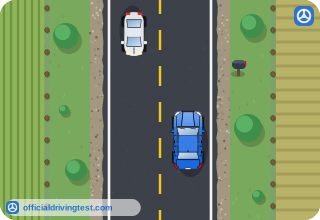
- Traffic signals at every junction
- Farm machinery and slow-moving vehicles
- Rest areas every few miles
- Separate bicycle lanes on every road
Show answer
Correct answer: Farm machinery and slow-moving vehicles
The manual lists farm machinery and slow-moving vehicles among the things to expect on rural roads.
Source: Class D & E Driver’s Guide (Revised August 2025 (DPSMV2052 R08/25)), page 104 · Open this page in the manual (Manual page 104)
-
Deer crossing signs are placed in areas that have had what?
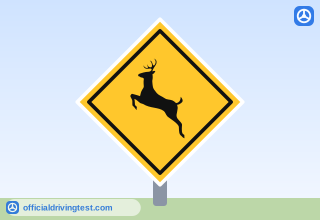
- Many farm vehicles crossing the road
- Frequent flooding of the roadway
- Many people crossing on foot
- A large number of deer/vehicle collisions
Show answer
Correct answer: A large number of deer/vehicle collisions
The manual says deer crossing signs are placed in areas that have had a large number of deer/vehicle collisions.
Source: Class D & E Driver’s Guide (Revised August 2025 (DPSMV2052 R08/25)), page 104 · Open this page in the manual (Manual page 104)
-
If you see one animal near the road, what should you expect?
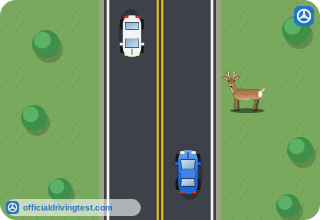
- Another animal is nearby
- The animal will cross alone
- The animal will wait until you pass
- Other animals avoid the area
Show answer
Correct answer: Another animal is nearby
The manual says that if you see one animal, you should expect there is another nearby.
Source: Class D & E Driver’s Guide (Revised August 2025 (DPSMV2052 R08/25)), page 104 · Open this page in the manual (Manual page 104)
-
When is wildlife more active?
- At noon and early afternoon
- Only after midnight
- At dusk and dawn
- Only in the middle of the day
Show answer
Correct answer: At dusk and dawn
The manual says wildlife is more active at dusk and dawn.
Source: Class D & E Driver’s Guide (Revised August 2025 (DPSMV2052 R08/25)), page 104 · Open this page in the manual (Manual page 104)
-
What makes dusk and dawn the times when it is hardest for our eyes to adjust?
- The sun is directly in every driver’s eyes then
- It is neither completely dark nor completely light
- Headlights are not allowed to be used then
- Animals’ eyes reflect too little light then
Show answer
Correct answer: It is neither completely dark nor completely light
The manual says dusk and dawn are when it is hardest for our eyes to adjust, as it is neither completely dark nor completely light.
Source: Class D & E Driver’s Guide (Revised August 2025 (DPSMV2052 R08/25)), page 104 · Open this page in the manual (Manual page 104)
-
Between which months does the manual say animals are most active?
- June through August
- January through March
- April through June
- October through December
Show answer
Correct answer: October through December
The manual says to use caution at dawn and dusk and between October and December, when animals are most active.
Source: Class D & E Driver’s Guide (Revised August 2025 (DPSMV2052 R08/25)), page 104 · Open this page in the manual (Manual page 104)
-
When you travel in a wildlife area, what should you actively do?
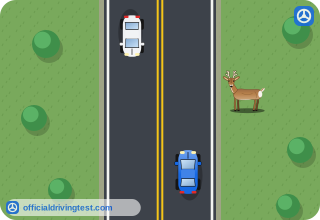
- Scan both sides of the road as you drive
- Watch only the center line
- Drive on the shoulder
- Keep your eyes on the road directly ahead only
Show answer
Correct answer: Scan both sides of the road as you drive
The manual says to actively scan both sides of the road as you drive in a wildlife area.
Source: Class D & E Driver’s Guide (Revised August 2025 (DPSMV2052 R08/25)), page 104 · Open this page in the manual (Manual page 104)
-
If a cow or other domesticated animal wanders into the roadway, what should you do?
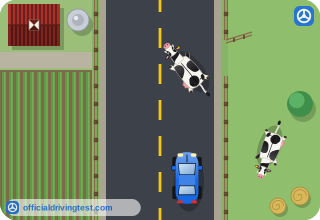
- Swerve around the animal to get past it quickly
- Rev your engine loudly to scare the animal off
- Sound your horn and brake in a controlled manner
- Speed up and pass the animal as quickly as possible
Show answer
Correct answer: Sound your horn and brake in a controlled manner
The manual says to sound your horn and brake in a controlled manner for a domesticated animal in the roadway.
Source: Class D & E Driver’s Guide (Revised August 2025 (DPSMV2052 R08/25)), page 104 · Open this page in the manual (Manual page 104)
-
After a domesticated animal such as a horse or cow wanders into the roadway, what should you do when it is safe?
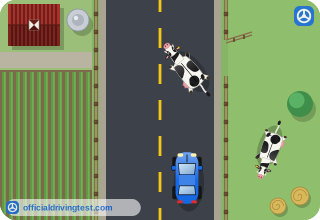
- Try to herd the animal away yourself
- Notify the local authorities of the problem
- Chase the animal off the road
- Move the animal to the shoulder yourself
Show answer
Correct answer: Notify the local authorities of the problem
The manual says that when it is safe you should notify the local authorities so the animal does not cause an incident or injury.
Source: Class D & E Driver’s Guide (Revised August 2025 (DPSMV2052 R08/25)), page 104 · Open this page in the manual (Manual page 104)
-
If wild animals are on the road, how should you pass them?
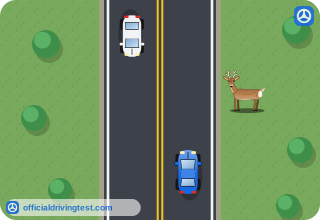
- As close to them as possible so they move
- As quickly as possible by speeding up
- Directly beside them without slowing down
- As far away from the animals as possible
Show answer
Correct answer: As far away from the animals as possible
The manual says to pass wild animals as far away from them as possible.
Source: Class D & E Driver’s Guide (Revised August 2025 (DPSMV2052 R08/25)), page 104 · Open this page in the manual (Manual page 104)
-
What should you look for when scanning the roadsides at night near woods and water to spot animals?
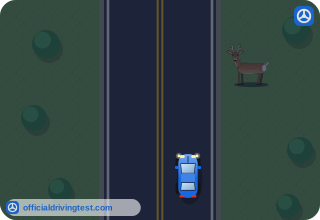
- The shadows of animals on the road ahead of your car
- The reflection of your headlights in the eyes of animals
- Tracks left by animals on the shoulder of the road
- Movement of the tall grass beside the road
Show answer
Correct answer: The reflection of your headlights in the eyes of animals
The manual says to scan the sides of the road for the reflection of your vehicle headlights in the eyes of animals.
Source: Class D & E Driver’s Guide (Revised August 2025 (DPSMV2052 R08/25)), page 104 · Open this page in the manual (Manual page 104)
-
What may animals standing near the roadway do?
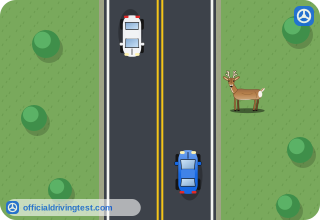
- Stay still until you have passed them
- Always run away from the road at once
- Move away once you slow down near them
- Bolt or change direction at the last minute
Show answer
Correct answer: Bolt or change direction at the last minute
The manual warns that animals standing near the roadway may bolt or change direction at the last minute, and others may follow since deer travel in groups.
Source: Class D & E Driver’s Guide (Revised August 2025 (DPSMV2052 R08/25)), page 105 · Open this page in the manual (Manual page 105)
-
How can you warn other drivers when animals are spotted on or near the road?
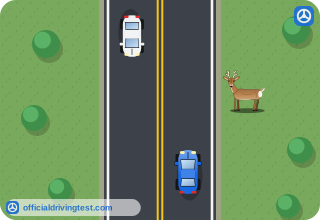
- Use flashers or a headlight signal
- Roll down your window and shout
- Switch to parking lights
- Use your turn signal
Show answer
Correct answer: Use flashers or a headlight signal
The manual says to use flashers or a headlight signal to warn other drivers when animals are spotted on or near the road.
Source: Class D & E Driver’s Guide (Revised August 2025 (DPSMV2052 R08/25)), page 105 · Open this page in the manual (Manual page 105)
-
What do deer tend to do about headlights?
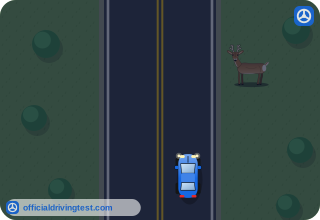
- Turn away from them
- Run toward them
- Fixate on them
- Ignore them
Show answer
Correct answer: Fixate on them
The manual says deer tend to fixate on headlights, so flashing them may cause the animal to freeze in the road.
Source: Class D & E Driver’s Guide (Revised August 2025 (DPSMV2052 R08/25)), page 105 · Open this page in the manual (Manual page 105)
-
How should you handle a dog that chases your vehicle?
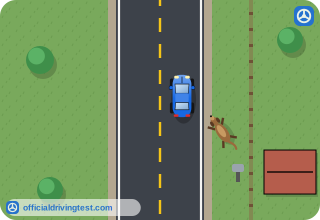
- Speed up at first, then stop when the dog is near
- Stop and wait in the road for the dog to leave
- Swerve toward the far side of the road at once
- Slow down until the dog is near, then accelerate away
Show answer
Correct answer: Slow down until the dog is near, then accelerate away
The manual says to slow down until the dog is near your vehicle and then accelerate away from the dog as it approaches.
Source: Class D & E Driver’s Guide (Revised August 2025 (DPSMV2052 R08/25)), page 105 · Open this page in the manual (Manual page 105)
-
A fluorescent or reflective orange and red triangle on the rear of a vehicle drawn by animals, farm equipment or construction equipment means the vehicle is traveling at what speed?
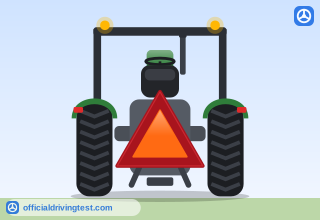
- Less than 10 mph
- Less than 15 mph
- Less than 40 mph
- Less than 25 mph
Show answer
Correct answer: Less than 25 mph
The manual says the orange and red triangle on the rear of such a vehicle means it is traveling less than 25 mph.
Source: Class D & E Driver’s Guide (Revised August 2025 (DPSMV2052 R08/25)), page 105 · Open this page in the manual (Manual page 105)
-
How large can farm machinery be on a rural road?
- Wide enough to take up more than one traffic lane
- Never wider than one traffic lane on state highways
- Limited to about half of one traffic lane in width
- Always narrower than a passenger car
Show answer
Correct answer: Wide enough to take up more than one traffic lane
The manual says farm machinery can be very large and wide enough to take up more than one traffic lane.
Source: Class D & E Driver’s Guide (Revised August 2025 (DPSMV2052 R08/25)), page 105 · Open this page in the manual (Manual page 105)
-
How may operators of farm machinery make a right turn?
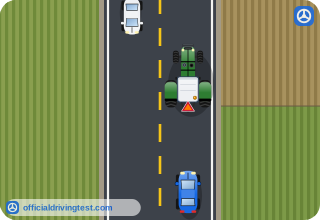
- Pull onto the right shoulder first
- Use turn signals and turn from the right lane
- Pull wide to the left and then turn to the right
- Turn sharply from the right edge of the road
Show answer
Correct answer: Pull wide to the left and then turn to the right
The manual says farm machinery usually has no turn signals and operators may pull wide to the left and then turn to the right.
Source: Class D & E Driver’s Guide (Revised August 2025 (DPSMV2052 R08/25)), page 105 · Open this page in the manual (Manual page 105)
-
What should you remember when you pass farm machinery?
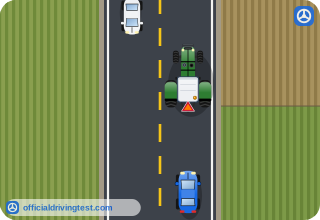
- The operator will signal when it is safe
- The operator cannot hear approaching vehicles
- The operator can see you in the mirrors
- The machinery will stop for passing vehicles
Show answer
Correct answer: The operator cannot hear approaching vehicles
The manual says to pass with caution and remember the operator of the farm machinery cannot hear approaching vehicles.
Source: Class D & E Driver’s Guide (Revised August 2025 (DPSMV2052 R08/25)), page 105 · Open this page in the manual (Manual page 105)
-
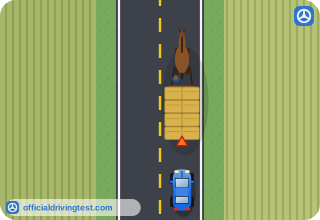
What rights do animal drawn vehicles have on the road?
- The right to use only the shoulder
- The right of way over every motor vehicle
- Exemption from the rules of the road
- The same rights as a motor vehicle
Show answer
Correct answer: The same rights as a motor vehicle
The manual says animal drawn vehicles have the same rights to use the road as a motor vehicle and must follow the same rules.
Source: Class D & E Driver’s Guide (Revised August 2025 (DPSMV2052 R08/25)), page 105 · Open this page in the manual (Manual page 105)
-
What are normal speeds for animal drawn vehicles?
- Between 5 and 8 miles per hour
- Between 1 and 3 miles per hour
- Between 10 and 15 miles per hour
- Between 15 and 20 miles per hour
Show answer
Correct answer: Between 5 and 8 miles per hour
The manual says normal speeds for animal drawn vehicles range between 5 and 8 miles per hour.
Source: Class D & E Driver’s Guide (Revised August 2025 (DPSMV2052 R08/25)), page 105 · Open this page in the manual (Manual page 105)
-
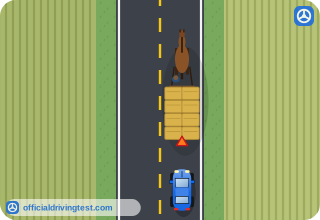
Why should you be extra cautious when passing an animal drawn vehicle pulling a large load?
- It can travel faster than 25 mph on rural roads
- It always has the right of way over other vehicles
- Its driver may not be able to see vehicles behind
- It has no right to use the road at all
Show answer
Correct answer: Its driver may not be able to see vehicles behind
The manual says that with large loads of hay or other equipment, drivers may not be able to see vehicles behind them.
Source: Class D & E Driver’s Guide (Revised August 2025 (DPSMV2052 R08/25)), page 106 · Open this page in the manual (Manual page 106)
-
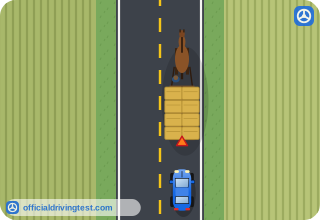
Why should you not use your horn or rev your engine when passing an animal drawn vehicle?
- It may make the driver stop in the road
- It may scare the horse and cause a crash
- It will cause the driver to turn left
- It is not allowed on rural roads
Show answer
Correct answer: It may scare the horse and cause a crash
The manual says not to use your horn or rev the engine because this may scare the horse and cause a crash.
Source: Class D & E Driver’s Guide (Revised August 2025 (DPSMV2052 R08/25)), page 106 · Open this page in the manual (Manual page 106)
-
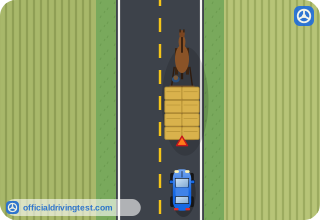
What should you anticipate from animal drawn vehicles?
- U-turns in the middle of the road
- Sudden stops on the shoulder
- Right turns onto the highway
- Left turns into fields and driveways
Show answer
Correct answer: Left turns into fields and driveways
The manual says to anticipate left turns made by animal drawn vehicles into fields and driveways.
Source: Class D & E Driver’s Guide (Revised August 2025 (DPSMV2052 R08/25)), page 106 · Open this page in the manual (Manual page 106)
-
How must horseback riders ride on the road?
- Single file near the right curb or road edge
- Two abreast near the center line of the road
- Single file facing traffic on the left edge
- In groups in the middle of the lane
Show answer
Correct answer: Single file near the right curb or road edge
The manual says horseback riders must ride single file near the right curb or road edge, or on a usable right shoulder, lane or path.
Source: Class D & E Driver’s Guide (Revised August 2025 (DPSMV2052 R08/25)), page 106 · Open this page in the manual (Manual page 106)
-
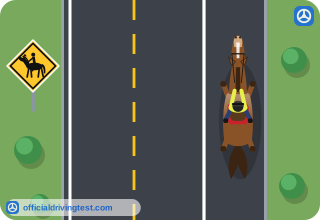
How should you drive when you approach a horse being ridden or led along a road?
- At the speed limit and as close as possible to the horse
- At a normal speed while sounding your horn
- At a reasonable speed and a reasonable distance away from the horse
- Slowly, while revving your engine
Show answer
Correct answer: At a reasonable speed and a reasonable distance away from the horse
The manual says to drive at a reasonable speed and at a reasonable distance away from the horse.
Source: Class D & E Driver’s Guide (Revised August 2025 (DPSMV2052 R08/25)), page 106 · Open this page in the manual (Manual page 106)
-
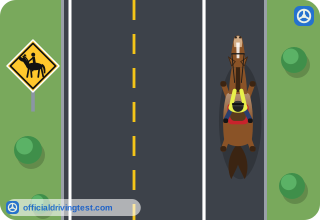
What may happen if you sound your horn or rev your engine loudly when approaching or passing a horse being ridden or led along the road?
- It will make the rider stop in the road
- It could scare the horse and cause a collision
- It will make the horse step aside and let you pass
- It will warn the rider that you are passing
Show answer
Correct answer: It could scare the horse and cause a collision
The manual says it could scare the horse and cause a collision.
Source: Class D & E Driver’s Guide (Revised August 2025 (DPSMV2052 R08/25)), page 106 · Open this page in the manual (Manual page 106)
-
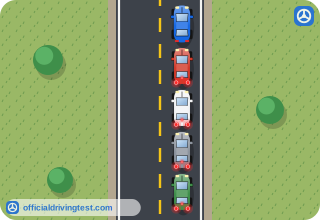
If you drive so slowly that other vehicles have to reduce speed behind you, what should you do?
- Speed up until you reach the posted speed limit on the road
- Stay in your lane and flash your hazard lights as you go
- Stop in your lane and wave for them to pass you
- Pull to the side of the roadway when safe and let them pass
Show answer
Correct answer: Pull to the side of the roadway when safe and let them pass
The manual says to pull to the side of the roadway when safe to do so and let the other vehicles pass.
Source: Class D & E Driver’s Guide (Revised August 2025 (DPSMV2052 R08/25)), page 106 · Open this page in the manual (Manual page 106)