Louisiana: Sharing the road — Part 4 Practice Test
Bicyclists, motorcycles, big trucks and their No Zones, school buses, slow-moving vehicles, farm machinery, horses and animals on the road. — Part 4
Independent educational site · not affiliated with any government agency or DMV
Ready? Test yourself
- Instant feedback with an explanation
- Every answer cites its source in the manual
- Your best score is saved on this device
Questions are original and based on the official manual "Class D & E Driver’s Guide" (Revised August 2025 (DPSMV2052 R08/25)), Louisiana Office of Motor Vehicles.
All 33 questions in this practice test
Take the test above first, then use this list to study. Tap “Show answer” to see the correct answer and explanation.
Show the questions and answersHide the questions
-
Why should you keep your headlights on low beam when following a truck at night?
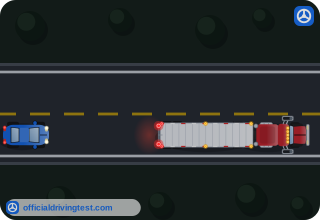
- High beams make the truck's brake lights harder to see at night
- The truck's many side mirrors reflect high beams into the driver's eyes
- High beams reduce the distance you can see ahead of the truck
- High beams cause the truck's headlights to dim automatically
Show answer
Correct answer: The truck's many side mirrors reflect high beams into the driver's eyes
The manual says that when following at night you should use low beam because the truck's many side mirrors reflect high beam lights right into the driver's eyes.
Source: Class D & E Driver’s Guide (Revised August 2025 (DPSMV2052 R08/25)), page 84 · Open this page in the manual (Manual page 84)
-
What does the manual say about mud flaps or mudguards on trucks?
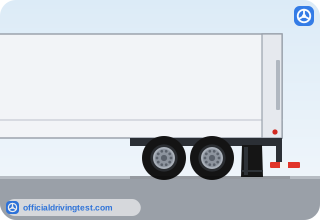
- They completely prevent spray from being thrown out from the sides and the rear of the truck
- They stop spray from the rear but still allow debris from the front wheels to be thrown out
- They are only used when a truck is carrying a loaded trailer on a wet road
- They reduce the debris thrown out but do not completely prevent spray from the sides and rear
Show answer
Correct answer: They reduce the debris thrown out but do not completely prevent spray from the sides and rear
The manual says mud flaps or mudguards reduce the debris thrown out from under a truck's wheels, but do not completely prevent spray from the sides and rear.
Source: Class D & E Driver’s Guide (Revised August 2025 (DPSMV2052 R08/25)), page 84 · Open this page in the manual (Manual page 84)
-
What should you keep clean and in good condition when traveling alongside a truck in wet conditions?
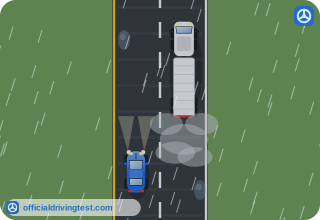
- Your side mirrors and your turn signals
- Your tires and your hubcaps
- Your license plate and your registration
- Your windshield and windshield wipers
Show answer
Correct answer: Your windshield and windshield wipers
The manual says to keep your windshield clean and windshield wipers in good condition to ensure you have the necessary field of vision.
Source: Class D & E Driver’s Guide (Revised August 2025 (DPSMV2052 R08/25)), page 84 · Open this page in the manual (Manual page 84)
-
When approaching an oncoming truck in rainy weather, when should you turn on your wipers?
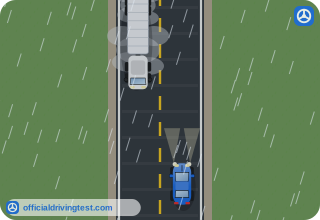
- After the truck has passed you
- Before the truck passes you
- Only after spray hits the windshield
- Only if the truck driver sounds the horn
Show answer
Correct answer: Before the truck passes you
The manual says to turn on your wipers before an oncoming truck passes you so your windshield is cleaned as soon as any spray is thrown onto it.
Source: Class D & E Driver’s Guide (Revised August 2025 (DPSMV2052 R08/25)), page 84 · Open this page in the manual (Manual page 84)
-
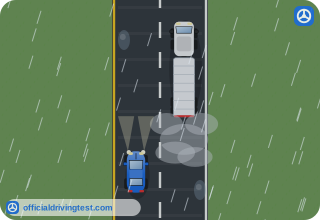
In wet conditions, you should not pull out to pass a truck unless what?
- Unless the truck is traveling below the speed limit
- Unless your headlights are on high beam
- Unless you can clearly see your way forward
- Unless the truck's driver sounds the horn
Show answer
Correct answer: Unless you can clearly see your way forward
The manual says not to pull out to pass a truck unless you can clearly see your way forward.
Source: Class D & E Driver’s Guide (Revised August 2025 (DPSMV2052 R08/25)), page 84 · Open this page in the manual (Manual page 84)
-
In wet conditions, how can you get further away from a truck's spray?
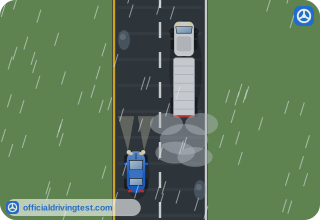
- Slow down so the distance between you and the truck increases
- Speed up so that you stay beside the truck's cab in the lane
- Move closer to the truck's rear wheels while you pass it
- Turn on your high beams and stay in the same position
Show answer
Correct answer: Slow down so the distance between you and the truck increases
The manual says to slow down so the distance between you and the truck increases, which gets you further away from the spray.
Source: Class D & E Driver’s Guide (Revised August 2025 (DPSMV2052 R08/25)), page 84 · Open this page in the manual (Manual page 84)
-
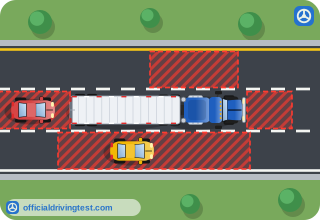
What does the manual call the blind spots around the front, back and sides of a large truck?
- Safe Zones
- Truck Lanes
- No-Zones
- Wind Pockets
Show answer
Correct answer: No-Zones
The manual says large trucks have blind spots, or No-Zones, around the front, back and sides of the truck.
Source: Class D & E Driver’s Guide (Revised August 2025 (DPSMV2052 R08/25)), page 84 · Open this page in the manual (Manual page 84)
-
According to the manual, what is the first rule of safety with trucks?
- See and be seen
- Pass and merge
- Stop and wait
- Match speed
Show answer
Correct answer: See and be seen
The manual says the first rule of safety with trucks is SEE AND BE SEEN.
Source: Class D & E Driver’s Guide (Revised August 2025 (DPSMV2052 R08/25)), page 84 · Open this page in the manual (Manual page 84)
-
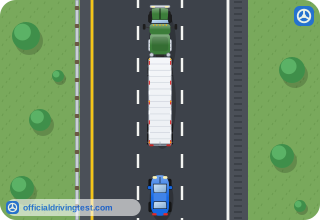
On which side should you pass a truck?
- On the right side
- On whichever side is clearer
- On the side away from the sun
- On the left side
Show answer
Correct answer: On the left side
The manual says that if you are passing a truck, you should always pass on the left side and allow plenty of room before cutting back in front of it.
Source: Class D & E Driver’s Guide (Revised August 2025 (DPSMV2052 R08/25)), page 85 · Open this page in the manual (Manual page 85)
-
What does the manual say to do to counter the effect of air turbulence when passing a truck?
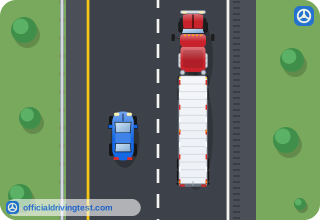
- Loosen your grip on the steering wheel
- Keep a firm control on the steering wheel
- Turn on your hazard flashers
- Drive as close to the truck as you can
Show answer
Correct answer: Keep a firm control on the steering wheel
The manual says to keep a firm control on the steering wheel to counter the effect of air turbulence when passing a truck.
Source: Class D & E Driver’s Guide (Revised August 2025 (DPSMV2052 R08/25)), page 85 · Open this page in the manual (Manual page 85)
-
Before pulling in front of a truck you have passed, what should you look for in your rear-view mirror?
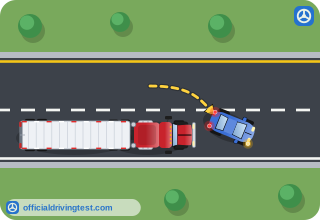
- The truck's rear axle only
- The whole front of the vehicle
- The truck's brake lights
- The truck's license plate
Show answer
Correct answer: The whole front of the vehicle
The manual says to look for the whole front of the vehicle in your rear-view mirror before pulling in front and maintaining speed.
Source: Class D & E Driver’s Guide (Revised August 2025 (DPSMV2052 R08/25)), page 85 · Open this page in the manual (Manual page 85)
-
When you are traveling in the right lane, what does courtesy dictate when a truck is merging?
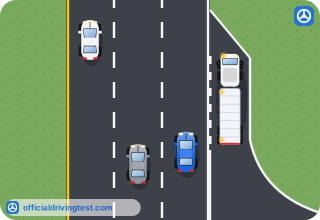
- Speed up to stay beside the truck
- Brake hard to let the truck go ahead
- Stay in your lane and sound your horn
- Move over to allow the truck to merge
Show answer
Correct answer: Move over to allow the truck to merge
The manual says that when traveling in the right lane, courtesy dictates that you move over to allow a truck to merge.
Source: Class D & E Driver’s Guide (Revised August 2025 (DPSMV2052 R08/25)), page 85 · Open this page in the manual (Manual page 85)
-
Why should you be careful when pulling in behind a truck that has just entered the highway?
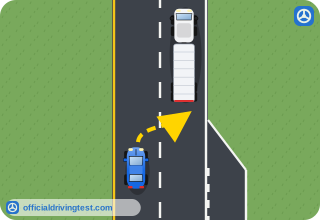
- It takes a lot longer for a large truck to get up to speed
- A large truck always accelerates faster than a car
- The truck will pull into the shoulder to slow down
- The truck must stop at the end of the ramp
Show answer
Correct answer: It takes a lot longer for a large truck to get up to speed
The manual says to be careful when pulling behind a truck that has just entered the highway because it takes a lot longer for a large truck to get up to speed.
Source: Class D & E Driver’s Guide (Revised August 2025 (DPSMV2052 R08/25)), page 85 · Open this page in the manual (Manual page 85)
-
What may a truck (or bus) sometimes do when it needs to make a right turn?
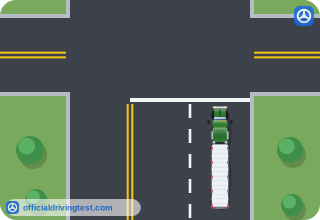
- Swing wide to the right to stay away from the curb as it turns
- Stop in the lane and wait for the traffic behind it to pass
- Swing wide to the left to safely turn right and clear the corner
- Turn right directly from the left lane without slowing down
Show answer
Correct answer: Swing wide to the left to safely turn right and clear the corner
The manual says a truck or bus will sometimes swing wide to the left in order to safely turn right and clear the corner of a curb or other obstruction.
Source: Class D & E Driver’s Guide (Revised August 2025 (DPSMV2052 R08/25)), page 85 · Open this page in the manual (Manual page 85)
-
What happens if you try to get in between a turning truck (or bus) and the curb?
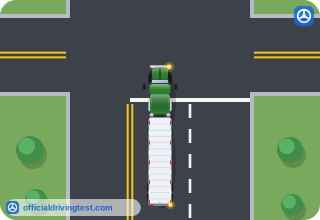
- You will be squeezed in between them and could suffer a serious crash
- The truck driver will see you and stop to let you through
- You will pass the truck safely before it completes its turn
- The truck will turn wider to the left to leave room for you
Show answer
Correct answer: You will be squeezed in between them and could suffer a serious crash
The manual says that if you try to get in between the truck (or bus) and the curb, you will be squeezed between them and could suffer a serious crash.
Source: Class D & E Driver’s Guide (Revised August 2025 (DPSMV2052 R08/25)), page 85 · Open this page in the manual (Manual page 85)
-
How can you avoid a crash with a truck (or bus) that is making a turn?
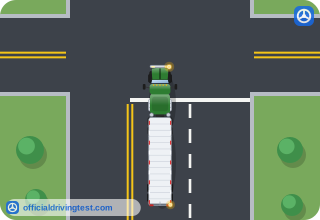
- Turn at the same time as the truck, staying right beside it
- Sound your horn and pass the truck on the right side
- Do not turn until the truck (or bus) has completed its turn
- Move between the truck and the curb as quickly as you can
Show answer
Correct answer: Do not turn until the truck (or bus) has completed its turn
The manual says that to avoid a crash you should not turn until the truck (or bus) has completed its turn.
Source: Class D & E Driver’s Guide (Revised August 2025 (DPSMV2052 R08/25)), page 85 · Open this page in the manual (Manual page 85)
-
What does the manual advise about the turn signals of large vehicles?
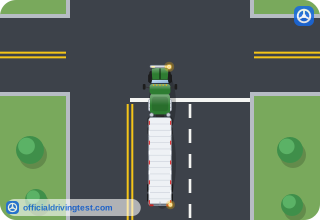
- Ignore them, because large vehicles often leave signals on
- Pay close attention to them and give the vehicles plenty of room
- Wait for them to flash twice before you pass the vehicle
- Pass the vehicle on the right as soon as its signal comes on
Show answer
Correct answer: Pay close attention to them and give the vehicles plenty of room
The manual says to pay close attention to large vehicles' turn signals and give them plenty of room to maneuver.
Source: Class D & E Driver’s Guide (Revised August 2025 (DPSMV2052 R08/25)), page 85 · Open this page in the manual (Manual page 85)
-
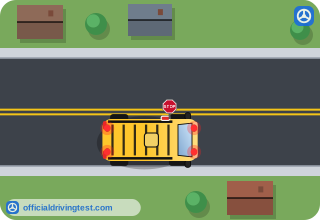
At least how far must you stop from a stopped school bus that is loading or unloading children?
- Ten feet
- Fifteen feet
- Thirty feet
- Fifty feet
Show answer
Correct answer: Thirty feet
The guide says you must stop at least thirty feet from a stopped school bus that is loading or unloading children.
Source: Class D & E Driver’s Guide (Revised August 2025 (DPSMV2052 R08/25)), page 88 · Open this page in the manual (Manual page 88)
-
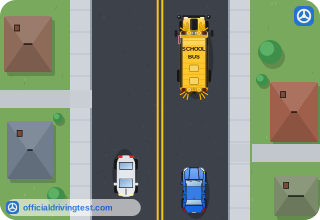
How far before a school bus stop do bus drivers activate the flashing yellow lights?
- At least 50 feet but no more than 100 feet before the stop
- At least 500 feet but no more than 1,000 feet before the stop
- Exactly 200 feet before the stop
- At least 100 feet but no more than 500 feet before the stop
Show answer
Correct answer: At least 100 feet but no more than 500 feet before the stop
The guide says bus drivers activate the flashing yellow lights at least 100 feet but no more than 500 feet before the school bus stop.
Source: Class D & E Driver’s Guide (Revised August 2025 (DPSMV2052 R08/25)), page 88 · Open this page in the manual (Manual page 88)
-
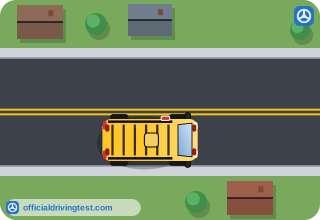
What activates as a school bus comes to a complete stop?
- The flashing red lights and stop signs
- The flashing yellow lights and a siren
- The flashing white lights and a horn
- Only the interior lights of the bus
Show answer
Correct answer: The flashing red lights and stop signs
The guide says the flashing red lights and stop signs of the bus activate as it comes to a complete stop.
Source: Class D & E Driver’s Guide (Revised August 2025 (DPSMV2052 R08/25)), page 88 · Open this page in the manual (Manual page 88)
-
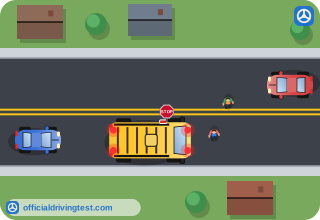
After stopping for a school bus that is loading or unloading children, what must you do before starting to drive again?
- Start as soon as the last child has crossed the road
- Start after sounding your horn twice
- Wait for the vehicle to move and scan before starting
- Start once the flashing yellow lights have stopped
Show answer
Correct answer: Wait for the vehicle to move and scan before starting
The guide says to wait for the vehicle to move and scan before starting to drive again.
Source: Class D & E Driver’s Guide (Revised August 2025 (DPSMV2052 R08/25)), page 88 · Open this page in the manual (Manual page 88)
-
When are you required by law to stop for a stopped school bus that is loading or unloading children?
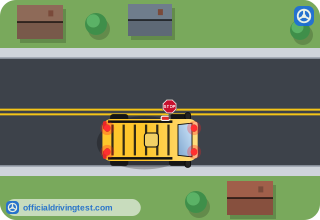
- Only when you are traveling behind the bus
- Whether you are meeting the bus or traveling behind it
- Only when you are meeting the bus
- Only when you can see children outside the bus
Show answer
Correct answer: Whether you are meeting the bus or traveling behind it
The guide says stopping is required by law whether you are meeting the bus or traveling behind it.
Source: Class D & E Driver’s Guide (Revised August 2025 (DPSMV2052 R08/25)), page 88 · Open this page in the manual (Manual page 88)
-
In which situation are you not required to stop for a school bus that is stopped to load or unload?
- The bus is on a road with one lane in each direction and you are meeting it head on
- The bus’s red lights are flashing but you cannot see any children getting on or off
- You are traveling behind the bus rather than meeting it, and the road is clear ahead
- The bus is in a loading zone completely off the roadway where pedestrians may not cross
Show answer
Correct answer: The bus is in a loading zone completely off the roadway where pedestrians may not cross
The guide says you do not have to stop when the bus is stopped in a loading zone completely off the roadway where pedestrians are not allowed to cross the roadway.
Source: Class D & E Driver’s Guide (Revised August 2025 (DPSMV2052 R08/25)), page 88 · Open this page in the manual (Manual page 88)
-
What should you do if you are following a school bus?
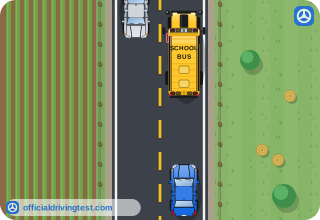
- Increase your following distance for a better view
- Pass it before it reaches its next pickup point
- Stay close behind it to keep traffic moving
- Move to the left lane and match its speed
Show answer
Correct answer: Increase your following distance for a better view
The guide says that if you are following a bus, you should increase your following distance in order to get a better view.
Source: Class D & E Driver’s Guide (Revised August 2025 (DPSMV2052 R08/25)), page 88 · Open this page in the manual (Manual page 88)
-
On which side may you pass a school bus with its red lights flashing?
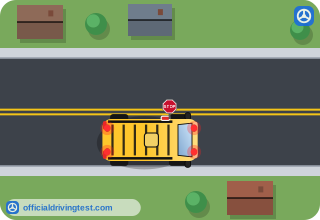
- The right side only
- The left side only
- Neither side
- Either side, if no children are visible
Show answer
Correct answer: Neither side
The guide says never to pass a bus with its red lights flashing on the right or on the left.
Source: Class D & E Driver’s Guide (Revised August 2025 (DPSMV2052 R08/25)), page 88 · Open this page in the manual (Manual page 88)
-
During the school year, when are school buses most likely to be on the road?
- A one-hour period in the morning and a one-hour period in the afternoon
- A three-hour period in the morning and a three-hour period in the afternoon
- A two-hour period at midday and a two-hour period at night
- A five-hour period in the morning only
Show answer
Correct answer: A three-hour period in the morning and a three-hour period in the afternoon
The guide says school buses are most likely on the road during a three-hour period in the morning and a three-hour period in the afternoon.
Source: Class D & E Driver’s Guide (Revised August 2025 (DPSMV2052 R08/25)), page 88 · Open this page in the manual (Manual page 88)
-
A school bus is stopped in the opposite lanes of a roadway. Which kind of separation between the roadways means you are not required to stop?
- A painted double yellow centerline
- A paved shoulder
- A broken white lane line
- A grassy median
Show answer
Correct answer: A grassy median
The guide says you are not required to stop when the bus is in opposite lanes of a roadway separated by a ditch, grassy median, elevated concrete barrier or any obstacle that prevents traffic from driving there.
Source: Class D & E Driver’s Guide (Revised August 2025 (DPSMV2052 R08/25)), page 88 · Open this page in the manual (Manual page 88)
-
A roadway has one lane in each direction and a dedicated two-way left turn lane. How is it treated for a stopped school bus?
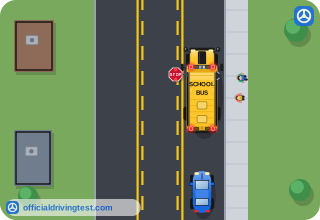
- It is a divided highway, so drivers in the opposite direction need not stop
- It is a divided highway, so only the lane next to the bus must stop
- It is not a divided highway, so drivers must stop for the school bus
- It is a divided highway, so drivers need not stop unless children are crossing
Show answer
Correct answer: It is not a divided highway, so drivers must stop for the school bus
The guide says such a roadway is not considered a divided highway and drivers must stop for the school bus.
Source: Class D & E Driver’s Guide (Revised August 2025 (DPSMV2052 R08/25)), page 89 · Open this page in the manual (Manual page 89)
-
A school bus is stopped on a road with one lane in each direction and a dedicated two-way left turn lane. What must drivers do?
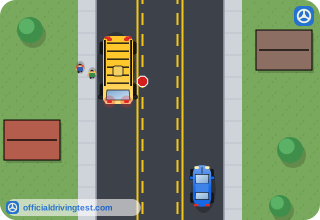
- Only drivers behind the bus must stop
- Drivers in both directions must stop
- Only drivers in the turn lane must stop
- No one must stop; the road is divided
Show answer
Correct answer: Drivers in both directions must stop
A roadway with one lane in each direction and with a dedicated two-way left turn lane is not considered a divided highway, and drivers must stop for the school bus.
Source: Class D & E Driver’s Guide (Revised August 2025 (DPSMV2052 R08/25)), page 89 · Open this page in the manual (Manual page 89)
-
Which traffic rules apply to persons riding bicycles?
- Only the rules written for pedestrians on foot
- Only the rules for traffic signs, not signals
- No rules when riding on the shoulder
- The same rules that apply to automobile drivers
Show answer
Correct answer: The same rules that apply to automobile drivers
The manual says every person riding a bicycle has the same rights and must follow the same rules and regulations as those driving an automobile.
Source: Class D & E Driver’s Guide (Revised August 2025 (DPSMV2052 R08/25)), page 97 · Open this page in the manual (Manual page 97)
-
When riding a bicycle, upon what must the rider ride?
- A cushion placed on the bicycle frame
- A rack fastened behind the seat
- A seat held by a passenger
- A seat that is attached to the bicycle
Show answer
Correct answer: A seat that is attached to the bicycle
The manual says the rider must ride upon a seat that is attached to the bicycle.
Source: Class D & E Driver’s Guide (Revised August 2025 (DPSMV2052 R08/25)), page 97 · Open this page in the manual (Manual page 97)
-
How many hands must the person controlling a bicycle keep on the handlebars at all times?
- Both
- Both, except when signaling a turn
- At least one
- None on a straight road
Show answer
Correct answer: At least one
The manual says the person controlling the bicycle must have at least one hand on the handlebars at all times.
Source: Class D & E Driver’s Guide (Revised August 2025 (DPSMV2052 R08/25)), page 97 · Open this page in the manual (Manual page 97)
-
What may a person riding a bicycle on public roadways not do?
- Attach the bicycle or rider to any vehicle
- Ride near the right side of the roadway
- Use hand signals to show a turn
- Wear an approved helmet
Show answer
Correct answer: Attach the bicycle or rider to any vehicle
The manual says no person riding a bicycle shall attach himself or herself or the bicycle to any vehicle on public roadways.
Source: Class D & E Driver’s Guide (Revised August 2025 (DPSMV2052 R08/25)), page 97 · Open this page in the manual (Manual page 97)