Louisiana: Sharing the road — Part 3 Practice Test
Bicyclists, motorcycles, big trucks and their No Zones, school buses, slow-moving vehicles, farm machinery, horses and animals on the road. — Part 3
Independent educational site · not affiliated with any government agency or DMV
Ready? Test yourself
- Instant feedback with an explanation
- Every answer cites its source in the manual
- Your best score is saved on this device
Questions are original and based on the official manual "Class D & E Driver’s Guide" (Revised August 2025 (DPSMV2052 R08/25)), Louisiana Office of Motor Vehicles.
All 33 questions in this practice test
Take the test above first, then use this list to study. Tap “Show answer” to see the correct answer and explanation.
Show the questions and answersHide the questions
-
How does the small profile of a motorcycle affect a driver's judgment?
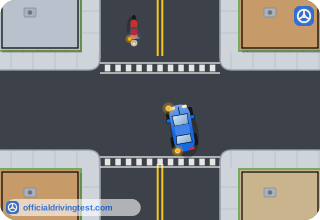
- It may make the motorcycle appear closer and faster than it actually is
- It may make the motorcycle appear larger than an automobile in traffic
- It may make the motorcycle appear farther away and slower than it actually is
- It may make the motorcycle appear to be stopped when it is moving
Show answer
Correct answer: It may make the motorcycle appear farther away and slower than it actually is
The manual says the small profile of a motorcycle may make it appear farther away and traveling slower than it actually is.
Source: Class D & E Driver’s Guide (Revised August 2025 (DPSMV2052 R08/25)), page 81 · Open this page in the manual (Manual page 81)
-
Because it is difficult to judge a motorcycle's distance and speed, what do car drivers need to do?
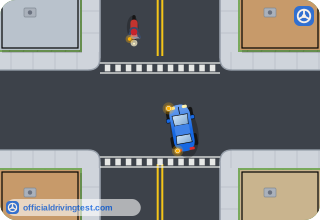
- Take a second look, and then a third
- Assume it is farther away than it looks
- Sound the horn before every lane change
- Slow to a stop until it has passed by
Show answer
Correct answer: Take a second look, and then a third
The manual says that because it is difficult to judge the motorcycle's distance and speed, car drivers need to take a second look, and then a third.
Source: Class D & E Driver’s Guide (Revised August 2025 (DPSMV2052 R08/25)), page 82 · Open this page in the manual (Manual page 82)
-
Some motorcyclists cut between cars and put themselves in places where drivers cannot see them. What should drivers do?
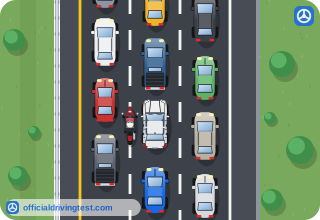
- Assume motorcycles stay in the lane they started in
- Drive near the lane lines to keep motorcycles out
- Be alert for a motorcycle to appear unexpectedly
- Look only in the mirrors before changing lanes
Show answer
Correct answer: Be alert for a motorcycle to appear unexpectedly
The manual tells drivers to be alert for a motorcycle to appear unexpectedly.
Source: Class D & E Driver’s Guide (Revised August 2025 (DPSMV2052 R08/25)), page 82 · Open this page in the manual (Manual page 82)
-
Where within a lane does a motorcyclist's need to see and be seen often mean riding?
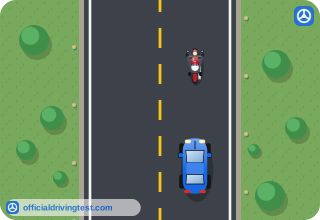
- On the shoulder beside the lane
- In the left portion of the traffic lane
- Straddling the line between two lanes
- Directly behind the rear bumper of the car ahead
Show answer
Correct answer: In the left portion of the traffic lane
The manual says a motorcyclist's need to see and be seen often means riding in the left portion of the traffic lane, for a better view and better visibility to others.
Source: Class D & E Driver’s Guide (Revised August 2025 (DPSMV2052 R08/25)), page 82 · Open this page in the manual (Manual page 82)
-
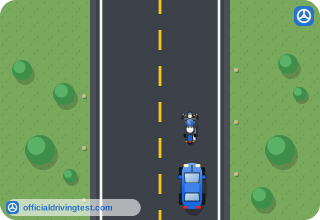
Why does a motorcyclist sometimes change position within the lane?
- To make room for another vehicle to share the same lane with it
- To stay out of the sight of other drivers around the motorcycle
- To slow down without using the brakes on the motorcycle itself
- To increase the distance from hazards such as potholes or railroad tracks
Show answer
Correct answer: To increase the distance from hazards such as potholes or railroad tracks
The manual says the cyclist changes position within the lane to increase the distance from potential hazards, and these movements sometimes occur suddenly.
Source: Class D & E Driver’s Guide (Revised August 2025 (DPSMV2052 R08/25)), page 82 · Open this page in the manual (Manual page 82)
-
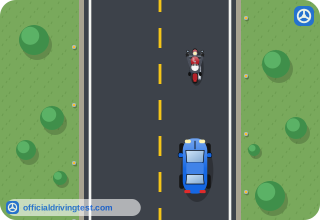
How much of a lane is a motorcycle allowed in which to maneuver?
- The left half of the lane
- The right half of the lane
- The center third of the lane
- The full width of the lane
Show answer
Correct answer: The full width of the lane
The manual says motorcycles are allowed the full width of a lane in which to maneuver.
Source: Class D & E Driver’s Guide (Revised August 2025 (DPSMV2052 R08/25)), page 82 · Open this page in the manual (Manual page 82)
-
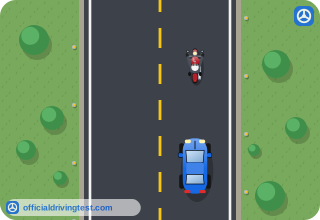
Why should a driver refrain from sharing a lane with a motorcycle?
- It is only allowed on roads with three or more lanes
- It restricts the rider’s ability to avoid hazardous situations
- It makes the motorcycle's headlight harder to see
- It causes the motorcycle's turn signals to shut off
Show answer
Correct answer: It restricts the rider’s ability to avoid hazardous situations
The manual says to refrain from sharing a lane with a motorcycle because it restricts the rider's ability to avoid hazardous situations.
Source: Class D & E Driver’s Guide (Revised August 2025 (DPSMV2052 R08/25)), page 82 · Open this page in the manual (Manual page 82)
-
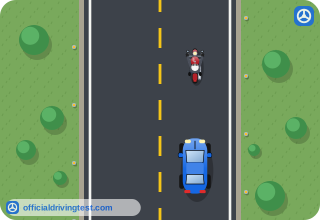
How should you pass a motorcycle?
- Within the same lane, staying as close to the rider as possible
- On the right side, since motorcycles tend to ride on the left
- Just as you would pass another vehicle, not too fast or too close
- Quickly, to spend as little time beside the rider as possible
Show answer
Correct answer: Just as you would pass another vehicle, not too fast or too close
The manual says a motorcycle has the right to a full traffic lane, so you should pass it just as you would another vehicle, and not too fast or too close.
Source: Class D & E Driver’s Guide (Revised August 2025 (DPSMV2052 R08/25)), page 82 · Open this page in the manual (Manual page 82)
-
What can the wind blast of large, fast-moving vehicles do to a motorcycle?
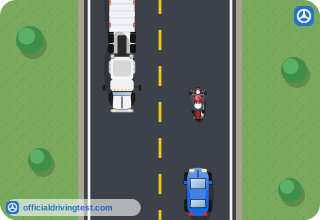
- Blow it out of control
- Make its headlight go dark
- Make it look larger than it is
- Cause its turn signal to stay on
Show answer
Correct answer: Blow it out of control
The manual says the wind blast of large, fast moving vehicles can blow a motorcycle out of control.
Source: Class D & E Driver’s Guide (Revised August 2025 (DPSMV2052 R08/25)), page 82 · Open this page in the manual (Manual page 82)
-
Where are car/motorcycle collisions most likely to occur?
- On freeway on-ramps
- In parking lots
- At intersections
- At railroad crossings
Show answer
Correct answer: At intersections
The manual says intersections are the most likely place for car/motorcycle collisions to occur.
Source: Class D & E Driver’s Guide (Revised August 2025 (DPSMV2052 R08/25)), page 82 · Open this page in the manual (Manual page 82)
-
What usually causes a car/motorcycle collision at an intersection?
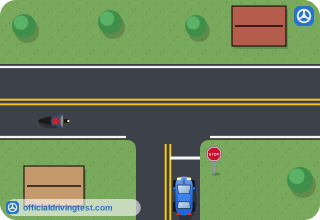
- The car driver does not see the motorcycle and turns into its path
- The motorcyclist rides too slowly for the traffic around
- The motorcyclist ignores a signal from the car driver
- The car driver stops too quickly in front of the motorcycle
Show answer
Correct answer: The car driver does not see the motorcycle and turns into its path
The manual says these collisions are usually the result of a car driver not seeing the motorcycle and turning into the motorcycle's path.
Source: Class D & E Driver’s Guide (Revised August 2025 (DPSMV2052 R08/25)), page 82 · Open this page in the manual (Manual page 82)
-
When does the manual say you may assume a motorcyclist's intention?
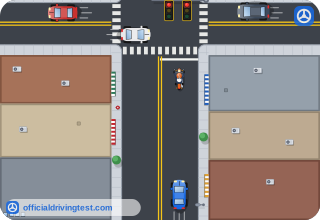
- As soon as the rider moves to one side of the lane for any reason
- As soon as the rider's turn signal begins to flash on and off
- As soon as the rider slows down when near an intersection
- Only after the maneuver is unmistakably started, such as a turn
Show answer
Correct answer: Only after the maneuver is unmistakably started, such as a turn
The manual says not to assume the cyclist's intention until the maneuver is unmistakably started, such as a turn into an intersection or driveway.
Source: Class D & E Driver’s Guide (Revised August 2025 (DPSMV2052 R08/25)), page 82 · Open this page in the manual (Manual page 82)
-
Why should you not rely only on a motorcycle's turn signal?
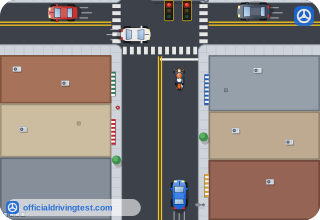
- Motorcycles are not required by law to have any working turn signals
- Turn signals may not shut off automatically, so riders may forget to cancel them
- Motorcycle turn signals are always dimmer than those on a car
- Motorcycle turn signals flash only while the rider is using the brakes
Show answer
Correct answer: Turn signals may not shut off automatically, so riders may forget to cancel them
The manual says turn signals may not automatically shut off on a motorcycle and cyclists occasionally forget to cancel them after a turn is completed.
Source: Class D & E Driver’s Guide (Revised August 2025 (DPSMV2052 R08/25)), page 82 · Open this page in the manual (Manual page 82)
-
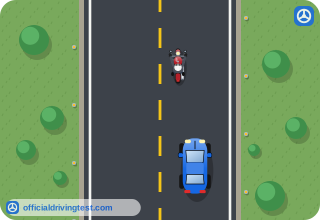
Because of the difficulty of judging a motorcycle's speed and distance, what should be done with the space between your vehicle and the motorcycle?
- It should be reduced so the rider sees you in the mirrors
- It should be kept the same as for any other vehicle
- It should be reduced so you can pass sooner
- It should be increased to avoid sudden braking
Show answer
Correct answer: It should be increased to avoid sudden braking
The manual says the space between the two vehicles should be increased to avoid sudden braking.
Source: Class D & E Driver’s Guide (Revised August 2025 (DPSMV2052 R08/25)), page 82 · Open this page in the manual (Manual page 82)
-
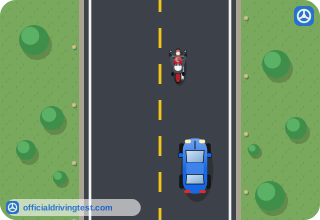
The manual compares tailgating a motorcycle in your car to what?
- An 18-wheeler tailgating you
- A bicycle tailgating you
- A school bus tailgating you
- A police car tailgating you
Show answer
Correct answer: An 18-wheeler tailgating you
The manual says tailgating a motorcycle in your car is comparable to an 18-wheeler tailgating you.
Source: Class D & E Driver’s Guide (Revised August 2025 (DPSMV2052 R08/25)), page 82 · Open this page in the manual (Manual page 82)
-
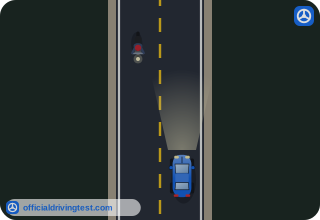
Why can a motorcycle's single headlight and single tail light cause you to misjudge distance?
- They are brighter than the lights of other vehicles
- They are placed much higher than the lights of cars
- They can blend into the lights of other vehicles
- They flash on and off when the rider changes lanes
Show answer
Correct answer: They can blend into the lights of other vehicles
The manual says the single headlight and single tail light of a motorcycle can blend into the lights of other vehicles, which can cause you to misjudge distance.
Source: Class D & E Driver’s Guide (Revised August 2025 (DPSMV2052 R08/25)), page 82 · Open this page in the manual (Manual page 82)
-
What should you do with your headlights when meeting a motorcycle?
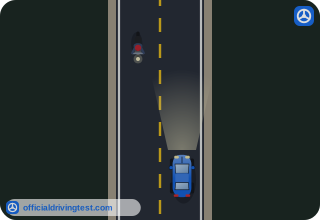
- Dim them, just as required for other vehicles
- Keep them on high beam, since a motorcycle has one headlight
- Turn them off until the motorcycle has passed you
- Flash them on and off to warn the rider
Show answer
Correct answer: Dim them, just as required for other vehicles
The manual says to always dim your headlights for a motorcycle just as required for other vehicles.
Source: Class D & E Driver’s Guide (Revised August 2025 (DPSMV2052 R08/25)), page 82 · Open this page in the manual (Manual page 82)
-
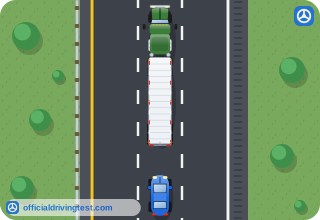
According to the manual, what is the most important tip for driving around a big truck?
- Stay close beside the truck so its driver can see you
- Drive around it the same way you drive around other vehicles
- Give a wide clearance (berth) to the big truck
- Pass it on the right so you stay out of its largest blind spot
Show answer
Correct answer: Give a wide clearance (berth) to the big truck
The manual says you cannot drive around a big truck the way you drive around other vehicles, and the most important tip is to give it a wide clearance (berth).
Source: Class D & E Driver’s Guide (Revised August 2025 (DPSMV2052 R08/25)), page 83 · Open this page in the manual (Manual page 83)
-
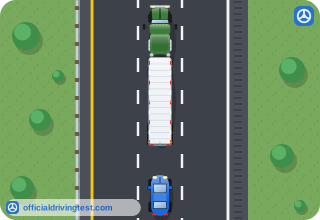
How does a big truck's stopping distance compare with that of other vehicles?
- It is about the same on dry roads and longer only on wet roads
- It is much longer, and longer still on wet roads
- It is shorter, because trucks have more brakes than cars
- It is much longer, but the same on wet roads and dry roads
Show answer
Correct answer: It is much longer, and longer still on wet roads
The manual says big trucks have a much longer stopping distance than other vehicles, and longer still on wet roads.
Source: Class D & E Driver’s Guide (Revised August 2025 (DPSMV2052 R08/25)), page 83 · Open this page in the manual (Manual page 83)
-
A loaded tractor trailer with properly adjusted brakes travels at 55 mph on a clear, dry roadway. What minimum distance does the manual say it needs to come to a complete stop?
- 140 feet
- 190 feet
- 390 feet
- 290 feet
Show answer
Correct answer: 290 feet
The manual says such a tractor trailer requires a minimum of 290 feet to come to a complete stop.
Source: Class D & E Driver’s Guide (Revised August 2025 (DPSMV2052 R08/25)), page 83 · Open this page in the manual (Manual page 83)
-
As a general rule, how much space should you keep between your vehicle and big trucks?
- Only a few feet
- A single car length
- Whatever the traffic allows
- As much space as possible
Show answer
Correct answer: As much space as possible
The manual says as a general rule to keep as much space as possible between your vehicle and big trucks.
Source: Class D & E Driver’s Guide (Revised August 2025 (DPSMV2052 R08/25)), page 83 · Open this page in the manual (Manual page 83)
-
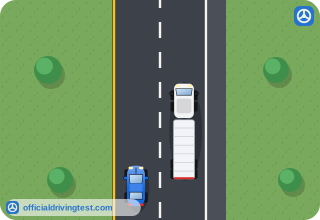
You see open space in front of a big truck. What is that space, according to the manual?
- A safe place to merge in front of the truck when you signal
- The truck's cushion of safety because of its stopping distance
- A lane the truck driver keeps open for passing cars
- Space that the driver leaves for other vehicles to enter
Show answer
Correct answer: The truck's cushion of safety because of its stopping distance
The manual says the space in front of a truck is the truck's cushion of safety because of its longer stopping distance, so you should not cut in front just because you see open space.
Source: Class D & E Driver’s Guide (Revised August 2025 (DPSMV2052 R08/25)), page 83 · Open this page in the manual (Manual page 83)
-
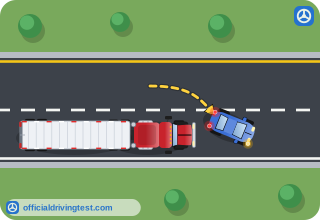
Why is it especially risky to cut in front of a truck that has a long hood?
- The driver is certain to sound the horn at you
- The hood blocks the truck's own brake lights
- The driver may not be able to see you at all
- The truck can stop faster than other trucks
Show answer
Correct answer: The driver may not be able to see you at all
The manual says that if the truck has a long hood, the driver may not be able to see you at all.
Source: Class D & E Driver’s Guide (Revised August 2025 (DPSMV2052 R08/25)), page 83 · Open this page in the manual (Manual page 83)
-
What does it mean if you cannot see a truck driver's face in one of the truck's mirrors?
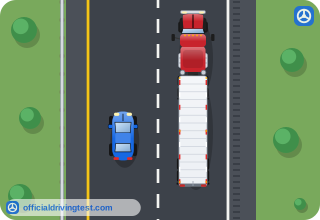
- The driver cannot see you and probably does not know you are there
- The driver can see you through the truck's windshield
- The driver can see you only when your headlights are on
- The driver is not paying attention to the road ahead
Show answer
Correct answer: The driver cannot see you and probably does not know you are there
The manual says that if you cannot see a truck driver's face in one of his mirrors, the driver cannot see you and probably does not know you are there.
Source: Class D & E Driver’s Guide (Revised August 2025 (DPSMV2052 R08/25)), page 83 · Open this page in the manual (Manual page 83)
-
You are following a truck and cannot see its side mirrors. What does that tell you?
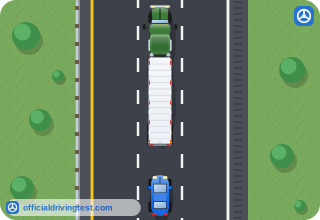
- You are at a safe distance for a truck at night
- You are in the position where the driver sees you best
- You are driving too close and should back off
- You are far enough back to pass the truck safely
Show answer
Correct answer: You are driving too close and should back off
The manual says that if you cannot see the truck's side mirrors while following, you are driving too close, so you should back off.
Source: Class D & E Driver’s Guide (Revised August 2025 (DPSMV2052 R08/25)), page 83 · Open this page in the manual (Manual page 83)
-
Why does a turning truck create varying blind spots for its driver?
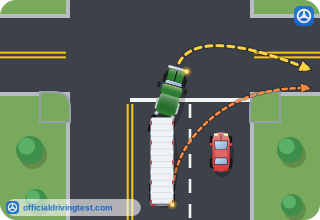
- The relationship between cab, mirrors, and trailer constantly changes
- The trailer's rear lights are turned off during any turn it makes
- The mirrors are folded in while the truck is turning a corner
- The cab turns faster than the trailer does at the start of a turn
Show answer
Correct answer: The relationship between cab, mirrors, and trailer constantly changes
The manual says the relationship between the cab, mirrors, and trailer changes constantly during a turn, creating varying blind spots.
Source: Class D & E Driver’s Guide (Revised August 2025 (DPSMV2052 R08/25)), page 83 · Open this page in the manual (Manual page 83)
-
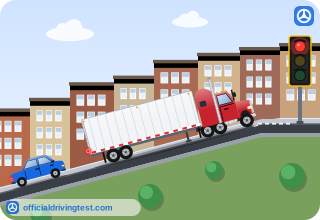
You find yourself traveling behind a truck on a hill. What does the manual advise?
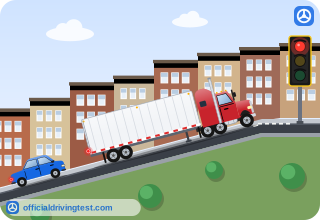
- Stay as close as possible behind it
- Pass it immediately on the right
- Sound your horn to warn the driver
- Leave extra space as a precaution
Show answer
Correct answer: Leave extra space as a precaution
The manual says a truck stopped on a hill will roll backwards when it begins to accelerate, so leave extra space behind it as a precaution.
Source: Class D & E Driver’s Guide (Revised August 2025 (DPSMV2052 R08/25)), page 83 · Open this page in the manual (Manual page 83)
-
Why does the manual say to avoid driving in the right lane, if possible, near truck weigh stations?
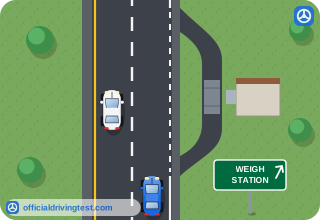
- Every vehicle in the right lane must stop at the weigh station
- Large vehicles will be attempting to re-enter faster-moving traffic
- The speed limit is lower in the right lane near weigh stations
- Trucks must remain in the right lane near weigh stations
Show answer
Correct answer: Large vehicles will be attempting to re-enter faster-moving traffic
The manual says large vehicles near weigh stations will be attempting to re-enter faster-moving traffic, so avoiding the right lane there reduces the possibility of a crash.
Source: Class D & E Driver’s Guide (Revised August 2025 (DPSMV2052 R08/25)), page 83 · Open this page in the manual (Manual page 83)
-
On a windy day, how long should you drive alongside a truck?
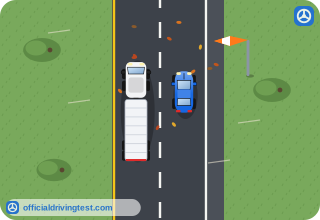
- For as long as it takes to match its speed
- No longer than you need to pass it
- Only until the truck driver has seen you
- As long as you stay in the center of your lane
Show answer
Correct answer: No longer than you need to pass it
The manual says that on windy days you should never drive alongside a truck for longer than you need to pass it, because turbulence can make a vehicle swerve or spin out of control.
Source: Class D & E Driver’s Guide (Revised August 2025 (DPSMV2052 R08/25)), page 83 · Open this page in the manual (Manual page 83)
-
What does the manual advise to minimize the effect of a truck's turbulence on a windy day?
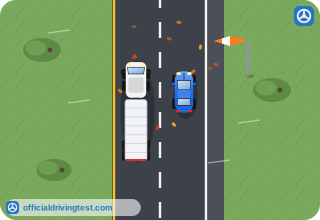
- Drive close to the truck so it blocks the wind from reaching your vehicle
- Move to the center of the lane and loosen your grip on the steering wheel
- Speed up to pass the truck and then cut in close in front of it
- Stay to the outer edge of the lane away from the truck and hold the wheel tightly
Show answer
Correct answer: Stay to the outer edge of the lane away from the truck and hold the wheel tightly
The manual says to stay to the outer edge of the lane away from the truck and hold the wheel tightly with both hands.
Source: Class D & E Driver’s Guide (Revised August 2025 (DPSMV2052 R08/25)), page 83 · Open this page in the manual (Manual page 83)
-
Generally speaking, which statement is true about the bigger a truck is?
- The longer it takes to accelerate
- The smaller its blind spots
- The less room it needs to maneuver
- The shorter it takes to stop
Show answer
Correct answer: The longer it takes to accelerate
The manual lists that, generally, the bigger the truck is, the bigger its blind spots, the more room it needs to maneuver, and the longer it takes to stop, pass it and accelerate.
Source: Class D & E Driver’s Guide (Revised August 2025 (DPSMV2052 R08/25)), page 83 · Open this page in the manual (Manual page 83)
-
Why does hanging back behind a truck help you?
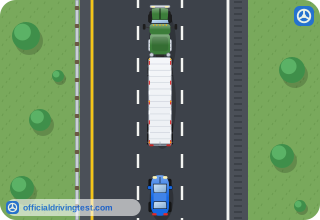
- It increases your field of vision and gives more stopping distance
- It lets you draft behind the truck in order to save fuel on the road
- It keeps the truck from needing to use its brakes in an emergency
- It makes your vehicle easier to see in the truck's side mirrors
Show answer
Correct answer: It increases your field of vision and gives more stopping distance
The manual says the truck may block your view of the road ahead, so hanging back increases your field of vision and gives you more stopping distance if the truck brakes suddenly.
Source: Class D & E Driver’s Guide (Revised August 2025 (DPSMV2052 R08/25)), page 84 · Open this page in the manual (Manual page 84)
-
At intersections and in slow traffic, how should you position yourself behind a truck?
- Close to the bumper so no other vehicle can enter
- Beside the trailer where the driver can watch you
- Far enough away for other drivers to see you
- Where the truck's mirrors cannot reflect your lights
Show answer
Correct answer: Far enough away for other drivers to see you
The manual says that because of a truck's size another driver's view of you may be restricted, so at intersections and in slow traffic you should stay far enough away for other drivers to see you.
Source: Class D & E Driver’s Guide (Revised August 2025 (DPSMV2052 R08/25)), page 84 · Open this page in the manual (Manual page 84)