Louisiana: Sharing the road — Part 2 Practice Test
Bicyclists, motorcycles, big trucks and their No Zones, school buses, slow-moving vehicles, farm machinery, horses and animals on the road. — Part 2
Independent educational site · not affiliated with any government agency or DMV
Ready? Test yourself
- Instant feedback with an explanation
- Every answer cites its source in the manual
- Your best score is saved on this device
Questions are original and based on the official manual "Class D & E Driver’s Guide" (Revised August 2025 (DPSMV2052 R08/25)), Louisiana Office of Motor Vehicles.
All 33 questions in this practice test
Take the test above first, then use this list to study. Tap “Show answer” to see the correct answer and explanation.
Show the questions and answersHide the questions
-
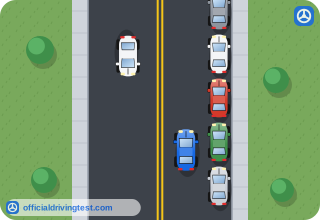
When you drive past parked cars, who might try to cross the road between them?
- Only other cars backing out
- Pedestrians or bicycles
- Only children on foot
- Only drivers looking for a space
Show answer
Correct answer: Pedestrians or bicycles
The manual says to watch for pedestrians or bicycles trying to cross the road between parked cars, and to be especially watchful for children.
Source: Class D & E Driver’s Guide (Revised August 2025 (DPSMV2052 R08/25)), page 70 · Open this page in the manual (Manual page 70)
-
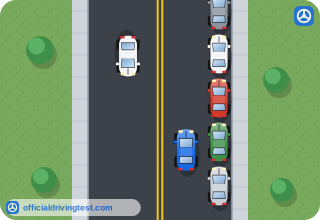
When you drive past parked cars, which people does the manual say to be especially watchful for?
- Motorcyclists
- Children
- Delivery drivers
- Passengers waiting in cars
Show answer
Correct answer: Children
The manual says to be especially watchful for children around parked cars.
Source: Class D & E Driver’s Guide (Revised August 2025 (DPSMV2052 R08/25)), page 70 · Open this page in the manual (Manual page 70)
-
When you get out of your car on the street side, which vehicles does the manual say to look carefully for in particular?
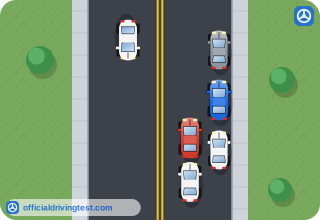
- Bicycles
- Buses
- Motorcycles
- Delivery trucks
Show answer
Correct answer: Bicycles
The manual says to look carefully for other vehicles, especially bicycles, that might be passing before getting out on the street side.
Source: Class D & E Driver’s Guide (Revised August 2025 (DPSMV2052 R08/25)), page 70 · Open this page in the manual (Manual page 70)
-
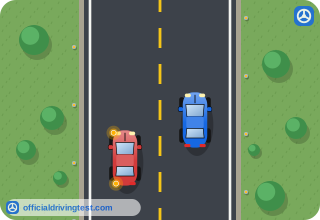
When you are about to be overtaken and passed on a two-lane highway, what should you do?
- Speed up so the other driver passes quickly
- Stay exactly where you are and keep your speed
- Slow down a little and move over to the right as far as you can safely
- Move over to the left lane to give the other driver more room
Show answer
Correct answer: Slow down a little and move over to the right as far as you can safely
The manual says to slow your speed a little and, on a two-lane highway, move over to the right as far as you can safely.
Source: Class D & E Driver’s Guide (Revised August 2025 (DPSMV2052 R08/25)), page 73 · Open this page in the manual (Manual page 73)
-
What rights and duties do bicyclists have on public roads, according to the manual?
- They have the same rights to use public roads as automobiles and must follow the same traffic laws
- They may use public roads only in marked bike lanes and are exempt from most traffic laws
- They have the right of way over automobiles in every situation on public roads
- They may use public roads at any time but must follow only the traffic signals
Show answer
Correct answer: They have the same rights to use public roads as automobiles and must follow the same traffic laws
The manual says bicycles have the same rights to use public roads as automobiles and must follow the same traffic laws as other vehicles.
Source: Class D & E Driver’s Guide (Revised August 2025 (DPSMV2052 R08/25)), page 80 · Open this page in the manual (Manual page 80)
-
How must a driver treat a bicyclist in an intersection?
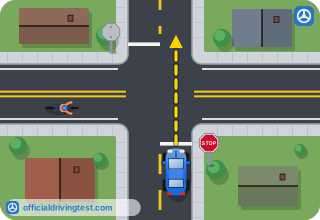
- Go first, because bicycles are slower and can wait for motor vehicles
- Sound the horn so the bicyclist stops before entering the intersection
- Yield to the bicyclist as you would for pedestrians and other vehicles
- Treat the bicyclist as a pedestrian who never has to be yielded to
Show answer
Correct answer: Yield to the bicyclist as you would for pedestrians and other vehicles
Drivers must yield to bicyclists in intersections as they would for pedestrians and other vehicles.
Source: Class D & E Driver’s Guide (Revised August 2025 (DPSMV2052 R08/25)), page 80 · Open this page in the manual (Manual page 80)
-
Why might a bicyclist not be riding in the extreme right of the lane?
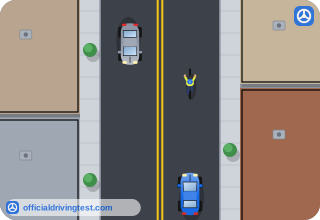
- Because bicyclists are not allowed to use the right side of the road
- Because the law requires bicyclists to ride in the center of every lane
- To signal drivers behind them that they intend to make a right turn
- To avoid gravel, debris, bad pavement, sewer grates or other obstacles
Show answer
Correct answer: To avoid gravel, debris, bad pavement, sewer grates or other obstacles
The manual says bicyclists not in the extreme right of the lane may be trying to avoid gravel, debris, bad pavement, sewer grates and other obstacles.
Source: Class D & E Driver’s Guide (Revised August 2025 (DPSMV2052 R08/25)), page 80 · Open this page in the manual (Manual page 80)
-
Why should a driver be cautious when a bicyclist moves into the left lane?
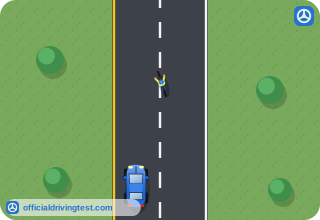
- The bicyclist may be preparing to make a right turn
- The bicyclist may be trying to race the vehicles nearby
- The bicyclist may be stopping to let pedestrians cross
- The bicyclist may be preparing to make a left turn
Show answer
Correct answer: The bicyclist may be preparing to make a left turn
The manual tells drivers to be cautious of bicyclists moving into the left lane because of a left turn.
Source: Class D & E Driver’s Guide (Revised August 2025 (DPSMV2052 R08/25)), page 80 · Open this page in the manual (Manual page 80)
-
On a two-way road, a bicyclist is ahead of you and a vehicle is approaching from the opposite direction. What should you do?
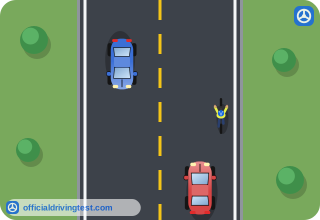
- Speed up and pass the bicyclist before the oncoming vehicle gets to your position
- Slow down, let the oncoming vehicle pass, then move left to pass with plenty of room
- Pass between the bicyclist and the oncoming vehicle if there is enough room
- Pass the bicyclist on the right side while the oncoming vehicle goes by
Show answer
Correct answer: Slow down, let the oncoming vehicle pass, then move left to pass with plenty of room
The manual says to avoid passing between a bicyclist and an oncoming vehicle: slow down, let the oncoming vehicle pass, then move to the left to pass with plenty of room.
Source: Class D & E Driver’s Guide (Revised August 2025 (DPSMV2052 R08/25)), page 80 · Open this page in the manual (Manual page 80)
-
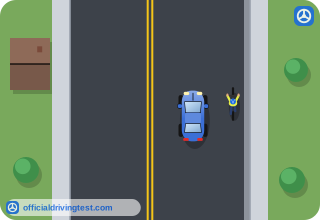
According to Louisiana law (R.S. 32:76.1), what distance must be present between a passing automobile and a slower traveling bicyclist?
- Two feet
- Five feet
- Three feet
- Six feet
Show answer
Correct answer: Three feet
The manual states that a three-foot distance must be present between the passing automobile and slower traveling bicyclists.
Source: Class D & E Driver’s Guide (Revised August 2025 (DPSMV2052 R08/25)), page 80 · Open this page in the manual (Manual page 80)
-
A bicyclist is passing a row of parked cars in your lane. What does the manual say to do?
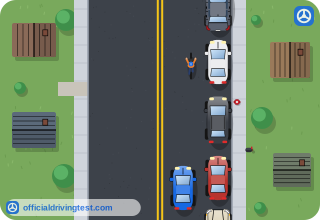
- Give the bicyclist the entire lane, so there is space to avoid opening doors
- Squeeze past the bicyclist within the same lane as quickly as possible
- Honk so that the bicyclist moves closer to the row of parked cars
- Stay right behind the bicyclist so other drivers will see both of you
Show answer
Correct answer: Give the bicyclist the entire lane, so there is space to avoid opening doors
The manual says to give bicyclists the entire lane when they are passing parked cars, because they need the space to avoid opening doors.
Source: Class D & E Driver’s Guide (Revised August 2025 (DPSMV2052 R08/25)), page 80 · Open this page in the manual (Manual page 80)
-
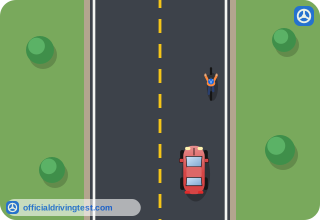
Why should a driver use caution when passing a bicyclist?
- Bicyclists are required to stop whenever a motor vehicle passes them
- Bicyclists cannot hear a vehicle that is approaching from behind
- The air current created by a passing vehicle may cause the bicyclist to crash
- Passing a bicyclist is illegal when there is a solid line on the road
Show answer
Correct answer: The air current created by a passing vehicle may cause the bicyclist to crash
The manual says the air current created by a passing vehicle may cause bicyclists to have a crash.
Source: Class D & E Driver’s Guide (Revised August 2025 (DPSMV2052 R08/25)), page 80 · Open this page in the manual (Manual page 80)
-
You are pulling a trailer and need to pass a bicyclist. What does the manual advise?
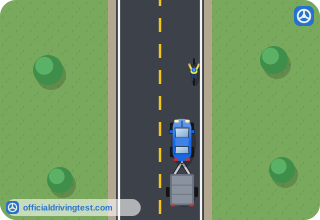
- Allow extra passing room
- Pass at a higher speed
- Use the usual passing room
- Pass only on the right
Show answer
Correct answer: Allow extra passing room
The manual says that if you are pulling a trailer, you should allow for extra passing room when passing bicyclists.
Source: Class D & E Driver’s Guide (Revised August 2025 (DPSMV2052 R08/25)), page 80 · Open this page in the manual (Manual page 80)
-
If a bicyclist is unsafely moving into your lane of travel, what should you do with your horn?
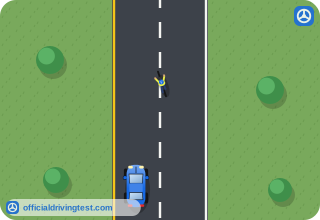
- Hold it down in a long, loud blast
- Sound it several times while speeding up
- Never use it, and flash your high beams
- Only give it a light tap
Show answer
Correct answer: Only give it a light tap
The manual says that if a bicyclist is unsafely moving into your lane of travel, you should only give your horn a light tap.
Source: Class D & E Driver’s Guide (Revised August 2025 (DPSMV2052 R08/25)), page 80 · Open this page in the manual (Manual page 80)
-
You are turning left and a bicyclist is coming toward you from the opposite direction. What must you do?
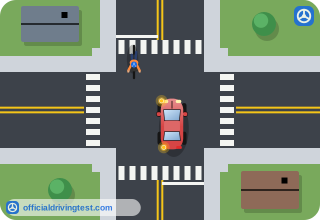
- Turn in front of the bicyclist, because bicycles are slow
- Wait until the oncoming bicyclist passes
- Flash your lights so that the bicyclist stops for you
- Turn if the bicyclist is more than three feet away
Show answer
Correct answer: Wait until the oncoming bicyclist passes
The manual says drivers who are turning left must wait until oncoming bicyclists pass.
Source: Class D & E Driver’s Guide (Revised August 2025 (DPSMV2052 R08/25)), page 80 · Open this page in the manual (Manual page 80)
-
You have just overtaken a bicyclist and want to make a right turn. What does the manual advise?
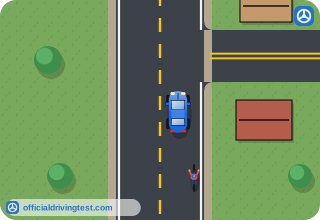
- Swing in front of the bicyclist quickly and then turn right
- Turn right immediately, because the bicyclist is now behind you
- Sound your horn and turn as soon as the bicyclist slows down
- Slow down and stay behind the bicyclist, or look once, then again
Show answer
Correct answer: Slow down and stay behind the bicyclist, or look once, then again
The manual says not to swing in front of a bicyclist to turn right; drivers should slow down and stay behind the bicyclist, or look once, then again.
Source: Class D & E Driver’s Guide (Revised August 2025 (DPSMV2052 R08/25)), page 80 · Open this page in the manual (Manual page 80)
-
How does the manual say bicycle speeds can vary?
- From under 10 mph to over 35 mph
- From under 5 mph to over 20 mph
- From under 15 mph to over 25 mph
- From under 10 mph to over 50 mph
Show answer
Correct answer: From under 10 mph to over 35 mph
The manual says speeds of bicycles are hard to judge and can vary from under 10 mph to over 35 mph.
Source: Class D & E Driver’s Guide (Revised August 2025 (DPSMV2052 R08/25)), page 80 · Open this page in the manual (Manual page 80)
-
Whose fault does the manual say it is when a driver opens a car door into traffic and a bicyclist hits it?
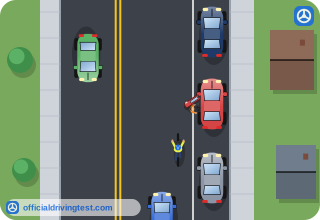
- The bicyclist’s
- Shared equally
- The driver’s
- Nobody’s
Show answer
Correct answer: The driver’s
The manual says that when opening your car door into traffic you should look first for bicyclists, and that this collision is the driver's fault.
Source: Class D & E Driver’s Guide (Revised August 2025 (DPSMV2052 R08/25)), page 80 · Open this page in the manual (Manual page 80)
-
How may a bicyclist react at a railroad crossing?
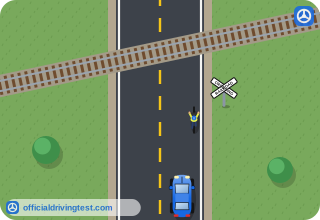
- Slow down and possibly zigzag in order to cross the tracks
- Speed up and ride straight across the tracks
- Always stop, get off, and walk across the tracks
- Move to the far left side of the lane before crossing
Show answer
Correct answer: Slow down and possibly zigzag in order to cross the tracks
The manual says railroad crossings can cause bicyclists to slow down and possibly zigzag in order to cross the tracks.
Source: Class D & E Driver’s Guide (Revised August 2025 (DPSMV2052 R08/25)), page 80 · Open this page in the manual (Manual page 80)
-
What should a bicyclist do on a metal or grated surface?
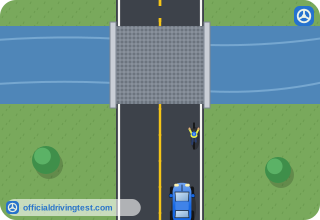
- Speed up and move to the far right edge of the road
- Stay in the same place in the lane and keep riding at the same speed
- Slow down and move to the center of the lane for room to handle the surface
- Ride on the sidewalk until the surface is behind the bicycle
Show answer
Correct answer: Slow down and move to the center of the lane for room to handle the surface
The manual says bicyclists should slow down and move to the center of the lane to allow room for handling the uneven surface.
Source: Class D & E Driver’s Guide (Revised August 2025 (DPSMV2052 R08/25)), page 80 · Open this page in the manual (Manual page 80)
-
A bicyclist crosses a metal or grated surface just ahead of you. For what should you be prepared?
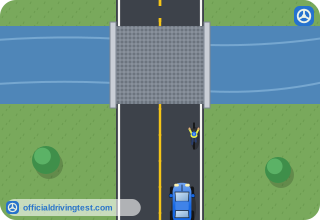
- The bicyclist may stop suddenly in the middle of the lane
- The bicyclist may swerve to correct for the new surface
- The bicyclist may speed up to get away from your vehicle
- The bicyclist may signal that you should pass right away
Show answer
Correct answer: The bicyclist may swerve to correct for the new surface
The manual says drivers should be prepared for a bicyclist who may be less experienced and may swerve to correct for the new surface.
Source: Class D & E Driver’s Guide (Revised August 2025 (DPSMV2052 R08/25)), page 81 · Open this page in the manual (Manual page 81)
-
Why can a passing truck be a problem for a bicyclist on a long open highway or bridge?
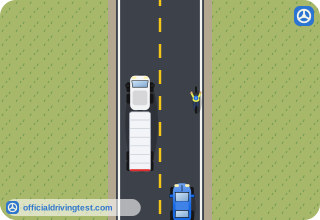
- Bicyclists are not allowed on long open highways and bridges
- The truck’s exhaust fumes make bicyclists stop riding
- The truck forces the bicyclist to ride on the sidewalk
- The truck’s windblast can move the bicyclist out of the path of travel
Show answer
Correct answer: The truck’s windblast can move the bicyclist out of the path of travel
The manual says trucks creating windblasts can move a bicyclist out of the path of travel on long open highways and bridges.
Source: Class D & E Driver’s Guide (Revised August 2025 (DPSMV2052 R08/25)), page 81 · Open this page in the manual (Manual page 81)
-
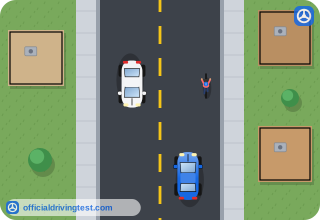
What should drivers be aware of when they see children on bicycles?
- The children always signal before they turn or stop
- The children can be expected to know traffic laws and signs
- The children are required to walk bicycles across intersections
- The children may make sudden movements or change direction
Show answer
Correct answer: The children may make sudden movements or change direction
The manual says children on bicycles may not be aware of their surroundings and may make sudden movements or change direction, and drivers should not expect children to know traffic laws.
Source: Class D & E Driver’s Guide (Revised August 2025 (DPSMV2052 R08/25)), page 81 · Open this page in the manual (Manual page 81)
-
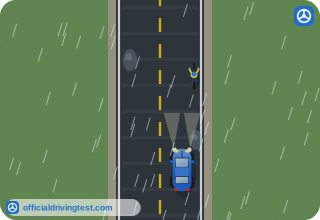
In inclement weather, what should drivers allow for bicyclists?
- Less following distance
- More following distance
- The same following distance
- No change if they are in a bike lane
Show answer
Correct answer: More following distance
The manual says inclement weather creates stability problems for all vehicles, so drivers should allow more following distance for bicyclists.
Source: Class D & E Driver’s Guide (Revised August 2025 (DPSMV2052 R08/25)), page 81 · Open this page in the manual (Manual page 81)
-
Under Louisiana law as stated in the manual, a parent or guardian may not allow a child younger than what age to ride a bicycle without an approved helmet?
- Eight
- Ten
- Twelve
- Fourteen
Show answer
Correct answer: Twelve
The manual says Louisiana law states that no parent or guardian shall allow a child under the age of twelve to operate or ride as a passenger on a bicycle without an approved helmet.
Source: Class D & E Driver’s Guide (Revised August 2025 (DPSMV2052 R08/25)), page 81 · Open this page in the manual (Manual page 81)
-
How should bicyclists communicate their actions to other drivers?
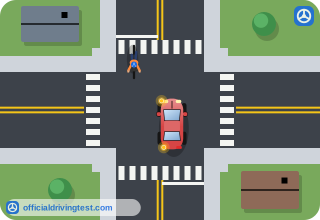
- With hand signals and eye contact
- By ringing a bell continuously
- By flashing the front light
- By riding in the center of the lane
Show answer
Correct answer: With hand signals and eye contact
The manual advises bicyclists to use hand signals and eye contact to communicate their actions with other drivers.
Source: Class D & E Driver’s Guide (Revised August 2025 (DPSMV2052 R08/25)), page 81 · Open this page in the manual (Manual page 81)
-
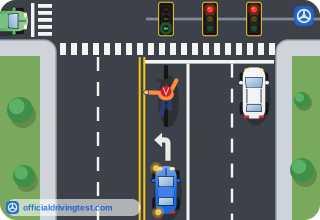
Where should a bicyclist ride when making a left-hand turn?
- On the right side of the turn lane
- On the sidewalk next to the road
- On the left side of the turn lane
- On the right edge of the road
Show answer
Correct answer: On the left side of the turn lane
The manual says that when making a left-hand turn a bicyclist should ride on the left side of the turn lane.
Source: Class D & E Driver’s Guide (Revised August 2025 (DPSMV2052 R08/25)), page 81 · Open this page in the manual (Manual page 81)
-
What does the manual advise bicyclists about the way they ride?
- Be predictable by riding in a straight line and following traffic laws
- Weave between lanes of traffic so that drivers will notice you
- Change position often so drivers cannot predict the next move
- Ride only on the sidewalk and cross streets at crosswalks
Show answer
Correct answer: Be predictable by riding in a straight line and following traffic laws
The manual tells bicyclists to be predictable by riding in a straight line and following traffic laws.
Source: Class D & E Driver’s Guide (Revised August 2025 (DPSMV2052 R08/25)), page 81 · Open this page in the manual (Manual page 81)
-
Whom must bicyclists yield to on crosswalks and on sidewalks?
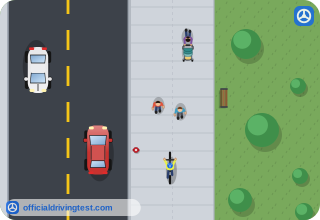
- Other bicyclists
- Motor vehicles
- Nobody
- Pedestrians
Show answer
Correct answer: Pedestrians
The manual tells bicyclists to yield to pedestrians on crosswalks and on sidewalks.
Source: Class D & E Driver’s Guide (Revised August 2025 (DPSMV2052 R08/25)), page 81 · Open this page in the manual (Manual page 81)
-
What lights must a bicycle have when it is ridden at night?
- A red front light and a white rear light visible from behind
- A white front light and a red rear light or reflector
- A white front light and a yellow reflector on each wheel
- Only a white front light, with nothing needed at the rear
Show answer
Correct answer: A white front light and a red rear light or reflector
The manual says that when riding at night, bicycles must have a white front light and a red rear light or reflector visible from the rear.
Source: Class D & E Driver’s Guide (Revised August 2025 (DPSMV2052 R08/25)), page 81 · Open this page in the manual (Manual page 81)
-
How many persons may a bicycle carry, according to the manual?
- Only the rider, with no passengers in any case at all
- No more than the number it is designed and equipped for
- Up to two persons on any bicycle that has a rear seat
- Any number, as long as every rider wears a helmet
Show answer
Correct answer: No more than the number it is designed and equipped for
The manual says to carry no more persons than the number for which the bicycle is designed and equipped.
Source: Class D & E Driver’s Guide (Revised August 2025 (DPSMV2052 R08/25)), page 81 · Open this page in the manual (Manual page 81)
-
What does the manual say about two bicyclists riding side-by-side?
- They may never do so on any public road
- They may do so, and it is safer than riding single file
- They may do so only at night with lights on
- They may do so, but it is safer to ride single file
Show answer
Correct answer: They may do so, but it is safer to ride single file
The manual says two cyclists may ride side-by-side, but it is safer to ride single file.
Source: Class D & E Driver’s Guide (Revised August 2025 (DPSMV2052 R08/25)), page 81 · Open this page in the manual (Manual page 81)
-
What does the manual advise a bicyclist to attach so that traffic behind can be checked easily?
- A rear view mirror
- A bell on the handlebars
- A second front light
- A flag on a tall pole
Show answer
Correct answer: A rear view mirror
The manual advises bicyclists to attach a rear view mirror so they can check traffic over their shoulder.
Source: Class D & E Driver’s Guide (Revised August 2025 (DPSMV2052 R08/25)), page 81 · Open this page in the manual (Manual page 81)