Louisiana: Seat belts and child safety — Part 3 Practice Test
Questions in this part include: “Which passengers should sit in the back seat of a vehicle equipped with air bags?” · “How often does the manual suggest inspecting seat belts for unusual wear or malfunctioning parts?”
Independent educational site · not affiliated with any government agency or DMV
Ready? Test yourself
- Instant feedback with an explanation
- Every answer cites its source in the manual
- Your best score is saved on this device
Questions are original and based on the official manual "Class D & E Driver’s Guide" (Revised August 2025 (DPSMV2052 R08/25)), Louisiana Office of Motor Vehicles.
All 16 questions in this practice test
Take the test above first, then use this list to study. Tap “Show answer” to see the correct answer and explanation.
Show the questions and answersHide the questions
-
Which passengers should sit in the back seat of a vehicle equipped with air bags?
- Only passengers who are pregnant or who are holding infants
- Older, frail persons and children 12 and under
- Only children younger than five years old
- Only passengers who are not wearing a safety belt
Show answer
Correct answer: Older, frail persons and children 12 and under
Front seat air bags have killed children and older people, so older, frail persons and children 12 and under should sit in the back seat.
Source: Class D & E Driver’s Guide (Revised August 2025 (DPSMV2052 R08/25)), page 41 · Open this page in the manual (Manual page 41)
-
How do seatbelts help protect an occupant in a crash?
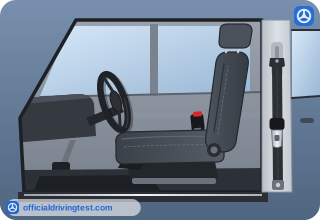
- They harden to hold the occupant completely still on impact
- They spread the force of the crash away from the passenger compartment
- They stretch to slow down the occupant's deceleration
- They inflate to cushion the occupant against the vehicle's interior
Show answer
Correct answer: They stretch to slow down the occupant's deceleration
Seatbelts limit the forward motion of an occupant, stretch to slow down the occupant's deceleration in a crash, and prevent occupants being ejected.
Source: Class D & E Driver’s Guide (Revised August 2025 (DPSMV2052 R08/25)), page 43 · Open this page in the manual (Manual page 43)
-
In a crash, what is "force" in the manual's words?
- The gradual loss of speed
- The weight of the vehicle
- The sudden transfer of energy
- The distance traveled before stopping
Show answer
Correct answer: The sudden transfer of energy
The manual describes the force of a crash as the sudden transfer of energy in a crash.
Source: Class D & E Driver’s Guide (Revised August 2025 (DPSMV2052 R08/25)), page 38 · Open this page in the manual (Manual page 38)
-
If you are not wearing a safety belt, what happens to your body after your car hits something and stops?
- It stays in the seat because the car has already come to a complete stop
- It is thrown forward until stopped by the windshield, dashboard or steering wheel
- It is thrown backward into the seat and the headrest until the car stops rolling
- It is pressed upward against the roof of the vehicle by the force of the crash
Show answer
Correct answer: It is thrown forward until stopped by the windshield, dashboard or steering wheel
Without a safety belt, your body is thrown forward until you are stopped by something like the windshield, the dashboard or the steering wheel.
Source: Class D & E Driver’s Guide (Revised August 2025 (DPSMV2052 R08/25)), page 38 · Open this page in the manual (Manual page 38)
-
In a crash, what happens after your body comes to a stop against some part of the car?
- The force of the crash ends as soon as your body has stopped moving
- The force of the crash passes harmlessly into the ground through the tires
- The seat absorbs the rest of the force before it reaches your body
- The force of the crash goes on inside you, and your internal organs crash too
Show answer
Correct answer: The force of the crash goes on inside you, and your internal organs crash too
Once your body stops against part of the car, the force of the crash goes on inside you, which causes many internal injuries.
Source: Class D & E Driver’s Guide (Revised August 2025 (DPSMV2052 R08/25)), page 38 · Open this page in the manual (Manual page 38)
-
According to the manual, what is your best protection in a crash?
- Driving only in daylight on roads you know well and avoiding bad weather
- Relying on air bags instead of safety belts when you take long trips
- Properly buckling up every time, obeying speed limit laws and always driving safely
- Avoiding the interstate and driving the shortest route to your destination
Show answer
Correct answer: Properly buckling up every time, obeying speed limit laws and always driving safely
Your best protection is to properly buckle up every time, obey the speed limit laws and always drive safely.
Source: Class D & E Driver’s Guide (Revised August 2025 (DPSMV2052 R08/25)), page 38 · Open this page in the manual (Manual page 38)
-
When can a safety belt protect you?
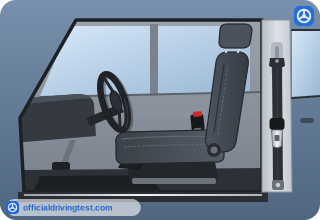
- Whenever it is in the vehicle, even if it is not fastened
- Only in the front seat of the vehicle
- Only if it is worn and worn correctly
- Only at speeds above 40 miles an hour
Show answer
Correct answer: Only if it is worn and worn correctly
A safety belt can protect you only if it is worn and worn correctly.
Source: Class D & E Driver’s Guide (Revised August 2025 (DPSMV2052 R08/25)), page 39 · Open this page in the manual (Manual page 39)
-
How often does the manual suggest inspecting seat belts for unusual wear or malfunctioning parts?
- Weekly
- Monthly
- Every six months
- Once a year
Show answer
Correct answer: Weekly
Inspecting seat belts for unusual wear or malfunctioning parts is on the suggested weekly checks.
Source: Class D & E Driver’s Guide (Revised August 2025 (DPSMV2052 R08/25)), page 44 · Open this page in the manual (Manual page 44)
-
Before starting your engine, what should you make sure about yourself and your passengers?
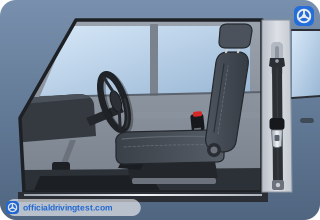
- That passengers sit in the front seat
- That passengers have their seat belts unfastened until moving
- That only the driver is belted
- That you and your passengers are correctly belted
Show answer
Correct answer: That you and your passengers are correctly belted
The manual says to make sure you and the passengers are correctly belted before starting the engine.
Source: Class D & E Driver’s Guide (Revised August 2025 (DPSMV2052 R08/25)), page 45 · Open this page in the manual (Manual page 45)
-
Which of these does the manual tell drivers not to do in the heat of summer?
- Share the travel itinerary with family
- Have the car serviced before a trip
- Use a sun shield when parked
- Leave pets or children waiting in a car
Show answer
Correct answer: Leave pets or children waiting in a car
The manual says the summer sun can create dangerously hot temperatures in a vehicle and tells drivers not to leave pets or children waiting in a car.
Source: Class D & E Driver’s Guide (Revised August 2025 (DPSMV2052 R08/25)), page 51 · Open this page in the manual (Manual page 51)
-
One of the National Safety Council’s guidelines says you should not start the engine until you have done what?
- Warmed up the engine for at least five minutes
- Secured each passenger, including children and pets
- Filled the fuel tank completely
- Told a friend which route you plan to take
Show answer
Correct answer: Secured each passenger, including children and pets
The guideline is not to start the engine without securing each passenger in the car, including children and pets.
Source: Class D & E Driver’s Guide (Revised August 2025 (DPSMV2052 R08/25)), page 54 · Open this page in the manual (Manual page 54)
-
Persons under what age may not be passengers in the open bed of a truck?
- Ten years
- Sixteen years
- Eighteen years
- Twelve years
Show answer
Correct answer: Twelve years
The manual says no person under the age of twelve years may be a passenger in the open bed of a truck.
Source: Class D & E Driver’s Guide (Revised August 2025 (DPSMV2052 R08/25)), page 96 · Open this page in the manual (Manual page 96)
-
When is a person of any age not permitted to be a passenger in the open bed of a truck?
- When the truck is moving faster than 35 mph
- When the truck is moving upon an interstate highway
- When the truck is moving on a two-lane road
- When the truck is moving after dark
Show answer
Correct answer: When the truck is moving upon an interstate highway
The manual says no person of any age may ride in the open bed of a truck that is moving upon an interstate highway.
Source: Class D & E Driver’s Guide (Revised August 2025 (DPSMV2052 R08/25)), page 96 · Open this page in the manual (Manual page 96)
-
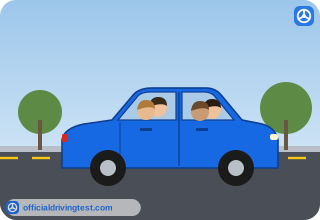
Before you start your engine, what should you verify about the occupants of the vehicle?
- That all of them are seated in the back
- That all of them are wearing seat belts
- That all of them know the route
- That all of them are over twelve years old
Show answer
Correct answer: That all of them are wearing seat belts
One of the things to remember before starting the engine is to verify that all occupants are wearing seat belts.
Source: Class D & E Driver’s Guide (Revised August 2025 (DPSMV2052 R08/25)), page 110 · Open this page in the manual (Manual page 110)
-
According to the manual, what is the best protection before a crash?
- Driving only short trips on roads that you know very well
- Keeping all loose items on the back seat of your vehicle
- Buckling your seat belt and shoulder harness before every trip
- Holding the steering wheel loosely with both of your hands
Show answer
Correct answer: Buckling your seat belt and shoulder harness before every trip
The best protection before a crash is to buckle your seat belt and shoulder harness before you start any trip, no matter how short.
Source: Class D & E Driver’s Guide (Revised August 2025 (DPSMV2052 R08/25)), page 114 · Open this page in the manual (Manual page 114)
-
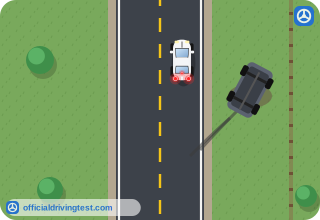
According to the manual, what is the most effective way to reduce the risk of injury or death in a rollover?
- Drive a taller vehicle
- Open the windows
- Use your safety belt
- Carry extra cargo for weight
Show answer
Correct answer: Use your safety belt
Without safety belts, occupants can be thrown from a rolling vehicle, so using your safety belt is the most effective protection.
Source: Class D & E Driver’s Guide (Revised August 2025 (DPSMV2052 R08/25)), page 115 · Open this page in the manual (Manual page 115)