Louisiana: Seat belts and child safety — Part 2 Practice Test
Questions in this part include: “A child falls into more than one category for age or weight. Which category must be chosen?” · “As a parent or caregiver, on which trips should you use a seat belt to set a good example?”
Independent educational site · not affiliated with any government agency or DMV
Ready? Test yourself
- Instant feedback with an explanation
- Every answer cites its source in the manual
- Your best score is saved on this device
Questions are original and based on the official manual "Class D & E Driver’s Guide" (Revised August 2025 (DPSMV2052 R08/25)), Louisiana Office of Motor Vehicles.
All 16 questions in this practice test
Take the test above first, then use this list to study. Tap “Show answer” to see the correct answer and explanation.
Show the questions and answersHide the questions
-
A child falls into more than one category for age or weight. Which category must be chosen?
- The less protective category
- The category that matches the child's age only
- The category the parent finds more comfortable
- The more protective category
Show answer
Correct answer: The more protective category
A child who falls into more than one category for age or weight must choose the more protective category.
Source: Class D & E Driver’s Guide (Revised August 2025 (DPSMV2052 R08/25)), page 41 · Open this page in the manual (Manual page 41)
-
Which of these must you never do when a small child rides with you?
- Place the child in an age- and size-appropriate car seat
- Buckle yourself and the child into a single safety belt
- Use a seat belt yourself on every trip, even a short one
- Seat the child in the back seat when one is available
Show answer
Correct answer: Buckle yourself and the child into a single safety belt
The manual says never to hold a child on your lap or buckle yourself and a child into a single safety belt, because you are not strong enough to hold onto even a small child in a crash.
Source: Class D & E Driver’s Guide (Revised August 2025 (DPSMV2052 R08/25)), page 41 · Open this page in the manual (Manual page 41)
-
How must a child never be allowed to ride in a vehicle?
- Standing on a seat
- In the middle of the back seat
- In a booster seat with restraints
- Buckled in the rear seat
Show answer
Correct answer: Standing on a seat
The manual says never to allow a child to ride standing on a seat.
Source: Class D & E Driver’s Guide (Revised August 2025 (DPSMV2052 R08/25)), page 41 · Open this page in the manual (Manual page 41)
-
As a parent or caregiver, on which trips should you use a seat belt to set a good example?
- Only trips on the interstate or other highways
- Only trips when children are riding with you
- Every trip, no matter how short
- Only trips longer than ten miles
Show answer
Correct answer: Every trip, no matter how short
A parent or caregiver should use a seat belt on every trip, no matter how short, which sets a good example.
Source: Class D & E Driver’s Guide (Revised August 2025 (DPSMV2052 R08/25)), page 41 · Open this page in the manual (Manual page 41)
-
How does the middle of the back seat in a passenger car compare with the front seat?
- It is less safe than the front seat
- It is safer than the front seat
- It is equally safe as the front seat
- It is safer only for adult passengers
Show answer
Correct answer: It is safer than the front seat
The middle of the back seat in a passenger car is safer than the front seat.
Source: Class D & E Driver’s Guide (Revised August 2025 (DPSMV2052 R08/25)), page 41 · Open this page in the manual (Manual page 41)
-
An air bag inflates rapidly with air or another gas during which kind of collision?
- Any hard braking or sudden stop
- A low-speed bump while parking
- Only a collision above highway speed
- A head on or nearly head on collision
Show answer
Correct answer: A head on or nearly head on collision
An airbag is a flexible membrane that inflates rapidly during a head on or nearly head on collision.
Source: Class D & E Driver’s Guide (Revised August 2025 (DPSMV2052 R08/25)), page 41 · Open this page in the manual (Manual page 41)
-
In which situation do air bags not deploy?
- When you are in a head on collision
- When you are in a nearly head on collision
- When you are rear-ended by another car
- When you are wearing a safety belt
Show answer
Correct answer: When you are rear-ended by another car
The manual states that air bags do not deploy when you are rear-ended by another car.
Source: Class D & E Driver’s Guide (Revised August 2025 (DPSMV2052 R08/25)), page 41 · Open this page in the manual (Manual page 41)
-
How do air bags relate to safety belts?
- They supplement the protection of safety belts but do not replace them
- They replace safety belts in vehicles that have front and side air bags
- They work only when the safety belt has been left unbuckled
- They protect the lower body while safety belts protect the head
Show answer
Correct answer: They supplement the protection of safety belts but do not replace them
Air bags do not replace safety belts; they supplement the safety that belts provide.
Source: Class D & E Driver’s Guide (Revised August 2025 (DPSMV2052 R08/25)), page 41 · Open this page in the manual (Manual page 41)
-
The manual calls air bags what kind of system?
- A Primary Restraint System
- A Replacement Restraint System
- A Secondary Braking System
- A Supplementary Restraint System
Show answer
Correct answer: A Supplementary Restraint System
Air bags are a Supplementary Restraint System, while your safety belt is your primary restraint.
Source: Class D & E Driver’s Guide (Revised August 2025 (DPSMV2052 R08/25)), page 42 · Open this page in the manual (Manual page 42)
-
What do air bags reduce the chance of?
- A whiplash injury from being struck from behind by another vehicle
- A head or upper body injury from the vehicle's interior equipment
- An injury to the lower body from striking the dashboard or pedals
- An injury from being thrown out of the vehicle through a window
Show answer
Correct answer: A head or upper body injury from the vehicle's interior equipment
Air bags reduce the chance of the occupant sustaining a head or upper body injury from encounters with the vehicle's interior equipment.
Source: Class D & E Driver’s Guide (Revised August 2025 (DPSMV2052 R08/25)), page 41 · Open this page in the manual (Manual page 41)
-
At about what speed does a deploying air bag come out?
- 50 to 75 miles per hour
- 80 to 100 miles per hour
- 150 to 200 miles per hour
- 250 to 300 miles per hour
Show answer
Correct answer: 150 to 200 miles per hour
The air bag, when it deploys, comes out at speeds of 150 to 200 miles per hour.
Source: Class D & E Driver’s Guide (Revised August 2025 (DPSMV2052 R08/25)), page 41 · Open this page in the manual (Manual page 41)
-
Why is the traditional 10 and 2 hand position no longer recommended in vehicles with air bags?
- It blocks your view of the instrument panel at the moment the air bag inflates
- A deploying air bag can throw your hands into your head or break your wrist or forearm
- It keeps the air bag from inflating fully when there is a head on collision
- It makes hand-over-hand steering impossible when driving at low speeds
Show answer
Correct answer: A deploying air bag can throw your hands into your head or break your wrist or forearm
If your hands are on the upper part of the wheel, a deploying air bag can throw them into your head, causing a serious head injury, or break your wrist or forearm.
Source: Class D & E Driver’s Guide (Revised August 2025 (DPSMV2052 R08/25)), page 41 · Open this page in the manual (Manual page 41)
-
What is the purpose of a passenger air bag on-off switch in the off position?
- To disable the driver's air bag for a driver who sits very close to the steering wheel
- To disable the side air bags so that a rear seat passenger can lean on the door
- To disable the passenger air bag for any passenger who is not wearing a safety belt
- To disable the front passenger air bag so a child age 12 or under can ride in the right front seat
Show answer
Correct answer: To disable the front passenger air bag so a child age 12 or under can ride in the right front seat
The off position disables the front passenger air bag so that a child age 12 or under can be transported in the right front passenger seat.
Source: Class D & E Driver’s Guide (Revised August 2025 (DPSMV2052 R08/25)), page 41 · Open this page in the manual (Manual page 41)
-
Which vehicles commonly have a passenger air bag on-off switch as standard equipment?
- Large sedans that have a wide back seat and side impact air bags in the doors
- Vans and station wagons that have three rows of seats for many passengers
- Vehicles without rear seats or with small rear seats, such as pickup trucks or sports cars
- Any vehicle that was built with a driver's side air bag as standard equipment
Show answer
Correct answer: Vehicles without rear seats or with small rear seats, such as pickup trucks or sports cars
Most vehicles without rear seats or with small rear seats, such as pickup trucks or sports cars, have a passenger air bag on-off switch as standard equipment.
Source: Class D & E Driver’s Guide (Revised August 2025 (DPSMV2052 R08/25)), page 41 · Open this page in the manual (Manual page 41)
-
Drivers of vehicles equipped with air bags must sit at least how far from the steering wheel?
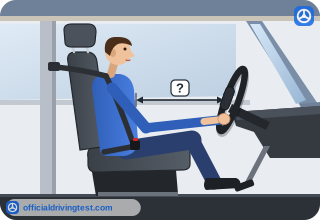
- 10 inches
- 5 inches
- 6 inches
- 14 inches
Show answer
Correct answer: 10 inches
The driver must sit at least 10 inches away from a steering wheel equipped with an air bag, otherwise the bag can explode into the driver and cause serious harm.
Source: Class D & E Driver’s Guide (Revised August 2025 (DPSMV2052 R08/25)), page 41 · Open this page in the manual (Manual page 41)
-
In a vehicle with air bags, how should a tilting steering wheel be set?
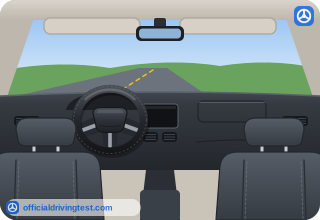
- Tilted toward the driver's head so the bag cannot reach the chest
- Level with the driver's eyes so the horn can be seen
- Tilted toward the floor to leave room for the knees
- Tilted away from the head, preferably toward the chest
Show answer
Correct answer: Tilted away from the head, preferably toward the chest
With a tilt function, the wheel should be tilted away from the head, preferably toward the chest.
Source: Class D & E Driver’s Guide (Revised August 2025 (DPSMV2052 R08/25)), page 41 · Open this page in the manual (Manual page 41)