Louisiana: Seat belts and child safety — Part 1 Practice Test
Questions in this part include: “The manual says deaths per 100 million miles traveled have dropped. What is most of that decrease due to?” · “According to the manual, what is your best defense against a drunk driver?”
Independent educational site · not affiliated with any government agency or DMV
Ready? Test yourself
- Instant feedback with an explanation
- Every answer cites its source in the manual
- Your best score is saved on this device
Questions are original and based on the official manual "Class D & E Driver’s Guide" (Revised August 2025 (DPSMV2052 R08/25)), Louisiana Office of Motor Vehicles.
All 16 questions in this practice test
Take the test above first, then use this list to study. Tap “Show answer” to see the correct answer and explanation.
Show the questions and answersHide the questions
-
Vehicles manufactured after which year must be equipped with functional seat belts, according to the road skills test note?
- 1964
- 1954
- 1974
- 1984
Show answer
Correct answer: 1964
The note states that all vehicles manufactured after 1964 must be equipped with functional seat belts.
Source: Class D & E Driver’s Guide (Revised August 2025 (DPSMV2052 R08/25)), page 9 · Open this page in the manual (Manual page 9)
-
The manual says deaths per 100 million miles traveled have dropped. What is most of that decrease due to?
- Lower speed limits on the nation’s highways and roads
- Fewer miles driven by Americans in their vehicles each year
- Seat belts, airbags and improved safety features in vehicles
- Stricter punishment for drivers brought before traffic courts
Show answer
Correct answer: Seat belts, airbags and improved safety features in vehicles
The manual says most of the decrease in deaths per 100 million miles traveled is due to seat belts, airbags and improved safety features in vehicles.
Source: Class D & E Driver’s Guide (Revised August 2025 (DPSMV2052 R08/25)), page 19 · Open this page in the manual (Manual page 19)
-
Under Louisiana's mandatory safety belt use law, who must be properly buckled?
- All passengers in both the front and back seats of cars, vans and pickup trucks
- Only the driver and the front seat passenger in cars, vans and pickup trucks
- Only drivers and passengers under 18 years old in cars and vans
- Only front seat passengers in cars and vans, but not in pickup trucks
Show answer
Correct answer: All passengers in both the front and back seats of cars, vans and pickup trucks
Louisiana's mandatory safety belt use law requires all passengers in both the front and back seats in cars, vans and pickup trucks to be properly buckled.
Source: Class D & E Driver’s Guide (Revised August 2025 (DPSMV2052 R08/25)), page 39 · Open this page in the manual (Manual page 39)
-
According to the manual, which automotive safety device saves more lives than any other?
- The front air bag
- The headrest
- The three-point safety belt
- The anti-lock braking system
Show answer
Correct answer: The three-point safety belt
The manual says the three-point safety belt saves more lives than any other automotive safety device.
Source: Class D & E Driver’s Guide (Revised August 2025 (DPSMV2052 R08/25)), page 39 · Open this page in the manual (Manual page 39)
-
Your safety belt should fit snugly across which part of your body?
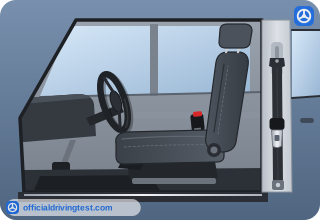
- Your ribs
- Your hips
- Your upper thighs
- Your lower back
Show answer
Correct answer: Your hips
The manual says a safety belt should fit snugly across your hips, because the strong hip bones can absorb more of the impact.
Source: Class D & E Driver’s Guide (Revised August 2025 (DPSMV2052 R08/25)), page 39 · Open this page in the manual (Manual page 39)
-
How should the upper strap of a safety belt be positioned?
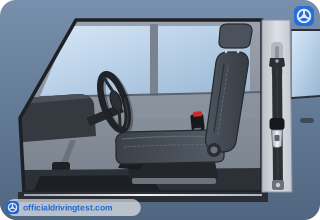
- Under the arm and snugly across the lower stomach
- Behind your back and across the hips
- Across the neck and over the opposite arm
- Over the shoulder and securely across the chest
Show answer
Correct answer: Over the shoulder and securely across the chest
The shoulder strap should slide over the shoulder and securely across the chest.
Source: Class D & E Driver’s Guide (Revised August 2025 (DPSMV2052 R08/25)), page 39 · Open this page in the manual (Manual page 39)
-
What can happen to unbelted backseat passengers in a crash?
- They are protected because the front seats absorb the force of the crash
- They are held in place by the headrests of the front seats
- They can be thrown into other passengers or ejected from the vehicle
- They are at risk only if the vehicle rolls over
Show answer
Correct answer: They can be thrown into other passengers or ejected from the vehicle
Backseat passengers who are not belted can be thrown into other passengers as well as ejected from the vehicle in a crash.
Source: Class D & E Driver’s Guide (Revised August 2025 (DPSMV2052 R08/25)), page 39 · Open this page in the manual (Manual page 39)
-
How does wearing a safety belt help if there is danger from fire or water after a crash?
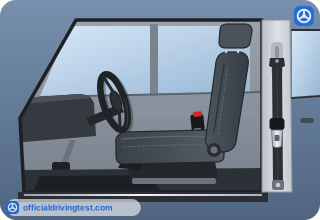
- There is much less chance of being knocked unconscious, so you can get out quickly
- The belt locks the doors so that fire and water cannot enter the vehicle during the crash
- The belt holds you in the seat so that rescuers can find you quickly after the crash
- The belt keeps your body away from the windows until help arrives at the scene
Show answer
Correct answer: There is much less chance of being knocked unconscious, so you can get out quickly
A belted occupant has much less chance of being knocked unconscious or seriously injured, so they can get out quickly if there is danger from fire or water.
Source: Class D & E Driver’s Guide (Revised August 2025 (DPSMV2052 R08/25)), page 39 · Open this page in the manual (Manual page 39)
-
How does a safety belt help you control the car in a crash?
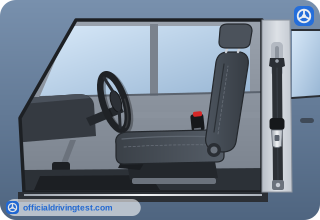
- It stops the vehicle sooner than an unbelted driver would be able to stop it
- It keeps the steering wheel from turning during the impact
- It keeps your foot pressed on the brake pedal during the crash
- It keeps you in position behind the wheel instead of being thrown from it
Show answer
Correct answer: It keeps you in position behind the wheel instead of being thrown from it
Safety belts keep you in a position so you can control the car, since the first impact in a crash frequently throws the driver from behind the wheel.
Source: Class D & E Driver’s Guide (Revised August 2025 (DPSMV2052 R08/25)), page 39 · Open this page in the manual (Manual page 39)
-
If you are pregnant, what should you wear to be much safer?
- Only a lap belt, without the shoulder strap
- A lap and shoulder belt
- No belt, so the unborn child is not squeezed
- Only the shoulder strap, across the chest
Show answer
Correct answer: A lap and shoulder belt
If you are pregnant, you and your unborn child are much safer if you wear a lap and shoulder belt.
Source: Class D & E Driver’s Guide (Revised August 2025 (DPSMV2052 R08/25)), page 40 · Open this page in the manual (Manual page 40)
-
According to the manual, what is your best defense against a drunk driver?
- A seat belt
- Air bags
- A headrest
- Tinted windows
Show answer
Correct answer: A seat belt
The manual states that a seat belt is your best defense against a drunk driver.
Source: Class D & E Driver’s Guide (Revised August 2025 (DPSMV2052 R08/25)), page 40 · Open this page in the manual (Manual page 40)
-
What does the Louisiana Child Passenger Restraint law (R.S. 32:295) require for all children?
- To ride in a rear-facing car seat until they are six years old, regardless of their size
- To use whichever seat belt or car seat the parent prefers, as long as they are buckled
- To be properly restrained in an age- or size-appropriate system that meets federal safety standards
- To ride in a booster seat until they are 13 years old, regardless of their weight and height
Show answer
Correct answer: To be properly restrained in an age- or size-appropriate system that meets federal safety standards
The law requires all children to be properly restrained and secured in an age- or size-appropriate passenger restraint system that meets the applicable federal motor vehicle safety standards.
Source: Class D & E Driver’s Guide (Revised August 2025 (DPSMV2052 R08/25)), page 40 · Open this page in the manual (Manual page 40)
-
Under the Louisiana law that sets child restraints by age, how must a 1-year-old child ride?
- In a forward facing, federally approved car seat
- In a rear facing, federally approved car seat
- In a booster seat with restraints
- In a lap shoulder seat belt secured correctly on the vehicle seat
Show answer
Correct answer: In a rear facing, federally approved car seat
From birth to at least 2 years, a child rides in a rear facing, federally approved car seat.
Source: Class D & E Driver’s Guide (Revised August 2025 (DPSMV2052 R08/25)), page 40 · Open this page in the manual (Manual page 40)
-
Which restraint does the Louisiana law list for children 2-4 years old?
- In a rear facing, federally approved car seat
- In a booster seat with restraints
- In a lap shoulder seat belt secured correctly on the vehicle seat
- In a forward facing, federally approved car seat
Show answer
Correct answer: In a forward facing, federally approved car seat
Children aged 2-4 years ride in a forward facing, federally approved car seat.
Source: Class D & E Driver’s Guide (Revised August 2025 (DPSMV2052 R08/25)), page 40 · Open this page in the manual (Manual page 40)
-
Under the Louisiana law that sets child restraints by age, how must a 6-year-old child ride?
- In a rear facing, federally approved car seat
- In a forward facing, federally approved car seat
- In a booster seat with restraints
- In a lap shoulder seat belt with no booster seat
Show answer
Correct answer: In a booster seat with restraints
Children aged 4-9 years ride in a booster seat with restraints.
Source: Class D & E Driver’s Guide (Revised August 2025 (DPSMV2052 R08/25)), page 40 · Open this page in the manual (Manual page 40)
-
Where should a child younger than 13 ride, when a rear seat is available?
- In the rear seat of the vehicle, properly restrained
- In the front passenger seat so the driver can watch the child
- In the front seat once the child reaches 9 years of age
- In either the front or rear seat, as long as the child is buckled
Show answer
Correct answer: In the rear seat of the vehicle, properly restrained
A child younger than 13 years rides in the rear seat of a vehicle, when available and properly restrained.
Source: Class D & E Driver’s Guide (Revised August 2025 (DPSMV2052 R08/25)), page 40 · Open this page in the manual (Manual page 40)