Pavement markings in Louisiana
The Class D & E Driver’s Guide shows or names everything on this page: 18 in all, on pages 34–36, 70.
Independent educational site · not affiliated with any government agency or DMV
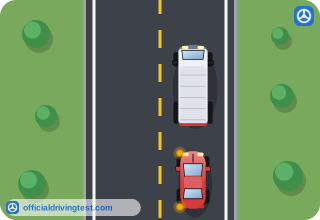
Single Broken Yellow Line
A Single Broken Yellow line is used to mark the centerline where there are only two lanes of traffic. You must drive to the right of the centerline. When it is safe, you may cross this line to turn or pass another vehicle.
Manual page 34 · Open this page in the manual (Manual page 34)
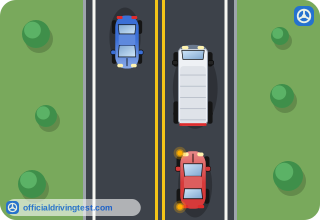
Double Solid Yellow Lines
Double Solid Yellow lines are used to mark the center of the roadway when there are four or more lanes of traffic. You may not cross these lines to pass. You may cross these lines to make a turn.
Manual page 34 · Open this page in the manual (Manual page 34)
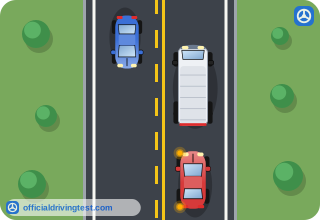
No Passing Line
A No Passing Line is a single solid yellow line used on two-lane roads to indicate zones where passing is prohibited. You may cross this line to make a turn or if the dashed line is present on your side of travel.
Manual page 34 · Open this page in the manual (Manual page 34)
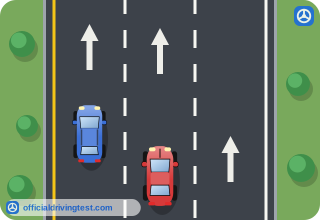
One-Way Road Lane Lines
White lines separate lanes of traffic moving in the same direction. You are required to drive between these lane lines.
Manual page 35 · Open this page in the manual (Manual page 35)
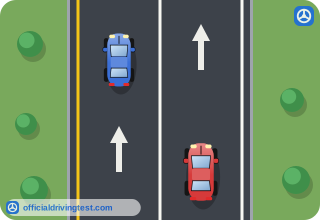
Single Solid White Line
Single Solid White lines indicate movement from lane to lane is hazardous. The wider the line, the greater the hazard. You may cross a solid white line only with great care.
Manual page 35 · Open this page in the manual (Manual page 35)
Single Dashed White Lane Lines
Single Dashed White Lane Lines may be crossed only when you can do so safely.
Manual page 35 · Open this page in the manual (Manual page 35)
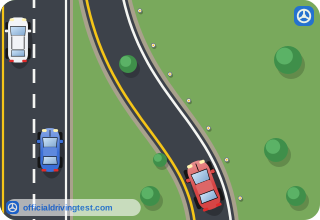
White Edge Lines
White edge lines are used along the right edge of the roadway. Yellow edge lines may be along the left edge of the roadway on divided streets and highways.
Manual page 35 · Open this page in the manual (Manual page 35)
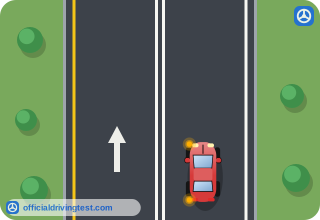
Double Solid White Lines
Double solid white lines separate two lanes of traffic going in the same direction. Crossing a double solid line is prohibited. Most commonly seen on interstates.
Manual page 35 · Open this page in the manual (Manual page 35)
Red Raised Pavement Markers
Red Raised Pavement Marking or reflectors indicate going against the direction of travel. This is a roadway that must not be entered.
Manual page 35 · Open this page in the manual (Manual page 35)
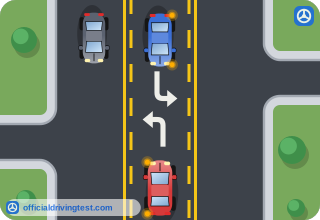
Two-Way Left Turn Lane
Two-Way Left Turn Lane markings are a combination of solid yellow and dashed yellow lines in the center of a roadway. The designated center lane may be used by vehicles traveling in either direction. For left turn maneuvers ONLY. The lane must NEVER be used for travel or passing.
Manual page 36 · Open this page in the manual (Manual page 36)
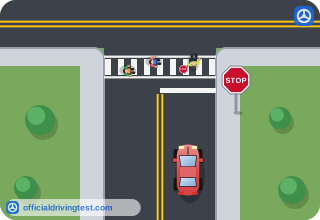
Stop Lines
Stop Lines are solid white lines painted across the traffic lanes at intersections and pedestrian crosswalks indicating the exact place at which to stop.
Manual page 36 · Open this page in the manual (Manual page 36)
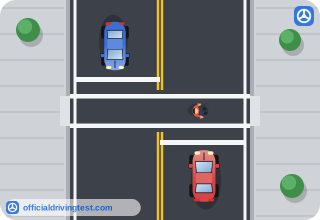
Crosswalk
Crosswalk lines are normally two solid white lines painted across the traffic lanes. However, diagonal or longitudinal lines are sometimes added for increased visibility. When pedestrians are in these crosswalks, they have the right of way over motor vehicles. You must stop for pedestrians in crosswalks.
Manual page 36 · Open this page in the manual (Manual page 36)
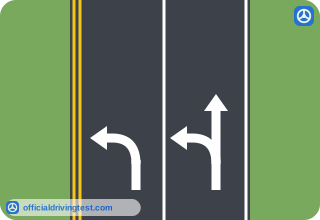
Directional Pavement Arrows
Directional Markings are white arrows or words painted in the traffic lane to indicate the direction in which you must go. You must move only in the direction indicated by the arrow. Where arrows indicate more than one direction, you may choose any direction
Manual page 36 · Open this page in the manual (Manual page 36)
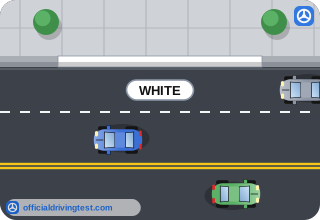
White Curb
White - indicates that only short stops are permitted
Manual page 70 · Open this page in the manual (Manual page 70)
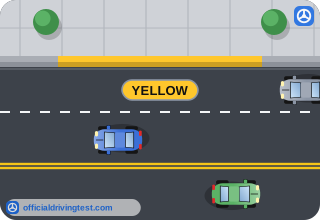
Yellow Curb
Yellow - indicates a loading zone or some other restriction
Manual page 70 · Open this page in the manual (Manual page 70)
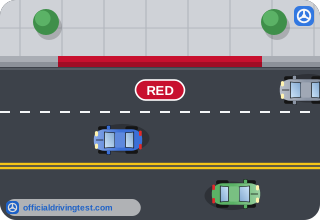
Red Curb
Red – indicates fire zone restrictions
Manual page 70 · Open this page in the manual (Manual page 70)
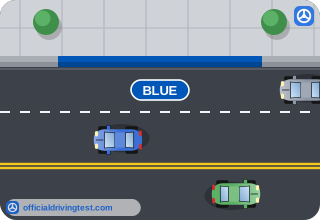
Blue Curb
Blue– indicates an accessibility restriction
Manual page 70 · Open this page in the manual (Manual page 70)
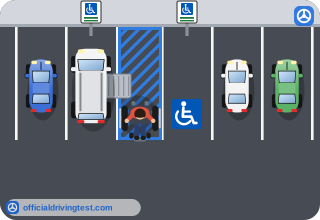
Accessible Space Access Aisle
Some accessible parking spaces have an area on the side marked by blue lines with blue diagonal stripes. This area is the access aisle. The purpose the access aisle is to allow safe loading and unloading of equipment and to provide safe access for individuals with disabilities.
Manual page 70 · Open this page in the manual (Manual page 70)