Louisiana: Railroad crossings — Part 2 Practice Test
Questions in this part include: “Your vehicle has a manual transmission. What does the manual say to do about shifting gears at a railroad crossing?” · “Which of these has the right of way 100% of the time over emergency vehicles, cars, the police and pedestrians?”
Independent educational site · not affiliated with any government agency or DMV
Ready? Test yourself
- Instant feedback with an explanation
- Every answer cites its source in the manual
- Your best score is saved on this device
Questions are original and based on the official manual "Class D & E Driver’s Guide" (Revised August 2025 (DPSMV2052 R08/25)), Louisiana Office of Motor Vehicles.
All 21 questions in this practice test
Take the test above first, then use this list to study. Tap “Show answer” to see the correct answer and explanation.
Show the questions and answersHide the questions
-
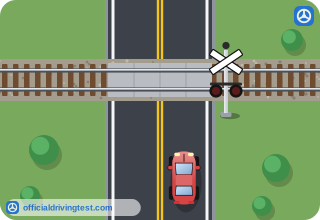
Why should you look both ways as you approach a railroad crossing even if the warning lights are not flashing?
- Trains only use the crossing at night
- The lights flash only after a train has passed
- The warning lights may not be working
- Warning lights are used only at private crossings
Show answer
Correct answer: The warning lights may not be working
The manual says to always look both ways, even if the warning lights are not flashing, because they may not be working.
Source: Class D & E Driver’s Guide (Revised August 2025 (DPSMV2052 R08/25)), page 95 · Open this page in the manual (Manual page 95)
-
Your vehicle has a manual transmission. What does the manual say to do about shifting gears at a railroad crossing?
- Shift into a lower gear as you cross the first rail
- Shift into neutral and coast across the tracks
- Shift before the tracks and do not change gears on them
- Change gears on the crossing only if you need to slow down
Show answer
Correct answer: Shift before the tracks and do not change gears on them
The manual says never to shift gears on the crossing: shift before reaching the tracks and do not change gears while crossing.
Source: Class D & E Driver’s Guide (Revised August 2025 (DPSMV2052 R08/25)), page 95 · Open this page in the manual (Manual page 95)
-
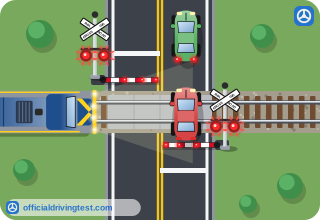
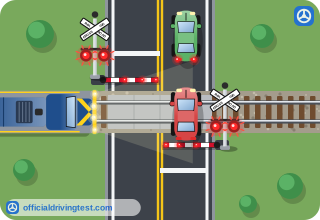
At a crossing with gates and flashing signals, when should you stop?
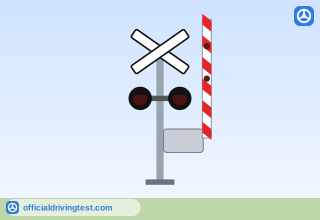
- When the light begins flashing and before the gates are lowered
- Only after the gates have been lowered
- Only when the train is in sight
- Only when the gates are lowered and a train is visible
Show answer
Correct answer: When the light begins flashing and before the gates are lowered
The manual says to stop when the light begins flashing and before the gates are lowered.
Source: Class D & E Driver’s Guide (Revised August 2025 (DPSMV2052 R08/25)), page 95 · Open this page in the manual (Manual page 95)
-
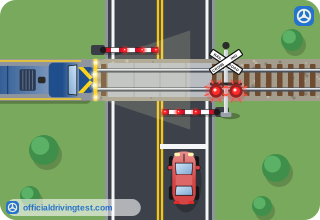
At a railroad crossing with gates, how long must you remain stopped?
- Until the first vehicle ahead of you has crossed
- Until you can see the far side of the tracks
- Until the train's horn stops sounding
- Until the gates are raised
Show answer
Correct answer: Until the gates are raised
The manual says to remain stopped until the gates are raised.
Source: Class D & E Driver’s Guide (Revised August 2025 (DPSMV2052 R08/25)), page 95 · Open this page in the manual (Manual page 95)
-
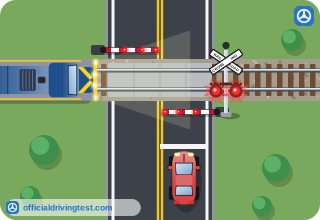
Which of these is against the law at a railroad crossing?
- Stopping 20 feet from the nearest rail
- Driving through or around any crossing gate
- Waiting for the gates to be raised
- Looking both ways before crossing
Show answer
Correct answer: Driving through or around any crossing gate
The manual says it is against the law to drive through or around any crossing gate at a railroad crossing.
Source: Class D & E Driver’s Guide (Revised August 2025 (DPSMV2052 R08/25)), page 95 · Open this page in the manual (Manual page 95)
-
At a railroad crossing, where and when should you expect a train?
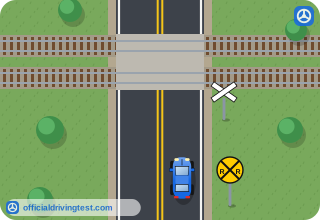
- Only on the track nearest to you
- On any track at any time
- Only at the times posted at the crossing
- Only during the daytime
Show answer
Correct answer: On any track at any time
The manual says to expect a train on any track at any time.
Source: Class D & E Driver’s Guide (Revised August 2025 (DPSMV2052 R08/25)), page 95 · Open this page in the manual (Manual page 95)
-
What does the manual say about the times and schedules of freight trains?
- They travel on fixed schedules posted at each crossing
- They travel only at night
- They do not travel at fixed times and schedules
- They travel only during daylight hours
Show answer
Correct answer: They do not travel at fixed times and schedules
The manual says freight trains do not travel at fixed times and schedules.
Source: Class D & E Driver’s Guide (Revised August 2025 (DPSMV2052 R08/25)), page 95 · Open this page in the manual (Manual page 95)
-
When does the manual say you should be especially careful at a railroad crossing?
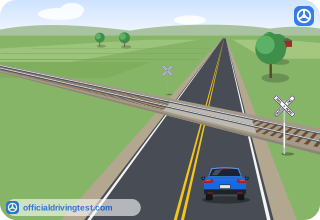
- When visibility is low or the tracks are hidden from view
- Only when the crossing has no gates
- Only when the crossing has more than one set of tracks
- Only when the flashing lights are on
Show answer
Correct answer: When visibility is low or the tracks are hidden from view
The manual says to be especially careful when visibility is low or the tracks may be hidden from view by trees, hills, buildings and similar things.
Source: Class D & E Driver’s Guide (Revised August 2025 (DPSMV2052 R08/25)), page 95 · Open this page in the manual (Manual page 95)
-
What is the Emergency Notification System (ENS) at a railroad crossing used for?
- To ask the railroad to hold a train for waiting traffic
- To check the posted schedule of trains that use the crossing
- To pay fines for crossing violations
- To notify the railroad of an emergency or warning device malfunction
Show answer
Correct answer: To notify the railroad of an emergency or warning device malfunction
The manual says the ENS is used to notify the railroad of an emergency or warning device malfunction.
Source: Class D & E Driver’s Guide (Revised August 2025 (DPSMV2052 R08/25)), page 95 · Open this page in the manual (Manual page 95)
-
Besides a telephone number, what does the Emergency Notification System sign at a railroad crossing list?
- The speed limit for trains
- A US DOT number
- The number of tracks at the crossing
- The date of the last inspection
Show answer
Correct answer: A US DOT number
The manual says the Emergency Notification System sign lists a telephone number along with a US DOT number.
Source: Class D & E Driver’s Guide (Revised August 2025 (DPSMV2052 R08/25)), page 95 · Open this page in the manual (Manual page 95)
-
What does the manual say about judging an oncoming train?
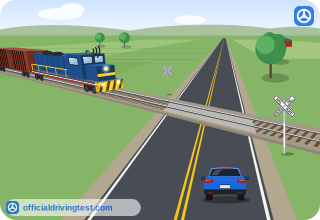
- You can judge its speed but not its distance
- You can judge both if the track is straight
- You cannot judge its distance and speed
- You can judge both if the gates are lowered
Show answer
Correct answer: You cannot judge its distance and speed
Track Fact #1 in the manual is that you cannot judge the distance and speed of an oncoming train.
Source: Class D & E Driver’s Guide (Revised August 2025 (DPSMV2052 R08/25)), page 96 · Open this page in the manual (Manual page 96)
-
What are railroad tracks, trestles, bridges and railroad yards, according to the manual?
- Private property
- Public property open to pedestrians
- Public rights-of-way
- State-owned roadways
Show answer
Correct answer: Private property
Track Fact #2 in the manual is that railroad tracks, trestles, bridges and railroad yards are private property.
Source: Class D & E Driver’s Guide (Revised August 2025 (DPSMV2052 R08/25)), page 96 · Open this page in the manual (Manual page 96)
-
Which of these has the right of way 100% of the time over emergency vehicles, cars, the police and pedestrians?
- Trains
- School buses
- Funeral processions
- Police vehicles with sirens
Show answer
Correct answer: Trains
Track Fact #4 in the manual is that trains have the right of way 100% of the time over emergency vehicles, cars, the police and pedestrians.
Source: Class D & E Driver’s Guide (Revised August 2025 (DPSMV2052 R08/25)), page 96 · Open this page in the manual (Manual page 96)
-
According to the manual, how far does a 100 car freight train traveling at 55 miles per hour need to stop?
- About a quarter of a mile
- About half a mile
- About 500 feet
- More than a mile
Show answer
Correct answer: More than a mile
The manual says a 100 car freight train traveling at 55 miles per hour requires more than a mile to stop.
Source: Class D & E Driver’s Guide (Revised August 2025 (DPSMV2052 R08/25)), page 96 · Open this page in the manual (Manual page 96)
-
How does the manual say many rural highway-railroad grade crossings are marked?
- With flashing red lights and lowering crossing gates
- Only with a stop sign and a stop line at the tracks
- With a flagger who stops traffic at each crossing
- Only with a warning sign and a white X-shaped sign
Show answer
Correct answer: Only with a warning sign and a white X-shaped sign
The manual says many rural crossings are marked only with a warning sign and a white X-shaped railroad crossing sign and typically have no lights or gates.
Source: Class D & E Driver’s Guide (Revised August 2025 (DPSMV2052 R08/25)), page 103 · Open this page in the manual (Manual page 103)
-
At a rural highway-railroad grade crossing without lights or gates, what should you always do?
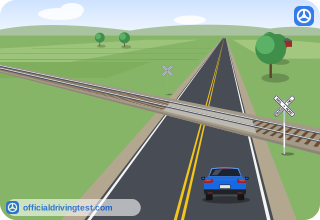
- Slow down, look both ways and be prepared to stop for a train
- Stop only if you can see a train approaching the tracks
- Speed up so you can clear the tracks as quickly as you can
- Sound your horn and cross without slowing down
Show answer
Correct answer: Slow down, look both ways and be prepared to stop for a train
The manual says you should always slow down, look both ways and be prepared to stop for a train before crossing the tracks.
Source: Class D & E Driver’s Guide (Revised August 2025 (DPSMV2052 R08/25)), page 103 · Open this page in the manual (Manual page 103)
-
If your vehicle is stalled on a railroad track and a train is an immediate danger, what should you do?
- Get all passengers and yourself out of the vehicle
- Stay inside and keep trying to restart the engine
- Stay inside with seat belts fastened and sound the horn
- Make a last-minute attempt to push the vehicle clear
Show answer
Correct answer: Get all passengers and yourself out of the vehicle
With an approaching train in immediate danger, do not try last-minute heroics; get all passengers and yourself out.
Source: Class D & E Driver’s Guide (Revised August 2025 (DPSMV2052 R08/25)), page 116 · Open this page in the manual (Manual page 116)
-
After you get everyone out of a vehicle stalled on the tracks with a train about to hit it, which way should you walk?
- Alongside the tracks, away from the approaching train
- Straight across the tracks to the far side
- Alongside the tracks, toward the approaching train
- Back along the road you came on, away from the tracks
Show answer
Correct answer: Alongside the tracks, toward the approaching train
Walk quickly alongside the tracks toward the approaching train so you will not be struck by debris when the vehicle is hit.
Source: Class D & E Driver’s Guide (Revised August 2025 (DPSMV2052 R08/25)), page 116 · Open this page in the manual (Manual page 116)
-
In the Class D chauffeur's license railroad stop rules, where must you stop in relation to the nearest rail?
- Within 25 feet but not closer than 5 feet
- Within 100 feet but not closer than 50 feet
- Within 50 feet but not closer than 15 feet
- Within 30 feet but not closer than 10 feet
Show answer
Correct answer: Within 50 feet but not closer than 15 feet
The manual says you must stop within 50 feet but not closer than 15 feet from the nearest rail.
Source: Class D & E Driver’s Guide (Revised August 2025 (DPSMV2052 R08/25)), page 129 · Open this page in the manual (Manual page 129)
-
According to the Class D chauffeur's license railroad stop rules, when may you change gears at a railroad crossing?
- Only while the front wheels are on the tracks
- Only after you have completely crossed the tracks
- Any time after you have come to a full stop
- Only when the crossing has no flashing lights
Show answer
Correct answer: Only after you have completely crossed the tracks
You may not change gears until you have completely crossed over the tracks.
Source: Class D & E Driver’s Guide (Revised August 2025 (DPSMV2052 R08/25)), page 129 · Open this page in the manual (Manual page 129)
-
In the Class D chauffeur's license section, the railroad stop rules also apply to which kind of crossing?
- Only rail crossings outside business and residential districts
- Only crossings that have lowered gates or flashing lights
- Only crossings on rural highways away from residential areas
- Street-rail crossings within a business or residential district
Show answer
Correct answer: Street-rail crossings within a business or residential district
The railroad stop rules also apply to street-rail crossings within a business or residential district.
Source: Class D & E Driver’s Guide (Revised August 2025 (DPSMV2052 R08/25)), page 129 · Open this page in the manual (Manual page 129)