Louisiana: Railroad crossings — Part 1 Practice Test
Questions in this part include: “Which line extends the entire distance of railroad crossing pavement markings to prevent passing?” · “What is painted across the traffic lane at railroad crossing pavement markings?”
Independent educational site · not affiliated with any government agency or DMV
Ready? Test yourself
- Instant feedback with an explanation
- Every answer cites its source in the manual
- Your best score is saved on this device
Questions are original and based on the official manual "Class D & E Driver’s Guide" (Revised August 2025 (DPSMV2052 R08/25)), Louisiana Office of Motor Vehicles.
All 21 questions in this practice test
Take the test above first, then use this list to study. Tap “Show answer” to see the correct answer and explanation.
Show the questions and answersHide the questions
-
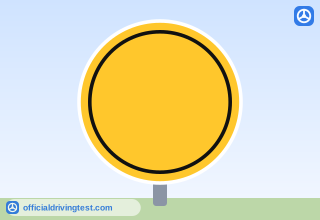
What is the yellow circular sign used for?
- School zone advance warning
- Construction zone warning
- Route marker identification
- Railroad advance warning
Show answer
Correct answer: Railroad advance warning
The round yellow sign is an advance warning sign used exclusively for railroad advance warning.
Source: Class D & E Driver’s Guide (Revised August 2025 (DPSMV2052 R08/25)), page 23 · Open this page in the manual (Manual page 23)
-
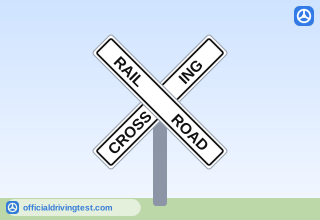
At which railroad crossings is a Railroad Cross buck sign required?
- Only crossings without flashing lights
- Only crossings on interstate highways
- All public railroad crossings
- Only crossings with more than one track
Show answer
Correct answer: All public railroad crossings
A Railroad Cross buck sign is required at all public railroad crossings.
Source: Class D & E Driver’s Guide (Revised August 2025 (DPSMV2052 R08/25)), page 29 · Open this page in the manual (Manual page 29)
-
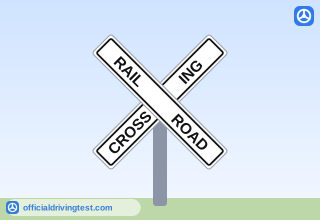
What does a Railroad Cross buck sign mean you must do?
- Stop and sound your horn before crossing
- Yield the right of way to a train
- Speed up to cross before the train arrives
- Follow the vehicle ahead across the tracks
Show answer
Correct answer: Yield the right of way to a train
A Railroad Cross buck sign means you must yield the right of way to a train.
Source: Class D & E Driver’s Guide (Revised August 2025 (DPSMV2052 R08/25)), page 29 · Open this page in the manual (Manual page 29)
-
Which pavement marking is a white marking painted in the traffic lane before a railroad crossing, with a large "X" and two "R's"?
- Crosswalk marking
- Stop line
- Two-way left turn lane marking
- Railroad crossing marking
Show answer
Correct answer: Railroad crossing marking
Railroad crossing markings are white markings painted in the traffic lane before railroad crossings, with a large X and two R's on the pavement.
Source: Class D & E Driver’s Guide (Revised August 2025 (DPSMV2052 R08/25)), page 35 · Open this page in the manual (Manual page 35)
-
Which line extends the entire distance of railroad crossing pavement markings to prevent passing?
- A double solid white line
- A dashed yellow center line
- A solid yellow center line
- A white edge line
Show answer
Correct answer: A solid yellow center line
At railroad crossing markings a solid yellow center line extends the entire distance to prevent passing.
Source: Class D & E Driver’s Guide (Revised August 2025 (DPSMV2052 R08/25)), page 35 · Open this page in the manual (Manual page 35)
-
What is painted across the traffic lane at railroad crossing pavement markings?
- A white stop line
- A yellow stop line
- A solid white crosswalk lane
- A broken yellow line
Show answer
Correct answer: A white stop line
A white stop line is painted across the traffic lane at railroad crossing pavement markings.
Source: Class D & E Driver’s Guide (Revised August 2025 (DPSMV2052 R08/25)), page 35 · Open this page in the manual (Manual page 35)
-
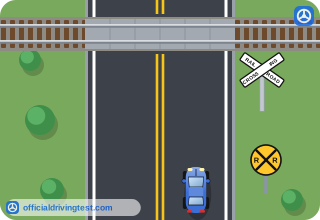
What should you do at the round warning sign as you approach a highway-railroad grade crossing?
- Speed up to cross before a train arrives
- Change lanes and sound your horn
- Slow down and look in each direction before the tracks
- Look only in the direction the train usually comes from
Show answer
Correct answer: Slow down and look in each direction before the tracks
You approach any highway-railroad grade crossing by slowing down at the round warning sign and looking in each direction prior to the tracks to make sure a train or railroad maintenance equipment is not coming.
Source: Class D & E Driver’s Guide (Revised August 2025 (DPSMV2052 R08/25)), page 63 · Open this page in the manual (Manual page 63)
-
Which vehicles does the manual say you should leave extra room for at railroad crossings?
- Motorcycles, bicycles and other light vehicles that can stop quickly
- Passenger cars carrying only one person across the tracks
- Transit buses, school buses and vehicles carrying hazardous materials
- Vehicles that have already crossed the tracks
Show answer
Correct answer: Transit buses, school buses and vehicles carrying hazardous materials
At railroad crossings you leave extra room for vehicles required to stop, including transit buses, school buses, and vehicles carrying hazardous materials.
Source: Class D & E Driver’s Guide (Revised August 2025 (DPSMV2052 R08/25)), page 66 · Open this page in the manual (Manual page 66)
-
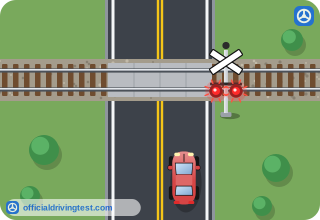
Under Louisiana law R.S. 32:171, how far from the nearest rail must a driver stop at a railroad crossing when a signal is flashing and a train is approaching?
- Within 100 feet but no less than 50 feet
- Within 25 feet but no less than 5 feet
- Within 50 feet but no less than 15 feet
- Within 30 feet but no less than 10 feet
Show answer
Correct answer: Within 50 feet but no less than 15 feet
R.S. 32:171 requires a driver to stop within 50 feet but no less than 15 feet from the nearest rail of the crossing.
Source: Class D & E Driver’s Guide (Revised August 2025 (DPSMV2052 R08/25)), page 94 · Open this page in the manual (Manual page 94)
-
Under R.S. 32:171, in which situation must a driver stop within 50 feet but no less than 15 feet from the nearest rail of a railroad crossing?
- A crossing gate is lowered
- The tracks are clear and no signal is flashing
- The crossing has more than one track
- The driver is the first vehicle in a line of traffic
Show answer
Correct answer: A crossing gate is lowered
The law requires a driver to stop when a signal device is flashing and a train is approaching, a crossing gate is lowered, or a train is an immediate hazard.
Source: Class D & E Driver’s Guide (Revised August 2025 (DPSMV2052 R08/25)), page 94 · Open this page in the manual (Manual page 94)
-
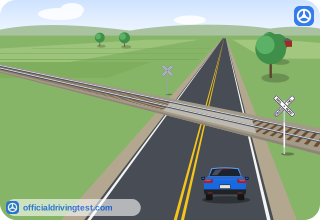
After stopping at a railroad crossing, when may the driver proceed to cross the tracks?
- After waiting at least 30 seconds
- Once the train's horn stops sounding
- After the next vehicle in line has crossed
- Only when he can do so safely
Show answer
Correct answer: Only when he can do so safely
R.S. 32:171 says that after stopping, the driver shall not proceed to cross the tracks until he can do so safely.
Source: Class D & E Driver’s Guide (Revised August 2025 (DPSMV2052 R08/25)), page 94 · Open this page in the manual (Manual page 94)
-
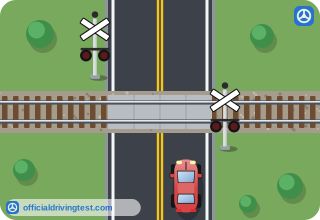
What does Louisiana law R.S. 32:171 say about stopping a vehicle on railroad tracks?
- It allows it when traffic ahead is backed up
- It prohibits any driver from doing so
- It allows it if the hazard lights are flashing
- It allows it for a short time if no train is in sight
Show answer
Correct answer: It prohibits any driver from doing so
R.S. 32:171 prohibits any driver from stopping a vehicle on railroad tracks.
Source: Class D & E Driver’s Guide (Revised August 2025 (DPSMV2052 R08/25)), page 94 · Open this page in the manual (Manual page 94)
-
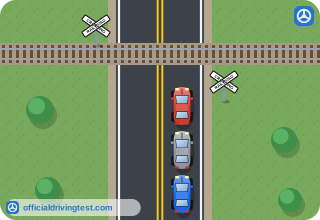
You are in a line of vehicles approaching a railroad grade crossing. When should you attempt to cross the tracks?
- As soon as the vehicle ahead of you has started to cross
- Only if you are certain you can cross to the other side safely
- Whenever the crossing gate is up
- Whenever the warning lights are not flashing
Show answer
Correct answer: Only if you are certain you can cross to the other side safely
The manual says you should not attempt to cross unless you are certain that your vehicle can safely cross to the other side of the tracks.
Source: Class D & E Driver’s Guide (Revised August 2025 (DPSMV2052 R08/25)), page 94 · Open this page in the manual (Manual page 94)
-
Your vehicle becomes pinned between two vehicles or stalls in the path of an oncoming train. What should you do?
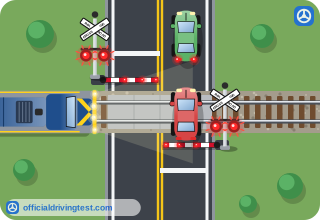
- Stay in the vehicle with your seat belt fastened and wait for help
- Get out and stand beside the vehicle until the train has passed
- Get out and move in the direction toward the approaching train, away from the tracks
- Stay in the vehicle and keep trying to restart it until the train arrives
Show answer
Correct answer: Get out and move in the direction toward the approaching train, away from the tracks
The manual says to get out and move in the direction toward the approaching train, away from the tracks.
Source: Class D & E Driver’s Guide (Revised August 2025 (DPSMV2052 R08/25)), page 94 · Open this page in the manual (Manual page 94)
-
What do advanced warning signs at a railroad crossing tell you to do?
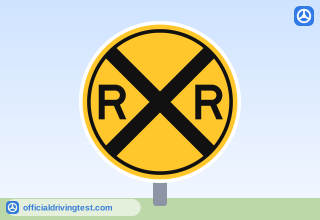
- Look, listen and slow down
- Stop completely and wait for a signal from the railroad
- Slow down, shift to a lower gear and cross at once
- Look, listen and speed up to cross quickly
Show answer
Correct answer: Look, listen and slow down
Advanced warning signs tell you to look, listen and slow down, and you may have to stop.
Source: Class D & E Driver’s Guide (Revised August 2025 (DPSMV2052 R08/25)), page 94 · Open this page in the manual (Manual page 94)
-
A vehicle carrying explosives or flammable liquids approaches a railroad crossing. What must its driver do?
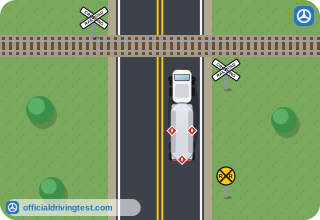
- Slow down, and stop only if a train is in sight
- Stop only if the warning lights are flashing
- Proceed if the tracks look clear
- Stop at the crossing
Show answer
Correct answer: Stop at the crossing
The manual says vehicles carrying explosives or flammable liquids must stop at railroad crossings.
Source: Class D & E Driver’s Guide (Revised August 2025 (DPSMV2052 R08/25)), page 94 · Open this page in the manual (Manual page 94)
-
What does the manual say about passing vehicles that must stop at railroad crossings?
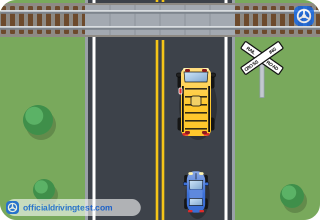
- Pass them at once so you are not delayed at the tracks
- Pass them only on the right side
- Pass them only when the warning lights are flashing
- Do not pass them unless it is legal and conditions are safe
Show answer
Correct answer: Do not pass them unless it is legal and conditions are safe
The manual says not to pass vehicles that must stop at railroad crossings unless it is legal to do so and there are no unsafe conditions.
Source: Class D & E Driver’s Guide (Revised August 2025 (DPSMV2052 R08/25)), page 94 · Open this page in the manual (Manual page 94)
-
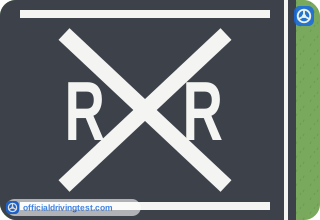
The pavement before a railroad crossing is marked with a large "X" and two "R"s. What type of zone is this?
- A school zone
- A no passing zone
- A slow-speed zone
- A turnaround zone
Show answer
Correct answer: A no passing zone
The manual says the large X and two R's marking painted before a railroad crossing is a no passing zone.
Source: Class D & E Driver’s Guide (Revised August 2025 (DPSMV2052 R08/25)), page 95 · Open this page in the manual (Manual page 95)
-
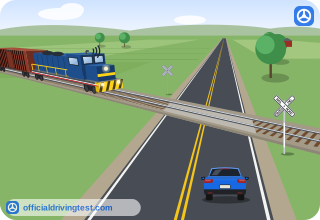
What should the driver do upon seeing a train when approaching a railroad crossing?
- Slow down and be prepared to stop
- Speed up to cross ahead of the train
- Keep a steady speed and look both ways
- Shift to a lower gear on the tracks
Show answer
Correct answer: Slow down and be prepared to stop
The manual says the driver should slow down and be prepared to stop upon seeing a train.
Source: Class D & E Driver’s Guide (Revised August 2025 (DPSMV2052 R08/25)), page 95 · Open this page in the manual (Manual page 95)
-
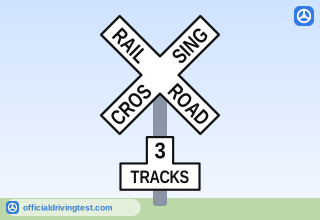
A railroad crossing has more than one track. What does the sign below the cross buck indicate?
- The speed limit for trains
- The distance to the next crossing
- The number of trains expected
- The number of tracks
Show answer
Correct answer: The number of tracks
The manual says that if there is more than one track, a sign below the cross buck indicates the number of tracks.
Source: Class D & E Driver’s Guide (Revised August 2025 (DPSMV2052 R08/25)), page 95 · Open this page in the manual (Manual page 95)
-
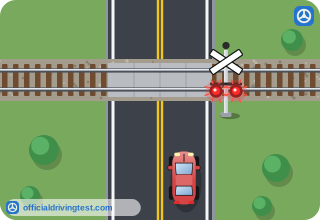
What should you always do when the lights at a railroad crossing are flashing?
- Slow down and cross if no train is visible to you
- Stop, because a train is coming
- Cross quickly if the gates are still raised
- Proceed carefully after looking both ways
Show answer
Correct answer: Stop, because a train is coming
The manual says to always stop when the lights are flashing because a train is coming.
Source: Class D & E Driver’s Guide (Revised August 2025 (DPSMV2052 R08/25)), page 95 · Open this page in the manual (Manual page 95)