Louisiana: Pedestrians Practice Test
Yielding to pedestrians, pedestrian signals, and blind pedestrians with a white cane or guide dog.
Independent educational site · not affiliated with any government agency or DMV
Ready? Test yourself
- Instant feedback with an explanation
- Every answer cites its source in the manual
- Your best score is saved on this device
Questions are original and based on the official manual "Class D & E Driver’s Guide" (Revised August 2025 (DPSMV2052 R08/25)), Louisiana Office of Motor Vehicles.
All 18 questions in this practice test
Take the test above first, then use this list to study. Tap “Show answer” to see the correct answer and explanation.
Show the questions and answersHide the questions
-
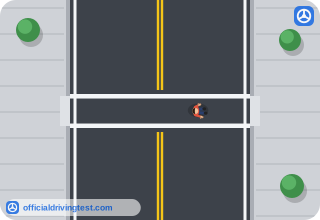
Who has the right of way over motor vehicles when pedestrians are in a crosswalk?
- The vehicle that arrived first
- The driver who has a green light
- The vehicle that is turning
- The pedestrians
Show answer
Correct answer: The pedestrians
When pedestrians are in crosswalks, they have the right of way over motor vehicles, and you must stop for them.
Source: Class D & E Driver’s Guide (Revised August 2025 (DPSMV2052 R08/25)), page 36 · Open this page in the manual (Manual page 36)
-
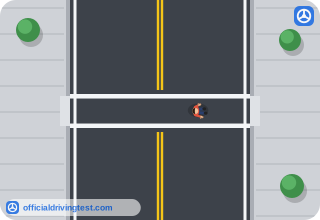
What may also be used where a crosswalk is located in the middle of the block?
- A stop sign
- A pedestrian crossing sign
- A flashing red signal
- A railroad crossing sign
Show answer
Correct answer: A pedestrian crossing sign
Crosswalks are sometimes located in the middle of the block, and in that case a pedestrian crossing sign may also be used.
Source: Class D & E Driver’s Guide (Revised August 2025 (DPSMV2052 R08/25)), page 36 · Open this page in the manual (Manual page 36)
-
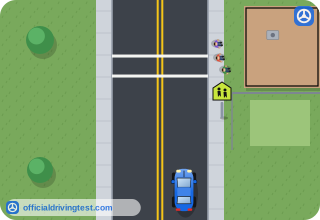
The manual says the end of summer signals the start of school. What should drivers do?
- Assume school zones are in effect only during the morning hours
- Avoid every road that has a crosswalk, even on routes they know
- Watch for school zones only on unfamiliar roads, not routes they know
- Notice where school zones and crosswalks are on roads they usually travel
Show answer
Correct answer: Notice where school zones and crosswalks are on roads they usually travel
Drivers should be familiar with school zones and get into the habit of noticing where school zones and crosswalks are on roads they generally travel.
Source: Class D & E Driver’s Guide (Revised August 2025 (DPSMV2052 R08/25)), page 51 · Open this page in the manual (Manual page 51)
-
What does the manual say the end of daylight saving time means for drivers?
- Longer daylight for evening driving
- Reduced visibility on the roads
- Lower sun glare in the afternoon
- Fewer cyclists and pedestrians on the roads
Show answer
Correct answer: Reduced visibility on the roads
The end of daylight saving time means reduced visibility on the roads, and pedestrians, cyclists and other roadway users will be less visible.
Source: Class D & E Driver’s Guide (Revised August 2025 (DPSMV2052 R08/25)), page 52 · Open this page in the manual (Manual page 52)
-
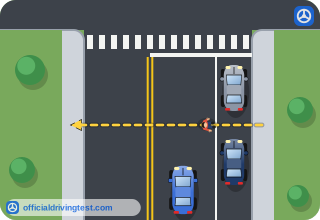
A pedestrian is crossing the street outside a crosswalk where they should not be (jaywalking). What must you do?
- Keep going, since they are not in a crosswalk
- Sound your horn and drive around them
- Stop only if a police officer is present
- Stop for them, even though jaywalking is illegal
Show answer
Correct answer: Stop for them, even though jaywalking is illegal
You must yield to pedestrians at all times; even if they are jaywalking, which is illegal, you must stop for them.
Source: Class D & E Driver’s Guide (Revised August 2025 (DPSMV2052 R08/25)), page 76 · Open this page in the manual (Manual page 76)
-
A vehicle ahead of you is stopped at a crosswalk. What should you do?
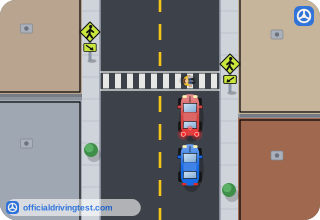
- Pass it carefully on the left
- Do not pass it, and be ready to stop
- Pass it only if the crosswalk is unmarked
- Sound your horn and pass on the right
Show answer
Correct answer: Do not pass it, and be ready to stop
You should not pass a vehicle stopped at a crosswalk; be prepared to stop for pedestrians walking in marked or unmarked crosswalks.
Source: Class D & E Driver’s Guide (Revised August 2025 (DPSMV2052 R08/25)), page 76 · Open this page in the manual (Manual page 76)
-
Why should you not come too close to a pedestrian who is crossing the roadway?
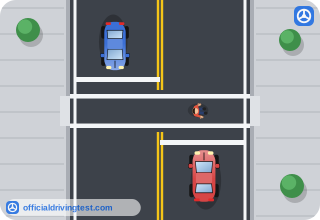
- You may block the next driver's view of the pedestrian
- Your engine noise may hurt the pedestrian's hearing
- Your headlights may blind the pedestrian at any hour
- The pedestrian may report you to the police
Show answer
Correct answer: You may block the next driver's view of the pedestrian
If you come too close to a pedestrian, you may block the vision of the next driver from seeing the pedestrian crossing the roadway.
Source: Class D & E Driver’s Guide (Revised August 2025 (DPSMV2052 R08/25)), page 76 · Open this page in the manual (Manual page 76)
-
When possible, how should pedestrians walk along a road?
- With their backs to traffic
- Along the middle of the lane
- Facing traffic
- On whichever side has shade
Show answer
Correct answer: Facing traffic
Pedestrians should always walk facing traffic when possible and should never enter a roadway without checking for oncoming traffic.
Source: Class D & E Driver’s Guide (Revised August 2025 (DPSMV2052 R08/25)), page 76 · Open this page in the manual (Manual page 76)
-
Before crossing a street, which way should a pedestrian look?
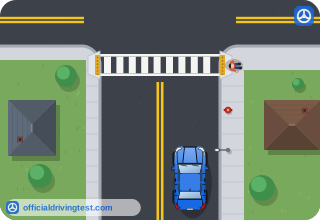
- Right, left and right again
- Left once, then cross quickly
- Only toward the signal ahead
- Left, right and left again
Show answer
Correct answer: Left, right and left again
Always look left, right and left again before crossing the street, and continue to check traffic while crossing.
Source: Class D & E Driver’s Guide (Revised August 2025 (DPSMV2052 R08/25)), page 76 · Open this page in the manual (Manual page 76)
-
You see children playing near the roadway ahead. What should you do?
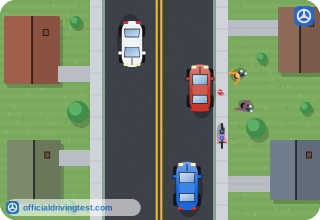
- Slow down
- Sound your horn
- Flash your headlights
- Keep your speed
Show answer
Correct answer: Slow down
When you see people walking or standing along a road, or children playing near a roadway, you should slow down and allow them as much room as safely possible.
Source: Class D & E Driver’s Guide (Revised August 2025 (DPSMV2052 R08/25)), page 76 · Open this page in the manual (Manual page 76)
-
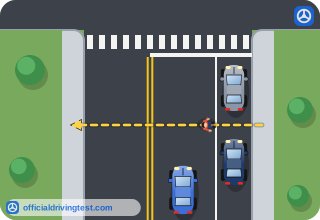
How does your speed affect your chance of avoiding a pedestrian?
- Speed matters only at intersections
- The faster you go, the less likely you can stop in time
- Speed has no effect if your brakes are good
- Driving faster gives pedestrians more time to move
Show answer
Correct answer: The faster you go, the less likely you can stop in time
The faster a vehicle is traveling, the less likely it is that a driver can stop in time to avoid hitting a pedestrian.
Source: Class D & E Driver’s Guide (Revised August 2025 (DPSMV2052 R08/25)), page 77 · Open this page in the manual (Manual page 77)
-
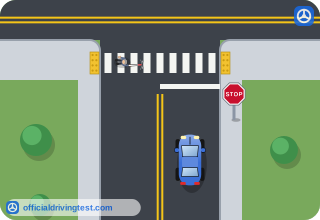
When must a pedestrian using a guide dog or a white cane be given the right of way?
- Only when crossing in a marked crosswalk
- Only when the cane has a red tip
- At all times
- Only when a WALK signal is showing
Show answer
Correct answer: At all times
Pedestrians using guide dogs or white canes, with or without a red tip, must be given the right of way at all times.
Source: Class D & E Driver’s Guide (Revised August 2025 (DPSMV2052 R08/25)), page 77 · Open this page in the manual (Manual page 77)
-
When you stop for a visually impaired pedestrian at a crosswalk, how far from the crosswalk should you stop?
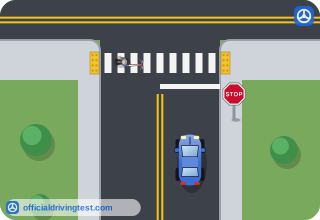
- No more than five feet away
- At least 50 feet back
- At least ten car lengths back
- In the middle of the crosswalk
Show answer
Correct answer: No more than five feet away
Don't stop your car more than five feet from the crosswalk; drive up to it so the person can hear your engine.
Source: Class D & E Driver’s Guide (Revised August 2025 (DPSMV2052 R08/25)), page 77 · Open this page in the manual (Manual page 77)
-
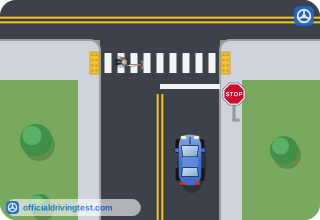
Why should you drive up close to the crosswalk when a visually impaired pedestrian is waiting?
- So your headlights can light up the crosswalk
- So the guide dog can see the color of your car
- So the driver behind you cannot pass your car
- The pedestrian uses your engine sound as a guide
Show answer
Correct answer: The pedestrian uses your engine sound as a guide
The pedestrian uses the sound of your engine as a guide, so drive up to the crosswalk to allow the person to hear you.
Source: Class D & E Driver’s Guide (Revised August 2025 (DPSMV2052 R08/25)), page 77 · Open this page in the manual (Manual page 77)
-
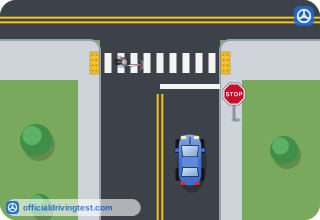
Should you call out verbal directions to a visually impaired pedestrian waiting to cross?
- Yes, tell the person when it is safe to cross
- No; the person listens to all traffic sounds first
- Yes, but only if no other cars are around
- Yes, if the person is using a white cane
Show answer
Correct answer: No; the person listens to all traffic sounds first
Don't give the pedestrian verbal directions; he listens to all traffic sounds before deciding to cross the street.
Source: Class D & E Driver’s Guide (Revised August 2025 (DPSMV2052 R08/25)), page 77 · Open this page in the manual (Manual page 77)
-
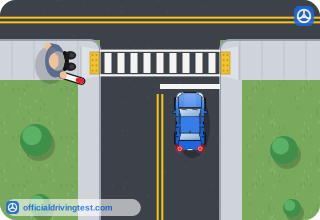
A visually impaired pedestrian at a crosswalk takes a step back and pulls in the cane. What does this mean?
- The person wants verbal directions
- You should honk to show you are waiting
- It is a definite sign that you should go
- You must wait for the next green light
Show answer
Correct answer: It is a definite sign that you should go
Don't wait too long for the pedestrian to cross; if the person takes a step back and pulls in the cane, that's a definite sign that you should go.
Source: Class D & E Driver’s Guide (Revised August 2025 (DPSMV2052 R08/25)), page 77 · Open this page in the manual (Manual page 77)
-
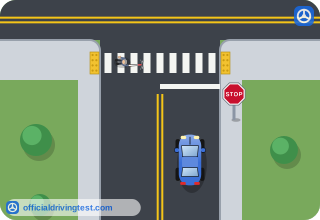
Why should you not stop in the middle of a crosswalk when a visually impaired pedestrian is crossing?
- It forces the person around your car into traffic
- It is legal only when the signal is flashing
- The guide dog is trained to stop at your bumper
- The person may think the crosswalk is closed
Show answer
Correct answer: It forces the person around your car into traffic
Stopping in the middle of a crosswalk forces the pedestrian to go around your car and into traffic outside of the crosswalk.
Source: Class D & E Driver’s Guide (Revised August 2025 (DPSMV2052 R08/25)), page 77 · Open this page in the manual (Manual page 77)
-
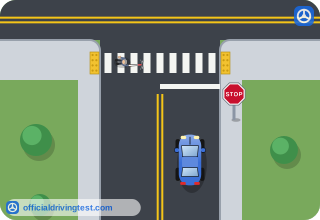
Why should you not honk at a visually impaired pedestrian?
- Honking near a crosswalk always earns you a ticket
- The guide dog may panic and run into the street
- Other drivers may think you are about to pass them
- He cannot tell who you are honking at and may be startled
Show answer
Correct answer: He cannot tell who you are honking at and may be startled
Don't honk at the pedestrian; he has no idea who you are honking at and may be startled by the noise.
Source: Class D & E Driver’s Guide (Revised August 2025 (DPSMV2052 R08/25)), page 77 · Open this page in the manual (Manual page 77)