Louisiana: Pavement markings — Part 2 Practice Test
Questions in this part include: “Where may yellow edge lines be found?” · “What markings are in the center of a roadway with a two-way left turn lane?”
Independent educational site · not affiliated with any government agency or DMV
Ready? Test yourself
- Instant feedback with an explanation
- Every answer cites its source in the manual
- Your best score is saved on this device
Questions are original and based on the official manual "Class D & E Driver’s Guide" (Revised August 2025 (DPSMV2052 R08/25)), Louisiana Office of Motor Vehicles.
All 16 questions in this practice test
Take the test above first, then use this list to study. Tap “Show answer” to see the correct answer and explanation.
Show the questions and answersHide the questions
-
Where may yellow edge lines be found?
- The left edge of the roadway on divided streets and highways
- Along the right edge of the roadway on two-lane roads
- Along both edges of every interstate highway
- Along the center of one-way streets
Show answer
Correct answer: The left edge of the roadway on divided streets and highways
Yellow edge lines may be along the left edge of the roadway on divided streets and highways.
Source: Class D & E Driver’s Guide (Revised August 2025 (DPSMV2052 R08/25)), page 35 · Open this page in the manual (Manual page 35)
-
What do double solid white lines separate, and what is prohibited?
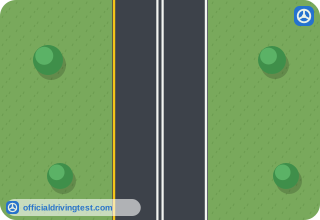
- Two lanes going in the same direction, and crossing the lines is prohibited
- Two lanes going in opposite directions, and passing is prohibited
- Two lanes going in the same direction, and crossing is allowed to turn
- A lane for bicycles, and driving in it is prohibited
Show answer
Correct answer: Two lanes going in the same direction, and crossing the lines is prohibited
Double solid white lines separate two lanes of traffic going in the same direction, and crossing a double solid line is prohibited.
Source: Class D & E Driver’s Guide (Revised August 2025 (DPSMV2052 R08/25)), page 35 · Open this page in the manual (Manual page 35)
-
Where are double solid white lines most commonly seen?
- In school zones
- At railroad crossings
- On interstates
- On one-way streets
Show answer
Correct answer: On interstates
The manual says double solid white lines are most commonly seen on interstates.
Source: Class D & E Driver’s Guide (Revised August 2025 (DPSMV2052 R08/25)), page 35 · Open this page in the manual (Manual page 35)
-
What do red raised pavement markings or reflectors indicate?
- A lane reserved for emergency vehicles
- Going against the direction of travel
- An upcoming railroad crossing ahead
- A sharp curve in the road ahead
Show answer
Correct answer: Going against the direction of travel
Red raised pavement markings or reflectors indicate going against the direction of travel; this is a roadway that must not be entered.
Source: Class D & E Driver’s Guide (Revised August 2025 (DPSMV2052 R08/25)), page 35 · Open this page in the manual (Manual page 35)
-
What are you required to do about white lane lines that separate lanes moving in the same direction?
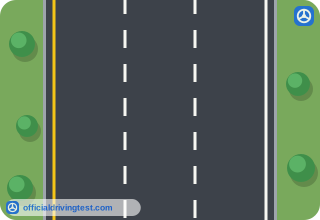
- Drive on top of them
- Drive to the left of them
- Drive to the right of them
- Drive between them
Show answer
Correct answer: Drive between them
White lines separate lanes of traffic moving in the same direction, and you are required to drive between these lane lines.
Source: Class D & E Driver’s Guide (Revised August 2025 (DPSMV2052 R08/25)), page 35 · Open this page in the manual (Manual page 35)
-
What markings are in the center of a roadway with a two-way left turn lane?
- Double solid white lines
- A combination of solid yellow and dashed yellow lines
- A single solid white line with a dashed white line
- Double solid yellow lines only
Show answer
Correct answer: A combination of solid yellow and dashed yellow lines
Two-way left turn lane markings are a combination of solid yellow and dashed yellow lines in the center of a roadway.
Source: Class D & E Driver’s Guide (Revised August 2025 (DPSMV2052 R08/25)), page 36 · Open this page in the manual (Manual page 36)
-
What may the designated center lane of a two-way left turn lane be used for?
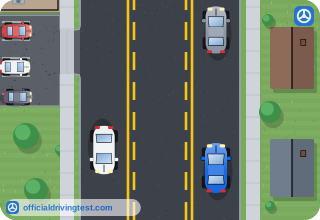
- Passing slower vehicles in either direction
- Left turns only, from either direction
- Parking while you load or unload
- Short stops by delivery vehicles
Show answer
Correct answer: Left turns only, from either direction
The center lane may be used by vehicles traveling in either direction for left turn maneuvers only.
Source: Class D & E Driver’s Guide (Revised August 2025 (DPSMV2052 R08/25)), page 36 · Open this page in the manual (Manual page 36)
-
For which purpose must the center lane of a two-way left turn lane NEVER be used?
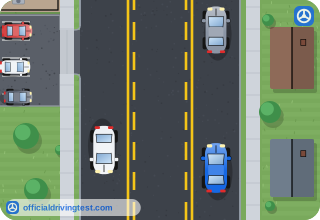
- Turning left into a driveway
- Waiting for a gap in oncoming traffic
- Turning left onto a side street
- Passing slower vehicles
Show answer
Correct answer: Passing slower vehicles
The center lane must never be used for passing.
Source: Class D & E Driver’s Guide (Revised August 2025 (DPSMV2052 R08/25)), page 36 · Open this page in the manual (Manual page 36)
-
What do stop lines indicate?
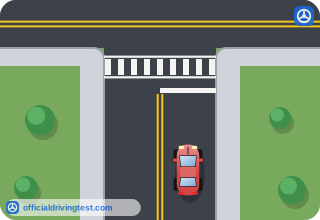
- The exact place at which to stop
- The place where passing is allowed
- The edge of the crosswalk where pedestrians wait
- The point where a turn must begin
Show answer
Correct answer: The exact place at which to stop
Stop lines are solid white lines painted across the traffic lanes at intersections and pedestrian crosswalks, indicating the exact place at which to stop.
Source: Class D & E Driver’s Guide (Revised August 2025 (DPSMV2052 R08/25)), page 36 · Open this page in the manual (Manual page 36)
-
How are crosswalk lines normally marked on the pavement?
- One solid yellow line painted across the traffic lanes
- A single dashed white line painted across the traffic lanes
- Two solid white lines painted across the traffic lanes
- Two solid yellow lines painted along the traffic lanes
Show answer
Correct answer: Two solid white lines painted across the traffic lanes
Crosswalk lines are normally two solid white lines painted across the traffic lanes, although diagonal or longitudinal lines are sometimes added for increased visibility.
Source: Class D & E Driver’s Guide (Revised August 2025 (DPSMV2052 R08/25)), page 36 · Open this page in the manual (Manual page 36)
-
What are directional markings?
- Yellow arrows painted along the edge of the roadway
- Raised reflectors that show the direction of travel
- White arrows or words that show the direction you must go
- White lines that separate lanes going in opposite directions
Show answer
Correct answer: White arrows or words that show the direction you must go
Directional markings are white arrows or words painted in the traffic lane to indicate the direction in which you must go.
Source: Class D & E Driver’s Guide (Revised August 2025 (DPSMV2052 R08/25)), page 36 · Open this page in the manual (Manual page 36)
-
Where arrows painted in your lane indicate more than one direction, what may you do?
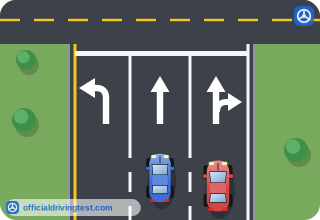
- Choose any direction shown
- Go only in the direction of the first arrow
- Go only straight ahead
- Change lanes before you choose
Show answer
Correct answer: Choose any direction shown
You must move only in the direction indicated by the arrow, and where arrows indicate more than one direction you may choose any direction.
Source: Class D & E Driver’s Guide (Revised August 2025 (DPSMV2052 R08/25)), page 36 · Open this page in the manual (Manual page 36)
-
On a multiple lane highway, when may you cross the painted continuous centerline?
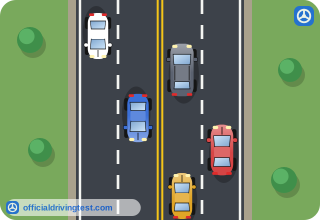
- Only during daylight hours
- Only when no police officer is present
- Only when the highway has more than two lanes in each direction
- Only to make a turn
Show answer
Correct answer: Only to make a turn
The guide says you cannot cross the painted continuous centerline of any multiple lane highway except for the purpose of making a turn.
Source: Class D & E Driver’s Guide (Revised August 2025 (DPSMV2052 R08/25)), page 87 · Open this page in the manual (Manual page 87)
-
In a shared center left turn lane, for what may vehicles traveling in either direction use the center lane?
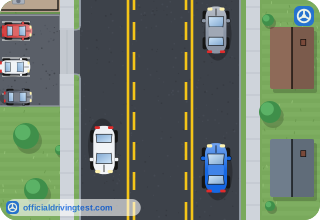
- Passing slower vehicles when the road ahead is clear
- Parking while you load or unload passengers
- Only to make left turns
- Waiting to merge into traffic from a parked position
Show answer
Correct answer: Only to make left turns
The guide says the broken yellow centerlines show that vehicles traveling in either direction may use the center lane only to make left turns.
Source: Class D & E Driver’s Guide (Revised August 2025 (DPSMV2052 R08/25)), page 90 · Open this page in the manual (Manual page 90)
-
What does the solid yellow centerline mean for a shared center left turn lane?
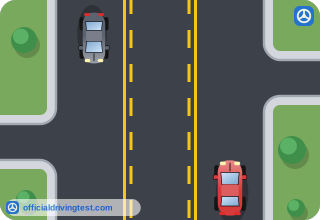
- You may use the center lane for passing when no one is oncoming
- You cannot use the center lane for passing
- You may use the center lane to make U-turns at any point
- You may use the center lane to wait for a parking space
Show answer
Correct answer: You cannot use the center lane for passing
The guide says the solid yellow centerline means you cannot use the center lane for passing.
Source: Class D & E Driver’s Guide (Revised August 2025 (DPSMV2052 R08/25)), page 90 · Open this page in the manual (Manual page 90)
-
What color are the railroad cross markings painted in the traffic lane before railroad crossings?
- Yellow
- Red
- White
- Orange
Show answer
Correct answer: White
The manual says railroad cross markings are white markings painted in the traffic lane before railroad crossings.
Source: Class D & E Driver’s Guide (Revised August 2025 (DPSMV2052 R08/25)), page 95 · Open this page in the manual (Manual page 95)