Louisiana: Pavement markings — Part 1 Practice Test
Questions in this part include: “Which highway safety feature is said to help nighttime drivers?” · “Where is a single broken yellow line used to mark the centerline?”
Independent educational site · not affiliated with any government agency or DMV
Ready? Test yourself
- Instant feedback with an explanation
- Every answer cites its source in the manual
- Your best score is saved on this device
Questions are original and based on the official manual "Class D & E Driver’s Guide" (Revised August 2025 (DPSMV2052 R08/25)), Louisiana Office of Motor Vehicles.
All 16 questions in this practice test
Take the test above first, then use this list to study. Tap “Show answer” to see the correct answer and explanation.
Show the questions and answersHide the questions
-
Which highway safety feature is said to help nighttime drivers?
- Rumble strips and synchronized traffic signals
- Breakaway poles and guard rails
- Retro reflective signs and pavement markings
- Skid resistant pavement and snow storage areas
Show answer
Correct answer: Retro reflective signs and pavement markings
The manual says retro reflective signs and pavement markings help nighttime drivers.
Source: Class D & E Driver’s Guide (Revised August 2025 (DPSMV2052 R08/25)), page 21 · Open this page in the manual (Manual page 21)
-
What do rumble strips alert the driver to?
- That the driver is approaching a railroad crossing ahead
- That the vehicle is veering off the road or into a different lane
- That the road ahead is closed for construction work
- That the vehicle is traveling above the posted speed limit
Show answer
Correct answer: That the vehicle is veering off the road or into a different lane
The manual says rumble strips alert the driver that he or she is veering off the road or heading into a different lane.
Source: Class D & E Driver’s Guide (Revised August 2025 (DPSMV2052 R08/25)), page 21 · Open this page in the manual (Manual page 21)
-
What do yellow center lines separate?
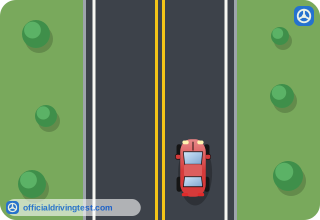
- Traffic moving in opposite directions
- Traffic moving in the same direction
- The roadway from the shoulder
- The roadway from the sidewalk
Show answer
Correct answer: Traffic moving in opposite directions
Yellow center lines are used to separate traffic in opposite directions.
Source: Class D & E Driver’s Guide (Revised August 2025 (DPSMV2052 R08/25)), page 34 · Open this page in the manual (Manual page 34)
-
Where is a single broken yellow line used to mark the centerline?
- Where there are only two lanes of traffic
- Where there are four or more lanes of traffic
- Where passing is prohibited in both directions
- Where a road is divided by a median
Show answer
Correct answer: Where there are only two lanes of traffic
A single broken yellow line marks the centerline where there are only two lanes of traffic.
Source: Class D & E Driver’s Guide (Revised August 2025 (DPSMV2052 R08/25)), page 34 · Open this page in the manual (Manual page 34)
-
When may you cross a single broken yellow centerline?
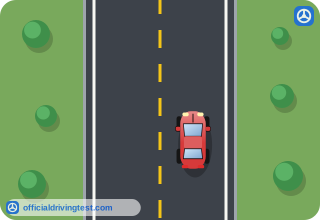
- Only to turn, never to pass
- Only to pass, never to turn
- When it is safe, to turn or to pass another vehicle
- Never, because you must stay to the right of it at all times
Show answer
Correct answer: When it is safe, to turn or to pass another vehicle
You must drive to the right of the centerline, but when it is safe you may cross a single broken yellow line to turn or pass another vehicle.
Source: Class D & E Driver’s Guide (Revised August 2025 (DPSMV2052 R08/25)), page 34 · Open this page in the manual (Manual page 34)
-
Where are double solid yellow lines used to mark the center of the roadway?
- Where there are only two lanes of traffic
- Where there are four or more lanes of traffic
- Only on roads that have a wide shoulder
- Only at railroad crossings
Show answer
Correct answer: Where there are four or more lanes of traffic
Double solid yellow lines mark the center of the roadway when there are four or more lanes of traffic.
Source: Class D & E Driver’s Guide (Revised August 2025 (DPSMV2052 R08/25)), page 34 · Open this page in the manual (Manual page 34)
-
What may you do when you come to double solid yellow lines?
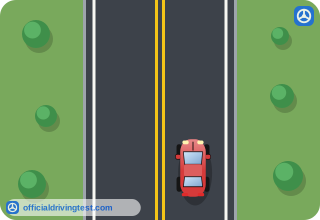
- Cross them to pass, but not to turn
- Cross them to pass or to turn
- Never cross them for any reason
- Cross them to make a turn, but not to pass
Show answer
Correct answer: Cross them to make a turn, but not to pass
You may not cross double solid yellow lines to pass, but you may cross them to make a turn.
Source: Class D & E Driver’s Guide (Revised August 2025 (DPSMV2052 R08/25)), page 34 · Open this page in the manual (Manual page 34)
-
On a two-lane road with a single broken yellow centerline, which side of the centerline must you drive on?
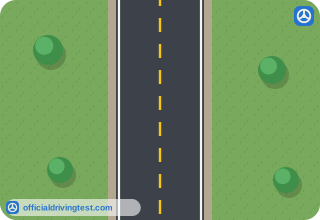
- To the left of the centerline
- On top of the centerline
- To the right of the centerline
- On either side, whichever is clearer
Show answer
Correct answer: To the right of the centerline
The manual says you must drive to the right of the centerline.
Source: Class D & E Driver’s Guide (Revised August 2025 (DPSMV2052 R08/25)), page 34 · Open this page in the manual (Manual page 34)
-
What is a single solid yellow line on a two-lane road used to indicate?
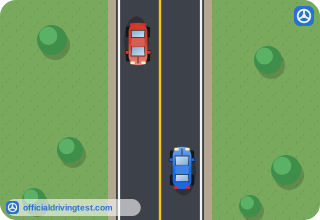
- Zones where passing is prohibited
- Zones where the speed limit is lower
- Lanes that are used only by buses
- Places where parking is permitted
Show answer
Correct answer: Zones where passing is prohibited
A No Passing Line is a single solid yellow line used on two-lane roads to indicate zones where passing is prohibited.
Source: Class D & E Driver’s Guide (Revised August 2025 (DPSMV2052 R08/25)), page 34 · Open this page in the manual (Manual page 34)
-
Besides to make a turn, when may you cross a single solid yellow no passing line?
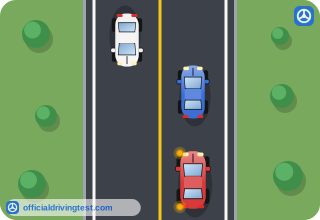
- If no vehicle is coming from the opposite direction
- If you are driving faster than the traffic ahead of you
- If the road ahead is straight and level
- If a dashed line is present on your side of travel
Show answer
Correct answer: If a dashed line is present on your side of travel
You may cross a no passing line to make a turn or if the dashed line is present on your side of travel.
Source: Class D & E Driver’s Guide (Revised August 2025 (DPSMV2052 R08/25)), page 34 · Open this page in the manual (Manual page 34)
-
What do white lines separate?
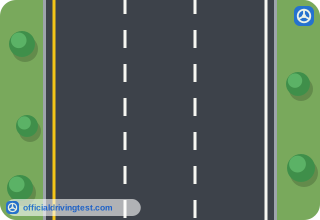
- Traffic moving in opposite directions
- Lanes of traffic moving in the same direction
- The roadway from the sidewalk
- Lanes that are reserved for emergency vehicles
Show answer
Correct answer: Lanes of traffic moving in the same direction
White lines separate lanes of traffic moving in the same direction.
Source: Class D & E Driver’s Guide (Revised August 2025 (DPSMV2052 R08/25)), page 35 · Open this page in the manual (Manual page 35)
-
According to Louisiana law, which lane should all vehicles travel in unless preparing for a left turn, passing another vehicle or when right hand lanes are congested?
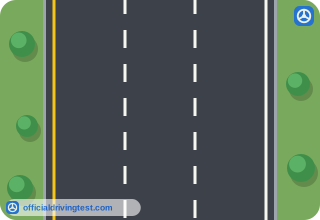
- The left hand lane
- The right hand lane
- The center lane
- The lane with the fewest vehicles
Show answer
Correct answer: The right hand lane
Louisiana law states that all vehicles should travel in the right hand lane unless preparing for a left turn, passing another vehicle or when right hand lanes are congested.
Source: Class D & E Driver’s Guide (Revised August 2025 (DPSMV2052 R08/25)), page 35 · Open this page in the manual (Manual page 35)
-
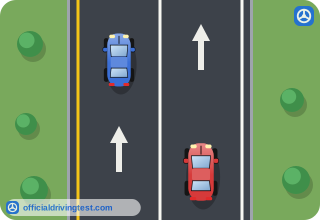
What does a single solid white line indicate, and how may you cross it?
- Moving from lane to lane is prohibited, so you may never cross it
- Moving from lane to lane is safe, so you may cross it freely
- Moving between lanes is hazardous; cross only with great care
- The lane ahead is closed, so you must cross it at once
Show answer
Correct answer: Moving between lanes is hazardous; cross only with great care
A single solid white line indicates that movement from lane to lane is hazardous (the wider the line, the greater the hazard), and you may cross it only with great care.
Source: Class D & E Driver’s Guide (Revised August 2025 (DPSMV2052 R08/25)), page 35 · Open this page in the manual (Manual page 35)
-
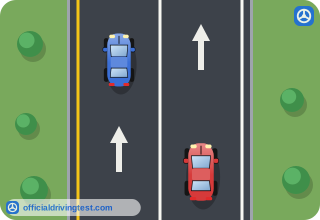
The manual says that the wider a solid white line is, what is greater?
- The speed limit in the lane
- The distance you must follow other vehicles
- The number of lanes in the road
- The hazard of moving from lane to lane
Show answer
Correct answer: The hazard of moving from lane to lane
The manual says the wider the line, the greater the hazard of moving from lane to lane.
Source: Class D & E Driver’s Guide (Revised August 2025 (DPSMV2052 R08/25)), page 35 · Open this page in the manual (Manual page 35)
-
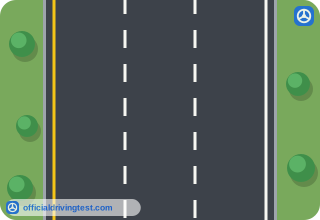
When may single dashed white lane lines be crossed?
- Only to make a turn
- Only when you can do so safely
- Only with great care and at a low speed
- Never, because they separate traffic
Show answer
Correct answer: Only when you can do so safely
Single dashed white lane lines may be crossed only when you can do so safely.
Source: Class D & E Driver’s Guide (Revised August 2025 (DPSMV2052 R08/25)), page 35 · Open this page in the manual (Manual page 35)
-
Along which edge of the roadway are white edge lines used?
- The left edge
- The center
- The right edge
- Both edges of divided highways only
Show answer
Correct answer: The right edge
White edge lines are used along the right edge of the roadway.
Source: Class D & E Driver’s Guide (Revised August 2025 (DPSMV2052 R08/25)), page 35 · Open this page in the manual (Manual page 35)