Louisiana: Emergency vehicles and work zones — Part 2 Practice Test
Questions in this part include: “What do flag persons wear, and what do they use to direct traffic through a work zone?” · “Following emergency vehicles that are responding to a call is unlawful when you are closer than what distance?”
Independent educational site · not affiliated with any government agency or DMV
Ready? Test yourself
- Instant feedback with an explanation
- Every answer cites its source in the manual
- Your best score is saved on this device
Questions are original and based on the official manual "Class D & E Driver’s Guide" (Revised August 2025 (DPSMV2052 R08/25)), Louisiana Office of Motor Vehicles.
All 17 questions in this practice test
Take the test above first, then use this list to study. Tap “Show answer” to see the correct answer and explanation.
Show the questions and answersHide the questions
-
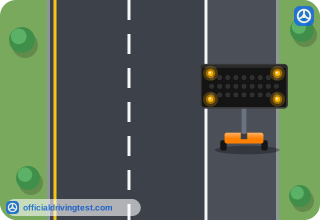
What do flashing or sequential arrow panels inform drivers of?
- A railroad crossing is ahead on the road
- Part of the road or street ahead is closed
- The speed limit has been lowered ahead
- A school bus is stopped on the road ahead
Show answer
Correct answer: Part of the road or street ahead is closed
Arrow panels guide drivers into certain traffic lanes and inform them that part of the road or street ahead is closed.
Source: Class D & E Driver’s Guide (Revised August 2025 (DPSMV2052 R08/25)), page 32 · Open this page in the manual (Manual page 32)
-
A work-zone arrow panel shows yellow lights in a row forming an arrow that points left. What is it labeled in the manual?

- Lane closed
- Move left
- Move right
- Road closed
Show answer
Correct answer: Move left
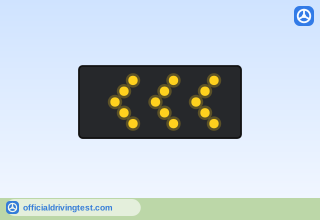
The manual labels a flashing arrow panel with an arrow pointing left "Move left" and the chevron-pattern panel "Lane closed."
Source: Class D & E Driver’s Guide (Revised August 2025 (DPSMV2052 R08/25)), page 32 · Open this page in the manual (Manual page 32)
-
A work-zone panel shows yellow lights arranged in three chevron shapes pointing left, with no arrow shaft. What is it labeled in the manual?
- Move left
- Detour ahead
- Flagger ahead
- Lane closed
Show answer
Correct answer: Lane closed
The manual labels the chevron-pattern flashing panel "Lane closed."
Source: Class D & E Driver’s Guide (Revised August 2025 (DPSMV2052 R08/25)), page 32 · Open this page in the manual (Manual page 32)
-
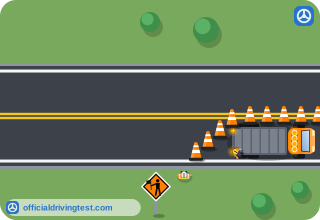
What are flag persons in highway and street work zones often provided to do?
- Stop, slow down or guide traffic safely through the area
- Check the licenses of drivers who enter the zone
- Issue warnings to drivers who exceed the speed limit
- Close the road to traffic until the work is finished
Show answer
Correct answer: Stop, slow down or guide traffic safely through the area
Flag persons are often provided in work zones to stop, slow down or guide traffic safely through the area.
Source: Class D & E Driver’s Guide (Revised August 2025 (DPSMV2052 R08/25)), page 33 · Open this page in the manual (Manual page 33)
-
What do flag persons wear, and what do they use to direct traffic through a work zone?
- Yellow-green vests, with white flags or lighted signal batons
- Blue jackets and caps, with green flags or hand-held lanterns
- Orange vests, shirts or jackets, with red flags or stop/slow paddles
- White shirts and helmets, with orange flags or reflective cones
Show answer
Correct answer: Orange vests, shirts or jackets, with red flags or stop/slow paddles
Flag persons wear orange vests, shirts or jackets and use red flags or stop/slow paddles.
Source: Class D & E Driver’s Guide (Revised August 2025 (DPSMV2052 R08/25)), page 33 · Open this page in the manual (Manual page 33)
-
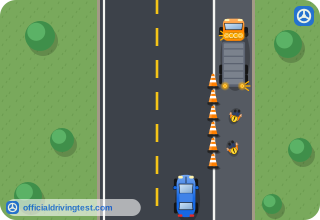
To safely navigate through a construction zone in warm weather, what does the manual tell drivers to do?
- Follow the vehicle ahead closely to keep the traffic moving
- Ignore the posted signs when no workers are visible nearby
- Obey all signs and watch for construction workers and their vehicles
- Use the left lane to pass slower vehicles and work vehicles
Show answer
Correct answer: Obey all signs and watch for construction workers and their vehicles
The manual says to obey all signs and watch for construction workers and their vehicles in construction zones.
Source: Class D & E Driver’s Guide (Revised August 2025 (DPSMV2052 R08/25)), page 51 · Open this page in the manual (Manual page 51)
-
Why should you leave extra room when following police vehicles, ambulances and fire trucks?
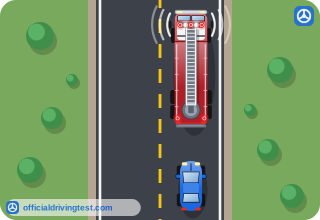
- They need more room to operate
- They always drive in the left lane
- They never use their brake lights
- They are required to stop at every intersection
Show answer
Correct answer: They need more room to operate
Police vehicles, ambulances, and fire trucks need more room to operate.
Source: Class D & E Driver’s Guide (Revised August 2025 (DPSMV2052 R08/25)), page 66 · Open this page in the manual (Manual page 66)
-
An emergency vehicle is sounding a siren and flashing warning lights. What must you do?
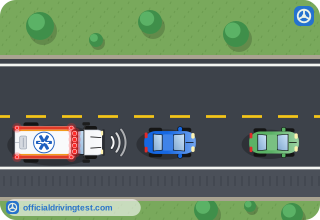
- Slow down and keep driving in your lane until it has passed
- Pull over to the right edge of the roadway clear of intersections and stop
- Stop immediately where you are, even if you are inside an intersection
- Pull over to the left edge of the roadway and keep your engine running
Show answer
Correct answer: Pull over to the right edge of the roadway clear of intersections and stop
You must yield by pulling over to the right edge of the roadway, clear of intersections, and stopping until the emergency vehicle has passed.
Source: Class D & E Driver’s Guide (Revised August 2025 (DPSMV2052 R08/25)), page 93 · Open this page in the manual (Manual page 93)
-
When you yield to an emergency vehicle that is sounding a siren and flashing warning lights, which traffic does this apply to?
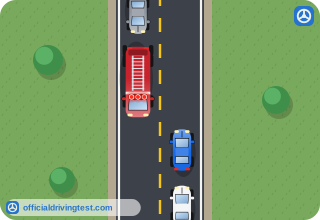
- Only traffic traveling in the same direction as the emergency vehicle
- Traffic in both directions
- Only traffic in the lane directly ahead of the emergency vehicle
- Only traffic approaching the emergency vehicle from the front
Show answer
Correct answer: Traffic in both directions
The manual says the duty to pull over and stop for an emergency vehicle applies to traffic in both directions.
Source: Class D & E Driver’s Guide (Revised August 2025 (DPSMV2052 R08/25)), page 93 · Open this page in the manual (Manual page 93)
-
What does the manual say you must do when a funeral procession is on the road?
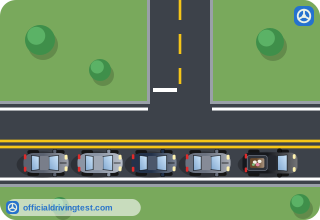
- Yield the right-of-way to the vehicles participating in it
- Pass it as quickly as possible
- Merge into the procession if it is traveling your way
- Stop and turn off your headlights until it has passed
Show answer
Correct answer: Yield the right-of-way to the vehicles participating in it
The manual says funeral processions require all operators of motor vehicles to yield the right-of-way to the vehicles participating in the procession.
Source: Class D & E Driver’s Guide (Revised August 2025 (DPSMV2052 R08/25)), page 97 · Open this page in the manual (Manual page 97)
-
What must each driver have while participating in a funeral procession?
- The headlights lighted and the horn sounding at intersections
- The parking lights on and a flag displayed
- The emergency lights flashing and the headlights off
- The headlights lighted and the emergency lights flashing
Show answer
Correct answer: The headlights lighted and the emergency lights flashing
The manual says each driver in a funeral procession must have the headlights lighted and the emergency lights flashing.
Source: Class D & E Driver’s Guide (Revised August 2025 (DPSMV2052 R08/25)), page 97 · Open this page in the manual (Manual page 97)
-
Following emergency vehicles that are responding to a call is unlawful when you are closer than what distance?
- 100 feet
- 300 feet
- 1,000 feet
- 500 feet
Show answer
Correct answer: 500 feet
The manual says following emergency vehicles responding to a call closer than 500 feet is unlawful.
Source: Class D & E Driver’s Guide (Revised August 2025 (DPSMV2052 R08/25)), page 97 · Open this page in the manual (Manual page 97)
-
After following an emergency vehicle, where must you not park?
- Within 50 feet of the stopped emergency vehicle
- Within the block where the emergency vehicle has stopped
- On the same side of the street as the emergency vehicle
- Within 1,000 feet of the stopped emergency vehicle
Show answer
Correct answer: Within the block where the emergency vehicle has stopped
The manual says you must not follow into and park within the block where the emergency vehicle has stopped.
Source: Class D & E Driver’s Guide (Revised August 2025 (DPSMV2052 R08/25)), page 97 · Open this page in the manual (Manual page 97)
-
When may you cross unprotected fire department hoses?
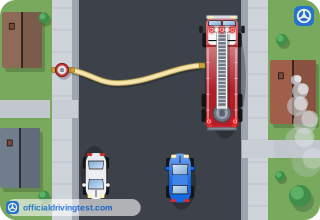
- Only at a speed under 5 mph
- Only when no firefighter is near the hose
- Only with consent given by the fire department
- Only when the hose lies across a paved road
Show answer
Correct answer: Only with consent given by the fire department
The manual says not to cross unprotected fire department hoses unless the fire department gives consent.
Source: Class D & E Driver’s Guide (Revised August 2025 (DPSMV2052 R08/25)), page 97 · Open this page in the manual (Manual page 97)
-
When an authorized emergency vehicle approaches using audible or visual signals, what must you do?
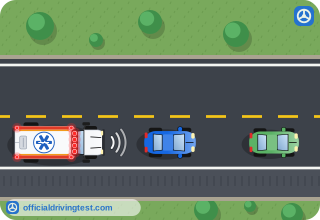
- Pull parallel to the right-hand edge or curb and stay stopped until it passes
- Pull to the left-hand edge and slow to a crawl until it has fully passed you
- Stop in your lane with your emergency flashers on until it has passed
- Speed up and stay ahead of it until it turns off
Show answer
Correct answer: Pull parallel to the right-hand edge or curb and stay stopped until it passes
You must yield the right-of-way and immediately drive to a position parallel to the right-hand edge or curb and remain stopped until the emergency vehicle has passed.
Source: Class D & E Driver’s Guide (Revised August 2025 (DPSMV2052 R08/25)), page 121 · Open this page in the manual (Manual page 121)
-
On an interstate or other highway with two or more lanes in your direction, how do you yield the right-of-way to a parked authorized emergency vehicle, if possible with due regard to safety and traffic conditions?
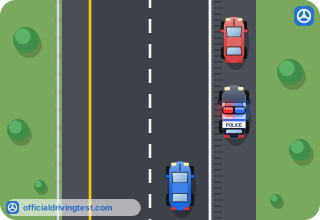
- Move into the lane right beside the parked vehicle and slow down to pass
- Stay in your lane and speed up to pass the parked vehicle quickly and safely
- Stop in your lane until the parked vehicle has driven away
- Make a lane change into a lane not adjacent to the parked vehicle
Show answer
Correct answer: Make a lane change into a lane not adjacent to the parked vehicle
Yield the right-of-way by changing into a lane not adjacent to the parked vehicle, if possible with due regard to safety and traffic conditions.
Source: Class D & E Driver’s Guide (Revised August 2025 (DPSMV2052 R08/25)), page 121 · Open this page in the manual (Manual page 121)
-
On a multi-lane highway, if you cannot change into a lane not next to a parked authorized emergency vehicle, what must you do?
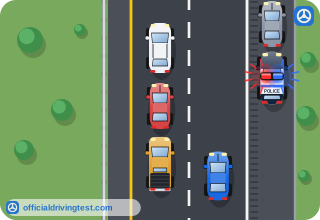
- Stop completely in the travel lane
- Slow to a reasonably safe speed
- Maintain speed and sound the horn
- Pull onto the left shoulder at once
Show answer
Correct answer: Slow to a reasonably safe speed
If a lane change is not possible, the driver shall slow to a reasonably safe speed.
Source: Class D & E Driver’s Guide (Revised August 2025 (DPSMV2052 R08/25)), page 121 · Open this page in the manual (Manual page 121)