Louisiana: Emergencies — Part 6 Practice Test
Skids, hydroplaning, brake failure, tire blowouts, a stuck accelerator, fires, a car in water, bad weather and what to do after a crash. — Part 6
Independent educational site · not affiliated with any government agency or DMV
Ready? Test yourself
- Instant feedback with an explanation
- Every answer cites its source in the manual
- Your best score is saved on this device
Questions are original and based on the official manual "Class D & E Driver’s Guide" (Revised August 2025 (DPSMV2052 R08/25)), Louisiana Office of Motor Vehicles.
All 34 questions in this practice test
Take the test above first, then use this list to study. Tap “Show answer” to see the correct answer and explanation.
Show the questions and answersHide the questions
-
At a crash scene, what should you have someone do to prevent further damage?
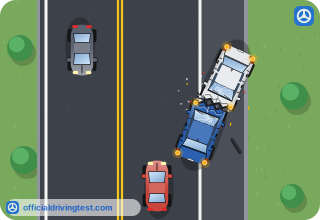
- Warn approaching traffic
- Tow the damaged vehicles away right after the crash
- Move all of the injured persons off the road
- Write down the license plates of passing cars
Show answer
Correct answer: Warn approaching traffic
Have someone warn approaching traffic to prevent further damage.
Source: Class D & E Driver’s Guide (Revised August 2025 (DPSMV2052 R08/25)), page 120 · Open this page in the manual (Manual page 120)
-
What should you make sure to do to the vehicles involved in a crash?
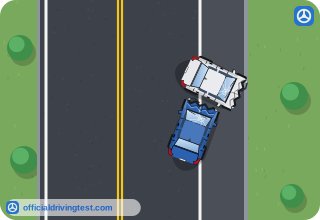
- Turn on their headlights and flashers
- Shift them into neutral gear
- Turn off their ignitions
- Open their hoods to check for damage
Show answer
Correct answer: Turn off their ignitions
Make sure to turn off the ignitions of the vehicles involved.
Source: Class D & E Driver’s Guide (Revised August 2025 (DPSMV2052 R08/25)), page 120 · Open this page in the manual (Manual page 120)
-
After stopping at a crash, what do you do for all persons involved?
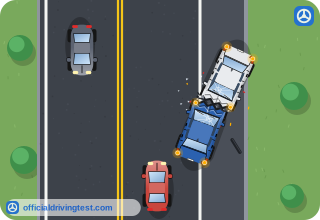
- Move them off the road at once, before help arrives
- Make a first aid check
- Give them fluids to help keep them calm
- Have them sit in their vehicles
Show answer
Correct answer: Make a first aid check
Make a first aid check of all persons involved in the crash.
Source: Class D & E Driver’s Guide (Revised August 2025 (DPSMV2052 R08/25)), page 120 · Open this page in the manual (Manual page 120)
-
If you are in doubt whether an ambulance is needed after a crash, what should you assume?
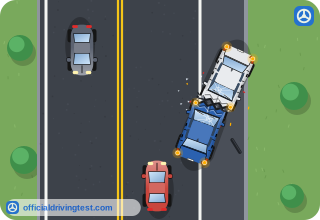
- That an ambulance is not needed
- That the police can decide on arrival
- That a doctor visit later is enough
- That an ambulance is needed
Show answer
Correct answer: That an ambulance is needed
Call the police and ask for an ambulance if needed; if in doubt, assume that an ambulance is needed.
Source: Class D & E Driver’s Guide (Revised August 2025 (DPSMV2052 R08/25)), page 120 · Open this page in the manual (Manual page 120)
-
Whose names should you gather at the scene of a crash?
- Only the drivers and the passengers who were in the damaged vehicles
- Only the people who were injured in the crash or who saw it happen
- Only the drivers, since passengers do not need to be named at all
- All persons in the vehicles and people who witnessed the crash
Show answer
Correct answer: All persons in the vehicles and people who witnessed the crash
Gather the names of all persons in the motor vehicles and of people who witnessed the crash.
Source: Class D & E Driver’s Guide (Revised August 2025 (DPSMV2052 R08/25)), page 120 · Open this page in the manual (Manual page 120)
-
What must drivers give to others involved in a collision?
- Their name, date of birth and Social Security number
- Their name, address and vehicle license number
- Their name, phone number and vehicle color
- Their name, employer and vehicle year
Show answer
Correct answer: Their name, address and vehicle license number
Drivers must give their name, address and vehicle license number to those involved in the collision.
Source: Class D & E Driver’s Guide (Revised August 2025 (DPSMV2052 R08/25)), page 120 · Open this page in the manual (Manual page 120)
-
If a person involved in a collision requests it, what must a driver do?
- Hand the license over to keep until later
- Give a written statement of who was at fault
- Display his or her driver's license
- Show the vehicle registration only
Show answer
Correct answer: Display his or her driver's license
Drivers must, if requested, display their driver's license to any person involved in the collision.
Source: Class D & E Driver’s Guide (Revised August 2025 (DPSMV2052 R08/25)), page 120 · Open this page in the manual (Manual page 120)
-
If you damage an unattended vehicle or property, what must you do?
- Notify the police and attempt to locate the owner
- Leave quickly if no one saw you hit the vehicle
- Call your insurance company and then leave the scene
- Wait for the owner to return without calling the police
Show answer
Correct answer: Notify the police and attempt to locate the owner
If you damage an unattended vehicle or property, you must notify the police and attempt to locate the owner.
Source: Class D & E Driver’s Guide (Revised August 2025 (DPSMV2052 R08/25)), page 120 · Open this page in the manual (Manual page 120)
-
What should you leave on a note for the owner of an unattended vehicle or property you damaged?
- Your name, employer and work phone number
- Your name, date of birth and e-mail address
- Your name, address and telephone number
- Your name, the time of the crash and a repair estimate
Show answer
Correct answer: Your name, address and telephone number
Leave your name, address and telephone number on a note where the owner will be sure to see it.
Source: Class D & E Driver’s Guide (Revised August 2025 (DPSMV2052 R08/25)), page 120 · Open this page in the manual (Manual page 120)
-
What should you note along with a quick diagram of a crash?
- The date, time and weather conditions
- The cost of repairs and the tow charge
- The names of the nearest businesses
- The make and model of every passing vehicle
Show answer
Correct answer: The date, time and weather conditions
Note the date, time and weather conditions in addition to the diagram.
Source: Class D & E Driver’s Guide (Revised August 2025 (DPSMV2052 R08/25)), page 120 · Open this page in the manual (Manual page 120)
-
What should a quick diagram of a crash show?
- Where each driver was standing after the crash occurred
- The points of damage on each vehicle and the cost of repairs
- The road's speed limit and the position of all nearby signs and signals
- Where occupants were seated, plus direction of travel and lane
Show answer
Correct answer: Where occupants were seated, plus direction of travel and lane
Make a quick diagram of where the vehicle occupants were seated and indicate the vehicle's direction of travel and lane.
Source: Class D & E Driver’s Guide (Revised August 2025 (DPSMV2052 R08/25)), page 120 · Open this page in the manual (Manual page 120)
-
If you are injured in a crash, what does the manual say to do as soon as possible?
- Wait a week to see if the pain goes away
- See your doctor
- Return to work and rest later
- Sign a settlement with the other driver
Show answer
Correct answer: See your doctor
See your doctor as soon as possible if you are injured.
Source: Class D & E Driver’s Guide (Revised August 2025 (DPSMV2052 R08/25)), page 120 · Open this page in the manual (Manual page 120)
-
After you summon help, what does the manual say to do for injured persons besides helping them where they lie?
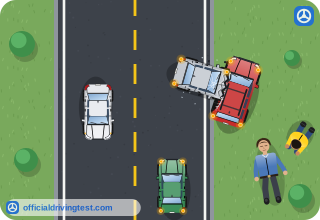
- Give them water to drink
- Have them walk around to stay alert
- Move them into your vehicle
- Keep them warm
Show answer
Correct answer: Keep them warm
Try to help the injured where they lie in order of their needs, and keep them warm.
Source: Class D & E Driver’s Guide (Revised August 2025 (DPSMV2052 R08/25)), page 120 · Open this page in the manual (Manual page 120)
-
Where should you try to help injured persons?
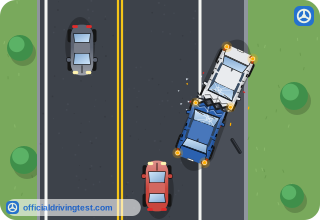
- Where they lie
- In the nearest vehicle
- At the side of the road
- In the nearest building
Show answer
Correct answer: Where they lie
Try to help the injured where they lie, in order of their needs.
Source: Class D & E Driver’s Guide (Revised August 2025 (DPSMV2052 R08/25)), page 120 · Open this page in the manual (Manual page 120)
-
How do you stop bleeding?
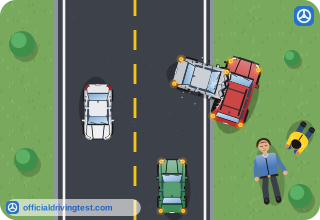
- Apply ice directly to the wound
- Leave the wound uncovered until help arrives
- Place a clean cloth over the wound
- Wrap the wound tightly in a plastic bag
Show answer
Correct answer: Place a clean cloth over the wound
To stop bleeding, place a clean cloth over the wound.
Source: Class D & E Driver’s Guide (Revised August 2025 (DPSMV2052 R08/25)), page 120 · Open this page in the manual (Manual page 120)
-
If an injured person has stopped breathing, what does the manual say to do?
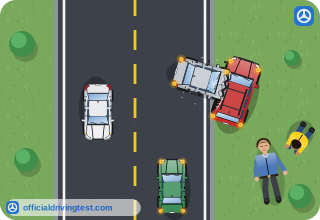
- Give first aid if you know how
- Wait for the ambulance without touching the person at all
- Move the person to a vehicle seat to keep warm
- Pour water on the person's face to wake the person
Show answer
Correct answer: Give first aid if you know how
If a person has stopped breathing, give first aid if you know how.
Source: Class D & E Driver’s Guide (Revised August 2025 (DPSMV2052 R08/25)), page 121 · Open this page in the manual (Manual page 121)
-
When should you move an injured person?
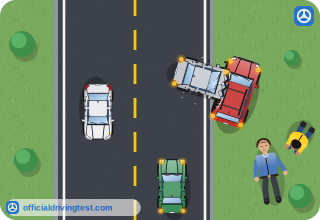
- As soon as you arrive at the scene of the crash
- Whenever the person asks to be moved somewhere else
- Only when there is immediate life-threatening danger
- When the weather is bad or it is getting dark outside
Show answer
Correct answer: Only when there is immediate life-threatening danger
Do not move the injured person unless there is immediate life threatening danger, since movement could cause more injury.
Source: Class D & E Driver’s Guide (Revised August 2025 (DPSMV2052 R08/25)), page 121 · Open this page in the manual (Manual page 121)
-
What should you ask a walking injured person to do?
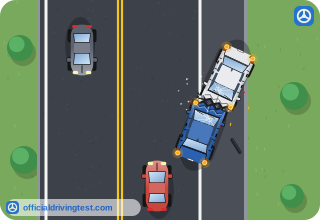
- Keep walking to stay warm
- Sit or lie down on his or her back
- Stand still and lean on a vehicle
- Sit in the driver's seat of a vehicle
Show answer
Correct answer: Sit or lie down on his or her back
Ask a walking injured person to sit or lie down on his back.
Source: Class D & E Driver’s Guide (Revised August 2025 (DPSMV2052 R08/25)), page 121 · Open this page in the manual (Manual page 121)
-
If an injured person is bleeding from the lower part of the face or jaw, what should you do?
- Keep the person lying flat on the back
- Sit the person upright, leaning forward
- Tilt the person's head back
- Turn the person on his or her side
Show answer
Correct answer: Turn the person on his or her side
If the person is bleeding from the lower part of the face or jaw, turn him or her on his or her side.
Source: Class D & E Driver’s Guide (Revised August 2025 (DPSMV2052 R08/25)), page 121 · Open this page in the manual (Manual page 121)
-
What should you not give an injured person?
- Warmth
- A clean cloth for bleeding
- Assurance that help is coming
- Fluids
Show answer
Correct answer: Fluids
Do not give fluids to an injured person.
Source: Class D & E Driver’s Guide (Revised August 2025 (DPSMV2052 R08/25)), page 121 · Open this page in the manual (Manual page 121)
-
When should you take an injured person to the hospital yourself?
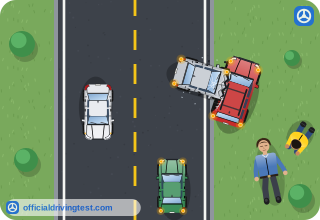
- Whenever the person asks you to do so and is able to walk
- Only when there is no other way to get help
- Whenever the ambulance is delayed even a little
- Whenever the injury looks minor
Show answer
Correct answer: Only when there is no other way to get help
You should not take an injured person to the hospital yourself unless there is no other way to get help, because improper movement may be harmful.
Source: Class D & E Driver’s Guide (Revised August 2025 (DPSMV2052 R08/25)), page 121 · Open this page in the manual (Manual page 121)
-
Louisiana’s "Move It, Move It, Move It - Steer It Clear" campaign makes the public aware of a duty to do what?
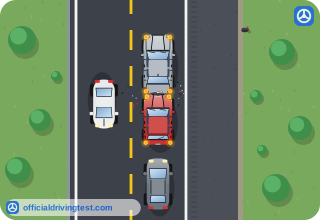
- Leave crashed vehicles in place until a tow truck arrives
- Report every roadside breakdown to a police officer
- Move vehicles from the roadway to the nearest soft shoulder
- Avoid stopping on any shoulder or ramp
Show answer
Correct answer: Move vehicles from the roadway to the nearest soft shoulder
The campaign makes the public aware of their responsibility to remove vehicles from the roadway to the nearest soft shoulder.
Source: Class D & E Driver’s Guide (Revised August 2025 (DPSMV2052 R08/25)), page 121 · Open this page in the manual (Manual page 121)
-
Removing vehicles from the roadway helps reduce traffic congestion and what else?
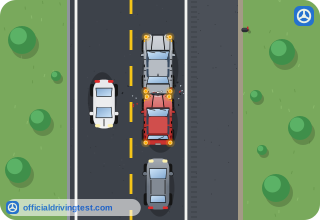
- The cost of vehicle registration and insurance
- The need for written crash reports
- The chances of secondary crashes
- The chance of tire blowouts
Show answer
Correct answer: The chances of secondary crashes
Removal of vehicles from the roadway helps reduce traffic congestion and the chances of secondary crashes.
Source: Class D & E Driver’s Guide (Revised August 2025 (DPSMV2052 R08/25)), page 121 · Open this page in the manual (Manual page 121)
-
Which warning devices must trucks carrying explosives, flammable liquids or compressed gases use?
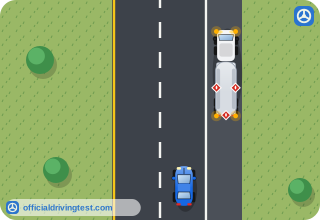
- Flares, fuses or red electric lanterns only
- Red electric lanterns or red emergency reflectors only
- Flares, fuses or red emergency reflectors only
- Flares or fuses placed behind the vehicle only
Show answer
Correct answer: Red electric lanterns or red emergency reflectors only
These trucks must use red electric lanterns or red emergency reflectors only; flares or fuses are not allowed.
Source: Class D & E Driver’s Guide (Revised August 2025 (DPSMV2052 R08/25)), page 129 · Open this page in the manual (Manual page 129)
-
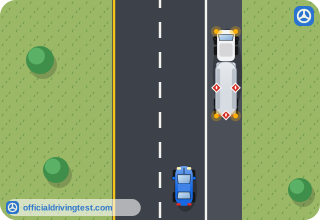
For trucks carrying explosives, flammable liquids or compressed gases, when must the red lanterns or reflectors be used?
- Only after dark when the vehicle breaks down
- Only when the vehicle breaks down on a highway
- Only after the vehicle has been stopped for ten minutes
- Immediately any time the vehicle breaks down
Show answer
Correct answer: Immediately any time the vehicle breaks down
The equipment must be used immediately any time the vehicle breaks down.
Source: Class D & E Driver’s Guide (Revised August 2025 (DPSMV2052 R08/25)), page 129 · Open this page in the manual (Manual page 129)
-
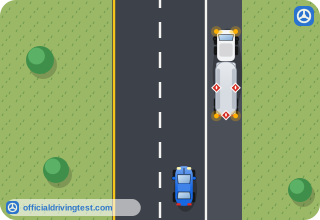
For a broken-down truck carrying explosives or flammable liquids, where must the first warning signals be placed?
- 50 feet behind and 50 feet forward of the vehicle
- 200 feet behind and 200 feet forward of the vehicle
- 100 feet behind and 100 feet forward of the vehicle
- 10 feet behind and 100 feet forward of the vehicle
Show answer
Correct answer: 100 feet behind and 100 feet forward of the vehicle
One signal must be placed 100 feet behind the vehicle and 100 feet forward of the vehicle.
Source: Class D & E Driver’s Guide (Revised August 2025 (DPSMV2052 R08/25)), page 129 · Open this page in the manual (Manual page 129)
-
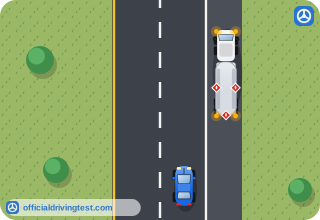
For a broken-down truck carrying explosives or flammable liquids, where must the 100-foot warning signals be placed?
- In the center of the lane or shoulder
- At the outer edge of the shoulder
- At the left edge of the lane
- Directly against the rear bumper
Show answer
Correct answer: In the center of the lane or shoulder
Each of these signals must be in the center of the lane or shoulder.
Source: Class D & E Driver’s Guide (Revised August 2025 (DPSMV2052 R08/25)), page 129 · Open this page in the manual (Manual page 129)
-
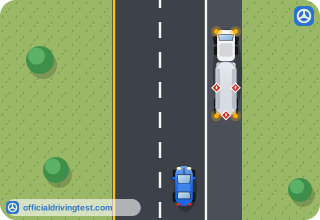
For a broken-down truck carrying explosives or flammable liquids, where must the third warning signal be placed?
- On the shoulder side of the truck, 10 feet to the front or rear
- On the traffic side of the truck, 50 feet to the front or rear
- In the center of the lane, 100 feet behind the truck
- On the traffic side of the truck, 10 feet to the front or rear
Show answer
Correct answer: On the traffic side of the truck, 10 feet to the front or rear
A third signal must be on the traffic side of the truck 10 feet to the front or rear.
Source: Class D & E Driver’s Guide (Revised August 2025 (DPSMV2052 R08/25)), page 129 · Open this page in the manual (Manual page 129)
-
If the brakes fail on a level road, what does the Class D chauffeur's license section say you should do?
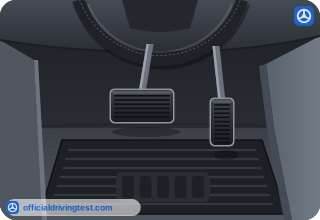
- Apply the parking brake suddenly and hold it on
- Turn the engine off and steer to the shoulder
- Drive slowly to the next exit and stop there
- Downshift and use engine compression to slow down
Show answer
Correct answer: Downshift and use engine compression to slow down
If your brakes fail on a level road, you should downshift and use engine compression to slow down.
Source: Class D & E Driver’s Guide (Revised August 2025 (DPSMV2052 R08/25)), page 130 · Open this page in the manual (Manual page 130)
-
What should you be able to do while making an emergency stop with air brakes?
- Lock the wheels to stop in a shorter distance
- Steer and keep the vehicle in a straight line
- Keep the brake pedal pressed lightly the whole time
- Release the parking brake control
Show answer
Correct answer: Steer and keep the vehicle in a straight line
In an emergency stop you should brake so you can steer and so your vehicle stays in a straight line.
Source: Class D & E Driver’s Guide (Revised August 2025 (DPSMV2052 R08/25)), page 131 · Open this page in the manual (Manual page 131)
-
Which emergency stop method with air brakes means putting on the brakes as hard as you can without locking the wheels?
- Controlled braking
- Stab braking
- Fanning
- Snub braking
Show answer
Correct answer: Controlled braking
Controlled braking means putting on the brakes as hard as you can without locking the wheels, and not turning the steering wheel while doing so.
Source: Class D & E Driver’s Guide (Revised August 2025 (DPSMV2052 R08/25)), page 131 · Open this page in the manual (Manual page 131)
-
In stab braking with air brakes, when do you release the brakes?
- When the air pressure falls to 60 psi
- When the vehicle slows to half speed
- When the wheels lock up
- When the low air warning light comes on
Show answer
Correct answer: When the wheels lock up
In stab braking you press the brake pedal as hard as you can and release the brakes when the wheels lock up.
Source: Class D & E Driver’s Guide (Revised August 2025 (DPSMV2052 R08/25)), page 131 · Open this page in the manual (Manual page 131)
-
In stab braking with air brakes, what do you do as soon as the wheels start rolling again?
- Release the brakes completely and steer
- Put on the brakes fully again
- Pump the brake pedal gently
- Pull the parking brake knob out
Show answer
Correct answer: Put on the brakes fully again
In stab braking, as soon as the wheels start rolling you put on the brakes fully again.
Source: Class D & E Driver’s Guide (Revised August 2025 (DPSMV2052 R08/25)), page 131 · Open this page in the manual (Manual page 131)
-
If the low air pressure warning comes on in a vehicle with air brakes, what should you do?
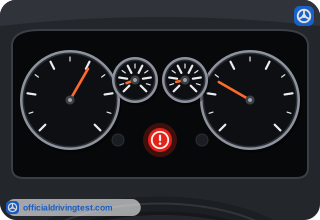
- Keep driving until the warning goes away
- Stop and safely park as soon as possible
- Pump the brake pedal to rebuild the air pressure
- Continue to your destination and have it checked
Show answer
Correct answer: Stop and safely park as soon as possible
If the low air pressure warning comes on, stop and safely park your vehicle as soon as possible.
Source: Class D & E Driver’s Guide (Revised August 2025 (DPSMV2052 R08/25)), page 132 · Open this page in the manual (Manual page 132)