Louisiana: Emergencies — Part 5 Practice Test
Skids, hydroplaning, brake failure, tire blowouts, a stuck accelerator, fires, a car in water, bad weather and what to do after a crash. — Part 5
Independent educational site · not affiliated with any government agency or DMV
Ready? Test yourself
- Instant feedback with an explanation
- Every answer cites its source in the manual
- Your best score is saved on this device
Questions are original and based on the official manual "Class D & E Driver’s Guide" (Revised August 2025 (DPSMV2052 R08/25)), Louisiana Office of Motor Vehicles.
All 34 questions in this practice test
Take the test above first, then use this list to study. Tap “Show answer” to see the correct answer and explanation.
Show the questions and answersHide the questions
-
What does the manual say about standing near your broken-down vehicle?
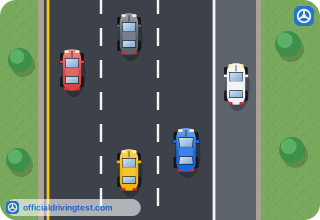
- Don't stand behind or next to it
- Stand behind it so drivers see you
- Stand next to it facing the traffic
- Stand beside the driver's door at all times
Show answer
Correct answer: Don't stand behind or next to it
Do not stand behind or next to your vehicle.
Source: Class D & E Driver’s Guide (Revised August 2025 (DPSMV2052 R08/25)), page 118 · Open this page in the manual (Manual page 118)
-
If your broken-down car is in the roadway, what should you do?
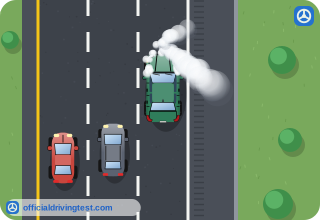
- Stay inside with the seat belt fastened and the windows closed
- Walk into the traffic lanes to flag down other vehicles
- Stand away from the vehicle and wait for help to arrive
- Stand behind it to warn approaching drivers
Show answer
Correct answer: Stand away from the vehicle and wait for help to arrive
If the car is in the roadway, stand away from the vehicle and wait for help to arrive.
Source: Class D & E Driver’s Guide (Revised August 2025 (DPSMV2052 R08/25)), page 118 · Open this page in the manual (Manual page 118)
-
If your broken-down car is safely out of traffic, what does the manual say to do while you wait?
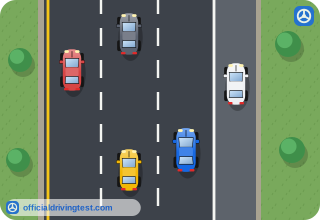
- Wait inside the vehicle with the doors locked
- Stand behind the vehicle to watch for traffic
- Walk along the shoulder looking for a phone
- Stand in front of the vehicle with the hood up
Show answer
Correct answer: Wait inside the vehicle with the doors locked
If the car is safely out of traffic, wait inside the vehicle with the doors locked and use a cell phone to call for help.
Source: Class D & E Driver’s Guide (Revised August 2025 (DPSMV2052 R08/25)), page 118 · Open this page in the manual (Manual page 118)
-
If you wait in your locked car and someone stops to offer help, what should you do?
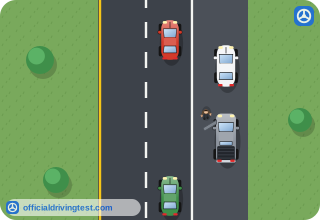
- Open the door and ride with them to the nearest phone
- Unlock the door and let them check the engine for you in person
- Open the window slightly and ask them to call for assistance
- Roll the window all the way down and explain the problem
Show answer
Correct answer: Open the window slightly and ask them to call for assistance
If someone stops and offers to help, open the window slightly and ask them to call for assistance.
Source: Class D & E Driver’s Guide (Revised August 2025 (DPSMV2052 R08/25)), page 118 · Open this page in the manual (Manual page 118)
-
Which roads does the manual say are patrolled regularly?
- Only interstate highways in rural areas and on bridges
- All interstate highways and major roads
- All local streets and county roads
- Only roads that have call-boxes
Show answer
Correct answer: All interstate highways and major roads
All interstate highways and major roads are patrolled regularly.
Source: Class D & E Driver’s Guide (Revised August 2025 (DPSMV2052 R08/25)), page 118 · Open this page in the manual (Manual page 118)
-
If you decide to walk to a source of help, how should you stay in relation to traffic?
- On the shoulder close to the lane so drivers see you
- Along the median beside the fastest lane
- Facing traffic in the right lane
- As far away from traffic as possible
Show answer
Correct answer: As far away from traffic as possible
If you can reach help on foot without jeopardizing your safety, keep as far away from traffic as possible.
Source: Class D & E Driver’s Guide (Revised August 2025 (DPSMV2052 R08/25)), page 118 · Open this page in the manual (Manual page 118)
-
Where does carbon monoxide come from?
- A vehicle's cooling system and radiator hoses
- A vehicle's fuel tank
- A vehicle's battery
- A vehicle's exhaust system
Show answer
Correct answer: A vehicle's exhaust system
Carbon monoxide is gas given off from a vehicle's exhaust system.
Source: Class D & E Driver’s Guide (Revised August 2025 (DPSMV2052 R08/25)), page 119 · Open this page in the manual (Manual page 119)
-
Why can you be affected by carbon monoxide without knowing it?
- Its odor is always hidden by the smell of the exhaust
- It does not have an odor
- It has an odor that fades within seconds
- It has an odor only when the engine is cold
Show answer
Correct answer: It does not have an odor
Because carbon monoxide does not have an odor, you can be affected without knowing it.
Source: Class D & E Driver’s Guide (Revised August 2025 (DPSMV2052 R08/25)), page 119 · Open this page in the manual (Manual page 119)
-
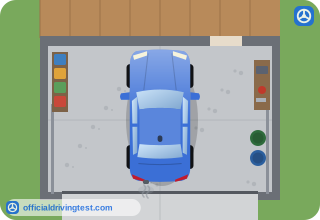
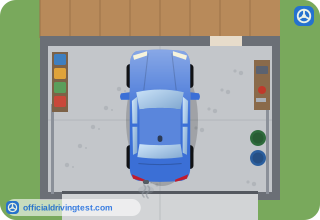
In which situation may carbon monoxide build up?
- When the car is parked outdoors with the engine off
- When the car is driven at highway speed with all the windows open
- When the engine is running in a closed space such as a garage
- When the fuel tank is nearly empty
Show answer
Correct answer: When the engine is running in a closed space such as a garage
Carbon monoxide may build up when the engine is running in a closed space such as a garage.
Source: Class D & E Driver’s Guide (Revised August 2025 (DPSMV2052 R08/25)), page 119 · Open this page in the manual (Manual page 119)
-
Which are early symptoms of carbon monoxide poisoning?
- Yawning, dizziness and upset stomach
- Itchy eyes, coughing and a runny nose
- Blurred vision, sneezing and ringing ears
- Chest pain, fever and shortness of breath
Show answer
Correct answer: Yawning, dizziness and upset stomach
Early symptoms of carbon monoxide poisoning include yawning, dizziness and upset stomach.
Source: Class D & E Driver’s Guide (Revised August 2025 (DPSMV2052 R08/25)), page 119 · Open this page in the manual (Manual page 119)
-
If you suspect carbon monoxide poisoning, what should you do?
- Turn up the heater and keep driving
- Close the windows and use the fan
- Get fresh air immediately
- Pull over and take a short nap
Show answer
Correct answer: Get fresh air immediately
If yawning, dizziness or upset stomach occur, suspect carbon monoxide poisoning and get fresh air immediately.
Source: Class D & E Driver’s Guide (Revised August 2025 (DPSMV2052 R08/25)), page 119 · Open this page in the manual (Manual page 119)
-
How quickly can flash floods occur after excessive rainfall?
- Within a few minutes or hours
- Only after several days
- Only after 24 hours of steady rain
- Only after the rain has stopped
Show answer
Correct answer: Within a few minutes or hours
Flash floods can occur within a few minutes or hours of excessive rainfall.
Source: Class D & E Driver’s Guide (Revised August 2025 (DPSMV2052 R08/25)), page 119 · Open this page in the manual (Manual page 119)
-
Where can floodwaters be found?
- Only next to streams and rivers
- Only on roads with no shoulders or guardrails
- Only in rural areas
- On roads, bridges and low areas
Show answer
Correct answer: On roads, bridges and low areas
Floodwaters can be found on roads, bridges and low areas.
Source: Class D & E Driver’s Guide (Revised August 2025 (DPSMV2052 R08/25)), page 119 · Open this page in the manual (Manual page 119)
-
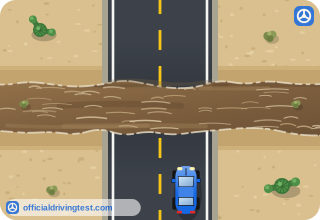
If you see a flooded roadway ahead, what should you do?
- Drive through slowly in a low gear
- Turn around and find another route
- Follow another vehicle across to check the depth
- Speed up to get across quickly
Show answer
Correct answer: Turn around and find another route
Do not drive through flooded areas; turn around and find another route to your destination.
Source: Class D & E Driver’s Guide (Revised August 2025 (DPSMV2052 R08/25)), page 119 · Open this page in the manual (Manual page 119)
-
How much water will reach the bottom of most passenger cars, causing loss of control or possible stalling?
- 2 inches
- 6 inches
- 12 inches
- 18 inches
Show answer
Correct answer: 6 inches
Six inches of water will reach the bottom of most passenger cars, causing loss of control or possible stalling.
Source: Class D & E Driver’s Guide (Revised August 2025 (DPSMV2052 R08/25)), page 119 · Open this page in the manual (Manual page 119)
-
How much rushing water can carry away most vehicles?
- 4 inches
- 8 inches
- 1 foot
- 2 feet
Show answer
Correct answer: 2 feet
Two feet of rushing water can carry away most vehicles.
Source: Class D & E Driver’s Guide (Revised August 2025 (DPSMV2052 R08/25)), page 119 · Open this page in the manual (Manual page 119)
-
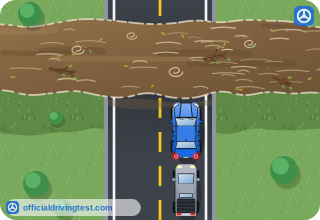
Why should you not try to cross a flooded road even if the water appears shallow?
- Water can hide dips and wash away the road surface
- Shallow floodwater always carries debris that blocks the lane
- Standing water always lowers the speed limit on the road
- Water over the road always makes the engine stall
Show answer
Correct answer: Water can hide dips and wash away the road surface
Water can hide dips, and floodwaters can damage roadways by washing away the underlying road surface.
Source: Class D & E Driver’s Guide (Revised August 2025 (DPSMV2052 R08/25)), page 119 · Open this page in the manual (Manual page 119)
-
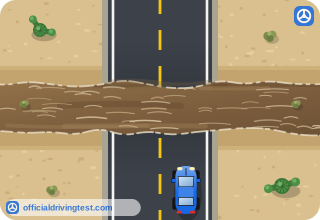
If there is no other route around a flooded road, what should you do?
- Wait at the edge of the water until a larger vehicle crosses first
- Cross at the shallowest point you can find, in low gear
- Proceed to higher ground and wait for the waters to subside
- Stay in your car in the low area until the rain stops
Show answer
Correct answer: Proceed to higher ground and wait for the waters to subside
If there is no other route, proceed to higher ground and wait for the waters to subside.
Source: Class D & E Driver’s Guide (Revised August 2025 (DPSMV2052 R08/25)), page 119 · Open this page in the manual (Manual page 119)
-
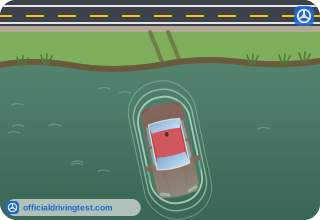
For how long will a vehicle that enters water float on the surface?
- 30 to 60 seconds
- 2 to 3 minutes
- 5 to 10 minutes
- 10 to 15 seconds
Show answer
Correct answer: 30 to 60 seconds
A vehicle that enters water will only float on the surface for 30 to 60 seconds, so you must try to get out immediately.
Source: Class D & E Driver’s Guide (Revised August 2025 (DPSMV2052 R08/25)), page 119 · Open this page in the manual (Manual page 119)
-
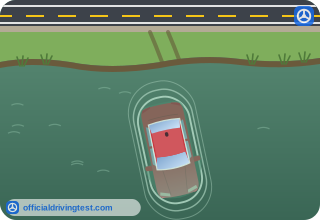
If your vehicle enters water, what should you do immediately?
- Stay in the car and wait for it to fill with water
- Climb into the back seat and wait for the water to rise
- Unbuckle your seat belt and roll the window down
- Call for help and wait inside until rescuers arrive
Show answer
Correct answer: Unbuckle your seat belt and roll the window down
Do not stay and wait for the car to fill with water; immediately unbuckle your seat belt and roll the window down.
Source: Class D & E Driver’s Guide (Revised August 2025 (DPSMV2052 R08/25)), page 119 · Open this page in the manual (Manual page 119)
-
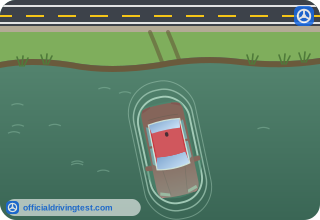
In a vehicle that has entered water, electronic windows keep working for some seconds if what is true?
- The doors stay unlocked and the headlights are switched on
- The key remains in the ignition and the engine is engaged
- The vehicle is still floating level and the lights are switched on
- The emergency flashers have been switched on
Show answer
Correct answer: The key remains in the ignition and the engine is engaged
Even the electronic windows keep working for some seconds if the key remains in the ignition and the engine is engaged.
Source: Class D & E Driver’s Guide (Revised August 2025 (DPSMV2052 R08/25)), page 119 · Open this page in the manual (Manual page 119)
-
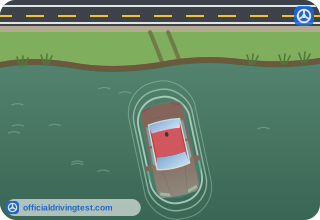
Once the window of a vehicle in water is down and the car is not fully submerged, what can you do?
- Wait inside until the car fills with water
- Stay in your seat until help arrives
- Close the window to keep the water out
- Climb on top of the vehicle
Show answer
Correct answer: Climb on top of the vehicle
Once the window is down, climb on top of the vehicle if the car is not fully submerged.
Source: Class D & E Driver’s Guide (Revised August 2025 (DPSMV2052 R08/25)), page 119 · Open this page in the manual (Manual page 119)
-
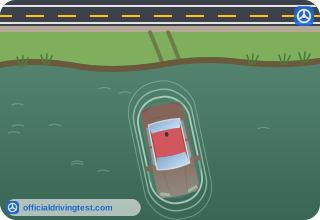
Before trying to swim away from a vehicle that went into water, what should you do?
- Wait for the car to sink completely
- Turn the ignition off again
- Close the window behind you
- Assess the current of the water
Show answer
Correct answer: Assess the current of the water
Before trying to swim away, assess the current of the water.
Source: Class D & E Driver’s Guide (Revised August 2025 (DPSMV2052 R08/25)), page 119 · Open this page in the manual (Manual page 119)
-
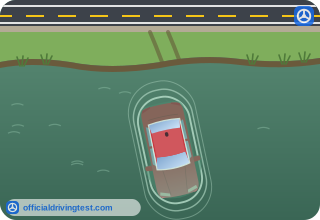
If a sinking vehicle's door and window will not open, what must you wait for?
- The engine to stop running
- The pressure to equalize
- Rescuers to arrive
- The water to stop rising
Show answer
Correct answer: The pressure to equalize
If the vehicle is sinking quickly and you cannot get the door or window open, you will have to wait for the pressure to equalize.
Source: Class D & E Driver’s Guide (Revised August 2025 (DPSMV2052 R08/25)), page 120 · Open this page in the manual (Manual page 120)
-
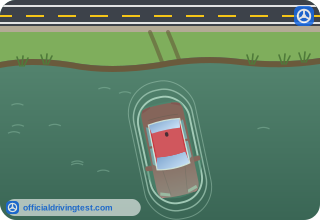
When escaping from a sinking vehicle, what should you do about clothing and shoes?
- Take off your shoes but keep your heavy clothing on
- Keep all clothing and shoes on so that you stay warm
- Take off heavy clothing but keep your shoes on
- Take off both heavy clothing and shoes
Show answer
Correct answer: Take off heavy clothing but keep your shoes on
Take off heavy clothing that will cause you to sink, but keep your shoes on in case you have to kick the window to escape.
Source: Class D & E Driver’s Guide (Revised August 2025 (DPSMV2052 R08/25)), page 120 · Open this page in the manual (Manual page 120)
-
Which window should you kick out to escape from a sinking vehicle?
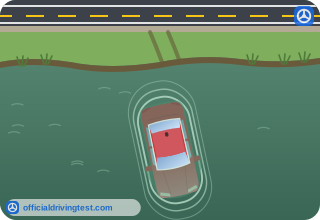
- A side window
- The windshield
- The rear window
- The sunroof
Show answer
Correct answer: A side window
Kick out a side window; do not try to break or kick out the windshield.
Source: Class D & E Driver’s Guide (Revised August 2025 (DPSMV2052 R08/25)), page 120 · Open this page in the manual (Manual page 120)
-
Why should you not try to break or kick out the windshield of a sinking vehicle?
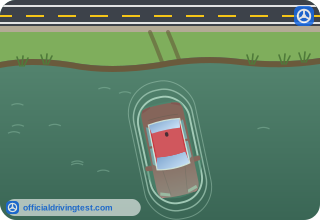
- Breaking it sets off the airbags and traps all of the passengers inside
- The windshield sits too high above the water for anyone to reach it
- Windshields are designed with glass that does not shatter
- Its frame is too narrow for any adult to be able to climb through
Show answer
Correct answer: Windshields are designed with glass that does not shatter
Windshields are now designed with glass that does not shatter, so kick out a side window instead.
Source: Class D & E Driver’s Guide (Revised August 2025 (DPSMV2052 R08/25)), page 120 · Open this page in the manual (Manual page 120)
-
When should you try to open the door of a sinking vehicle?
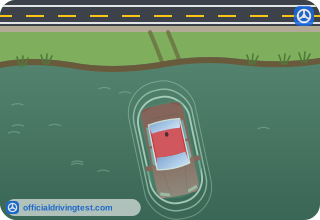
- When the water along the window is to your shoulder
- After the vehicle has fully settled on the bottom of the water
- When the water has reached the bottom of the seats inside
- Once the engine has stopped and all the lights have gone out
Show answer
Correct answer: When the water along the window is to your shoulder
When the water along the window is to your shoulder, try to open the door.
Source: Class D & E Driver’s Guide (Revised August 2025 (DPSMV2052 R08/25)), page 120 · Open this page in the manual (Manual page 120)
-
If you cannot open the door or a window of a sinking vehicle, where is a small air pocket?
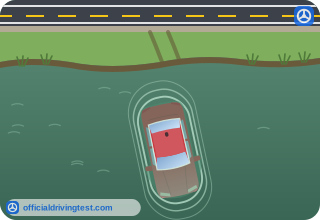
- Near the part of the vehicle which is lowest in the water, by the floor
- Under the dashboard on the driver's side, near the pedals
- Inside the trunk behind the rear seat, away from the doors
- Near the part of the vehicle which is highest in the water
Show answer
Correct answer: Near the part of the vehicle which is highest in the water
There will be a small air pocket near the part of the vehicle which is highest in the water.
Source: Class D & E Driver’s Guide (Revised August 2025 (DPSMV2052 R08/25)), page 120 · Open this page in the manual (Manual page 120)
-
Why might passengers have to escape out the front of a sinking car?
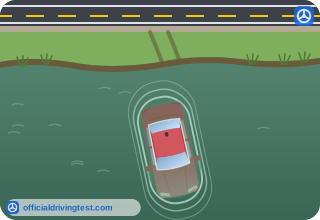
- Rear doors are always sealed shut by the pressure of the water
- Some windows are not designed to roll down completely
- Rear windows are made of glass that can never be broken at all
- The front of every car sinks last, which gives more time there
Show answer
Correct answer: Some windows are not designed to roll down completely
Passengers may have to escape out the front because some cars have passenger windows that are not designed to roll down completely.
Source: Class D & E Driver’s Guide (Revised August 2025 (DPSMV2052 R08/25)), page 120 · Open this page in the manual (Manual page 120)
-
In what order should you unbuckle children in a sinking car?
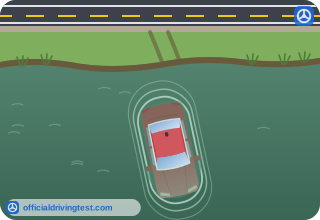
- The youngest child first, and then each of the older ones in turn
- The oldest child first, then the smaller younger ones
- All children at the same time, using both of your hands
- The child seated nearest the door, and then all the rest
Show answer
Correct answer: The oldest child first, then the smaller younger ones
Unbuckle the oldest child first, because older children need less assistance than the smaller ones.
Source: Class D & E Driver’s Guide (Revised August 2025 (DPSMV2052 R08/25)), page 120 · Open this page in the manual (Manual page 120)
-
In the acronym POGO for escaping a car in water, what does the P stand for?
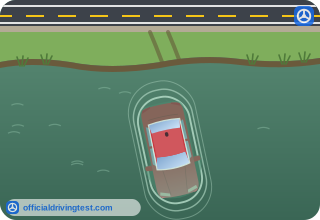
- Pull the parking brake up
- Push the door open
- Phone for help
- Pop the seat belt open
Show answer
Correct answer: Pop the seat belt open
In the acronym, P stands for Pop the seat belt open.
Source: Class D & E Driver’s Guide (Revised August 2025 (DPSMV2052 R08/25)), page 120 · Open this page in the manual (Manual page 120)
-
In the acronym POGO for escaping a car in water, what does the first O stand for?
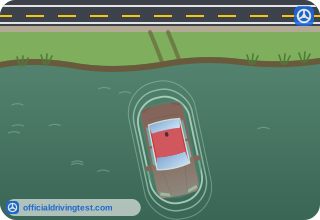
- Open windows by breaking or rolling them down
- Open the doors and swim out of the vehicle
- Open the hood to release air
- Open the trunk to find an air pocket for breathing
Show answer
Correct answer: Open windows by breaking or rolling them down
The first O stands for Open windows by breaking or rolling them down.
Source: Class D & E Driver’s Guide (Revised August 2025 (DPSMV2052 R08/25)), page 120 · Open this page in the manual (Manual page 120)
-
If you are involved in a traffic crash with injury, death or property damage, what are you required to do?
- Drive to the nearest police station to report it first
- Move on if no one is injured and the damage is only minor
- Stop your vehicle immediately if it is clear and safe
- Stop only if a police officer is present at the scene
Show answer
Correct answer: Stop your vehicle immediately if it is clear and safe
You are required to stop your vehicle immediately if it is clear and safe, and not leave the scene without identifying yourself.
Source: Class D & E Driver’s Guide (Revised August 2025 (DPSMV2052 R08/25)), page 120 · Open this page in the manual (Manual page 120)