Louisiana: Emergencies — Part 4 Practice Test
Skids, hydroplaning, brake failure, tire blowouts, a stuck accelerator, fires, a car in water, bad weather and what to do after a crash. — Part 4
Independent educational site · not affiliated with any government agency or DMV
Ready? Test yourself
- Instant feedback with an explanation
- Every answer cites its source in the manual
- Your best score is saved on this device
Questions are original and based on the official manual "Class D & E Driver’s Guide" (Revised August 2025 (DPSMV2052 R08/25)), Louisiana Office of Motor Vehicles.
All 35 questions in this practice test
Take the test above first, then use this list to study. Tap “Show answer” to see the correct answer and explanation.
Show the questions and answersHide the questions
-
When you turn the ignition off after your gas pedal sticks, what must you take care NOT to do?
- Shift the gear lever out of neutral into drive
- Lock the steering wheel locking mechanism
- Switch off the hazard flashers
- Press on the brake pedal
Show answer
Correct answer: Lock the steering wheel locking mechanism
When turning the ignition off, use care not to lock the steering wheel locking mechanism.
Source: Class D & E Driver’s Guide (Revised August 2025 (DPSMV2052 R08/25)), page 117 · Open this page in the manual (Manual page 117)
-
After you turn the ignition off because of a stuck gas pedal, what will a vehicle with power steering and brakes require?
- Much less effort to steer
- Much more effort to control
- No change in steering or braking
- The key to be put back in the ignition
Show answer
Correct answer: Much more effort to control
A vehicle with power steering and brakes takes much more effort to control once the ignition is off.
Source: Class D & E Driver’s Guide (Revised August 2025 (DPSMV2052 R08/25)), page 117 · Open this page in the manual (Manual page 117)
-
Why should you not put the parking brake on suddenly when your brakes fail?
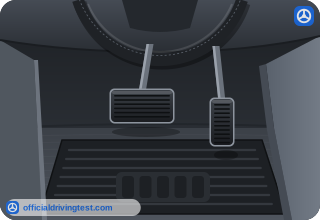
- It could cause the engine to catch fire
- It could lock the ignition and the steering
- It will damage the brake lines
- You could lose control of your vehicle
Show answer
Correct answer: You could lose control of your vehicle
Putting the parking brake on suddenly could cause you to lose control of your vehicle.
Source: Class D & E Driver’s Guide (Revised August 2025 (DPSMV2052 R08/25)), page 117 · Open this page in the manual (Manual page 117)
-
When your brakes fail, where should you work your vehicle?
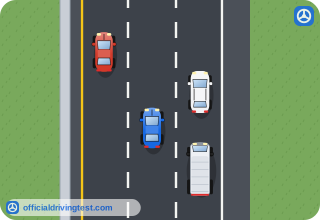
- Into the right lane, then toward the shoulder or an exit
- Into the left lane, then toward the center median
- Straight ahead in your lane until the car stops on its own
- Across all lanes to the nearest intersection
Show answer
Correct answer: Into the right lane, then toward the shoulder or an exit
When brakes fail, work the vehicle into the right lane and then toward the shoulder or, if possible, toward an exit.
Source: Class D & E Driver’s Guide (Revised August 2025 (DPSMV2052 R08/25)), page 117 · Open this page in the manual (Manual page 117)
-
How can the engine help slow the car when your brakes fail?
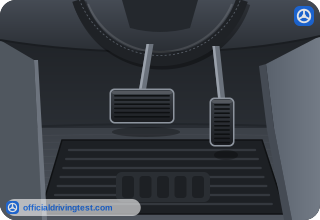
- Shift the car into reverse gear to slow the vehicle
- Turn the engine off immediately
- Shift the car into a lower gear
- Press the gas pedal gently
Show answer
Correct answer: Shift the car into a lower gear
With failed brakes, take your foot off the gas and shift into a lower gear to let the engine help slow the car.
Source: Class D & E Driver’s Guide (Revised August 2025 (DPSMV2052 R08/25)), page 117 · Open this page in the manual (Manual page 117)
-
After your car has slowed in a lower gear with failed brakes, what is the next step?
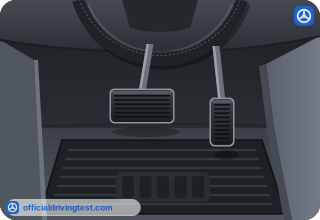
- Shift into neutral and gradually apply the hand brake
- Pull the hand brake as hard as you can right away until the car stops
- Turn off the engine and apply the hand brake quickly
- Shift into park and hold the wheel steady
Show answer
Correct answer: Shift into neutral and gradually apply the hand brake
Next, shift into neutral and gradually apply the hand brake until the vehicle stops.
Source: Class D & E Driver’s Guide (Revised August 2025 (DPSMV2052 R08/25)), page 117 · Open this page in the manual (Manual page 117)
-
If your brakes have failed and the hand brake has also failed, what does the manual say to do?
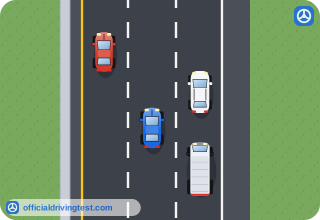
- Brake as hard as you can until the pedal grips again and the car stops
- Steer into the oncoming lane to scrub off your speed
- Steer onto a soft shoulder or rub a wheel against a curb
- Turn the ignition off and let the car coast to a halt
Show answer
Correct answer: Steer onto a soft shoulder or rub a wheel against a curb
If the hand brake has also failed, direct the car onto a soft shoulder or rub the wheel against a curb to help it slow down.
Source: Class D & E Driver’s Guide (Revised August 2025 (DPSMV2052 R08/25)), page 117 · Open this page in the manual (Manual page 117)
-
What does the manual say about driving a vehicle that has no working brakes?
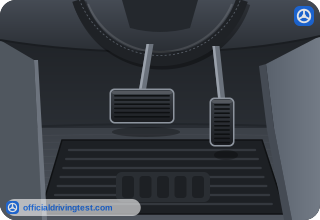
- Drive it slowly in a low gear to the nearest garage or service station
- Do not drive it, no matter how slowly; call for help
- Drive it on side streets only until you reach home
- Drive it only at night when traffic is light
Show answer
Correct answer: Do not drive it, no matter how slowly; call for help
Do not attempt to drive your vehicle without brakes, no matter how slowly; call for help.
Source: Class D & E Driver’s Guide (Revised August 2025 (DPSMV2052 R08/25)), page 117 · Open this page in the manual (Manual page 117)
-
If steam begins to come from under the hood, what should you do?
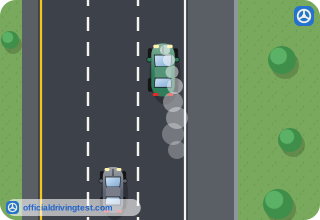
- Open the radiator cap right away to let the steam escape
- Keep driving at low speed to the next exit
- Pour cold water over the engine immediately
- Pull to the side of the road and turn off the engine
Show answer
Correct answer: Pull to the side of the road and turn off the engine
Steam means your cooling system is boiling, so pull to the side of the road and turn off the engine.
Source: Class D & E Driver’s Guide (Revised August 2025 (DPSMV2052 R08/25)), page 117 · Open this page in the manual (Manual page 117)
-
After you pull over and turn off an overheating engine, what should you do?
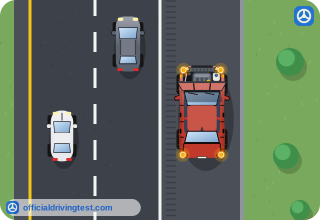
- Open the radiator cap to check the coolant
- Restart the engine to circulate the coolant
- Add cold water to the radiator right away
- Wait for the engine to cool
Show answer
Correct answer: Wait for the engine to cool
Do not open the radiator cap; wait for the engine to cool.
Source: Class D & E Driver’s Guide (Revised August 2025 (DPSMV2052 R08/25)), page 117 · Open this page in the manual (Manual page 117)
-
Which of these is named as a cause of most vehicle fires?
- Under-inflated tires
- An overheated engine
- Worn windshield wipers
- A cracked windshield
Show answer
Correct answer: An overheated engine
Most vehicle fires result from an overheated engine, an electrical short, a fuel leak or an oil leak.
Source: Class D & E Driver’s Guide (Revised August 2025 (DPSMV2052 R08/25)), page 117 · Open this page in the manual (Manual page 117)
-
How should you treat any burning odor in your vehicle?
- Ignore it unless smoke appears
- Wait until the next service check
- Investigate it immediately
- Treat it as normal engine heat
Show answer
Correct answer: Investigate it immediately
Any burning odor should be immediately investigated because it may signal a vehicle fire.
Source: Class D & E Driver’s Guide (Revised August 2025 (DPSMV2052 R08/25)), page 117 · Open this page in the manual (Manual page 117)
-
If smoke comes from under the hood of your vehicle, what is the first step?
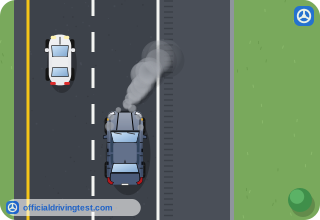
- Drive off the road clear of traffic and stop
- Open the hood to see where the smoke is coming from
- Stop in your lane and turn on your hazard flashers
- Keep driving to the nearest repair shop
Show answer
Correct answer: Drive off the road clear of traffic and stop
With smoke coming from under the hood, first drive off the road clear of traffic and stop.
Source: Class D & E Driver’s Guide (Revised August 2025 (DPSMV2052 R08/25)), page 117 · Open this page in the manual (Manual page 117)
-
After you stop clear of traffic with smoke coming from under the hood, what do you turn off?
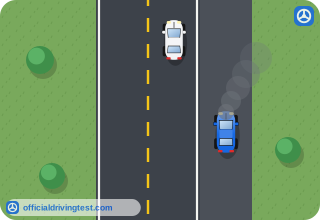
- Only the radio and the air conditioning
- Only the engine, leaving electrical switches on
- The engine and all electrical switches
- Nothing; leave the engine running to cool it
Show answer
Correct answer: The engine and all electrical switches
Turn off the engine and all electrical switches.
Source: Class D & E Driver’s Guide (Revised August 2025 (DPSMV2052 R08/25)), page 117 · Open this page in the manual (Manual page 117)
-
Why should you get all passengers out of and away from a vehicle that has smoke coming from under the hood?
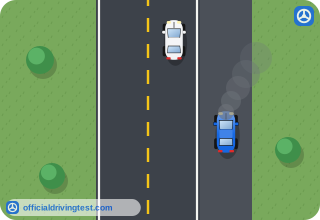
- Poisonous fumes may fill the vehicle
- The fuel tank will explode within seconds
- The doors may lock automatically
- The seat belts may melt onto the seats
Show answer
Correct answer: Poisonous fumes may fill the vehicle
Get all passengers out of and away from the vehicle because poisonous fumes may fill it.
Source: Class D & E Driver’s Guide (Revised August 2025 (DPSMV2052 R08/25)), page 117 · Open this page in the manual (Manual page 117)
-
What may you use to smother a small vehicle fire?
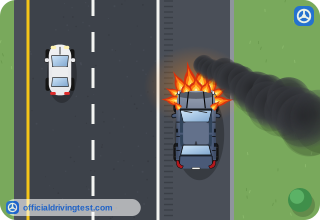
- Water from a puddle
- Cold engine oil
- Windshield washer fluid
- Sand or dirt
Show answer
Correct answer: Sand or dirt
If the fire is small, use a chemical fire extinguisher, dirt, mud, sand or clothing to smother it.
Source: Class D & E Driver’s Guide (Revised August 2025 (DPSMV2052 R08/25)), page 117 · Open this page in the manual (Manual page 117)
-
What should you not use on a small gasoline, oil or electrical fire?
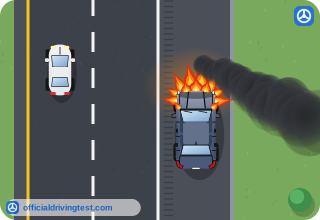
- Clothing
- Water
- A chemical fire extinguisher
- Sand from the roadside
Show answer
Correct answer: Water
Do not use water on a gasoline, oil or electrical fire.
Source: Class D & E Driver’s Guide (Revised August 2025 (DPSMV2052 R08/25)), page 117 · Open this page in the manual (Manual page 117)
-
What should you do if a large gasoline or oil fire develops in your vehicle?
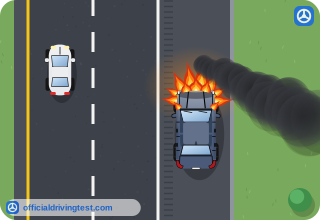
- Pour water on the fire from a safe distance
- Do not try to fight it; seek assistance
- Drive the vehicle to the nearest water source
- Use all the dirt and clothing you can find to smother it
Show answer
Correct answer: Do not try to fight it; seek assistance
You may not be able to fight a large gasoline or oil fire, so don't try; seek assistance.
Source: Class D & E Driver’s Guide (Revised August 2025 (DPSMV2052 R08/25)), page 117 · Open this page in the manual (Manual page 117)
-
Why must you be very careful when you jump start a car from another car's battery?
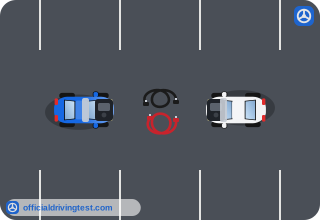
- The cables could freeze to the battery posts
- The engine could start in gear and lurch forward
- The jump could burn out the headlights
- Either battery could explode and cause injury
Show answer
Correct answer: Either battery could explode and cause injury
Either battery could possibly explode and cause you injury during a jump start.
Source: Class D & E Driver’s Guide (Revised August 2025 (DPSMV2052 R08/25)), page 118 · Open this page in the manual (Manual page 118)
-
Before jump starting a car, what do you do with the vent caps and the vent wells of the batteries?
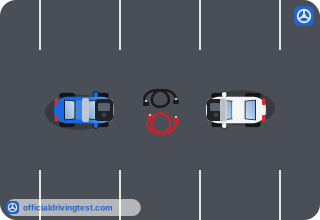
- Take off the vent caps and put a cloth over the open vent wells
- Keep the vent caps on and spray the vent wells with water to cool them
- Take off the vent caps and leave the vent wells uncovered to let air in
- Take off one vent cap and cover the other with tape
Show answer
Correct answer: Take off the vent caps and put a cloth over the open vent wells
Take off the vent caps from both batteries and put a cloth over the open vent wells.
Source: Class D & E Driver’s Guide (Revised August 2025 (DPSMV2052 R08/25)), page 118 · Open this page in the manual (Manual page 118)
-
Before connecting jumper cables, what should you turn off?
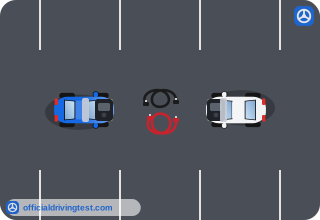
- Only the headlights and the parking lights, leaving the heater on
- Only the radio and the windshield wipers
- Lights, heater or air conditioning, and radio
- Nothing; all electrical items should stay on
Show answer
Correct answer: Lights, heater or air conditioning, and radio
Turn off lights, heater or air conditioning and radio before jump starting.
Source: Class D & E Driver’s Guide (Revised August 2025 (DPSMV2052 R08/25)), page 118 · Open this page in the manual (Manual page 118)
-
When jump starting a car, the positive post of the dead battery is connected to which post?
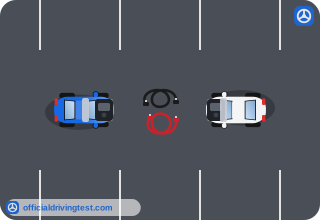
- The positive post of the live battery
- The negative post of the live battery, on the other car
- The engine block of the live car
- The frame of the dead car
Show answer
Correct answer: The positive post of the live battery
Connect the positive post of the dead battery to the positive post of the live battery.
Source: Class D & E Driver’s Guide (Revised August 2025 (DPSMV2052 R08/25)), page 118 · Open this page in the manual (Manual page 118)
-
After the positive posts are connected in a jump start, the negative post of the live battery is connected to which of these?
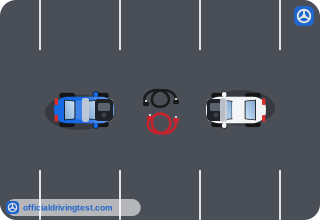
- The dead battery's positive post, or the radiator support bracket
- The dead car's fuel line, exhaust pipe or radiator hose at the front
- The dead battery's negative post, or the engine block or frame
- The live battery's own positive post
Show answer
Correct answer: The dead battery's negative post, or the engine block or frame
Connect the negative post of the live battery to the negative post of the dead battery or to the engine block or frame.
Source: Class D & E Driver’s Guide (Revised August 2025 (DPSMV2052 R08/25)), page 118 · Open this page in the manual (Manual page 118)
-
Before starting the car that is giving the jump, what must you make sure of?
- The two cars are parked bumper to bumper
- The two cars are not touching
- Both engines are running at the same time
- The hoods of both cars are closed
Show answer
Correct answer: The two cars are not touching
Make sure the two cars are not touching, then start the car giving the jump.
Source: Class D & E Driver’s Guide (Revised August 2025 (DPSMV2052 R08/25)), page 118 · Open this page in the manual (Manual page 118)
-
During a jump start, which car do you start first?
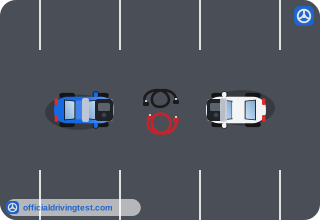
- The car with the dead battery, using the live car's cables
- Both cars at the same time
- Whichever car is parked on the right
- The car giving the jump
Show answer
Correct answer: The car giving the jump
Start the car giving the jump first; after it has run a few minutes, start the other car.
Source: Class D & E Driver’s Guide (Revised August 2025 (DPSMV2052 R08/25)), page 118 · Open this page in the manual (Manual page 118)
-
How do you take off the jumper cables after the dead car has started?
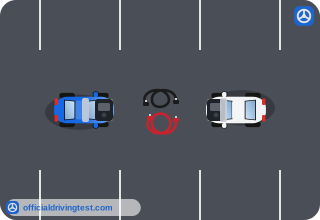
- In the same order in which they were connected to the batteries
- All at once, pulling both ends together
- With the engines turned off, in any order that you choose
- In the opposite order from the way they were connected
Show answer
Correct answer: In the opposite order from the way they were connected
Take off the cables in the opposite order and put the vent caps back on.
Source: Class D & E Driver’s Guide (Revised August 2025 (DPSMV2052 R08/25)), page 118 · Open this page in the manual (Manual page 118)
-
If you get battery acid on your skin, eyes or car, what should you do?
- Wipe it off with a dry cloth and wait
- Wash it off immediately with water
- Cover it with a cloth and drive on
- Let it dry before cleaning it
Show answer
Correct answer: Wash it off immediately with water
Battery acid on your skin, eyes or car should be washed off immediately with water.
Source: Class D & E Driver’s Guide (Revised August 2025 (DPSMV2052 R08/25)), page 118 · Open this page in the manual (Manual page 118)
-
Why must you never light a match or smoke a cigarette near a battery?
- The battery acid will ignite on contact with smoke
- The heat can drain the battery's charge completely
- The fumes from the battery can cause an explosion
- The smoke can damage the battery cells for good
Show answer
Correct answer: The fumes from the battery can cause an explosion
The fumes from a battery can cause an explosion.
Source: Class D & E Driver’s Guide (Revised August 2025 (DPSMV2052 R08/25)), page 118 · Open this page in the manual (Manual page 118)
-
At the first sign of car trouble while driving, what should you do?
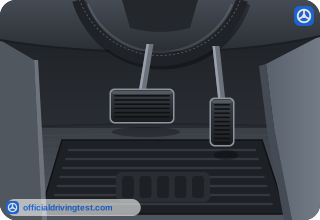
- Gently and smoothly take your foot off the accelerator
- Brake hard and stop where you are as quickly as you possibly can
- Speed up to reach the next exit before the car stops
- Switch off the ignition right away to protect the engine
Show answer
Correct answer: Gently and smoothly take your foot off the accelerator
At the first sign of car trouble, gently and smoothly take your foot off the accelerator and do not brake hard or suddenly.
Source: Class D & E Driver’s Guide (Revised August 2025 (DPSMV2052 R08/25)), page 118 · Open this page in the manual (Manual page 118)
-
If car trouble happens while you are on an interstate, what should you try to do?
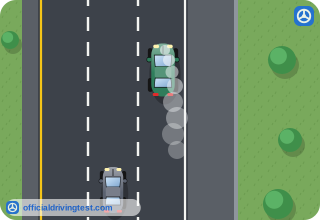
- Stop immediately in your lane
- Turn around and drive back to the last exit
- Reach an exit
- Cross the median to the opposite side
Show answer
Correct answer: Reach an exit
On an interstate, try to reach an exit while working your vehicle toward the side of the road.
Source: Class D & E Driver’s Guide (Revised August 2025 (DPSMV2052 R08/25)), page 118 · Open this page in the manual (Manual page 118)
-
When you work a troubled vehicle toward the side of the road, what do you do about the drivers behind you?
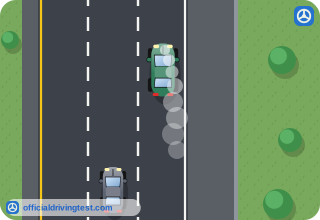
- Signal your intentions to them
- Flash your high beams at them to get them to slow down
- Sound the horn continuously
- Wave them around your vehicle
Show answer
Correct answer: Signal your intentions to them
Signal your intentions to drivers behind you as you work toward the side of the road.
Source: Class D & E Driver’s Guide (Revised August 2025 (DPSMV2052 R08/25)), page 118 · Open this page in the manual (Manual page 118)
-
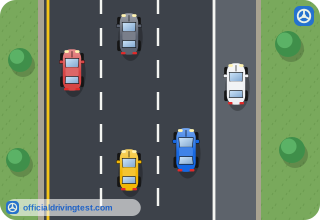
Once your disabled car is off the road, how do you make it visible to other drivers?
- Leave the headlights on high beam and the engine running
- Wave a flashlight at approaching cars from the edge of the roadway
- Put the spare tire in the lane behind your vehicle as a warning
- Put reflectorized triangles behind it or use emergency flashers
Show answer
Correct answer: Put reflectorized triangles behind it or use emergency flashers
Put reflectorized triangles behind your vehicle or use your emergency flashers to alert other drivers.
Source: Class D & E Driver’s Guide (Revised August 2025 (DPSMV2052 R08/25)), page 118 · Open this page in the manual (Manual page 118)
-
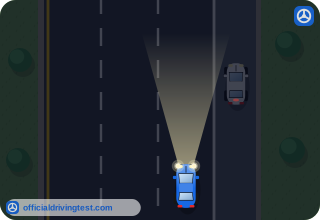
If it is dark when your disabled car is stopped off the road, what should you turn on?
- The high-beam headlights
- The interior dome light
- The windshield wipers
- The radio and heater
Show answer
Correct answer: The interior dome light
If it is dark, turn on the interior dome light so your vehicle can be seen.
Source: Class D & E Driver’s Guide (Revised August 2025 (DPSMV2052 R08/25)), page 118 · Open this page in the manual (Manual page 118)
-
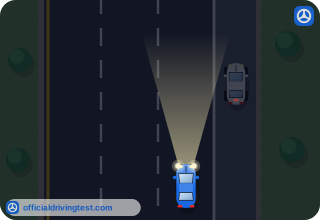
If you have flares, how far behind your disabled car should you put them?
- At least 25 feet
- At least 100 feet
- At least 50 feet
- At least 300 feet
Show answer
Correct answer: At least 100 feet
Put flares at least 100 feet behind your car.
Source: Class D & E Driver’s Guide (Revised August 2025 (DPSMV2052 R08/25)), page 118 · Open this page in the manual (Manual page 118)
-
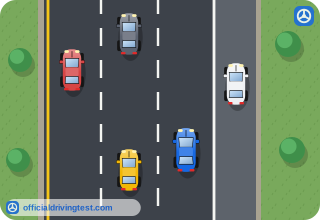
Instead of trying to flag down other vehicles, what should you do when your car has broken down?
- Stand at the back of the car and wave a flashlight at passing drivers
- Walk along the edge of the interstate to find a phone
- Sit in the driver's seat and keep honking the horn
- Raise your hood and tie a white cloth to the antenna or a window
Show answer
Correct answer: Raise your hood and tie a white cloth to the antenna or a window
Do not flag down vehicles; raise your hood and tie a white cloth to the radio antenna or hang it out a window so officers or tow truck operators know you need help.
Source: Class D & E Driver’s Guide (Revised August 2025 (DPSMV2052 R08/25)), page 118 · Open this page in the manual (Manual page 118)